Wildlife Guide · Southern Ocean & North Pacific
Albatross
Diomedeidae
The ocean's greatest gliders — and the world's most threatened bird family.
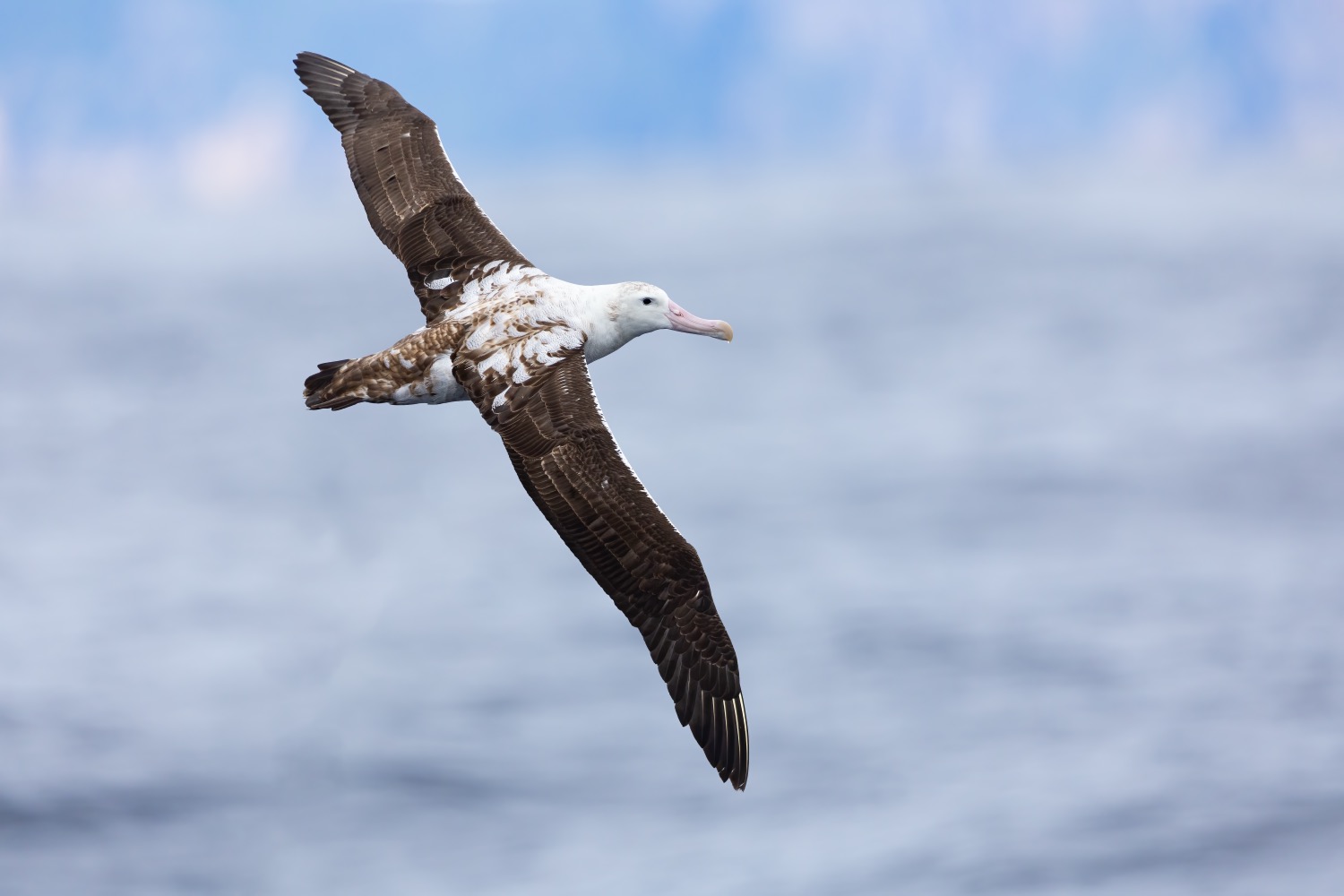
Source: Wikimedia Commons — “Gibson's Albatross 0A2A4153” by JJ Harrison, CC BY-SA 3.0
In brief
An albatross is a large oceanic seabird of the family Diomedeidae, comprising about 22 species. Albatrosses have the longest wingspan of any living bird — up to around 3.5 metres in the wandering albatross — and glide vast distances over the Southern Ocean and North Pacific, coming ashore only to breed.
Also in Animals A to Z · Animals that start with A
By WARN Research & Conservation TeamLast updated
Albatrosses are large seabirds of the family Diomedeidae, with around 22 species ranging across the Southern Ocean and the North Pacific. They are famous for having the longest wingspan of any living bird — the wandering albatross reaches roughly 3.5 metres — which lets them glide for thousands of kilometres over open water using barely a wingbeat. Superbly adapted to a life at sea, they come ashore only to breed, often on remote islands, and many pairs bond for life. Yet albatrosses are also the most threatened bird family on Earth, with many species classed as Vulnerable, Endangered or Critically Endangered, chiefly because they are killed as bycatch on longline fishing gear.
~22
species in the family Diomedeidae
~3.5 m
largest wingspan of any living bird
Most
species are threatened with extinction
50+ yrs
lifespan of long-lived individuals
Figures sourced from Albatross — Wikipedia, Wandering albatross — Wikipedia, IUCN Red List and other references on this page.
Albatross: Quick Facts
| Common name | Albatross |
|---|---|
| Family | Diomedeidae |
| Number of species | About 22 |
| Largest wingspan | Up to ~3.5 m (wandering albatross) |
| Habitat | Open ocean; breeds on remote islands |
| Range | Southern Ocean and North Pacific |
| Diet | Squid, fish, krill; some scavenging |
| Lifespan | Often decades; some over 50 years |
| Clutch size | Usually a single egg |
| Main threat | Longline-fishing bycatch |
Scientific Classification
| Kingdom | Animalia |
|---|---|
| Phylum | Chordata |
| Class | Aves |
| Order | Procellariiformes |
| Family | Diomedeidae |
| Genera | Diomedea, Thalassarche, Phoebastria, Phoebetria |
| Species | About 22 species |
Conservation Status
- IUCN Status
- Albatrosses are the most threatened bird family in the world. Of about 22 species, many are listed by the IUCN as Vulnerable, Endangered or Critically Endangered, while only a few are nearer to Least Concern. Status varies by species, so no single category applies to the whole family.
- Population
- Varies widely by species; several are in long-term decline, with some of the rarest numbering only a few thousand breeding pairs.
- Trend
- Decreasing for many species
- Assessed
- Assessed per species by the IUCN Red List
- CITES
- Several albatross species are listed on the Convention on Migratory Species; international agreements also target seabird bycatch.
Longline and trawl fishing bycatch is the leading threat, compounded by introduced predators on breeding islands, plastic pollution and climate change. Proven mitigation measures, such as night setting, weighted lines and bird-scaring lines, can sharply reduce seabird deaths.
Key Facts: Albatross
- Albatrosses (family Diomedeidae, about 22 species) are large seabirds of the open ocean.
- The wandering albatross has the largest wingspan of any living bird, up to roughly 3.5 metres.
- They use a technique called dynamic soaring to glide vast distances with very little effort.
- Most spend years at sea, returning to land only to breed, and many pairs bond for life.
- Albatrosses are the most threatened bird family on Earth, with many species Vulnerable, Endangered or Critically Endangered.
- Longline-fishing bycatch is the leading driver of their decline.
Why do albatrosses have such enormous wings?
Albatrosses are built for a life of near-perpetual flight over the open ocean, and their wings are the key to it. The wandering albatross has the longest wingspan of any living bird, reaching around 3.5 metres, with the great albatrosses generally the largest. Their wings are long, narrow and stiff — a shape that excels at gliding rather than flapping. To stay aloft over featureless seas without exhausting themselves, albatrosses use a technique known as dynamic soaring. They repeatedly climb into the wind, then turn and swoop down across it, harvesting energy from the difference in wind speed between the wave troughs and the air higher up. The result is that an albatross can travel for hours, and cover thousands of kilometres, with scarcely a wingbeat. A tendon arrangement in the shoulder even lets them lock their wings open, holding them outstretched at little muscular cost. This efficiency is why albatrosses can forage across entire ocean basins and circle the globe between breeding seasons.
Where do albatrosses live and how do they breed?
Most albatross species live in the Southern Ocean, ranging across the seas around Antarctica, South America, southern Africa, Australia and New Zealand, and breeding on remote subantarctic and oceanic islands. A smaller group lives in the North Pacific. They are pelagic for most of their lives, drinking seawater and excreting excess salt through specialised glands above the bill, and coming ashore only to nest. Breeding is famously slow and deliberate. Albatrosses are long-lived — individuals can survive for decades, with some passing fifty years — and they typically mate for life, reuniting with the same partner across many seasons. Pairs perform elaborate courtship dances of bowing, bill-clattering and calling. Most lay only a single egg, and in the larger species the chick takes the best part of a year to fledge, so many pairs breed only once every two years. This low reproductive rate makes albatross populations slow to recover from any added source of adult deaths.
Why are albatrosses so threatened?
Albatrosses are widely regarded as the most threatened bird family on Earth. The single greatest pressure is bycatch in longline fisheries: birds dive on the baited hooks set behind fishing vessels, get caught, and are dragged underwater and drowned. Because albatrosses are long-lived and breed slowly, the loss of even modest numbers of breeding adults each year can drive steep population declines. Trawl fisheries also kill birds through collisions with cables. On their breeding islands, introduced predators such as rats, cats and mice prey on eggs, chicks and even adults, while plastic pollution and ingested debris add further harm. Climate change and shifting ocean conditions may compound these threats. The encouraging news is that bycatch is largely preventable: measures such as setting lines at night, weighting them to sink quickly, and trailing bird-scaring streamer lines can cut seabird deaths dramatically where they are adopted, offering a realistic path to recovery for many species.
Great albatrosses vs mollymawks
| Feature | Great albatrosses (Diomedea) | Mollymawks (Thalassarche) |
|---|---|---|
| Size | Largest albatrosses; wingspan up to ~3.5 m | Smaller, more compact albatrosses |
| Example species | Wandering and royal albatrosses | Black-browed and grey-headed albatrosses |
| Bill colour | Large pale pinkish bill | Often dark bill with bright yellow or orange ridges |
| Plumage | Older birds become very white-bodied | Typically darker mantle and distinctive head markings |
| Breeding cycle | Chick takes ~a year; often breeds every other year | Many breed annually with a shorter chick-rearing period |
What WARN Does
WARN does not run field projects specifically for albatrosses, which live far from the countries where our partners work out on the open ocean. This guide is part of WARN's free educational work: helping people understand the wildlife that shares our planet and the pressures it faces. The threats that drive albatross declines — habitat loss on breeding islands, introduced predators, pollution and unsustainable fishing — are the same forces that endanger many of the animals WARN does protect closer to home.
If this guide deepened your wonder at the natural world, a small gift helps WARN keep producing free wildlife education and caring for animals in the communities we serve.
Albatross: Frequently Asked Questions
What is the wingspan of an albatross?
How long can an albatross fly without landing?
Are albatrosses endangered?
What do albatrosses eat?
Do albatrosses mate for life?
How long do albatrosses live?
Where do albatrosses live?
Are albatrosses dangerous?
How big is an albatross?
Sources & References
Population figures, conservation status and biological facts on this page are drawn from authoritative scientific and intergovernmental sources.
Terms used on this page
Plain-English definitions, from our wildlife and conservation glossary.
Latest Albatross Stories
Quick, fact-checked reads on the albatross — amazing facts, key questions and the threats it faces.
Species
12 Amazing Facts About Penguins (And Why None of Them Live at the North Pole)
Solid bones, a gland that removes salt, and a species that fasts for two months on the ice. Twelve verified penguin facts.
Read the storySpecies
12 Amazing Facts About Sea Otters (The Densest Fur on Earth, and Tool Use)
A million hairs per square inch, a favourite rock kept in a pouch, and a keystone role holding kelp forests together.
Read the storyExplore more animals
Discover more animals, their habitats and their conservation status in the WARN wildlife-guide library.