Wildlife Guide · Sub-Saharan Africa & Arabian Peninsula (hamadryas baboon)
Baboon
Genus Papio — 6 species: hamadryas, olive, yellow, chacma, Guinea and Kinda baboon
Africa's largest monkey — powerful, social and adaptable across savanna and desert.
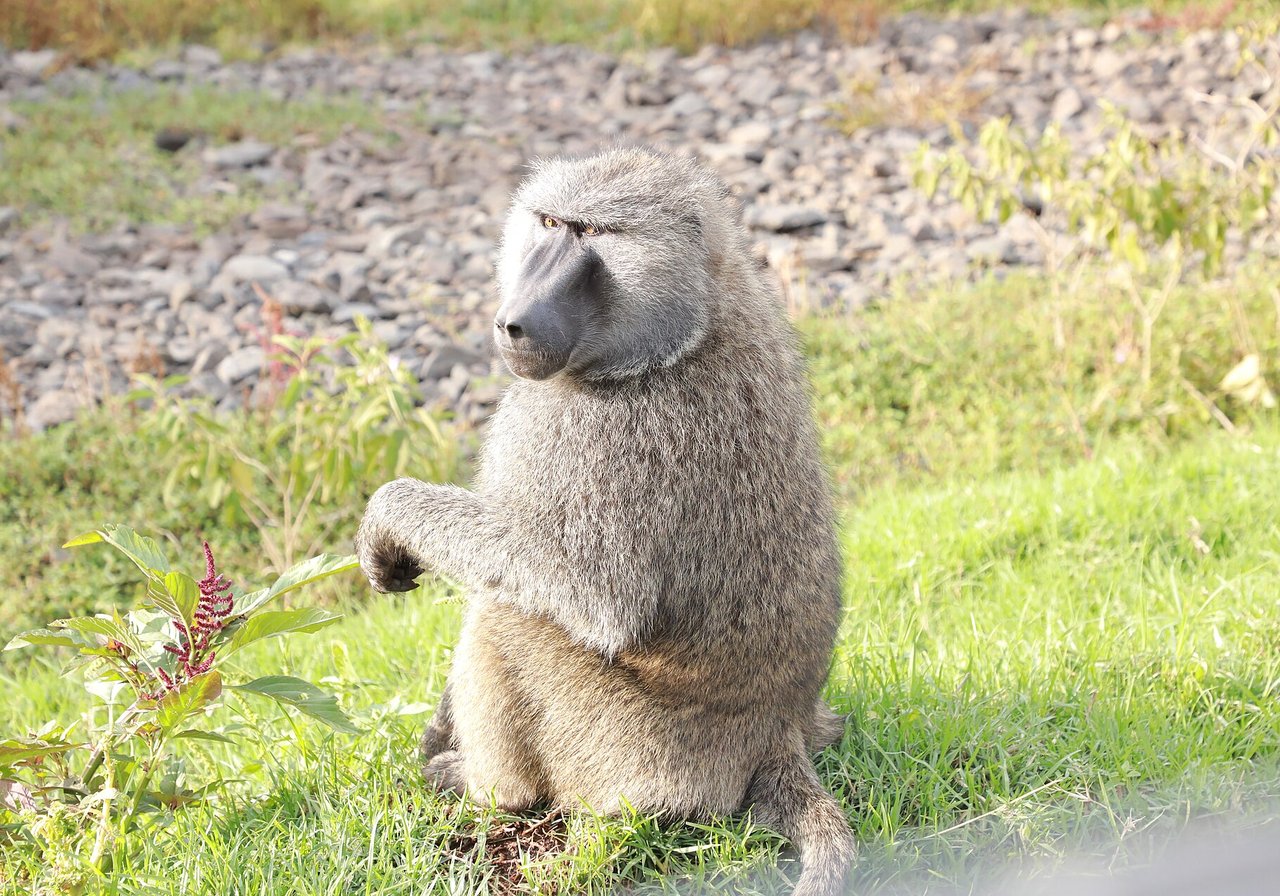
Source: Wikimedia Commons
In brief
Baboons are large Old World monkeys of the genus Papio, living in complex social troops across African savanna and desert; most species are Least Concern but face habitat loss and conflict with agriculture.
Also in Animals A to Z · Animals that start with B
How you can help
You can symbolically adopt an orangutan from £5 a month — a donation to WARN’s orangutan welfare and conservation appeal, with a personalised certificate you can keep or give as a gift — or give once to where it is needed most.
By WARN Research & Conservation TeamLast updated
Baboons are large Old World monkeys of the genus Papio, found across sub-Saharan Africa and the Arabian Peninsula. Six species are recognised, ranging from the hamadryas baboon of the Horn of Africa and Arabia to the chacma baboon of southern Africa. Baboons are among the largest monkeys — males of some species exceed 40 kg — with dog-like muzzles, powerful jaws and complex social hierarchies. They live in large troops of up to 200 individuals, foraging on the ground by day and roosting in cliffs or trees at night. Most species are Least Concern, but habitat loss and conflict with farmers who shoot baboons raiding crops remain persistent threats.
6
Recognised baboon species
40+ kg
Maximum male weight (chacma baboon)
200
Troop size in some populations
Appendix II
CITES listing
Figures sourced from IUCN Red List — Papio assessments, CITES — Checklist of CITES Species, Amboseli Baboon Research Project .
Baboon: Quick Facts
| Species | 6 recognised baboon species |
|---|---|
| Weight | 14–45 kg (males much larger than females) |
| Diet | Omnivorous — fruit, roots, insects, small prey |
| Social unit | Troop of 20–200 individuals |
| Habitat | Savanna, woodland, semi-desert, rocky hills |
| CITES | Appendix II |
Scientific Classification
| Kingdom | Animalia |
|---|---|
| Phylum | Chordata |
| Class | Mammalia |
| Order | Primates |
| Family | Cercopithecidae (Old World monkeys) |
| Genus | Papio |
Conservation Status
- IUCN Status
- Most species Least Concern. Guinea baboon (Papio papio) Near Threatened due to habitat loss in West Africa.
- Population
- Hundreds of thousands across Africa; no precise global count
- Trend
- Stable globally; decreasing locally where habitat is lost
- Assessed
- Varies by species
- CITES
- Appendix II
Key Facts: Baboon
- Baboons are the largest monkeys in Africa, with dog-like muzzles and powerful jaws.
- Six species range from Guinea baboons in West Africa to chacma baboons in the south.
- Troops can contain up to 200 individuals with complex dominance hierarchies.
- Baboons are omnivorous, eating fruit, roots, insects, small mammals and occasionally crops.
- Conflict with farmers — crop raiding and retaliatory killing — is a major human-wildlife issue.
- Most species are Least Concern, but local populations are declining where habitat is lost.
Six species across Africa
The genus Papio contains six species. The hamadryas baboon (P. hamadryas) ranges from the Horn of Africa across the Arabian Peninsula, living in one-male units that merge into larger bands. The olive baboon (P. anubis) is the most widespread, spanning equatorial Africa. The yellow baboon (P. cynocephalus) inhabits eastern and central Africa; the chacma baboon (P. ursinus) dominates southern Africa. The Guinea baboon (P. papio) is restricted to West Africa and is Near Threatened. The Kinda baboon (P. kindae) of central Africa was recognised as a separate species in 2013. All share the characteristic baboon silhouette: large body, long muzzle, short tail and calloused buttocks (ischial callosities) for sitting on rough surfaces.
Baboons and people
As agriculture expands into savanna and woodland, baboons increasingly raid maize, sugar cane and fruit crops. Farmers often shoot or poison raiding troops. In South Africa, chacma baboons in the Cape Peninsula have become habituated to urban areas, entering homes and cars for food — leading to management programmes involving relocation and aversive conditioning. In Ethiopia and Saudi Arabia, hamadryas baboons are sometimes kept as pets or used in traditional practices. Tourism that feeds baboons creates aggression and disease risk. Sustainable solutions include electric fencing, guard dogs, compensation schemes and waste management that removes attractants.
Conservation status
Most baboon species are Least Concern with large populations and adaptable behaviour. The Guinea baboon is Near Threatened due to habitat loss and hunting in West Africa. CITES lists all baboon species on Appendix II.
Because baboons are not globally threatened, they receive less conservation funding than endangered primates — yet local extirpation occurs where habitat is destroyed or persecution is intense. Protected areas and wildlife corridors maintain connectivity between troops. Research on baboon social behaviour continues to inform understanding of primate cognition and human evolution.
What WARN Does
WARN publishes this baboon guide as free public education. Baboons illustrate the complexity of human-wildlife coexistence — adaptable enough to persist, yet vulnerable to persecution where forests become farms.
If this guide helps you understand wildlife and the pressures it faces, a gift to WARN supports habitat protection and free public education in our partner countries.
Baboon: Frequently Asked Questions
How many baboon species are there?
Are baboons dangerous?
What do baboons eat?
How big are baboon troops?
Are baboons endangered?
What is the difference between a baboon and a mandrill?
Where do baboons live?
How long do baboons live?
Sources & References
Population figures, conservation status and biological facts on this page are drawn from authoritative scientific and intergovernmental sources.
Terms used on this page
Plain-English definitions, from our wildlife and conservation glossary.
Latest Baboon Stories
Quick, fact-checked reads on the baboon — amazing facts, key questions and the threats it faces.
Species
Tiger vs Lion: 7 Key Differences Between the Two Biggest Cats
Tigers are bigger, stripier and solitary; lions are social and live in prides. Here's how the two largest cats really differ in size, habitat and behaviour.
Read the storySpecies
12 Astonishing Facts About the Pangolin, the World's Only Scaly Mammal
From a tongue anchored near its pelvis to scales that weigh a fifth of its body, the pangolin is one of nature's strangest mammals. Here are 12 facts that explain why.
Read the storySpecies
How Big Is a Pangolin — and How Long Is Its Tongue?
Pangolins range from house-cat size to over 30 kg, and the largest have a tongue longer than their entire body. Here are the real numbers.
Read the storyExplore more animals
Discover more animals, their habitats and their conservation status in the WARN wildlife-guide library.
Social structure and intelligence
Baboon troops are among the most complex societies in the animal kingdom. Females stay in their natal troop and inherit rank from their mothers, forming matrilines that dominate troop politics. Males leave at maturity and transfer between troops, competing fiercely for access to females. Alliances, grooming and political manoeuvring determine rank. Baboons communicate through facial expressions, vocalisations and gestures — researchers have documented over 30 distinct signals. They use tools in some populations, swim when necessary, and adapt behaviour to urban edges in South Africa and Kenya. This intelligence makes them fascinating to study but also formidable crop raiders.