Wildlife Guide · Arctic Ocean & Subarctic seas
Beluga Whale
Delphinapterus leucas
The Arctic's Singing Ghost — A White Whale That Talks, Mimics and Rules the Ice
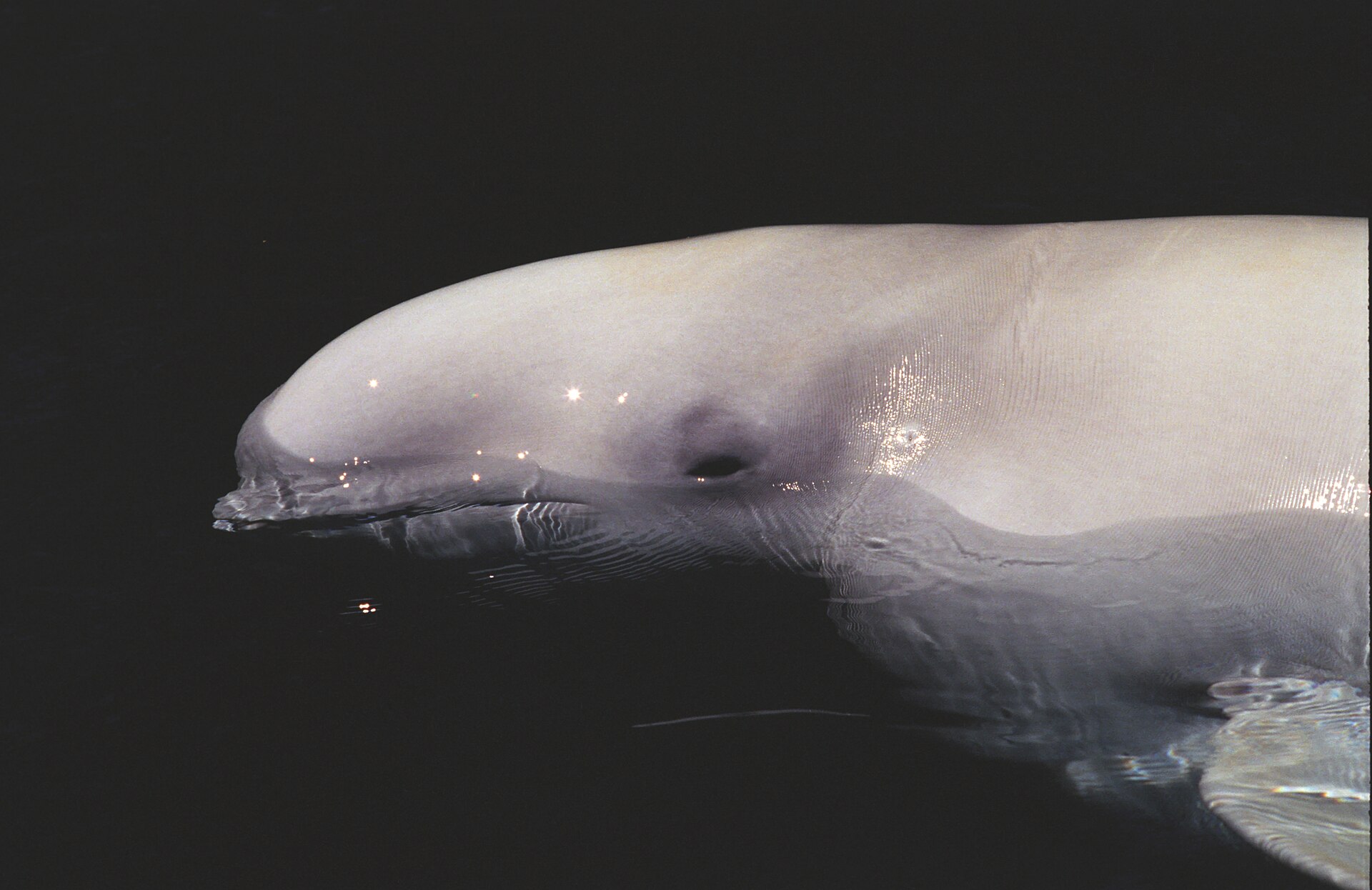
Photo: Jerzystrzelecki / Wikimedia Commons (CC BY 3.0)
In brief
The beluga whale is a small, all-white Arctic cetacean renowned for its extraordinary vocal range, flexible neck and ability to navigate beneath sea ice, currently assessed as Least Concern overall by the IUCN but with several regional populations in serious decline.
Also in Animals A to Z · Animals that start with B
By WARN Research & Conservation TeamLast updated
The beluga whale (Delphinapterus leucas) is one of the most distinctive and vocal mammals on Earth. Cloaked in pure white skin that earned it the Russian name beluga — meaning "white" — this small, stocky cetacean inhabits the Arctic and subarctic seas of the Northern Hemisphere, navigating ice-choked waters with extraordinary dexterity. Unlike most whales, belugas lack a dorsal fin, an adaptation that allows them to swim freely beneath sea ice without snagging. Their flexible neck — another cetacean rarity — enables them to turn their heads in all directions. Perhaps most famously, belugas produce an astonishing repertoire of clicks, whistles, chirps and bell-like tones that earned them the enduring nickname "canaries of the sea." Highly social, intelligent and long-lived, they are sentinel species whose health mirrors the vitality of the entire Arctic marine ecosystem.
~150,000–200,000
Global population
Up to 80 years
Maximum lifespan
14–14.5 months
Gestation period
5.5 m / 1,600 kg
Max size (male)
Figures sourced from IUCN Red List — Delphinapterus leucas, NOAA Fisheries — Beluga Whale species profile, WWF Arctic — Beluga Whale and other references on this page.
Beluga Whale: Quick Facts
| Lifespan | Up to 80 years |
|---|---|
| Length | Up to 5.5 m (males) |
| Weight | Up to 1,600 kg (males) |
| Diet | Fish, squid, crustaceans (100+ species) |
| Gestation | 14–14.5 months |
| Birth interval | Every 2–3 years |
| Dive depth | Up to 1,000 m |
| Dive duration | Up to 25 minutes |
| Social group | Pods of 5–25; mega-pods up to 1,000 |
| Vocalisations | ~1,700 call types recorded |
Scientific Classification
| Kingdom | Animalia |
|---|---|
| Phylum | Chordata |
| Class | Mammalia |
| Order | Artiodactyla |
| Suborder | Whippomorpha |
| Family | Monodontidae |
| Genus | Delphinapterus |
| Species | Delphinapterus leucas (Pallas, 1776) |
Conservation Status
- IUCN Status
- Least Concern
- Population
- ~136,000 mature individuals (150,000–200,000 total)
- Trend
- Unknown (stable overall; several subpopulations declining)
- Assessed
- 2017
- CITES
- Appendix II
Cook Inlet distinct population segment separately assessed as Critically Endangered; St Lawrence Estuary population listed as threatened in Canada.
Did you know?
A beluga whale's melon — the rounded forehead — is not a fixed structure. It is filled with specialised lipid tissue that the whale can literally reshape mid-vocalisation to focus and steer echolocation beams, making it one of the most sophisticated biological sonar systems in the animal kingdom.
Key Facts: Beluga Whale
- Belugas are the only whales with a fully flexible neck, allowing them to nod and turn their heads — a unique trait among cetaceans.
- Their bulbous forehead, called the melon, changes shape as they produce echolocation clicks across a frequency range of 40–120 kHz.
- A single beluga calf is nursed for up to two years and calves are born dark grey, gradually whitening over the first decade of life — reaching full white at around seven years in females and nine years in males.
- The Cook Inlet population in Alaska has declined by approximately 75% since the 1970s and is now listed as Critically Endangered as a distinct population segment.
- Climate change is melting the sea ice belugas rely on for protection from orca predation and disrupting the prey fish they depend on.
- Underwater noise pollution from shipping and oil exploration masks beluga vocalisations, impairing communication and navigation in critical feeding grounds.
What is a beluga whale, and how is it different from other whales?
The beluga whale is a medium-sized toothed whale belonging to the family Monodontidae — a group it shares with only one other living species, the narwhal. Its genus name, Delphinapterus, translates from Greek as "dolphin without a fin," and its species epithet, leucas, simply means "white." Both names capture the animal's most immediately striking features: its unmarked, porcelain-white skin and its smooth, finless back. Adult males reach up to 5.5 metres in length and can weigh as much as 1,600 kilograms, while females are somewhat smaller. Belugas are born slate grey or brownish; their skin lightens progressively through childhood and adolescence, becoming fully white by around the age of seven in females and nine in males. Beneath the skin lies a thick layer of blubber — typically around 10 centimetres deep, and thicker seasonally — that provides buoyancy, insulation and an energy reserve during Arctic winters. The prominent forehead, or melon, is composed of lipid-filled tissue and is uniquely deformable: belugas physically reshape it as they produce different echolocation sounds, giving them extraordinary sonar precision for hunting fish and navigating ice.
Where do beluga whales live, and how do they migrate?
Belugas inhabit a broad circumpolar range across the Arctic Ocean and adjacent subarctic seas, including Hudson Bay, the Gulf of St Lawrence, the Bering Sea, the Beaufort Sea, the Sea of Okhotsk and the waters around Svalbard and Greenland. They are opportunistic migrants, moving between shallow coastal estuaries in summer and deeper offshore or ice-edge waters in winter. In summer, large groups gather at warm, shallow river mouths and estuaries — a behaviour thought to facilitate moulting, as belugas rub against gravel to shed their outer skin. Some populations undertake migrations of thousands of kilometres; the Eastern Chukchi Sea population, for instance, travels from Alaska's coast to the Bering Sea and back each year. Belugas are capable of diving to depths of at least 1,000 metres and can remain submerged for up to 25 minutes, though most dives are shallower. They congregate in pods typically numbering five to 25 individuals, though aggregations of up to a thousand animals are occasionally recorded at prime summering grounds. This strong site fidelity — returning to the same estuaries year after year — is learned from mothers and maintained across generations, making each population genetically and behaviourally distinct.
How do beluga whales communicate and hunt?
Belugas are among the most vocal of all cetaceans. Scientists have catalogued approximately 1,700 different vocalisation types produced in at least 21 different social contexts — a complexity rivalled by very few marine mammals. Their acoustic toolkit includes ultrasonic echolocation pulses (40–120 kHz), lower-frequency social whistles, chirps, clucks, mews, trills and resonant bell-like tones. This sonic diversity prompted early mariners to dub them "canaries of the sea." The melon focuses and steers echolocation clicks into a directed beam, allowing belugas to detect prey hidden in murky or ice-covered water with impressive accuracy. Their flexible neck lets them orient their head precisely toward a target, a significant advantage over most whales. Belugas are generalist predators, consuming more than 100 species of fish, crustaceans and molluscs depending on season and location. Favourite prey includes Arctic cod, capelin, herring, halibut, shrimp-like amphipods and squid. Pods cooperate to herd fish into shallows or trap them against ice. Intriguingly, belugas also display vocal mimicry — there are documented cases of captive individuals reproducing human speech patterns, suggesting a level of intentional sound-learning unusual even among cetaceans.
What threats do beluga whales face today?
Despite a global Least Concern classification, beluga whales face an escalating suite of threats that are driving several regional populations toward crisis. Climate change is the most pervasive: Arctic sea ice is retreating at an unprecedented rate, dismantling the frozen habitat that belugas use as refuge from orca predation and as a platform for their migrations. Warming oceans are also reshuffling prey communities, forcing belugas to dive deeper and more frequently to find food, which increases physiological stress and suppresses reproductive rates. Noise pollution from commercial shipping, seismic oil-exploration surveys and recreational vessels disrupts the acoustic world that belugas depend on for hunting, navigation and social cohesion; high-intensity noise can cause temporary or permanent hearing loss. Chemical pollution is another persistent hazard — heavy metals such as mercury and persistent organic pollutants accumulate through the food chain, reaching concentrations in beluga tissue that compromise immune function and reproduction. Entanglement in fishing gear and direct vessel strikes pose additional mortality risks. Subsistence hunting by Indigenous communities continues under regulated regimes, but for already-small populations, any additional mortality can be significant. The Cook Inlet population of Alaska, now numbering only around 331 individuals based on 2022 aerial surveys, illustrates the extremity of decline that localised pressure can produce: it has lost roughly 75% of its 1970s numbers and is now separately listed as Critically Endangered.
Why does the beluga whale matter, and what does conservation look like?
Belugas are apex consumers and ecological integrators — their presence indicates a productive, intact Arctic food web, while their decline signals systemic disruption. As long-lived, slow-reproducing mammals with strong maternal learning traditions, beluga populations cannot recover quickly from declines; a female produces at most one calf every two to three years after a 14-month gestation, and that calf is nursed for up to two years. Effective conservation therefore requires long-term, multi-threat strategies. In the United States, NOAA Fisheries monitors abundance through aerial surveys and has published recovery plans for the Cook Inlet Critically Endangered population segment. Canada's Species at Risk Act affords protection to the threatened St Lawrence Estuary population, whose numbers have declined by roughly 1–1.5% per year since the early 2000s. International coordination under CITES Appendix II regulates commercial trade in beluga products, requiring that any trade not be detrimental to wild populations. Reducing ship speed and rerouting vessels in critical habitats can significantly cut both noise and strike risk, and several Arctic nations have introduced voluntary or mandatory speed limits in sensitive areas. Scientific tagging programmes continue to unravel migration routes, helping governments identify and protect key foraging and breeding aggregation sites. Public engagement — through education, citizen-science monitoring and reduced plastic and chemical pollution — forms a critical third pillar of any realistic conservation response.
What WARN Does
WARN does not currently run conservation projects for the beluga whale, and this guide is offered as free educational content to help people understand this remarkable Arctic species. While belugas range far outside WARN's current project countries of its partner-network countries, the pressures driving beluga declines — habitat degradation, pollution and climate disruption — are the same forces threatening wildlife in every corner of the planet. Understanding them matters everywhere.
Arctic wildlife like the beluga whale faces an uncertain future as climate change, pollution and habitat disruption accelerate. While WARN focuses its rescue and conservation work on wildlife in its partner-network countries, every donation supports the broader mission of protecting animals and wild places — because healthy oceans and intact ecosystems benefit wildlife everywhere.
Beluga Whale: Frequently Asked Questions
Why are beluga whales white?
How long do beluga whales live?
Are beluga whales endangered?
What do beluga whales eat?
Why are beluga whales called the canaries of the sea?
Can beluga whales swim backwards?
Where do beluga whales live?
Are beluga whales dangerous?
How big is a beluga whale?
Sources & References
Population figures, conservation status and biological facts on this page are drawn from authoritative scientific and intergovernmental sources.
Terms used on this page
Plain-English definitions, from our wildlife and conservation glossary.
Latest Beluga Whale Stories
Quick, fact-checked reads on the beluga whale — amazing facts, key questions and the threats it faces.
Species
12 Amazing Facts About Sea Otters (The Densest Fur on Earth, and Tool Use)
A million hairs per square inch, a favourite rock kept in a pouch, and a keystone role holding kelp forests together.
Read the storySpecies
12 Amazing Facts About Narwhals (The Tusk Is a Tooth, and It Can Sense)
A left canine that grows through the lip, ten million nerve endings, and dives past 1,500 metres. Twelve narwhal facts.
Read the storyExplore more animals
Discover more animals, their habitats and their conservation status in the WARN wildlife-guide library.