Wildlife Guide · South-east Asia & India
Binturong
Arctictis binturong (Raffles, 1821)
The bearcat of the canopy — shaggy, prehensile-tailed and vanishing with the forest.
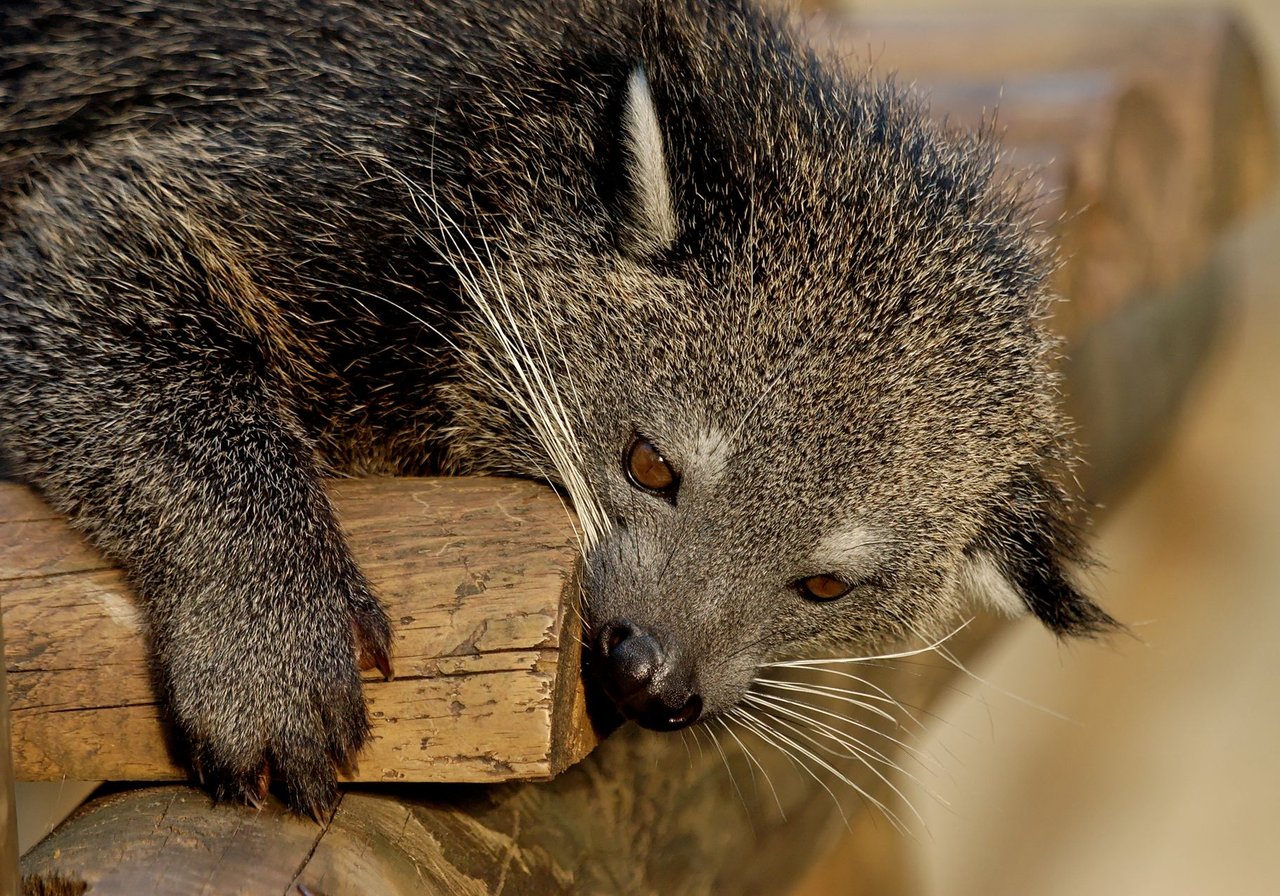
Source: Wikimedia Commons
In brief
The binturong (Arctictis binturong) is a Vulnerable tree-dwelling viverrid of South-east Asian rainforest, the only Old World mammal with a fully prehensile tail; it is threatened by deforestation and the illegal pet trade.
Also in Animals A to Z · Animals that start with B
How you can help
You can symbolically adopt an orangutan from £5 a month — a donation to WARN’s orangutan welfare and conservation appeal, with a personalised certificate you can keep or give as a gift — or give once to where it is needed most.
By WARN Research & Conservation TeamLast updated
The binturong is a large viverrid — related to civets — of South-east Asian rainforest, named 'bearcat' for its stocky body, shaggy black fur and cat-like face. It is the only Old World mammal with a fully prehensile tail, which it uses to anchor itself in the canopy. Binturongs smell of buttered popcorn due to a glandular secretion. Listed as Vulnerable by the IUCN, populations are declining from deforestation, the pet trade and hunting for bushmeat and traditional medicine. Binturongs are slow breeders — typically one or two young per litter — making recovery difficult once populations are depleted.
Vulnerable
IUCN Red List status (2016 assessment)
30%
Estimated population decline over three generations
9–20 kg
Typical adult weight
Appendix III
CITES listing (India)
Figures sourced from IUCN Red List — Arctictis binturong, CITES — Checklist of CITES Species, San Diego Zoo Wildlife Alliance — binturong .
Binturong: Quick Facts
| Weight | 9–20 kg |
|---|---|
| Tail | Fully prehensile — unique among Old World mammals |
| Scent | Popcorn-like — from caudal gland secretion |
| Diet | Mainly frugivorous — figs and other fruit |
| Activity | Mainly nocturnal and arboreal |
| CITES | Appendix III (India) |
Scientific Classification
| Kingdom | Animalia |
|---|---|
| Phylum | Chordata |
| Class | Mammalia |
| Order | Carnivora |
| Family | Viverridae |
| Genus | Arctictis |
| Species | Arctictis binturong (Raffles, 1821) |
Conservation Status
- IUCN Status
- Vulnerable (IUCN, 2016). Estimated 30% decline over three generations.
- Population
- No precise global count; declining across most of range
- Trend
- Decreasing
- Assessed
- 2016
- CITES
- Appendix III (India)
Key Facts: Binturong
- Binturongs smell of buttered popcorn — a scent from a glandular secretion.
- They are the only Old World mammal with a fully prehensile tail.
- Despite the nickname 'bearcat', binturongs are viverrids related to civets.
- Deforestation for palm oil, logging and agriculture is the primary threat.
- Binturongs are slow breeders — one to two young per litter.
- The pet trade removes individuals from the wild with high mortality in transit.
A tree-dwelling viverrid
The binturong belongs to the family Viverridae alongside civets, genets and linsangs. It is the largest living viverrid, with a stocky body, coarse black fur often tipped with grey, stiff white whiskers and small rounded ears. The muscular prehensile tail — as long as the body — grips branches and acts as a fifth limb.
Binturongs are mainly nocturnal and arboreal, though they descend to the ground more than many rainforest mammals. Six subspecies are recognised across South-east Asia, from India and Nepal through Myanmar, Thailand, Malaysia, Indonesia and the Philippines to southern China.
Diet and ecological role
Binturongs are omnivorous frugivores, eating figs and other fruit as a staple and supplementing with small vertebrates, insects, eggs and carrion. They are important seed dispersers — fig seeds pass through the gut and germinate in new locations, linking binturong survival to the health of fig tree communities.
In captivity, binturongs live over 25 years; wild lifespans are shorter. They communicate through scent marking, vocalisations including chuckles and howls, and the distinctive popcorn-scented secretion from a gland beneath the tail.
Threats and the pet trade
Habitat loss is the primary driver of decline. South-east Asia has lost vast areas of lowland rainforest to oil palm, rubber, logging and dam construction. Binturongs cannot survive in plantations or heavily logged forest. Hunting for bushmeat and traditional medicine persists, and the illegal pet trade removes individuals — often young — from the wild. Binturongs are poor pets: they need large arboreal enclosures, specialist diets and nocturnal routines. Most confiscated animals cannot be released and require lifetime sanctuary care.
Conservation outlook
The IUCN lists the binturong as Vulnerable with an estimated 30% population decline over three generations. It occurs in numerous protected areas but enforcement against hunting and trapping is weak in many range countries. CITES Appendix III in India requires export permits. Protecting connected primary forest, enforcing anti-trafficking law and reducing demand for exotic pets are the most effective measures. WARN's orangutan and slow loris work in Indonesia and Malaysia overlaps binturong range, where shared habitat protection benefits all rainforest mammals.
What WARN Does
WARN publishes this guide for education and is developing support through assessed animal-welfare grants. A species range, source citation or photograph does not establish a recipient or funding agreement. Check /about/where-your-money-goes/#grant-register for published grant and payment records; records not yet published must not be read as zero activity. Browse /appeals/ for the purposes currently available to support.
If this guide helps you understand wildlife and the pressures it faces, a gift to WARN supports habitat protection and free public education in our partner countries.
How can I help save the binturong?
Explore practical ways to support the binturong, from everyday choices and sharing reliable information to reviewing a related appeal before giving.
Explore ways to support
Read the related appeal’s purpose, recipient status and fund terms. Choose an affordable gift after checking what is proposed and what has been reported.
Ease the pressures
Avoid the wildlife trade and souvenirs, never buy wild animals as pets, and choose sustainable, habitat-friendly products — the threats behind the binturong's decline fall when demand does.
Spread the word
Share accurate, sourced information about the binturong. Wider awareness is what turns concern into lasting protection.
Binturong: Frequently Asked Questions
How can I help save the binturong?
Why do binturongs smell like popcorn?
Is a binturong a bear or a cat?
Are binturongs endangered?
Where do binturongs live?
Can you keep a binturong as a pet?
What do binturongs eat?
Are binturongs dangerous?
How long do binturongs live?
How big is a binturong?
Sources & References
Population figures, conservation status and biological facts on this page are drawn from authoritative scientific and intergovernmental sources.
Terms used on this page
Plain-English definitions, from our wildlife and conservation glossary.
Latest Binturong Stories
Quick, fact-checked reads on the binturong — amazing facts, key questions and the threats it faces.
Species
Tiger vs Lion: 7 Key Differences Between the Two Biggest Cats
Tigers are bigger, stripier and solitary; lions are social and live in prides. Here's how the two largest cats really differ in size, habitat and behaviour.
Read the storySpecies
Slow Loris vs Pygmy Slow Loris: 6 Key Differences
They look alike and share a venomous bite, but the pygmy slow loris now has its own genus. Here's how to tell these night-time primates apart.
Read the storySpecies
12 Amazing Facts About the Dugong, the Ocean's Only Vegetarian Sea Cow
From mermaid myths to tonnes of seagrass and 70-year lifespans, here are 12 remarkable facts about the dugong, the only marine mammal that lives entirely on plants.
Read the storyExplore more animals
Discover more animals, their habitats and their conservation status in the WARN wildlife-guide library.