Wildlife Guide · North America
Blue Jay
Cyanocitta cristata
The bold, blue-crested corvid that mimics hawks and plants oak forests one acorn at a time.
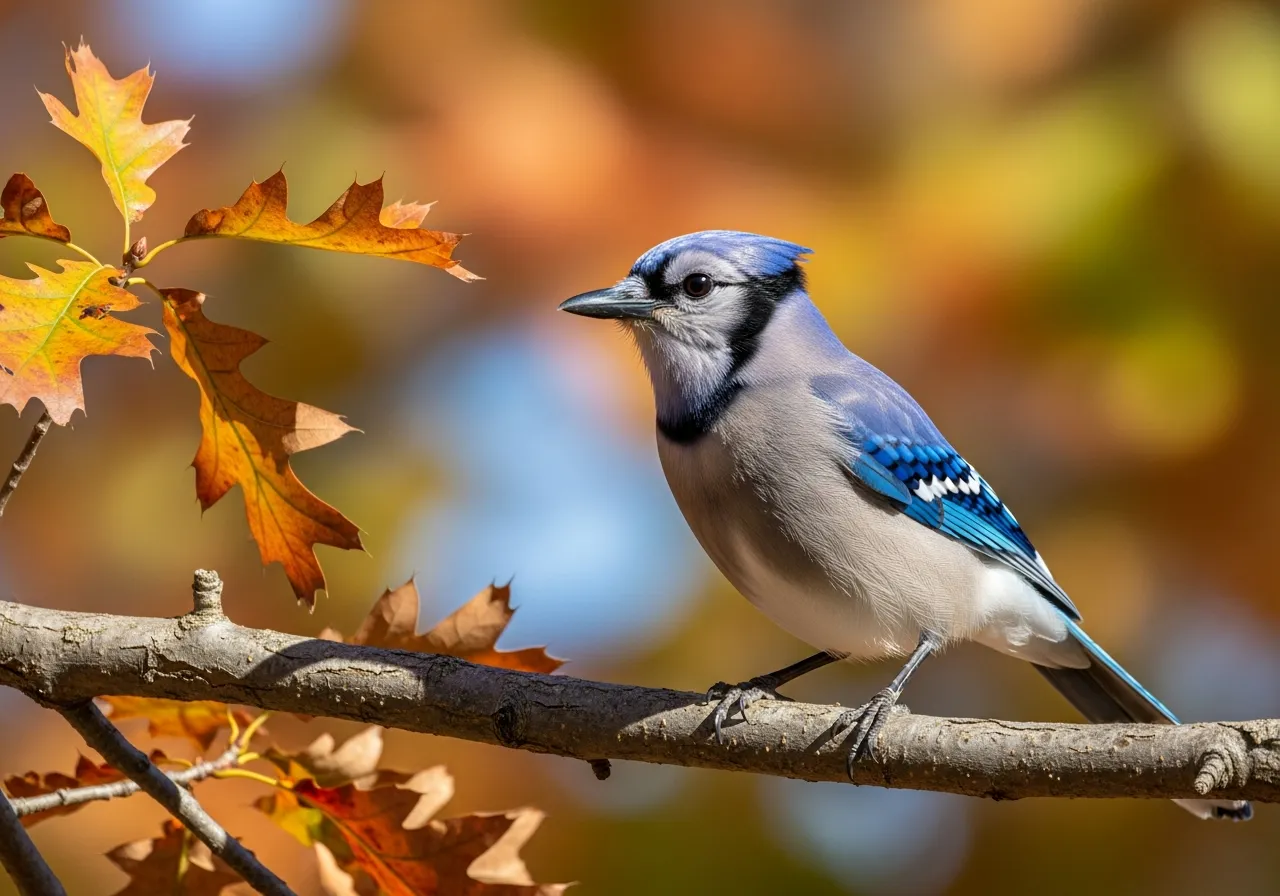
Source: Global Animal Guide (WARN)
In brief
A blue jay (Cyanocitta cristata) is a bold, crested blue songbird of eastern and central North America, and a member of the corvid family alongside crows and ravens. Known for mimicking hawk calls and caching acorns, it is common, intelligent, and listed as Least Concern by the IUCN.
Also in Animals A to Z · Animals that start with B
By WARN Research & Conservation TeamLast updated
The blue jay (Cyanocitta cristata) is a striking, crested songbird of eastern and central North America, and a member of the corvid family that includes crows, magpies and ravens. Roughly the size of an American robin but bulkier, it is unmistakable in lavish blue, white and black plumage, with a pointed crest it raises when alert or excited. Blue jays are loud, intelligent and highly social, famous for imitating the screams of hawks and for caching thousands of acorns each autumn. By burying nuts they later forget, they help oak woodlands regenerate. Adaptable and widespread, the species is classed as Least Concern on the IUCN Red List and is not listed by CITES.
~25–30 cm
Body length, bill to tail
~34–43 cm
Wingspan
~65–110 g
Typical adult weight
Least Concern
IUCN Red List status
Figures sourced from Blue jay — Wikipedia, IUCN Red List — Cyanocitta cristata, Blue Jay — Cornell Lab, All About Birds and other references on this page.
Blue Jay: Quick Facts
| Common name | Blue jay |
|---|---|
| Scientific name | Cyanocitta cristata |
| Family | Corvidae (crows and jays) |
| Range | Eastern and central North America |
| Habitat | Mixed and deciduous woodland, parks, gardens |
| Diet | Omnivore; nuts, seeds, insects, fruit |
| Body length | About 25–30 cm |
| Wingspan | About 34–43 cm |
| IUCN status | Least Concern |
| CITES listing | Not listed |
Scientific Classification
| Kingdom | Animalia |
|---|---|
| Phylum | Chordata |
| Class | Aves |
| Order | Passeriformes |
| Family | Corvidae |
| Genus | Cyanocitta |
| Species | Cyanocitta cristata |
Conservation Status
- IUCN Status
- Least Concern on the IUCN Red List. The blue jay is common and widespread across eastern and central North America, with a large range and population, and it has expanded westward over time. It adapts well to parks, gardens and suburbs, and is not currently considered at risk.
- Population
- Not precisely quantified; abundant and widespread, with a large global population
- Trend
- Stable
- Assessed
- IUCN Red List (Least Concern)
- CITES
- Not listed on any CITES Appendix
Although secure, blue jays remain dependent on healthy woodland, particularly oak and beech, and on the wider tree cover of parks and gardens. Broad threats to birds such as habitat loss, collisions and changes in land use can still affect local populations.
Key Facts: Blue Jay
- The blue jay is a crested corvid native to eastern and central North America, closely related to crows, magpies and ravens.
- It is a skilled vocal mimic, often imitating the calls of hawks such as the red-shouldered hawk.
- Blue jays cache large numbers of acorns each autumn and, by forgetting some, help oak forests spread.
- The bird's blue colour comes from light scattering by feather structure, not from blue pigment.
- Adaptable and widespread, the species is listed as Least Concern by the IUCN and is not CITES-listed.
- Some northern populations migrate in loose daytime flocks, while many individuals stay put year-round.
What does a blue jay look like?
The blue jay is one of North America's most recognisable birds, roughly 25–30 cm long with a wingspan of around 34–43 cm and a weight usually between about 65 and 110 grams. Its upperparts are bright blue, the face and underparts are pale grey-white, and a distinctive black 'necklace' runs across the throat and around the head. The wings and tail are barred in vivid blue, white and black, and a jaunty crest on the crown rises and falls with the bird's mood. Males and females look alike, which is unusual among colourful birds. Strikingly, the blue is not produced by pigment. The feathers contain the dark pigment melanin, but their microscopic structure scatters light so that we perceive blue, a phenomenon called structural colour. Crush a blue feather and the blue disappears. Strong legs, a stout black bill and a steady, slightly undulating flight complete the picture of a robust, confident bird at home in woodland and gardens alike.
What do blue jays eat, and why do they cache acorns?
Blue jays are omnivores with a strong preference for nuts and seeds. Acorns, beechnuts and other tree seeds form a major part of the diet, supplemented by insects, fruit, grain and the occasional egg or nestling. A throat pouch lets a jay carry several acorns at once, and in autumn a single bird may transport and bury thousands of nuts in scattered caches to see it through winter. Because not every cache is recovered, many acorns are effectively planted in suitable soil, well spaced from the parent tree. Ecologists credit jays with helping oaks recolonise ground after the last Ice Age and with shaping the spread of oak woodland today, making them important seed dispersers. Blue jays will also visit garden feeders, favouring sunflower seeds, peanuts and suet, and are bold enough to dominate smaller birds. Their intelligence shows in problem-solving and in the way they remember the locations of hidden food, a feat of spatial memory shared across the corvid family.
Why do blue jays imitate hawks?
Blue jays are accomplished vocal mimics, and their best-known impression is the piercing scream of a hawk, particularly the red-shouldered hawk. The reason is not fully settled, but several explanations are plausible and not mutually exclusive. A convincing hawk call may scatter other birds from a feeder or food source, clearing the way for the jay. It may also serve as a warning that a real hawk is nearby, alerting family members and other jays to genuine danger. Beyond mimicry, blue jays have a wide vocabulary of harsh 'jay-jay' calls, soft whistles, clicks and rattles, and pairs use quiet notes when close together. They are social birds, often moving in family groups and mobbing predators such as owls and hawks as a team. This combination of loud alarm calls, mimicry and cooperative defence makes the blue jay both a sentinel of the woodland and, to other species, a sometimes unwelcome bully at the bird table.
Where do blue jays live, and do they migrate?
Blue jays are found across eastern and central North America, from southern Canada through the eastern and central United States. They favour mixed and deciduous woodland, especially where oaks and beeches grow, but they thrive equally in parks, suburbs and gardens, which has helped the species expand its range westward over time. Migration in blue jays is famously puzzling. Some northern birds gather into loose flocks and travel south by day in autumn, often along shorelines and ridgelines, yet many individuals of the same population stay put all winter. Even individual birds may migrate one year and remain the next, and the triggers are not fully understood. Breeding pairs build a cup nest of twigs in a tree, where the female incubates a clutch of eggs while the male brings food. Both parents care for the young. With their adaptability, varied diet and tolerance of human landscapes, blue jays remain common and widespread, which is reflected in their secure conservation status.
What WARN Does
World Animal Rescue Network does not run field projects specifically for the blue jay, which is a common and secure species living mainly outside the countries where WARN's partners work partner countries. This guide is part of WARN's free educational work, helping people understand and value wildlife everywhere. The threats that erode bird populations elsewhere, above all habitat loss and the degradation of woodland and wild spaces, are the same pressures that endanger the animals WARN does protect on the ground.
If learning about the blue jay deepened your care for wildlife, a small gift helps fund WARN's free educational work and on-the-ground protection for animals that need it most.
Blue Jay: Frequently Asked Questions
Are blue jays members of the crow family?
Why are blue jays blue?
Do blue jays really imitate hawks?
What do blue jays eat?
Do blue jays migrate?
Where do blue jays live?
Are blue jays dangerous?
How long do blue jays live?
How big is a blue jay?
Sources & References
Population figures, conservation status and biological facts on this page are drawn from authoritative scientific and intergovernmental sources.
Terms used on this page
Plain-English definitions, from our wildlife and conservation glossary.
Latest Blue Jay Stories
Quick, fact-checked reads on the blue jay — amazing facts, key questions and the threats it faces.
Species
12 Amazing Facts About Grey Wolves (And Why Alpha Wolves Aren't Real)
A howl that carries 16 km, a pack that is really a family, and the debunked study behind the 'alpha wolf' myth. Twelve verified facts.
Read the storySpecies
12 Amazing Facts About Beavers (Iron in Their Teeth, and They Rebuild Rivers)
Orange iron-hardened incisors, transparent eyelids, and a keystone role that reduces flooding and drought. Twelve facts.
Read the storySpecies
12 Amazing Facts About Wolverines (They Take Down Prey Five Times Their Size)
Frost-resistant fur, jaws that crush frozen bone, and territories the size of small countries. Twelve verified facts.
Read the storyExplore more animals
Discover more animals, their habitats and their conservation status in the WARN wildlife-guide library.