Wildlife Guide · All oceans — Arctic to Antarctic; migratory between feeding and breeding grounds
Blue Whale
Balaenoptera musculus (Linnaeus, 1758)
The largest animal ever known — a colossal filter-feeder recovering from the whaling era.
Source: Wikimedia Commons
In brief
The blue whale (Balaenoptera musculus) is the Endangered largest animal on Earth — a krill-filtering baleen whale found in all oceans, recovering slowly after twentieth-century whaling.
Also in Animals A to Z · Animals that start with B
How you can help
You can support the related appeal — read its purpose, recipient status and fund terms first — or give once to where it is needed most. Sharing accurate information helps too.
By WARN Research & Conservation TeamLast updated
The blue whale is the largest animal known to have lived, reaching lengths of up to 30 metres and masses exceeding 150 tonnes. This baleen whale filters krill and small crustaceans through fringed plates hanging from the upper jaw. Once hunted to the brink of extinction, the species is now Endangered on the IUCN Red List with populations slowly rebuilding under international protection. Blue whales migrate between high-latitude feeding grounds and lower-latitude calving areas, crossing shipping lanes where vessel strikes remain a leading modern threat.
30 m
Maximum recorded length
Endangered
IUCN Red List status
10,000–25,000
Estimated global population
CITES I
International commercial trade prohibited
Figures sourced from IUCN Red List — blue whale, Smithsonian Ocean — blue whale, Encyclopaedia Britannica — blue whale and other references on this page.
Blue Whale: Quick Facts
| IUCN status | Endangered |
|---|---|
| Length | Up to ~30 m |
| Diet | Krill and small crustaceans |
| Population | ~10,000–25,000 mature individuals |
| Feeding method | Lunge feeding with baleen |
| CITES | Appendix I |
Scientific Classification
| Kingdom | Animalia |
|---|---|
| Phylum | Chordata |
| Class | Mammalia |
| Order | Artiodactyla |
| Family | Balaenopteridae |
| Species | Balaenoptera musculus |
Conservation Status
- IUCN Status
- Endangered globally due to historic whaling depletion; populations increasing slowly under protection.
- Population
- 10,000–25,000 mature individuals
- Trend
- Increasing slowly
- Assessed
- 2018
- CITES
- Appendix I
Antarctic subspecies remains heavily depleted relative to pre-whaling abundance.
Key Facts: Blue Whale
- Blue whales eat up to four tonnes of krill daily during feeding season.
- Commercial whaling reduced global numbers by roughly 99 percent before the 1966 moratorium.
- Ship strikes and ocean noise are now major threats alongside climate impacts on krill.
- Heart size can exceed 180 kg; arteries are wide enough for a child to crawl through.
- Subspecies include Antarctic, pygmy and northern Indian Ocean forms with distinct ranges.
- Recovery is measurable but slow — females produce one calf every two to three years.
Anatomy and feeding
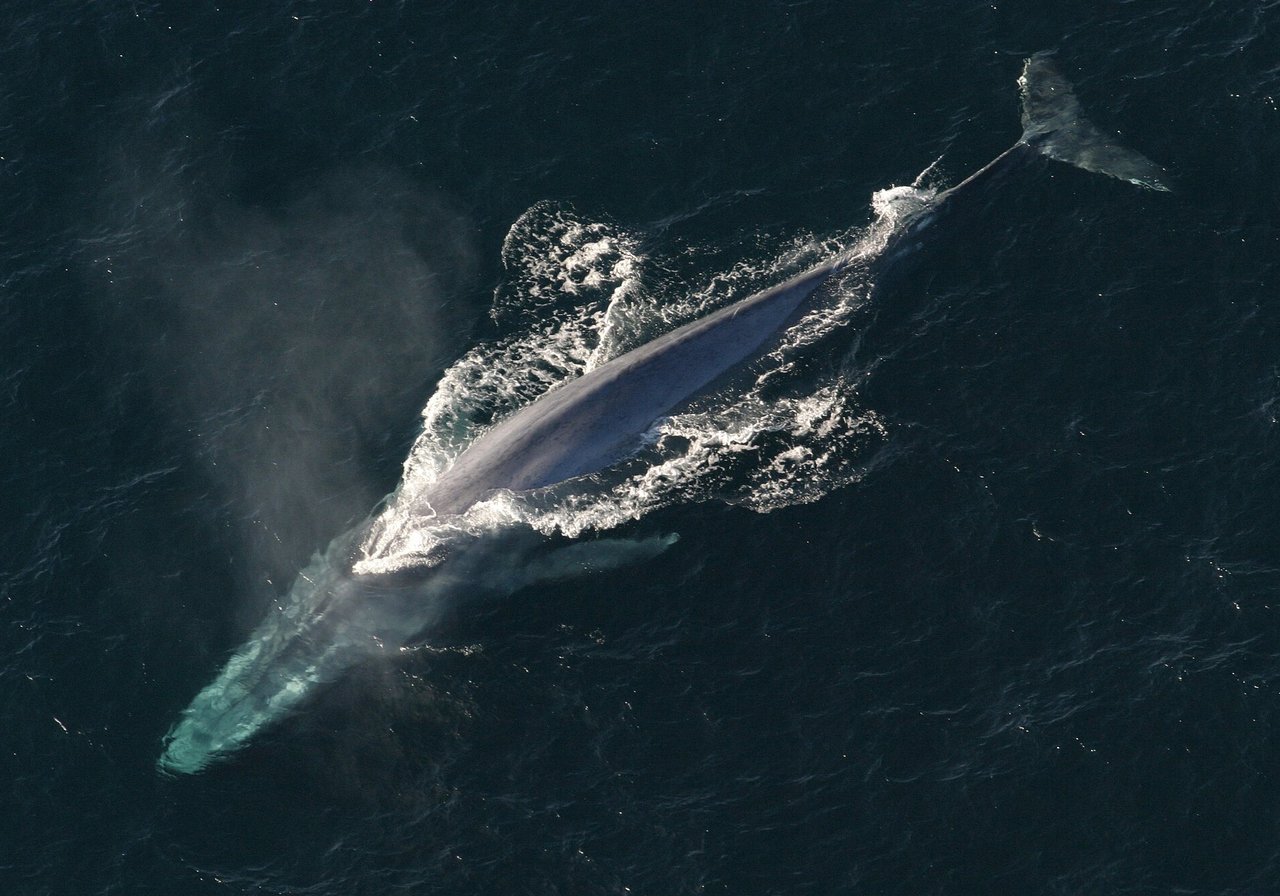
Blue whales belong to the rorqual family Balaenopteridae, characterised by pleated throat grooves that expand during feeding. The whale lunges through krill swarms, taking in tonnes of water, then expels it through baleen plates that trap prey.
Despite their size, blue whales feed almost exclusively on tiny euphausiid crustaceans. They accumulate fat reserves in summer feeding grounds — Antarctic, California, Sri Lanka — then migrate to warmer waters to calve, fasting or eating little during migration.
The blow can reach nine metres high. Flukes and mottled blue-grey skin with diatom film aid individual photo-identification in research catalogues.
Migration and reproduction
Blue whales undertake some of the longest migrations of any mammal, travelling thousands of kilometres between poles and tropics. Timing follows krill blooms and calving advantages in warmer, predator-scarcer seas.
Gestation lasts about ten to twelve months. Calves are born roughly seven metres long, nursing on rich milk and gaining weight rapidly. Mothers invest heavily in single offspring; interbirth intervals of two to three years limit recovery speed.
Vocalisations — low-frequency pulses travelling hundreds of kilometres — may coordinate mating or maintain contact across ocean basins. Anthropogenic noise interferes with these calls.
Whaling history and recovery
Industrial whaling in the twentieth century killed an estimated 350,000-plus blue whales, collapsing Antarctic populations especially. The International Whaling Commission protected blue whales in 1966; populations began slow increase thereafter.
The IUCN assessed the species as Endangered in 2018, estimating 10,000 to 25,000 mature individuals globally — a fraction of pre-whaling abundance. Antarctic blue whales remain at roughly 1 percent of historic numbers.
Legal protection continues, but illegal whaling is not the main modern risk. Ship strikes, entanglement, plastic ingestion and krill fishery expansion threaten recovery trajectories.
Blue whales and people
Whale-watching for blue whales supports coastal economies in Sri Lanka, California and Quebec when conducted with approach limits. Scientific tagging reveals migration routes that inform shipping lane adjustments to reduce strikes.
Climate change may shift krill distribution, forcing whales to alter historic feeding grounds. International cooperation on ocean noise — from shipping, seismic surveys and naval sonar — is essential.
Readers can support blue whales indirectly through marine protected areas advocacy, sustainable seafood choices and organisations funding non-invasive research — not captivity, as blue whales cannot be kept humanely.
What WARN Does
WARN's educational mission reaches readers across its partner-network countries — nations with coastlines where shipping, fisheries and pollution affect ocean giants. This blue whale guide is free outreach supporting informed care for marine habitats.
If this guide helps you understand wildlife and the pressures it faces, a gift to WARN supports habitat protection and free public education in our partner countries.
How can I help save the blue whale?
Explore practical ways to support the blue whale, from everyday choices and sharing reliable information to reviewing a related appeal before giving.
Explore ways to support
Read the related appeal’s purpose, recipient status and fund terms. Choose an affordable gift after checking what is proposed and what has been reported.
Ease the pressures
Avoid the wildlife trade and souvenirs, never buy wild animals as pets, and choose sustainable, habitat-friendly products — the threats behind the blue whale's decline fall when demand does.
Spread the word
Share accurate, sourced information about the blue whale. Wider awareness is what turns concern into lasting protection.
Blue Whale: Frequently Asked Questions
How can I help save the blue whale?
How big is a blue whale?
Are blue whales endangered?
What do blue whales eat?
Where do blue whales live?
Why did blue whales decline?
How long do blue whales live?
Are blue whales dangerous?
Sources & References
Population figures, conservation status and biological facts on this page are drawn from authoritative scientific and intergovernmental sources.
Terms used on this page
Plain-English definitions, from our wildlife and conservation glossary.
Latest Blue Whale Stories
Quick, fact-checked reads on the blue whale — amazing facts, key questions and the threats it faces.
Explore more animals
Discover more animals, their habitats and their conservation status in the WARN wildlife-guide library.