Wildlife Guide · United Kingdom & Europe
Common Buzzard
Buteo buteo
The broad-winged, mewing raptor that became Britain's commonest bird of prey.
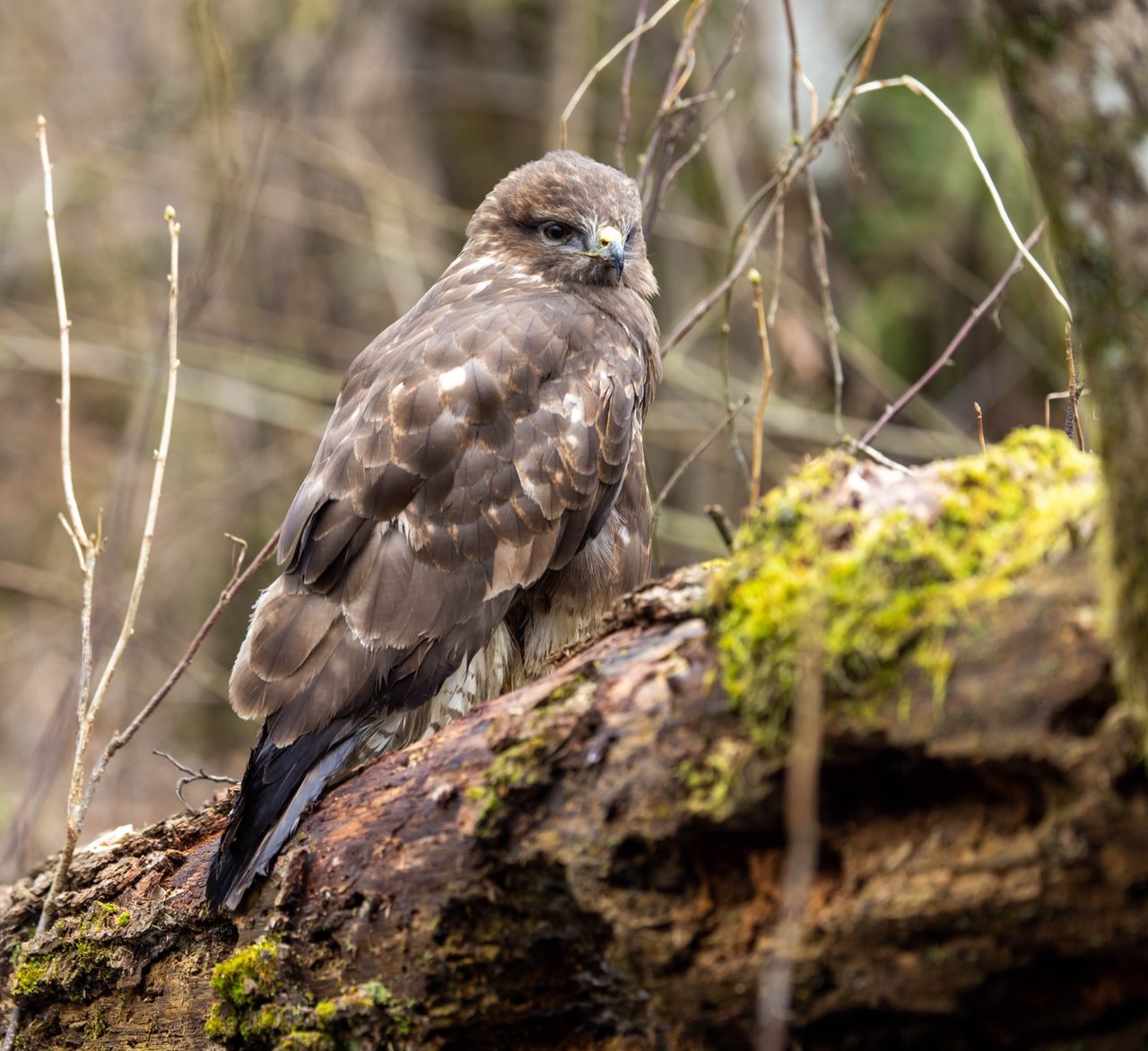
Source: Wikimedia Commons — “Buteo buteo juv Log (2)” by Yerpo, CC BY-SA 4.0
In brief
A common buzzard (Buteo buteo) is a medium-large, broad-winged bird of prey and Britain's most common and widespread raptor. It soars in slow circles, gives a distinctive cat-like mewing call, and hunts small mammals, earthworms and carrion across farmland, woodland and moorland.
Also in Animals A to Z · Animals that start with C
By WARN Research & Conservation TeamLast updated
The common buzzard (Buteo buteo) is a medium-large bird of prey and the most widespread raptor across Britain and much of Europe. Stocky and broad-winged, it is most often seen soaring in slow circles on rising warm air, or perched motionless on a fence post or bare branch scanning for prey. Its plumage is famously variable, ranging from dark chocolate-brown to almost creamy-white, usually with a pale band across the chest. The buzzard's far-carrying, cat-like "pee-yow" mewing call is one of the most recognisable sounds of open countryside. A patient, opportunistic hunter, it feeds largely on small mammals, earthworms and carrion, and has recovered strongly to recolonise much of its former range.
109-140 cm
Wingspan
40-58 cm
Body length
300+
Recorded prey species
Least Concern
IUCN Red List status
Figures sourced from Wikipedia - Common buzzard, IUCN Red List - Buteo buteo, CITES - Appendices and other references on this page.
Common Buzzard: Quick Facts
| Common name | Common buzzard |
|---|---|
| Scientific name | Buteo buteo |
| Type | Bird of prey (raptor) |
| Wingspan | 109-140 cm |
| Body length | 40-58 cm |
| Diet | Small mammals, birds, earthworms, carrion |
| Call | Cat-like mewing 'pee-yow' |
| Distribution | Europe and western/central Asia; UK resident |
| UK status | Most common and widespread bird of prey |
| IUCN status | Least Concern |
Scientific Classification
| Kingdom | Animalia |
|---|---|
| Phylum | Chordata |
| Class | Aves |
| Order | Accipitriformes |
| Family | Accipitridae |
| Genus | Buteo |
| Species | Buteo buteo |
Conservation Status
- IUCN Status
- Least Concern (IUCN Red List). The common buzzard has an extremely large global range and population, assessed as stable or increasing, and is not currently considered at risk of extinction. In the UK it has recovered strongly from historical persecution to become the most common and widespread bird of prey, though local threats such as illegal poisoning, vehicle and powerline collisions, and persecution persist.
- Population
- Very large; global population estimated in the millions of mature individuals (IUCN), with a substantial and widespread breeding population in the UK.
- Trend
- Stable to increasing
- Assessed
- 2021
- CITES
- Appendix II
Listed on CITES Appendix II, which covers all birds of prey (Accipitriformes) and regulates international trade. Fully protected under UK wildlife law.
Key Facts: Common Buzzard
- The common buzzard is Britain's most common and widespread bird of prey, found in nearly every county.
- It is a broad-winged, stocky raptor best known for soaring in slow circles and giving a cat-like mewing call.
- Plumage is highly variable, from dark brown to pale cream, often with a paler chest band.
- It is a generalist predator, taking small mammals, birds, earthworms and carrion, with over 300 prey species recorded.
- Once heavily persecuted and reduced to the west and north, it has recovered to recolonise most of Britain since the late 20th century.
- Globally it is classified as Least Concern, with a large and stable to increasing population.
What does a common buzzard look like?
The common buzzard is a medium-large raptor with a compact body, broad rounded wings and a relatively short, fanned tail. Adults typically measure 40-58 cm from bill to tail, with a wingspan of roughly 109-140 cm, and females are noticeably larger and heavier than males. The most striking feature is the variability of its plumage: individuals range from very dark, almost uniform chocolate-brown to pale, creamy birds with extensive white, and many show a paler band or 'necklace' across the breast. In flight the wings are held in a shallow V, the tips slightly upturned, and the tail is often spread into a fan. The underwing usually shows pale patches contrasting with darker margins, and the flight feathers are barred. The bill is hooked and dark-tipped with a yellow base, the legs and feet are yellow, and the eyes are dark. This combination of broad wings, short neck and rounded silhouette helps separate the buzzard from larger eagles and from the more angular, long-tailed kites and harriers.
What does a buzzard eat and how does it hunt?
The common buzzard is a true generalist predator, and more than 300 prey species have been recorded across its range. The bulk of its diet is small mammals, especially voles, mice, rabbits and young hares, and in many regions vole abundance directly influences how many chicks a pair can raise. It also takes small and medium birds, reptiles, amphibians, large insects and, importantly, earthworms, which it gathers by walking over damp pasture. Carrion is a significant food source, particularly in winter, and buzzards are frequently seen feeding on roadkill and dead livestock. Hunting is typically unspectacular: the bird perches patiently on a post, pole or bare branch and drops onto prey it has spotted below, or quarters slowly over open ground. It will also soar and, less often, hover briefly in a headwind. This flexible, low-energy approach allows the buzzard to thrive in farmland, woodland edge, moorland and even the fringes of towns, wherever there is a mix of open hunting ground and trees or crags for nesting.
Why has the buzzard become so common again?
For much of the 19th and early 20th centuries the buzzard was heavily persecuted across Britain, shot and poisoned on game estates and squeezed back into the wilder west and north. Numbers fell further in the 1950s when myxomatosis devastated the rabbit, a key prey, and when agricultural pesticides affected many birds of prey. From the late 20th century, however, the picture reversed dramatically. Legal protection, a decline in illegal persecution in many areas, the recovery of rabbit populations and the buzzard's own dietary flexibility allowed it to spread back eastwards across England. It is now found in nearly every part of the country and is widely regarded as the UK's most numerous bird of prey. The species' adaptability, its willingness to eat carrion and earthworms, and its tolerance of farmed landscapes have all helped. This recovery is a genuine conservation success story, though buzzards can still fall victim to illegal poisoning, collisions with vehicles and overhead lines, and localised persecution.
Buzzard vs Red Kite: how to tell them apart
| Feature | Common Buzzard | Red Kite |
|---|---|---|
| Wing shape | Broad, rounded; held in shallow V when soaring | Long, narrow, angled; flexed in flight |
| Tail | Short, fanned, rounded | Long, deeply forked, twisted in flight |
| Plumage | Variable brown, often with pale chest band | Rich rufous body, pale head, bold white wing patches |
| Flight style | Slow soaring and patient perching | Buoyant, agile, constantly steering with tail |
| Call | Cat-like mewing 'pee-yow' | Thinner, wavering whistle |
| Main food | Small mammals, earthworms, carrion | Largely carrion and scraps, some small prey |
What WARN Does
WARN does not run field projects dedicated specifically to the common buzzard, which is widespread and secure across Britain and Europe and largely outside the countries where WARN's partners work. This guide is part of WARN's free educational library, written to help people understand and value the wildlife around them. The threats that shaped the buzzard's story, habitat loss, poisoning and persecution, are the same pressures that endanger the raptors and other animals WARN's partners do protect on the ground.
If this guide deepened your appreciation of birds of prey, a small gift helps keep WARN's wildlife education free and supports the animals our partners protect.
Common Buzzard: Frequently Asked Questions
Is a buzzard the same as a hawk?
What sound does a buzzard make?
How big is a common buzzard?
Do buzzards attack pets, livestock or people?
Where do buzzards live and nest?
Are buzzards protected and is their population safe?
What do common buzzards eat?
Are common buzzards dangerous?
How long do common buzzards live?
Sources & References
Population figures, conservation status and biological facts on this page are drawn from authoritative scientific and intergovernmental sources.
Terms used on this page
Plain-English definitions, from our wildlife and conservation glossary.
Latest Common Buzzard Stories
Quick, fact-checked reads on the common buzzard — amazing facts, key questions and the threats it faces.
Guides
UK Animal Charities Explained: A Friendly Guide to 10 of the Biggest, and How They Differ
Who does what across UK animal welfare? A neutral, supporter-friendly guide to ten of the biggest UK animal charities — RSPCA, Dogs Trust, Battersea, Cats Protection, Blue Cross, PDSA, The Donkey Sanctuary, Brooke, Wood Green and Mayhew — with each charity's own donate link, and an honest section on where international field rescue fits in.
Read the storyGuides
What Is an Animal Sanctuary? How Sanctuaries Work, Who They Help, and How to Support One
Animal sanctuary, animal shelter, animal rescue — the terms are often used interchangeably, but they mean different things. This guide explains the difference, what life inside a sanctuary looks like, and how you can support sanctuaries in the UK and internationally.
Read the storyGuides
Fostering a Rescue Dog in the UK: A Complete Guide for New and Experienced Foster Carers
Fostering a rescue dog gives a dog in a shelter or rescue centre a temporary home while they wait for adoption — and it can make an enormous difference to their behaviour, health and chances of finding a permanent family. This guide covers how dog fostering works, what to expect, and how to get started.
Read the storyExplore more animals
Discover more animals, their habitats and their conservation status in the WARN wildlife-guide library.