Wildlife Guide · Papua New Guinea & Indonesia (West Papua, Maluku Islands)
Cassowary
Casuarius spp.
The rainforest's living gardener — a flightless giant that reshapes forests one seed at a time
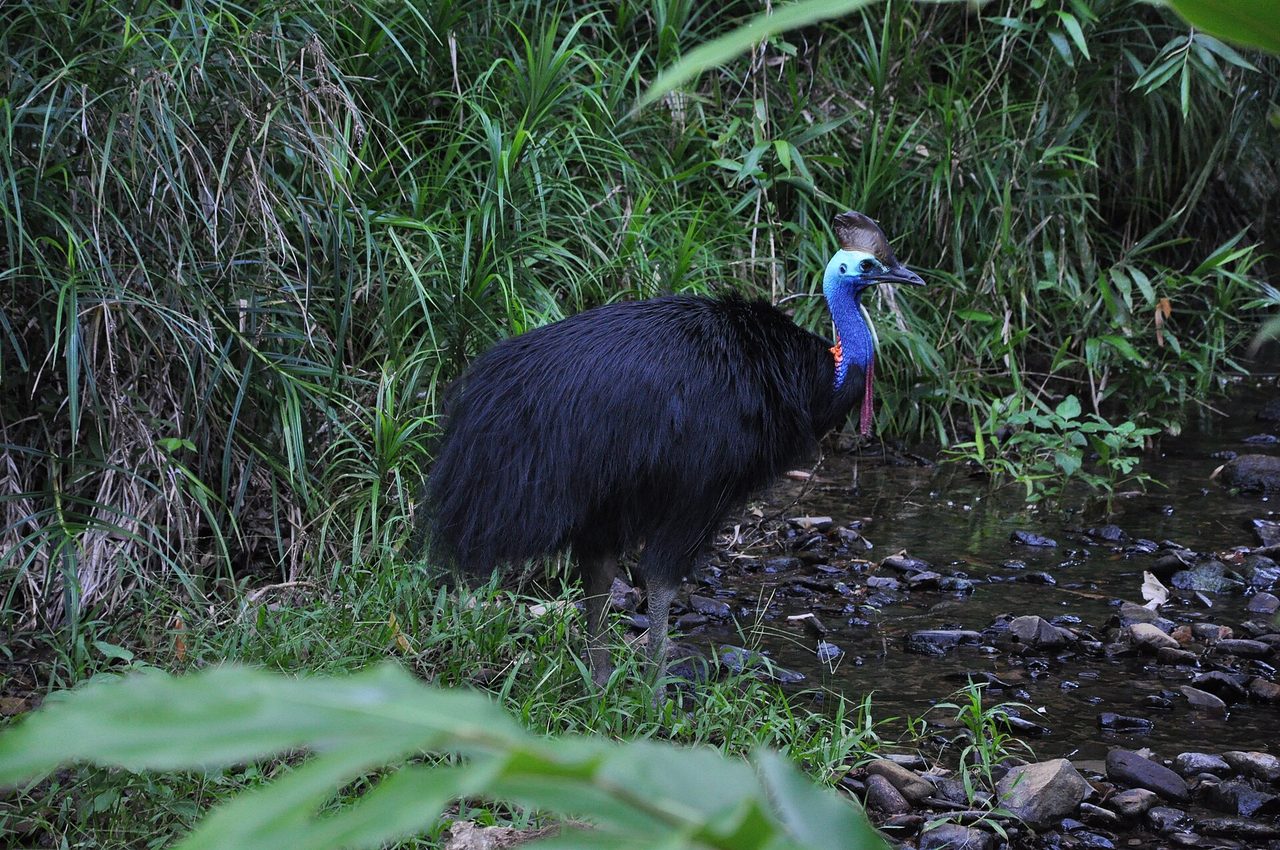
Photo: Dmitry Brant / Wikimedia Commons (CC BY-SA 4.0)
In brief
The cassowary is a large, flightless bird native to the rainforests of New Guinea and north-eastern Australia, renowned for its bony head casque, vivid neck colouring, and critical role as a seed disperser for hundreds of tropical plant species.
Also in Animals A to Z · Animals that start with C
By WARN Research & Conservation TeamLast updated
The cassowary is one of the world's most extraordinary birds: a towering, flightless ratite cloaked in glossy black feathers, topped with a bony helmet called a casque, and armed with a dagger-like inner claw that can reach 12 cm in length. Three species inhabit the tropical rainforests and montane forests of New Guinea and the surrounding islands, with the southern cassowary (Casuarius casuarius) also found in the Wet Tropics of north-eastern Queensland, Australia. Despite their fearsome reputation, cassowaries are far more valuable as ecological architects than as threats: they are the only animals capable of dispersing the large seeds of more than 45 rainforest plant species, making them an irreplaceable keystone species. Without them, the forest itself would change beyond recognition.
~76 kg
Max female weight (southern cassowary)
~45 plant spp.
Large-seeded species only cassowaries disperse
1.5 km
Max seed dispersal distance per bird
~4,000–5,000
Estimated wild population in Australia
Figures sourced from BirdLife International — Southern Cassowary Species Factsheet (BirdLife DataZone), Cassowary Fact Sheet — IELC LibGuides (Population and Conservation Status), Smithsonian National Zoo — Southern Cassowary and other references on this page.
Cassowary: Quick Facts
| Type | Flightless ratite bird |
|---|---|
| Height (southern) | Up to 1.7 m (5.6 ft) |
| Weight (female) | Up to 76 kg (167 lb) |
| Lifespan (wild) | ~18–22 years |
| Diet | Frugivore; also fungi, invertebrates |
| Incubation | 49–52 days (by male only) |
| IUCN status | Least Concern (southern, 2018) |
| Australian status | Endangered (EPBC Act) |
Scientific Classification
| Kingdom | Animalia |
|---|---|
| Phylum | Chordata |
| Class | Aves |
| Order | Casuariiformes |
| Family | Casuariidae |
| Genus | Casuarius |
| Species | C. casuarius (southern), C. unappendiculatus (northern), C. bennetti (dwarf) |
Conservation Status
- IUCN Status
- Least Concern (southern cassowary, globally)
- Population
- 20,000–50,000 mature individuals globally; ~4,000–5,000 in Australia
- Trend
- Decreasing
- Assessed
- 2018
- CITES
- Not listed under CITES; export prohibited by national law in Australia, Indonesia, and Papua New Guinea
The Australian subspecies (C. c. johnsonii) is listed as Endangered under the EPBC Act and by Queensland state law despite the global Least Concern assessment.
Did you know?
A cassowary's call can drop below 20 Hz — below the range of human hearing — allowing its booming rumbles to travel long distances through dense rainforest. You might feel a cassowary before you hear one.
Key Facts: Cassowary
- Cassowaries are ratites — ancient flightless birds related to emus, ostriches, and rheas — with three living species, all native to New Guinea and its surrounding region.
- The southern cassowary is the largest of the three and can stand up to 1.7 m tall, with females heavier than males at up to 76 kg.
- Their bony casque is covered in keratin and likely helps amplify low-frequency calls and may assist with thermoregulation or social signalling.
- Cassowaries are keystone seed dispersers: they swallow whole fruits and deposit seeds up to 1.5 km from parent trees, sustaining at least 238 plant species and enabling forest regeneration after cyclones.
- The Australian population is listed as Endangered under domestic law, with vehicle strikes accounting for roughly 55% of recorded adult deaths and dog attacks a further 18%.
- Habitat loss has already removed 75–80% of former cassowary habitat in Australia, making road-safety corridors and forest protection urgent conservation priorities.
What is a cassowary?
Cassowaries belong to the ratite lineage, a group of large, flightless birds that diverged from flying ancestors tens of millions of years ago and spread across the southern continents. The three living species — southern cassowary (Casuarius casuarius), northern cassowary (C. unappendiculatus), and dwarf cassowary (C. bennetti) — form the family Casuariidae within the order Casuariiformes, which also includes the emu. All three species share a suite of dramatic features. The plumage is uniformly glossy black, formed by modified, hair-like feathers that lack the interlocking barbules of typical bird feathers. The skin of the neck and face blazes in vivid blue, violet, and red, varying by species. Most striking of all is the casque: a hollow, keratinous helmet that grows throughout the bird's life and can reach up to 17 cm in height. Researchers believe it may amplify the bird's deep, booming calls — which fall partly below the threshold of human hearing — and could also help with thermoregulation or provide protection as the bird pushes through dense undergrowth. The cassowary's inner toe bears a straight, dagger-like claw up to 12 cm long. Though the bird is generally shy and avoids humans, it can deliver a powerful forward kick when cornered, making it one of the few birds genuinely capable of injuring a person.
Where do cassowaries live?
Cassowaries are creatures of dense, humid tropical rainforest. The southern cassowary occupies lowland and foothill rainforest across New Guinea — including the Indonesian provinces of Papua and West Papua as well as Papua New Guinea — the Aru Islands, Seram, and the Wet Tropics of north-eastern Queensland, Australia. The northern cassowary is largely confined to lowland forests of West New Guinea and the Vogelkop Peninsula, while the smaller dwarf cassowary favours higher-altitude montane forests across New Guinea and some satellite islands. All three species depend on areas with abundant fruiting trees and enough forest cover to buffer temperature extremes. In Australia, suitable habitat is now largely restricted to a narrow coastal strip between Cooktown and Townsville, centred on the World Heritage-listed Wet Tropics. Camera-trap studies published in 2025 confirmed that Australian cassowaries show strong habitat associations with high rainfall and intact forest quality, avoiding degraded and fragmented areas. Their large home ranges — up to 5 sq km for a single bird — mean even moderate habitat fragmentation can sever access to seasonally essential food trees.
What do cassowaries eat and why does it matter?
Cassowaries are predominantly frugivorous, consuming fallen fruit from at least 238 plant species recorded in Queensland alone. They swallow fruit whole, and their large gizzard processes the flesh while many seeds pass through undamaged — or even with improved germination rates, as the digestive process scarifies hard seed coats and deposits seeds in a packet of nutrient-rich droppings. This makes the cassowary the only long-distance dispersal agent for more than 45 rainforest plant species whose seeds are simply too large for any other animal to swallow. Without cassowaries, these plants would be limited to short-range dispersal via falling from the parent tree, drastically reducing genetic exchange between forest patches. After Cyclone Larry struck north Queensland in 2006, cassowaries were observed moving immediately into damaged forest, and researchers noted that subsequent regeneration was measurably richer in large-seeded species in areas with active cassowaries than in those without. This 'gardener of the rainforest' role makes the cassowary an ecological keystone: its loss would trigger a cascade of changes that would fundamentally alter forest composition over decades. Cassowaries supplement their fruit diet with fungi, snails, insects, and occasionally small vertebrates, particularly when fruit is scarce in drier months.
How do cassowaries breed and raise young?
Cassowary breeding biology upends typical avian gender roles in a striking way. Females are larger than males, hold larger territories, and are polyandrous — mating with several males in sequence across a single breeding season. Breeding in New Guinea typically runs from June to October, coinciding with the peak fruiting season following the dry period. The female lays three to eight large, pale green or blue-green eggs into a shallow nest of leaf litter prepared by the male, then departs to find another mate, leaving all parental duties to him. The male incubates the eggs alone for approximately 49 to 52 days, carefully adding or removing leaf litter to regulate nest temperature. After hatching, the chicks — striped brown and cream for camouflage — remain with their father for up to nine months. The male breaks fruit flesh into manageable pieces and catches insects to provide chicks with protein during their rapid growth phase. He defends them aggressively against predators. Young cassowaries begin to take on the adult black plumage and developing casque at around 12 to 18 months, and reach full sexual maturity at roughly three years of age. In the wild, cassowaries are believed to live for around 18 to 22 years, though captive birds have survived beyond 40 years.
Why are cassowaries at risk, and what is being done?
Globally, the southern cassowary is assessed as Least Concern by the IUCN (2018 assessment, population 20,000–50,000 mature individuals, trend decreasing), partly because the large New Guinea population remains relatively intact. However, the Australian subspecies (C. c. johnsonii) is listed as Endangered under Australian federal law — the EPBC Act — and as Endangered in Queensland, with only an estimated 4,000 to 5,000 individuals remaining in the wild. Habitat loss is the root cause: an estimated 75–80% of former cassowary habitat in Australia has been cleared for agriculture and development. Of deaths that can be attributed to a specific cause, vehicle strikes account for approximately 55% and dog attacks a further 18%. Roads that bisect remaining rainforest fragments are particularly lethal during wet-season fruit shortages when birds range more widely. Conservation responses in Australia include wildlife crossing structures, reduced speed limits in cassowary zones, public feeding bans (hand-feeding habituates birds to roadsides), and community monitoring programs that encourage residents to report sightings and injured birds. In New Guinea, the primary threats are hunting for meat and feathers, as well as forest clearance. While cassowaries are not listed under the Convention on International Trade in Endangered Species (CITES), export of live cassowaries is prohibited by national law in Australia, Indonesia, and Papua New Guinea — an important check on the live-bird and feather trade.
What WARN Does
WARN does not currently run projects for the cassowary — this guide is offered as free educational content to support public awareness. Cassowaries range across New Guinea and Australia, outside WARN's current active countries, though their habitat does extend into Indonesia's West Papua province, which borders WARN's regional focus area. Understanding the ecological importance of species like the cassowary helps build the case for protecting intact tropical forests everywhere, and that knowledge connects directly to WARN's rainforest and habitat conservation work in Indonesia and beyond.
Intact tropical rainforest is the cassowary's lifeline — and the lifeline of the hundreds of plant species that depend on it to spread their seeds. WARN's habitat protection work helps preserve the forests that species like the cassowary, and countless others, cannot live without. Every contribution supports that mission.
Cassowary: Frequently Asked Questions
Is the cassowary really the world's most dangerous bird?
How many species of cassowary are there?
What does the cassowary's casque do?
Why is the cassowary so important to the rainforest?
What are the main threats to cassowaries in Australia?
Can cassowaries be kept or traded legally?
What do cassowaries eat?
Where do cassowaries live?
How long do cassowaries live?
How big is a cassowary?
Sources & References
Population figures, conservation status and biological facts on this page are drawn from authoritative scientific and intergovernmental sources.
- BirdLife International — Southern Cassowary Species Factsheet (BirdLife DataZone)
- Cassowary Fact Sheet — IELC LibGuides (Population and Conservation Status)
- Smithsonian National Zoo — Southern Cassowary
- Anderson et al. (2025) — Range-Wide Camera Trapping for the Australian Cassowary (Ecology and Evolution, PMC)
- Animal Diversity Web — Casuarius casuarius
Terms used on this page
Plain-English definitions, from our wildlife and conservation glossary.
Explore more animals
Discover more animals, their habitats and their conservation status in the WARN wildlife-guide library.