Wildlife Guide · West Africa & Central Africa
Chimpanzee
Pan troglodytes
Our closest living relatives, sharing tools, culture and roughly 98-99% of our DNA.
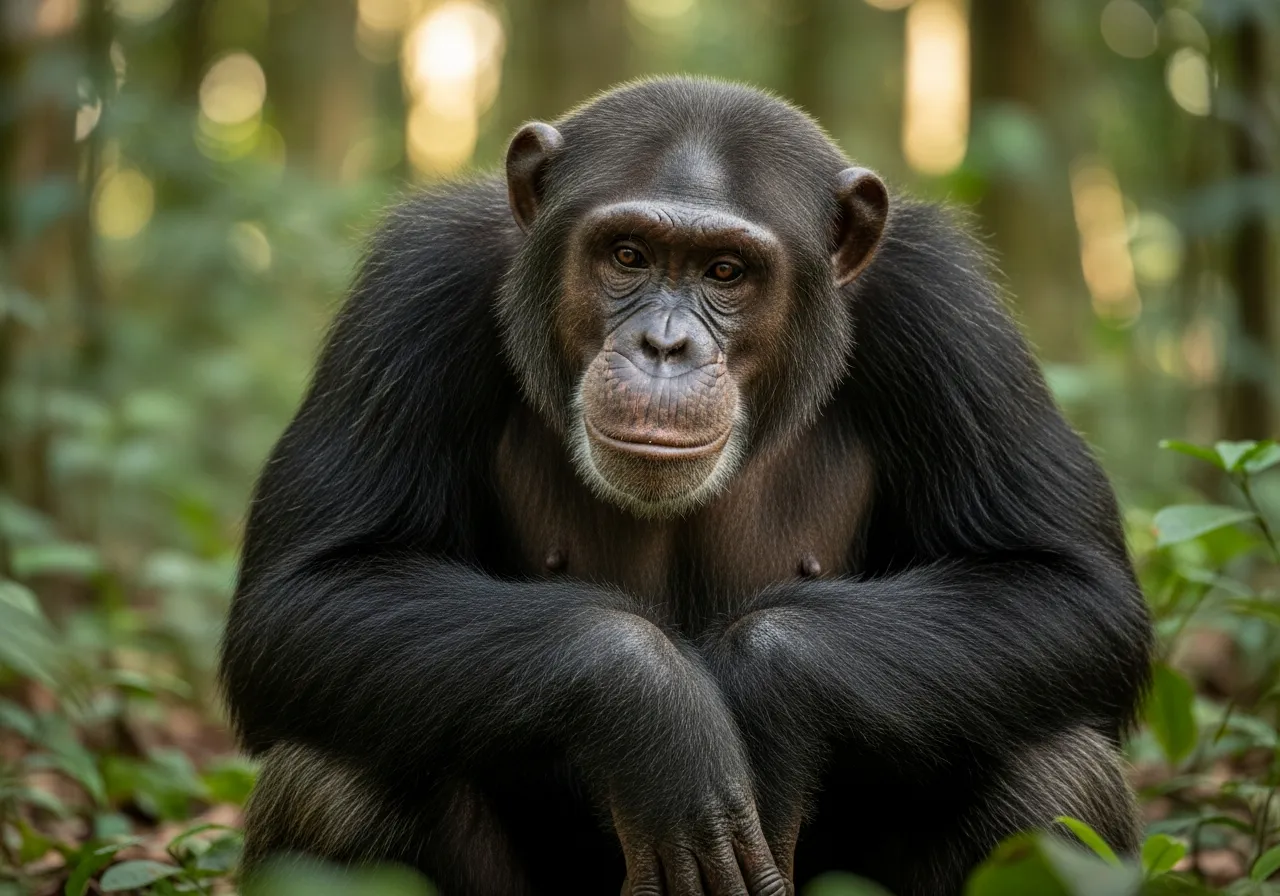
Source: Global Animal Guide (WARN)
In brief
A chimpanzee (Pan troglodytes) is a great ape from the forests and woodlands of equatorial Africa. Along with the bonobo, it is humans' closest living relative, sharing roughly 98-99% of our DNA. Famous for tool use, complex societies and culture, it is classified as Endangered.
Also in Animals A to Z · Animals that start with C
How you can help
You can support the related appeal — read its purpose, recipient status and fund terms first — or give once to where it is needed most. Sharing accurate information helps too.
By WARN Research & Conservation TeamLast updated
The chimpanzee (Pan troglodytes) is a great ape native to the forests and savanna woodlands of equatorial Africa. Together with the bonobo, it is our closest living relative, sharing an estimated 98-99% of its DNA with humans. Chimpanzees are renowned for their intelligence: they make and use tools, hunt cooperatively, pass learned behaviours between generations as local "cultures", and live in complex fission-fusion societies. Four subspecies are recognised across West, Central and East Africa. Classified as Endangered on the IUCN Red List and listed on CITES Appendix I, chimpanzees face mounting pressure from habitat loss, the bushmeat trade, disease and the illegal pet trade, and their numbers are falling.
~98.8%
DNA shared with humans
4
subspecies
50+
years lifespan in the wild
8
months gestation
Figures sourced from Chimpanzee - Wikipedia, IUCN Red List - Pan troglodytes, CITES - Appendices and other references on this page.
Chimpanzee: Quick Facts
| Scientific name | Pan troglodytes |
|---|---|
| Size (standing) | About 1-1.5 m tall |
| Weight | Males ~40 kg; females ~30 kg |
| Lifespan | 30-50+ years in the wild; older in captivity |
| Diet | Omnivore; mainly fruit, plus leaves, insects and some meat |
| Habitat | Rainforest, woodland and savanna of equatorial Africa |
| Range | West, Central and East Africa |
| Gestation | About 8 months; single infant |
| Group name | Community (or troop) |
| Subspecies | Four recognised |
Scientific Classification
| Kingdom | Animalia |
|---|---|
| Phylum | Chordata |
| Class | Mammalia |
| Order | Primates |
| Family | Hominidae |
| Genus | Pan |
| Species | Pan troglodytes |
Conservation Status
- IUCN Status
- Endangered on the IUCN Red List, with a decreasing population trend. Listed on CITES Appendix I, prohibiting commercial international trade. All four subspecies are threatened, and the Western chimpanzee (P. t. verus) is assessed as Critically Endangered.
- Population
- Roughly 170,000-300,000 across its range, though estimates are uncertain
- Trend
- Decreasing
- Assessed
- Assessed Endangered in the most recent IUCN Red List review
- CITES
- Appendix I
Habitat loss, the bushmeat trade, poaching, disease (including Ebola) and the illegal pet trade are driving declines. The species' slow reproduction makes recovery difficult, and its patchy distribution means local extinctions can erase unique cultural behaviours.
Did you know?
Chimpanzees in different regions have their own "cultures": one community may crack nuts with stone hammers while a neighbouring group, with the same nuts and stones available, never does, because the skill is learned socially and passed down rather than instinctive.
Key Facts: Chimpanzee
- Chimpanzees and bonobos are humans' closest living relatives, sharing roughly 98-99% of our DNA.
- They make and use tools, from termite-fishing sticks to nut-cracking stones, and pass these skills to their young.
- Chimpanzees live in fission-fusion communities that can exceed 100 members, splitting into smaller foraging parties.
- Four subspecies are recognised across West, Central and East Africa.
- They are classified as Endangered on the IUCN Red List and listed on CITES Appendix I, with numbers falling.
- Habitat loss, the bushmeat trade, poaching, disease and the illegal pet trade are their main threats.
What chimpanzees look like and where they live
Chimpanzees are robust, mostly black-haired great apes with bare faces, ears, hands and feet, and long, powerful arms suited to climbing and swinging through trees. Standing upright they reach about 1 to 1.5 metres tall; males typically weigh around 40 kg and females around 30 kg, with exceptional captive individuals heavier still. Their faces lighten or darken with age, and infants are born with a pale face and a tuft of white tail hair that fades over time. They walk on all fours using a distinctive knuckle-walking gait but stand and walk upright when carrying food or peering over vegetation. Chimpanzees range discontinuously across equatorial Africa, from Senegal in the west to Tanzania and Uganda in the east. They occupy a wide variety of habitats, including tropical rainforest, swamp forest, montane forest, woodland and dry savanna, provided there are fruiting trees and water. Each community defends a home range that it patrols and forages across, building fresh leafy sleeping nests in the trees each night.
Tool use, hunting and chimpanzee culture
Few animals rival the chimpanzee for behavioural complexity. Nearly every wild population studied uses tools, and different communities favour different techniques, a pattern scientists describe as culture because the behaviours are learned socially rather than inherited. Chimpanzees strip leaves from twigs to "fish" for termites and ants, crumple leaves into sponges to soak up drinking water, and in parts of West Africa use stone or wooden hammers and anvils to crack hard-shelled nuts, a skill that takes years to master. Some populations have even been seen sharpening sticks to jab at small prey. Diets are broad and largely plant-based, dominated by ripe fruit but including leaves, seeds, flowers, bark, insects and honey. Chimpanzees also hunt cooperatively, most famously pursuing red colobus monkeys, then sharing the meat in ways shaped by social bonds. Communication is rich, combining dozens of vocalisations such as the carrying pant-hoot with facial expressions, gestures and drumming on tree buttresses. These cultural traditions vary so much between sites that losing a population can mean losing unique behaviours forever.
Society, family life and reproduction
Chimpanzees live in multi-male, multi-female communities of roughly 15 to more than 150 individuals, organised around a fission-fusion structure: the whole community rarely gathers at once, instead splitting into smaller, ever-changing parties that forage and travel together before regrouping. Males usually remain in their birth community for life and form the core of a status hierarchy headed by an alpha male, whose position depends as much on alliances and grooming as on size or strength. Females often transfer to a new community as they mature, reducing inbreeding. Bonds are maintained through long bouts of social grooming, which calms tensions and reinforces relationships. Reproduction is slow, which makes population recovery difficult. After a gestation of about eight months a female gives birth to a single infant, which she carries, nurses and teaches for years; weaning occurs around three years of age and the interval between births is often four to six years. Youngsters learn foraging, tool use and social rules largely by watching their mothers and others. In the wild chimpanzees can live well past 40 and sometimes beyond 50 years, with some captive individuals reaching their sixties or older.
Chimpanzee vs bonobo: how our two closest relatives differ
| Feature | Chimpanzee (Pan troglodytes) | Bonobo (Pan paniscus) |
|---|---|---|
| Range | West, Central and East Africa, north of the Congo River | Only south of the Congo River, in the DR Congo |
| Build | Stockier, more robust | More slender, with longer legs |
| Society | Male-dominated hierarchies | More female-centred and egalitarian |
| Conflict | Hunts often; can show marked intercommunity aggression | Uses social and sexual behaviour to defuse tension |
| IUCN status | Endangered | Endangered |
What WARN Does
WARN does not currently run dedicated field projects for chimpanzees, which live outside the countries where WARN's partners work; this guide is part of WARN's free educational and awareness work to help people understand the species and the pressures it faces. The very threats that endanger chimpanzees, above all habitat loss alongside the wildlife trade, also harm the animals WARN does protect, which is why building public understanding of them matters.
If you value clear, science-based wildlife guides like this one, a small gift helps fund WARN's habitat and wildlife work for the animals in its care.
How can I help save the chimpanzee?
Explore practical ways to support the chimpanzee, from everyday choices and sharing reliable information to reviewing a related appeal before giving.
Explore ways to support
Read the related appeal’s purpose, recipient status and fund terms. Choose an affordable gift after checking what is proposed and what has been reported.
Ease the pressures
Avoid the wildlife trade and souvenirs, never buy wild animals as pets, and choose sustainable, habitat-friendly products — the threats behind the chimpanzee's decline fall when demand does.
Spread the word
Share accurate, sourced information about the chimpanzee. Wider awareness is what turns concern into lasting protection.
Chimpanzee: Frequently Asked Questions
How can I help save the chimpanzee?
Are chimpanzees endangered?
How much DNA do chimpanzees share with humans?
What do chimpanzees eat?
Do chimpanzees really use tools?
How long do chimpanzees live?
What is the difference between a chimpanzee and a bonobo?
Where do chimpanzees live?
Are chimpanzees dangerous?
How big is a chimpanzee?
Sources & References
Population figures, conservation status and biological facts on this page are drawn from authoritative scientific and intergovernmental sources.
Terms used on this page
Plain-English definitions, from our wildlife and conservation glossary.
Latest Chimpanzee Stories
Quick, fact-checked reads on the chimpanzee — amazing facts, key questions and the threats it faces.
Explore more animals
Discover more animals, their habitats and their conservation status in the WARN wildlife-guide library.