Wildlife Guide · Indonesia & Malaysia
Clouded Leopard
Neofelis nebulosa & Neofelis diardi
The forest ghost with a sabre-tooth's smile and an acrobat's ankles.
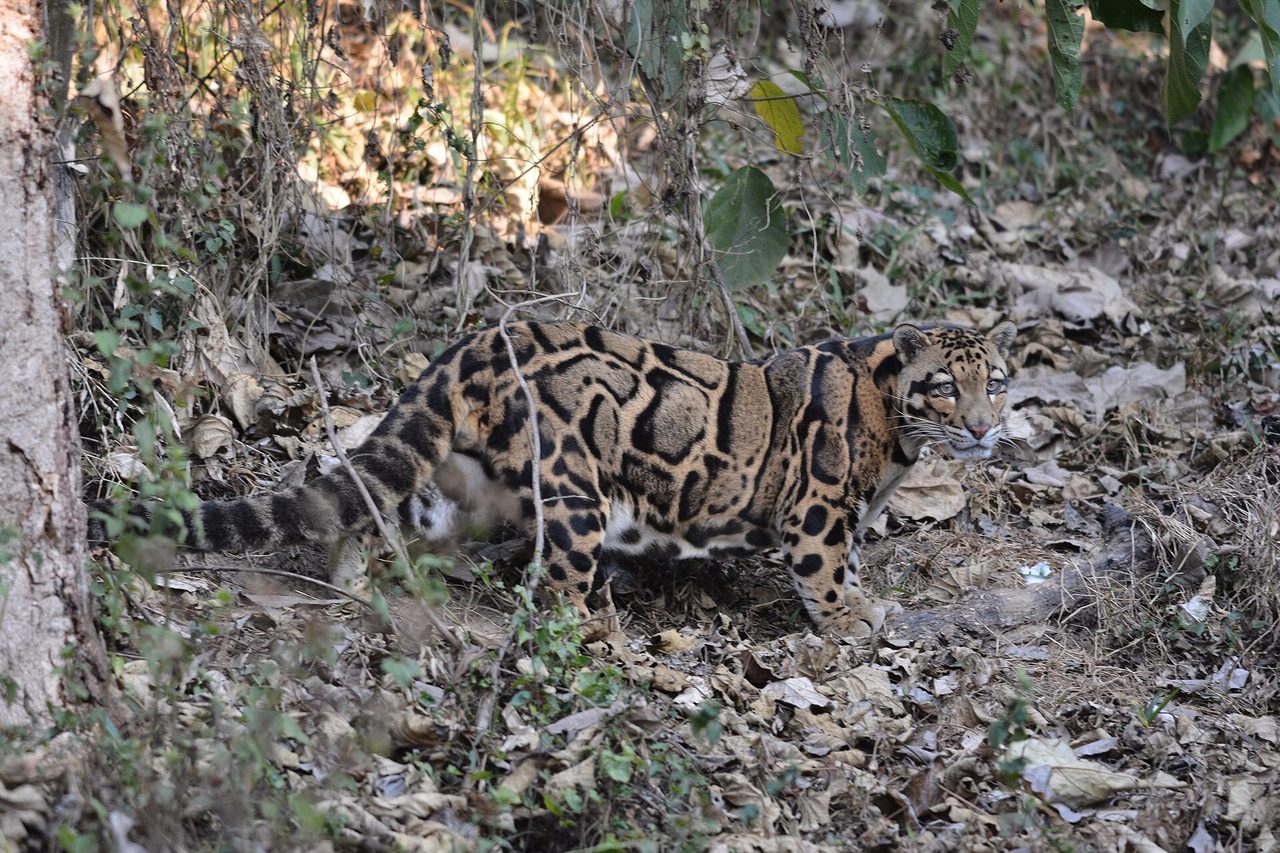
Photo: Dr. Raju Kasambe / Wikimedia Commons (CC BY-SA 4.0)
In brief
A clouded leopard is a medium-sized arboreal wild cat native to the forests of Asia, recognised by its cloud-shaped coat patches and famous for having the longest canine teeth relative to body size of any living cat; two species exist, the mainland (Neofelis nebulosa) and Sunda (Neofelis diardi) clouded leopards, both listed as Vulnerable.
Also in Animals A to Z · Animals that start with C
How you can help
You can support the related appeal — read its purpose, recipient status and fund terms first — or give once to where it is needed most. Sharing accurate information helps too.
By WARN Research & Conservation TeamLast updated
The clouded leopard is a mid-sized, tree-dwelling wild cat of Asia's forests, named for the smoky cloud-shaped markings on its coat. Two separate species are now recognised: the mainland clouded leopard (Neofelis nebulosa) and the Sunda clouded leopard (Neofelis diardi) of Borneo and Sumatra. Both are assessed as Vulnerable by the IUCN, with shrinking, fragmented populations driven down by forest loss and snaring.
4 cm
Canine teeth — longest of any cat for its size
180°
Ankle rotation, allowing headfirst tree descent
Vulnerable
IUCN status for both clouded leopard species
<10,000
Estimated mature Sunda clouded leopards
Figures sourced from IUCN Red List — Neofelis nebulosa (Clouded Leopard), IUCN Red List — Neofelis diardi (Sunda Clouded Leopard), IUCN Cat Specialist Group — Clouded Leopard and other references on this page.
Clouded Leopard: Quick Facts
| Lifespan | ~11 years typical in care; up to ~17 |
|---|---|
| Weight | 11.5–26 kg (25–57 lb) |
| Head-body length | ~69–108 cm, plus a tail nearly as long as the body |
| Diet | Carnivore — monkeys, deer, wild pigs, birds, small mammals |
| Gestation | ~85–110 days |
| Young per birth | 1–5 cubs, usually 2–3 |
| Baby name | Cub |
| Notable trait | Longest canines of any living cat for its size (~4 cm) |
| Climbing | Ankles rotate ~180°, enabling headfirst tree descent |
| CITES | Appendix I (both species) |
Scientific Classification
| Kingdom | Animalia |
|---|---|
| Phylum | Chordata |
| Class | Mammalia |
| Order | Carnivora |
| Family | Felidae |
| Subfamily | Pantherinae |
| Genus | Neofelis |
| Species | Neofelis nebulosa (Griffith, 1821) — mainland; and Neofelis diardi (Cuvier, 1823) — Sunda |
Conservation Status
- IUCN Status
- Vulnerable
- Population
- Mainland (N. nebulosa): ~3,700–5,580 mature individuals; Sunda (N. diardi): fewer than 10,000 mature individuals
- Trend
- Decreasing
- Assessed
- Mainland assessed 2021 (IUCN Red List 2022.2); Sunda assessed 2015
- CITES
- Appendix I (both species)
Both species are rated Vulnerable, but the two Sunda subspecies — Bornean (N. d. borneensis) and Sumatran (N. d. diardi) — are each assessed as Endangered. Estimates carry wide uncertainty because these cats are elusive and live at low densities.
Did you know?
Clouded leopards can climb down a tree trunk headfirst and even hang upside-down from a branch by their hind feet, thanks to ankle joints that rotate almost 180 degrees.
Key Facts: Clouded Leopard
- Two distinct species exist: the mainland clouded leopard (Neofelis nebulosa) and the Sunda clouded leopard (Neofelis diardi), split into separate species in the mid-2000s based on genetic and pelt differences.
- Relative to body size, clouded leopards have the longest canine teeth of any living cat — around 4 cm (about 2 inches) — earning them the nickname 'modern-day sabre-tooth'.
- They are among the most arboreal of cats: rotating ankle joints let them climb down trees headfirst and even hang from branches by their hind feet.
- Both species are assessed as Vulnerable by the IUCN with decreasing populations; the mainland species is estimated at roughly 3,700–5,580 mature individuals.
- the Sunda clouded leopard occurs in Indonesia (Borneo and Sumatra) and Malaysia (Borneo), where oil-palm-driven deforestation is a leading threat.
- Both species are listed on CITES Appendix I, banning commercial international trade, yet illegal hunting for skins, teeth and bones continues.
Two species, one cloud-patterned cat
For most of the 20th century all clouded leopards were treated as a single species. Genetic and morphological studies in the mid-2000s showed that the island populations of Borneo and Sumatra were distinct enough to be recognised as a separate species, Neofelis diardi, the Sunda clouded leopard, leaving the mainland populations as Neofelis nebulosa. The two look similar but differ in detail: mainland cats tend to have larger, paler cloud markings with fewer interior spots, while Sunda cats are darker with smaller, more densely spotted clouds. The Sunda species is itself divided into two subspecies, the Bornean (N. d. borneensis) and Sumatran (N. d. diardi) clouded leopards, both of which the IUCN has assessed as Endangered even though the species overall is rated Vulnerable.
Built for the canopy
Clouded leopards are arguably the most accomplished tree-climbers among the wild cats. They have short, powerful legs, broad paws and exceptionally flexible ankle joints that can rotate roughly 180 degrees, letting them descend trunks headfirst, run along the undersides of branches and hang by their hind feet. A tail almost as long as the body acts as a balancing pole. Their most striking feature is dental: their upper canines are the longest of any living cat relative to skull and body size, reaching about 4 cm, which has led scientists to compare them loosely to the extinct sabre-toothed cats. They are largely nocturnal and secretive, hunting birds, monkeys, deer, wild pigs and small mammals both in the trees and on the ground.
Why they are threatened
Both clouded leopard species are in decline, and the IUCN infers a population reduction of more than 30 percent across recent generations for the mainland species. The dominant pressures are habitat loss and fragmentation — Southeast Asia has some of the world's fastest rates of forest clearance, much of it for oil-palm and other plantations — together with hunting. Clouded leopards are killed deliberately for their distinctively patterned skins, teeth and bones, which feed illegal wildlife markets and traditional medicine, and are caught incidentally in the wire snares set across their range for other animals. Because they are elusive and live at low densities, reliable range-wide population counts are difficult, and estimates carry wide uncertainty.
What rescue and protection involve
Protecting clouded leopards is mostly about protecting forest and stopping snaring rather than hands-on animal rescue, because wild individuals are rarely seen. Practical work in their range includes anti-poaching and snare-removal patrols, camera-trap monitoring to track where cats survive, securing and connecting protected forest blocks, and caring for cubs and adults confiscated from the illegal pet and skin trade. In Indonesia and Malaysia, this depends on locally based ranger teams, wildlife rescue centres and sanctuaries that can respond to seizures and rehabilitate animals where possible.
Mainland vs Sunda clouded leopard
| Feature | Mainland (Neofelis nebulosa) | Sunda (Neofelis diardi) |
|---|---|---|
| Range | Mainland Asia: Himalayas to Indochina and Peninsular Malaysia | Islands of Borneo and Sumatra |
| Coat pattern | Larger, paler cloud blotches with few inner spots | Smaller, darker clouds with many inner spots |
| IUCN status | Vulnerable (2021) | Vulnerable (2015); both subspecies Endangered |
| Population estimate | ~3,700–5,580 mature individuals | Fewer than 10,000 mature individuals |
| CITES | Appendix I | Appendix I |
| WARN range overlap | No grant relationship established by this comparison | Indonesia and Malaysia; see the appeal for any grant status |
What WARN Does
WARN publishes this guide for education and is developing support through assessed animal-welfare grants. A species range, source citation or photograph does not establish a recipient or funding agreement. Check /about/where-your-money-goes/#grant-register for published grant and payment records; records not yet published must not be read as zero activity. Browse /appeals/ for the purposes currently available to support.
A gift to WARN helps fund the local Indonesian and Malaysian partners working to keep Borneo's and Sumatra's forests standing and snare-free — the difference between a future with the Sunda clouded leopard and one without.
How can I help save the clouded leopard?
Explore practical ways to support the clouded leopard, from everyday choices and sharing reliable information to reviewing a related appeal before giving.
Explore ways to support
Read the related appeal’s purpose, recipient status and fund terms. Choose an affordable gift after checking what is proposed and what has been reported.
Ease the pressures
Avoid the wildlife trade and souvenirs, never buy wild animals as pets, and choose sustainable, habitat-friendly products — the threats behind the clouded leopard's decline fall when demand does.
Spread the word
Share accurate, sourced information about the clouded leopard. Wider awareness is what turns concern into lasting protection.
Clouded Leopard: Frequently Asked Questions
How can I help save the clouded leopard?
How long do clouded leopards live?
What do clouded leopards eat?
How big is a clouded leopard?
Are clouded leopards dangerous to humans?
How many clouded leopards are left?
Why are clouded leopards endangered?
What is a baby clouded leopard called?
Where do clouded leopards live?
Sources & References
Population figures, conservation status and biological facts on this page are drawn from authoritative scientific and intergovernmental sources.
- IUCN Red List — Neofelis nebulosa (Clouded Leopard)
- IUCN Red List — Neofelis diardi (Sunda Clouded Leopard)
- IUCN Cat Specialist Group — Clouded Leopard
- IUCN Cat Specialist Group — Sunda Clouded Leopard
- Smithsonian's National Zoo & Conservation Biology Institute — Clouded Leopard
- CITES Appendices (Felidae)
- Animal Diversity Web — Neofelis nebulosa
Terms used on this page
Plain-English definitions, from our wildlife and conservation glossary.
Latest Clouded Leopard Stories
Quick, fact-checked reads on the clouded leopard — amazing facts, key questions and the threats it faces.
Species
12 Amazing Facts About the Clouded Leopard, the Forest's Acrobat Cat
From sabre-tooth-style canines to ankles that swivel 180 degrees, here are 12 original, sourced facts about the clouded leopard, one of Asia's most elusive wild cats.
Read the storySpecies
Clouded Leopard vs Snow Leopard: Key Differences Between Two Misnamed Cats
Despite the shared name, neither cat is a true leopard, and they differ sharply in size, habitat and looks. Here is how to tell the clouded leopard from the snow leopard.
Read the storySpecies
How Big, Strong and Acrobatic Is a Clouded Leopard? The Numbers Explained
Clouded leopards weigh about 11.5–26 kg, carry the longest canines of any living cat for their size, and own ankles that swivel 180 degrees. Here are the real figures.
Read the storyExplore more animals
Discover more animals, their habitats and their conservation status in the WARN wildlife-guide library.