Wildlife Guide · North America & Central America
Coyote
Canis latrans
North America's most adaptable wild canid — thriving from Arctic tundra to city parks
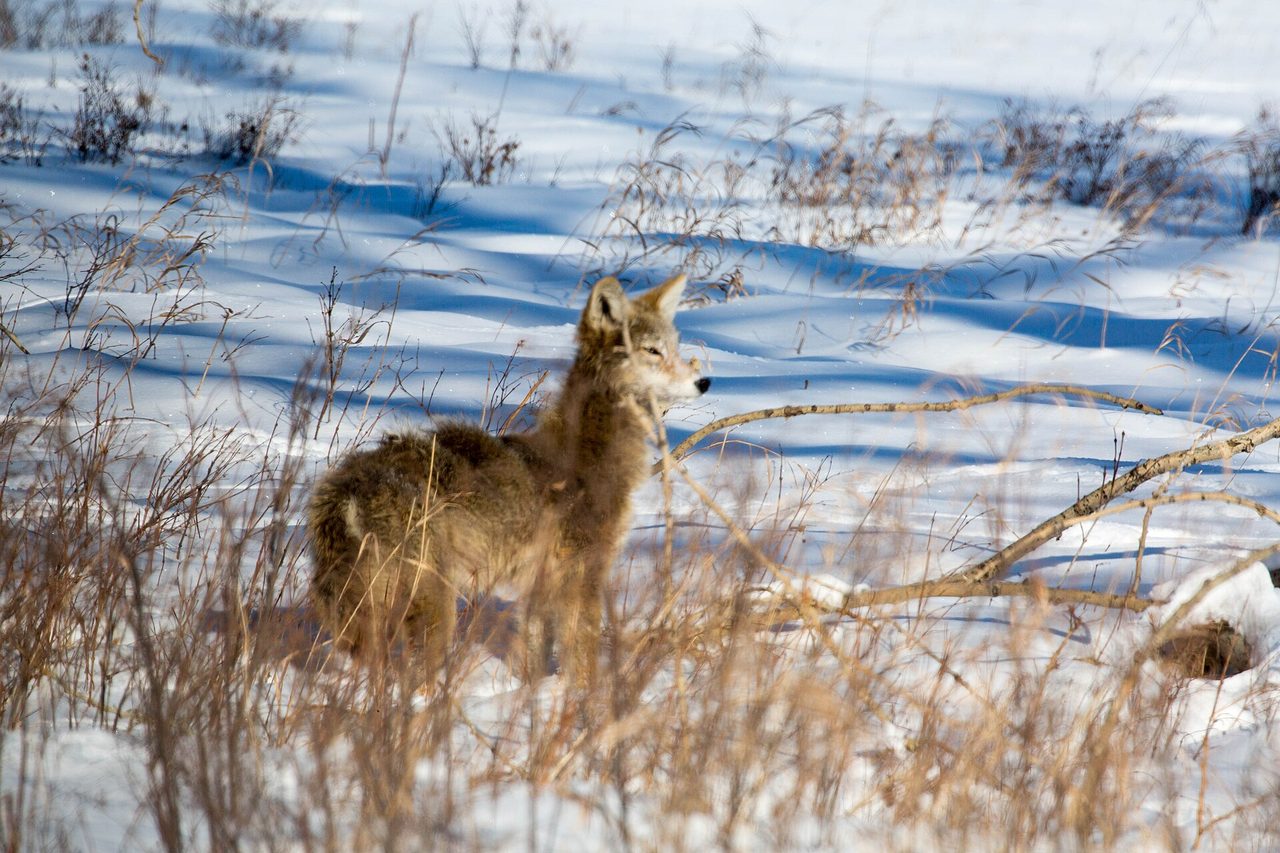
Photo: David A Mitchell / Wikimedia Commons (CC BY 2.0)
In brief
The coyote (Canis latrans) is a highly adaptable wild canid found across North and Central America — from Alaska to Panama — where it plays a vital role controlling rodent populations and is classified as Least Concern by the IUCN with a stable and expanding population.
Also in Animals A to Z · Animals that start with C
By WARN Research & Conservation TeamLast updated
The coyote (Canis latrans) is a medium-sized wild canid native to North and Central America, whose scientific name translates from Latin as "barking dog" — a nod to its extraordinary vocal repertoire of howls, yips, and barks. Smaller than a gray wolf but far more flexible in its habits, the coyote has quietly become the continent's great wildlife success story of the past century, expanding from its original western plains heartland into every U.S. state except Hawaii, across Canada, and south to Panama. This omnivore thrives in deserts, forests, mountains, farmland, suburban parks, and dense city neighbourhoods alike, filling an outsized ecological role as a regulator of rodent populations and a recycler of carrion. Reviled and persecuted for generations, the coyote nonetheless continues to flourish, making it one of the most studied and debated animals in North America.
~500,000
Killed per year in the US
64 km/h
Top running speed
19
Recognised subspecies
40%+
Range expansion since 1900
Figures sourced from IUCN Red List — Canis latrans assessment, Animal Diversity Web — Canis latrans, Urban Coyote Research — North American Distribution and other references on this page.
Coyote: Quick Facts
| Body weight | 7–20 kg (15–44 lb) |
|---|---|
| Body length | 1.0–1.35 m including tail |
| Top speed | 64 km/h (40 mph) |
| Lifespan (wild) | 5–6 years typical; up to 12 years |
| Litter size | Average 6 pups; range 1–19 |
| Gestation | 60–63 days |
| Diet | Omnivore — rodents, rabbits, fruit, carrion, insects |
| Subspecies | 19 recognised |
Scientific Classification
| Kingdom | Animalia |
|---|---|
| Phylum | Chordata |
| Class | Mammalia |
| Order | Carnivora |
| Family | Canidae |
| Genus | Canis |
| Species | Canis latrans Say, 1823 |
Conservation Status
- IUCN Status
- Least Concern
- Population
- Estimated 1–10 million across North America; over 2.8–4.7 million in the US alone
- Trend
- Increasing
- Assessed
- 2018
- CITES
- Not listed
Despite approximately 500,000 being killed annually in the United States through government culling and recreational hunting, coyote populations continue to grow and expand, demonstrating strong compensatory reproduction in response to persecution.
Did you know?
A family of coyotes howling together can sound like a dozen animals through rapid overlapping calls — an acoustic trick that may bluff rival packs into thinking a territory is more heavily defended than it actually is.
Key Facts: Coyote
- Coyotes have expanded their range by more than 40% since 1900, colonising every U.S. state except Hawaii and reaching as far south as Panama.
- Their scientific name, Canis latrans, means 'barking dog' — a reference to their rich vocabulary of howls, yips, barks, and whines used to defend territory and maintain family bonds.
- Eastern coyotes carry wolf and domestic dog DNA from historic hybridisation, making them larger and better suited to forested and urban landscapes than their western counterparts.
- Coyotes suppress rodent and rabbit populations, reducing crop damage and the spread of tick-borne and rodent-borne diseases — providing significant economic and public-health benefits.
- Despite half a million being killed annually in the United States through trapping, shooting, and poisoning, populations remain robust because coyotes respond to persecution by producing larger litters.
- Coyotes are among the few large carnivores to thrive in megacities; stable urban populations have been documented in Chicago, Los Angeles, New York, and dozens of other major metropolitan areas.
What is a coyote?
The coyote (Canis latrans) belongs to the family Canidae and is one of North America's most recognisable wild mammals. Adults typically weigh between 7 and 20 kg (15–44 lb), with males slightly heavier than females and northern subspecies considerably larger than their southern counterparts. Body length ranges from about 1.0 to 1.35 metres including a distinctive bushy, black-tipped tail that is held low when running — a reliable field mark separating coyotes from dogs. Their coat is a blend of grey, buff, and russet tones with a pale underside, and their faces are narrow and fox-like, with large erect ears, a slender muzzle, and striking yellow eyes. Nineteen subspecies are currently recognised, varying in size, coat colour, and genetic make-up across their vast range. The so-called 'eastern coyote' — sometimes nicknamed 'coywolf' — is the result of historic hybridisation with grey wolves and domestic dogs as coyotes colonised the north-east, leaving eastern populations approximately 64% coyote, 26% wolf, and 10% domestic dog by ancestry. This hybrid vigour has given eastern coyotes longer legs, larger jaws, and a greater capacity to prey on white-tailed deer, broadening their ecological role in forested and suburban landscapes.
Where do coyotes live?
Coyotes occupy one of the broadest and most ecologically diverse ranges of any wild canid on Earth. Historically centred on the grasslands and shrublands of western North America, the species has expanded dramatically since the early 20th century as forests were cleared, wolves were extirpated, and human settlements provided new food sources. Today coyotes are found from the boreal forests of Alaska and northern Canada south through the United States and Mexico to the tropical forests of Panama — a latitudinal span of roughly 8°N to 70°N. Within that range they occupy deserts, prairies, temperate rainforests, alpine meadows, agricultural land, suburban neighbourhoods, and the hearts of major cities. They are supremely habitat-generalist, requiring only sufficient food, water, and cover for denning. In urban environments, coyotes tend to shift their activity towards night, using parks, golf courses, railway corridors, and river greenways as movement routes. Population densities in wolf-occupied territories are typically 40–65% lower than in wolf-free areas, confirming that wolves suppress coyote numbers through direct predation and competition — a dynamic well-documented in Yellowstone National Park since wolf reintroduction in 1995.
What do coyotes eat and how do they hunt?
Coyotes are highly opportunistic omnivores whose diet shifts with season, region, and prey availability. Across most of their range, small mammals — eastern cottontail rabbits, ground squirrels, voles, and mice — form the dietary backbone, comprising up to 90% of intake during spring and summer. In autumn, fruit, berries, insects, and other plant matter can account for more than half the diet, an unusual flexibility among wild canids. Coyotes also consume carrion, birds, amphibians, reptiles, fish, and, in suburban and urban settings, human food waste and outdoor pet food. Hunting strategy is equally flexible. Solitary coyotes stalk and pounce on rodents in a manner reminiscent of foxes; mated pairs co-operate to flush and pursue jackrabbits; and family groups or loose packs may relay-chase white-tailed deer until exhaustion. The 'bounce pounce' used to pin rodents beneath deep snow is an iconic behaviour shared with red foxes and reinforces how thoroughly coyotes have exploited the ecological niches left vacant across a continent that has lost many of its apex predators. By suppressing rodent populations, coyotes indirectly benefit bird communities, reduce agricultural crop losses, and help limit the prevalence of rodent-borne diseases including hantavirus and plague.
How do coyotes communicate and reproduce?
The coyote's complex vocal communication is among the most studied in North American wildlife. Their signature sound — a high-pitched howl followed by a cascade of yips — carries over kilometres of open country and functions primarily to advertise territorial boundaries and maintain contact between family members. Pairs and packs produce 'group yip-howls' that increase in apparent number through rapid overlapping calls, a phenomenon sometimes called the 'beau geste effect', which may deter rival packs without revealing true group size. Coyotes also use whines, growls, huffs, and barks in close-range social interaction. Mating occurs between January and March. Pairs are largely monogamous within a breeding season and often reunite across multiple years. After a gestation of 60–63 days, females give birth to litters averaging 6 pups, though litter size is famously responsive to population pressure: when coyote numbers are reduced through culling, females produce larger litters and pups disperse earlier — an evolutionary counter-response that has made lethal control largely ineffective at reducing populations over the long term. Pups emerge from the den at around 3 weeks and are weaned by 5–7 weeks; both parents and sometimes 'helper' offspring from prior years provision and guard them. Young coyotes typically disperse at 6–9 months, with some travelling more than 160 km to establish new territories.
Why are coyotes persecuted and why do they keep thriving?
Since European colonisation of North America, coyotes have been viewed with suspicion and targeted by farmers, ranchers, and government agencies concerned about livestock depredation and, more recently, by urban residents anxious about pet safety. The United States federal programme that became Wildlife Services kills an estimated 400,000–500,000 coyotes annually through trapping, aerial gunning, and poisoning; additional thousands are taken in recreational hunting and fur trapping. Yet North American coyote populations have not declined — they have grown. The biological reason is a density-dependent reproductive rebound: when local populations are reduced, coyotes produce larger litters (documented up to 19 pups), more females breed, and pups disperse quickly to fill empty territories, often within weeks. This compensatory reproduction means that lethal control rarely achieves sustained population reduction. Ecologists increasingly argue that non-lethal coexistence strategies — livestock guardian animals, secure food storage, hazing — are more effective long-term management tools. The coyote's success also reflects genuine adaptability: omnivory, habitat flexibility, tolerance of human proximity, and a social structure that scales from solitary individuals to extended family groups all contribute to a resilience unmatched among North American carnivores. The species stands as a compelling case study in how wildlife can persist — and even prosper — in the face of intense human pressure.
What WARN Does
WARN does not currently run field projects for the coyote, as our conservation partnerships are focused in its partner-network countries. This guide is offered as free educational content because understanding how resilient species like the coyote navigate human-dominated landscapes provides valuable lessons for wildlife coexistence worldwide. Supporting WARN's habitat-protection work in our partner countries helps preserve the intact ecosystems that all wild carnivores — including relatives of the coyote — depend upon.
Wild carnivores like the coyote remind us how resilient nature can be when given a chance. Every donation to WARN helps protect the habitats in our partner countries where less adaptable species — big cats, primates, forest birds — are fighting for survival without the coyote's advantages.
Coyote: Frequently Asked Questions
Is the coyote endangered?
Are coyotes dangerous to humans?
What is the difference between a coyote and a wolf?
What is a coywolf?
Why do coyotes howl?
Do coyotes help the ecosystem?
What do coyotes eat?
Where do coyotes live?
How long do coyotes live?
How big is a coyote?
Sources & References
Population figures, conservation status and biological facts on this page are drawn from authoritative scientific and intergovernmental sources.
- IUCN Red List — Canis latrans assessment
- Animal Diversity Web — Canis latrans
- Urban Coyote Research — North American Distribution
- NCBI — Range expansion genetics of eastern coyote
- NCBI — Mapping coyote expansion across North and Central America
- Wildlife Society — Wolves and coyotes play different ecosystem roles
Terms used on this page
Plain-English definitions, from our wildlife and conservation glossary.
Latest Coyote Stories
Quick, fact-checked reads on the coyote — amazing facts, key questions and the threats it faces.
Species
11 Amazing Facts About the Harpy Eagle, the Rainforest's Apex Raptor
From talons as long as a grizzly bear's claws to a single chick every two to three years, here are 11 fact-checked things that make the Harpy Eagle the most powerful bird of prey in the Americas.
Read the storySpecies
12 Amazing Facts About Grey Wolves (And Why Alpha Wolves Aren't Real)
A howl that carries 16 km, a pack that is really a family, and the debunked study behind the 'alpha wolf' myth. Twelve verified facts.
Read the storySpecies
12 Amazing Facts About Axolotls (They Regrow Their Own Brains)
Limb, spinal cord and partial brain regeneration, permanent larval form, and near-extinction in the wild. Twelve facts.
Read the storyExplore more animals
Discover more animals, their habitats and their conservation status in the WARN wildlife-guide library.