Wildlife Guide · Oceans worldwide & Coastlines and estuaries
Crab
Infraorder Brachyura
Ten-legged, sideways-walking crustaceans found in nearly every watery habitat on Earth.
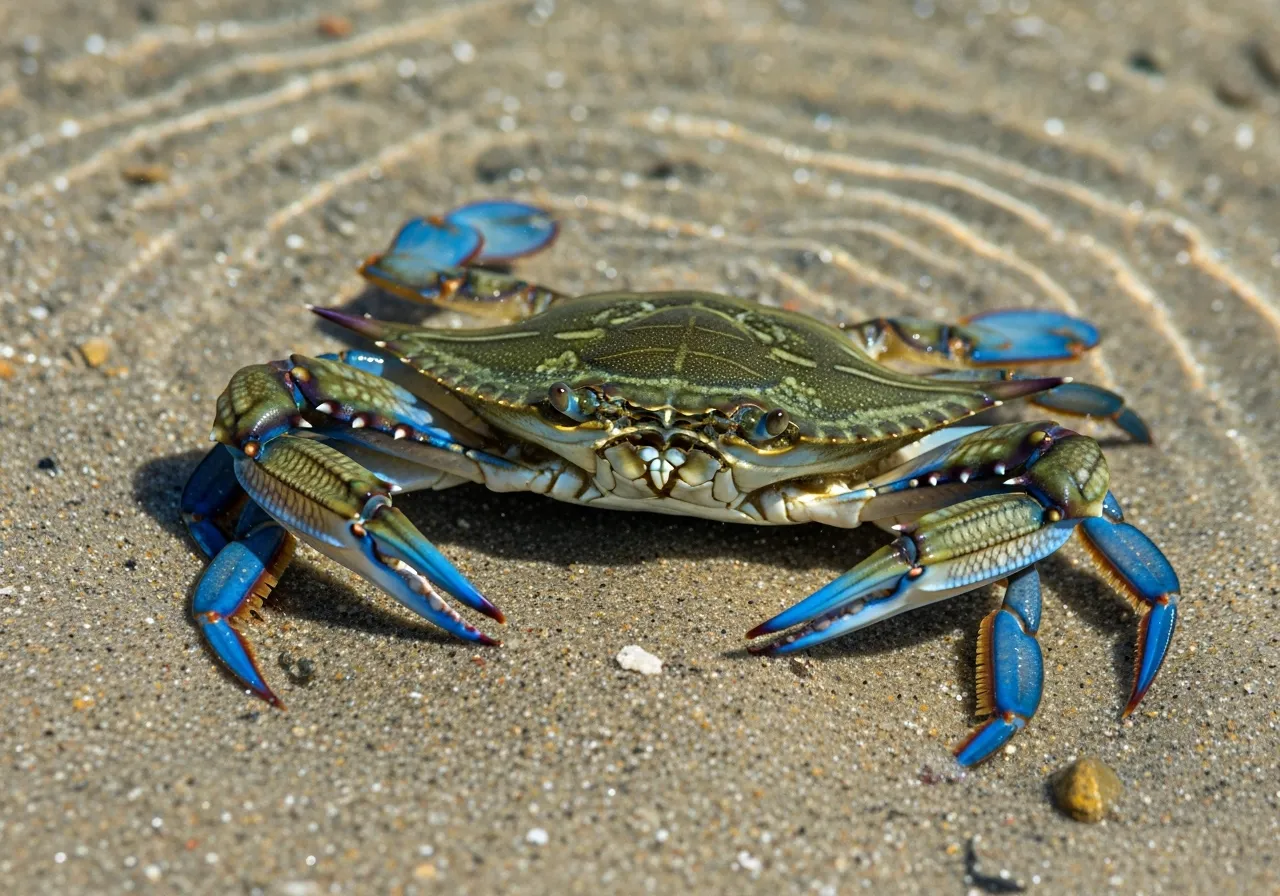
Source: Global Animal Guide (WARN)
In brief
A crab is a ten-legged crustacean of the infraorder Brachyura, with a hard exoskeleton, a short broad body, a pair of front pincers and a sideways walk. About 7,000 species live in the oceans, in fresh water and on land worldwide.
Also in Animals A to Z · Animals that start with C
By WARN Research & Conservation TeamLast updated
Crabs are decapod crustaceans of the infraorder Brachyura, a hugely successful group of roughly 7,000 species. They are instantly recognisable by a short, broad body protected by a hard exoskeleton, a pair of clawed front legs called chelae, and a characteristic sideways scuttle. Crabs live almost everywhere there is water: across the world's oceans from shallow rock pools to the deep sea, in fresh water, and even on land in tropical forests. Most "true" crabs share a folded tail tucked beneath the body, distinguishing them from look-alikes such as hermit and porcelain crabs. As scavengers, grazers and predators, they are vital recyclers and prey throughout aquatic food webs.
~7,000
species of true crab
10
legs (front pair are pincers)
All oceans + land
habitats colonised
Sideways
their signature walk
Figures sourced from Crab — Wikipedia, Brachyura — Wikipedia, Crab — Encyclopaedia Britannica and other references on this page.
Crab: Quick Facts
| Common name | Crab (true crab) |
|---|---|
| Group | Infraorder Brachyura |
| Type | Decapod crustacean |
| Number of species | About 7,000 |
| Legs | 10 (front pair are pincers) |
| Body covering | Hard exoskeleton (carapace) |
| Growth | By moulting the shell |
| Movement | Typically walks sideways |
| Habitats | Oceans, fresh water, land |
| Diet | Mostly omnivorous scavengers |
Scientific Classification
| Kingdom | Animalia |
|---|---|
| Phylum | Arthropoda |
| Subphylum | Crustacea |
| Class | Malacostraca |
| Order | Decapoda |
| Infraorder | Brachyura (true crabs) |
| Species | ~7,000 described |
Conservation Status
- IUCN Status
- Crabs are a vast group of roughly 7,000 species, and the IUCN Red List has assessed only a fraction of them. Most crab species are therefore listed as Not Evaluated, meaning their conservation status is unknown rather than secure. Many widespread marine and coastal crabs are common, while some freshwater and narrow-range island species face real threats from habitat loss and pollution.
- Population
- Unknown; varies enormously by species, with many common and abundant
- Trend
- Unknown overall; declining for some range-restricted freshwater and island species
- Assessed
- Varies by species (most not assessed)
- CITES
- Not broadly listed; true crabs are generally not on CITES appendices
Because most crab species have never been formally assessed, statements about crabs in general should be treated qualitatively rather than as precise figures.
Key Facts: Crab
- Crabs are decapod crustaceans of the infraorder Brachyura, with about 7,000 known species.
- They have ten legs in total; the front pair are modified into pincers (chelae) for feeding and defence.
- A hard exoskeleton protects the body, and crabs must moult it periodically to grow.
- Their sideways walk comes from the way their legs bend at the joints.
- Crabs live in oceans, fresh water and on land, from shallow shores to the deep sea.
- Most crab species have never been formally assessed by the IUCN, so their conservation status is largely unknown.
What makes a crab a crab?
Crabs belong to the infraorder Brachyura, a name meaning "short tail" that points to their defining feature. Unlike lobsters or shrimp, a true crab's abdomen is small and folded tightly underneath the body, hidden beneath a broad, flattened shell called the carapace. Like all decapods, crabs have ten legs. The rearmost four pairs are used mainly for walking, while the front pair is enlarged into chelae, or pincers, used to grasp food, fight, dig and signal to other crabs. The hard outer exoskeleton is made largely of chitin reinforced with minerals, giving crabs their armoured appearance. Because this shell cannot stretch, a crab grows by moulting: it sheds the old casing and emerges soft and vulnerable, then takes in water to swell before the new shell hardens. Crabs sense the world through two stalked compound eyes, a pair of antennae and fine sensory hairs. Many look-alikes, including hermit crabs, porcelain crabs and horseshoe crabs, are not true Brachyura at all, despite sharing the name.
Why do crabs walk sideways?
The sideways scuttle is one of the most familiar things about crabs, and it comes down to anatomy. A crab's legs are jointed so that they bend outward to the sides rather than forward and back, the way ours do. Pushing off in a sideways direction lets a crab move quickly and efficiently across sand, rock and seabed without its legs tangling, while keeping its broad body low and stable. Walking sideways also presents the narrower edge of the body to the direction of travel, which can help when squeezing between rocks or into crevices. That said, the rule is not absolute. Some crabs can walk forwards or backwards when needed, and certain swimming crabs have flattened, paddle-like rear legs that let them propel themselves through open water. Spider crabs and others amble more slowly in any direction. The sideways gait is best understood as the most natural and rapid movement for a typical broad-bodied crab, rather than the only one available to it.
Where do crabs live and what do they eat?
Crabs are extraordinarily adaptable and have colonised an enormous range of habitats. The majority are marine, found from intertidal rock pools and sandy beaches down to coral reefs and the cold, dark deep sea. Others thrive in brackish estuaries and mangroves, while true freshwater crabs live in rivers, streams and lakes across the tropics and subtropics. Some species are largely terrestrial: land crabs and robber crabs roam tropical forests and shorelines, returning to water mainly to breed, and famous mass migrations see millions move between forest and sea. Most crabs are omnivorous opportunists. They scavenge dead plants and animals, graze on algae, sift detritus and hunt smaller creatures such as molluscs, worms and other crustaceans, using their pincers to tear and manipulate food. This broad diet makes crabs important recyclers, cleaning up organic matter and turning over sediment. In turn they are eaten by fish, birds, octopuses, mammals and people, giving them a central place in many food webs.
True crab vs hermit crab
| Feature | True crab (Brachyura) | Hermit crab |
|---|---|---|
| Group | Infraorder Brachyura | Superfamily Paguroidea |
| Abdomen | Short, hard, folded under body | Soft, curled, often unprotected |
| Shell | Own hard carapace | Borrows empty snail shells |
| A true crab? | Yes | No |
| Movement | Usually sideways | Drags borrowed shell along |
What WARN Does
World Animal Rescue Network does not run field projects specifically for crabs, which live far beyond the countries where WARN's partners work and are mostly outside its rescue remit. This guide is part of WARN's free educational work, helping people understand the wildlife that shares our planet. The threats that affect crabs, such as habitat loss, coastal pollution and overharvesting, are the same pressures that harm the animals WARN does protect, so learning about one corner of the natural world supports care for all of it.
If this guide deepened your wonder at the natural world, a small gift helps keep WARN's educational work free and its rescue work going.
Crab: Frequently Asked Questions
How many legs does a crab have?
Why do crabs walk sideways?
How do crabs grow if they have a hard shell?
Are hermit crabs and horseshoe crabs real crabs?
What do crabs eat?
Where do crabs live?
Are crabs dangerous?
How big is a crab?
How long do crabs live?
Sources & References
Population figures, conservation status and biological facts on this page are drawn from authoritative scientific and intergovernmental sources.
Terms used on this page
Plain-English definitions, from our wildlife and conservation glossary.
Latest Crab Stories
Quick, fact-checked reads on the crab — amazing facts, key questions and the threats it faces.
Species
12 Amazing Facts About the Humpback Whale, the Ocean's Great Singer
From hours-long songs that only males sing to flippers longer than any other whale, here are 12 genuinely surprising facts about the humpback whale.
Read the storySpecies
How Big Is a Humpback Whale? Size, Weight and Strength Explained
Humpback whales reach 14 to 16 metres and weigh up to 30 tonnes, with the longest flippers of any whale. Here's how their size, weight and power really compare.
Read the storySpecies
Humpback Whale vs Blue Whale: 6 Key Differences and How to Tell Them Apart
Both are great whales, but the humpback and the blue whale differ in size, shape, flippers, behaviour and conservation status. Here's how to tell them apart.
Read the storyExplore more animals
Discover more animals, their habitats and their conservation status in the WARN wildlife-guide library.