Wildlife Guide · Worldwide
Deer
Cervidae
The world's antlered ruminants, from common woodland deer to species that survive only in captivity.
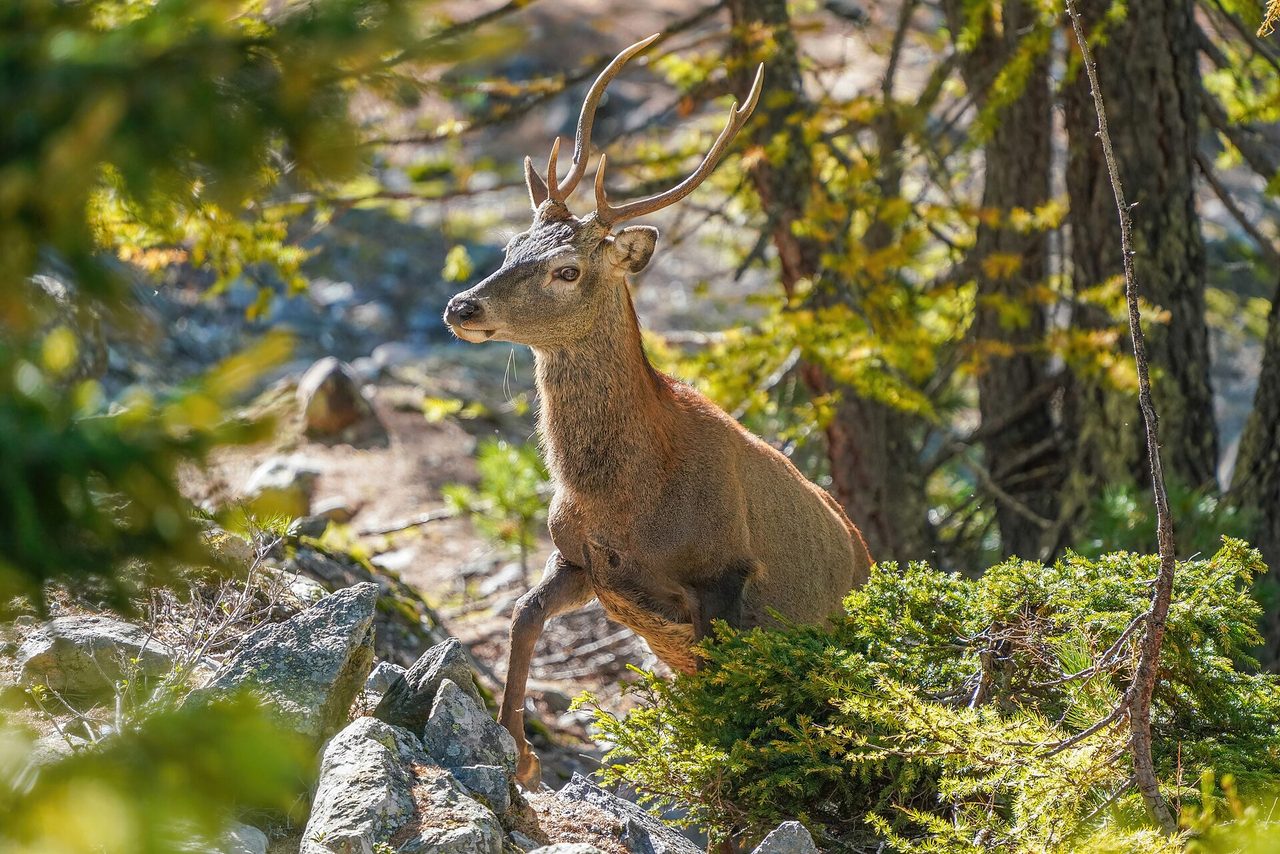
Photo: Giles Laurent / Wikimedia Commons (CC BY-SA 4.0)
In brief
Deer are antlered, hoofed ruminant mammals of the family Cervidae, comprising about 50 species worldwide; most are Least Concern, but several, including Père David's deer (Extinct in the Wild) and the hog deer, are threatened.
Also in Animals A to Z · Animals that start with D
By WARN Research & Conservation TeamLast updated
Deer are hoofed, plant-eating mammals that make up the family Cervidae, with roughly 50 living species spread across nearly every continent except Antarctica and Australia (where some have been introduced). Their defining feature is antlers: bony structures that grow on the heads of males in almost every species, are shed each year, and regrow from scratch the following season. Deer range from the tiny Southern pudu, barely the size of a small dog, to the towering moose. While many familiar deer such as the white-tailed deer and red deer are abundant, the family also includes some of the world's most threatened mammals, making "deer" a single name covering very different conservation stories.
~50
living species in the family Cervidae
Annually
antlers are shed and regrown each year
~30 mph
top running speed of many deer (≈48 km/h)
~200 days
typical gestation in white-tailed deer
Figures sourced from Wikipedia: Deer, IUCN Red List: White-tailed Deer (Odocoileus virginianus), Wikipedia: Père David's deer and other references on this page.
Deer: Quick Facts
| Lifespan | Commonly 6–14 years in the wild; up to about 20 years in captivity (varies by species) |
|---|---|
| Weight | From ~9 kg (Southern pudu) to over 600 kg (moose) |
| Size | Shoulder height roughly 35 cm (pudu) to 2 m (moose) |
| Diet | Herbivore; browses and grazes on leaves, shoots, grasses, fruit and bark |
| Gestation | About 200 days in white-tailed deer; roughly 6.5–9.5 months across species |
| Young | Usually 1–2 per birth (twins common in well-fed does) |
| Baby name | Fawn (or calf in larger species) |
| Group name | Herd |
| Top speed | Around 30 mph (≈48 km/h) in many species |
| CITES | Several species listed (e.g. Père David's deer and hog deer); most are not |
Scientific Classification
| Kingdom | Animalia |
|---|---|
| Phylum | Chordata |
| Class | Mammalia |
| Order | Artiodactyla |
| Family | Cervidae |
| Subfamilies | Cervinae and Capreolinae |
Conservation Status
- IUCN Status
- Varies by species (Least Concern to Extinct in the Wild)
- Population
- No single figure; abundant species number in the millions, while Père David's deer survives only in managed and reintroduced herds
- Trend
- Mixed — stable or increasing for many common species, declining for several threatened ones
- Assessed
- 2016
- CITES
- Listed for several species (e.g. Père David's deer, hog deer); most cervids are not CITES-listed
Cervidae is a large family, so conservation status must be read at the species level rather than for the group as a whole.
Did you know?
Antlers are among the fastest-growing tissues in the animal kingdom; during peak summer growth a large deer's antlers can lengthen by well over a centimetre a day.
Key Facts: Deer
- Deer form the family Cervidae, with roughly 50 living species found across the Americas, Europe, Asia and North Africa, plus introduced populations elsewhere.
- Antlers are the family's signature trait: grown by males of almost all species (and by female reindeer), shed every year, then regrown, unlike the permanent horns of cattle or antelope.
- The Chinese water deer is the notable exception, growing tusk-like canine teeth instead of antlers.
- Deer are ruminants with a four-chambered stomach, browsing and grazing on leaves, shoots, grasses, fruit and bark.
- Conservation status varies widely: many deer are Least Concern, but Père David's deer is Extinct in the Wild and species such as the hog deer are Endangered.
- Sizes span an enormous range, from the cat-sized pudu to the moose, the largest living deer.
What makes a deer a deer?
All deer belong to the family Cervidae within the order of even-toed ungulates (Artiodactyla), the same broad group as cattle, antelope and giraffes. The trait that sets cervids apart is the antler: a fast-growing bony structure that develops on the heads of males in nearly all species, is covered in a living skin called velvet while it grows, and is then shed and regrown on an annual cycle. This contrasts with the permanent, unbranched horns of bovids. Female reindeer (caribou) are unusual in growing antlers too, while the Chinese water deer grows none at all and instead bears protruding canine tusks. Deer are ruminants, digesting fibrous plant matter in a four-chambered stomach, and most have long legs built for running and leaping to escape predators.
Diversity and where deer live
With about 50 species, deer are remarkably varied. The family is usually divided into two main groups: the Old World deer (such as red deer, sika, fallow and the muntjacs) and the New World deer (such as white-tailed deer, mule deer, brocket deer and the tiny pudus), along with reindeer and moose. Naturally they occur across North and South America, Europe, Asia and parts of North Africa, occupying forests, grasslands, wetlands, mountains and tundra. Humans have introduced several species, including red deer and fallow deer, to regions such as Australia and New Zealand where deer are not native. This wide distribution and adaptability is one reason deer are among the most recognised wild mammals on Earth.
Conservation: a family of contrasts
Because the deer family is so large, no single conservation label fits it. Many species are assessed by the IUCN as Least Concern and are widespread or even locally overabundant, with the white-tailed deer being a prime example. At the other end, Père David's deer is classified as Extinct in the Wild and survives only because captive herds, later reintroduced in China, prevented its total loss. The hog deer is listed as Endangered, and other cervids fall into Vulnerable or Near Threatened categories, while several remain Data Deficient. The main pressures are habitat loss, hunting and competition with livestock. Reading any claim about 'deer' therefore requires knowing which species is meant.
Antlers vs. horns: how deer differ from horned animals
| Feature | Deer (antlers) | Cattle and antelope (horns) |
|---|---|---|
| Structure | Solid bone | Bony core covered in keratin sheath |
| Branching | Often branched | Usually unbranched |
| Shed each year? | Yes, shed and regrown annually | No, permanent and grow for life |
| Who grows them | Males of almost all species (and female reindeer) | Often both sexes, depending on species |
| Animal family | Cervidae | Bovidae |
What WARN Does
WARN publishes this guide for education and is developing support through assessed animal-welfare grants. A species range, source citation or photograph does not establish a recipient or funding agreement. Check /about/where-your-money-goes/#grant-register for published grant and payment records; records not yet published must not be read as zero activity. Browse /appeals/ for the purposes currently available to support.
If you would like to help, read /appeals/ and choose a purpose that matches your intentions. WARN is raising funds towards assessed support; donations do not guarantee a treatment or rescue. Sharing accurate information is another welcome way to help.
Deer: Frequently Asked Questions
How many species of deer are there?
Do deer really shed their antlers every year?
What is a baby deer called?
What is a group of deer called?
What do deer eat?
Where do deer live?
Are deer dangerous?
How long do deer live?
How big is a deer?
Sources & References
Population figures, conservation status and biological facts on this page are drawn from authoritative scientific and intergovernmental sources.
Terms used on this page
Plain-English definitions, from our wildlife and conservation glossary.
Latest Deer Stories
Quick, fact-checked reads on the deer — amazing facts, key questions and the threats it faces.
Guides
Pet Adoption vs. Animal Rescue: How to Help When You Can't Adopt
Pet adoption, cat adoption, dog adoption, puppies for adoption — they all matter. But what about the animals you cannot bring home?
Read the storyGuides
Giving in Memory of a Pet: A Complete Guide to Tribute Donations and Pet Memorials
How to give in memory of a much-loved pet, what a tribute donation actually does, how memorial walls work, and how WARN matches your gift to the same species your animal belonged to.
Read the storySpecies
12 Amazing Facts About the Humpback Whale, the Ocean's Great Singer
From hours-long songs that only males sing to flippers longer than any other whale, here are 12 genuinely surprising facts about the humpback whale.
Read the storyExplore more animals
Discover more animals, their habitats and their conservation status in the WARN wildlife-guide library.