Wildlife Guide · Australia & Southeast Asia (Thailand, Borneo, Indonesia, Papua New Guinea — ancient and relict range)
Dingo
Canis lupus dingo
Australia's ancient wild canid — apex predator, ecosystem architect, and living link to human prehistory
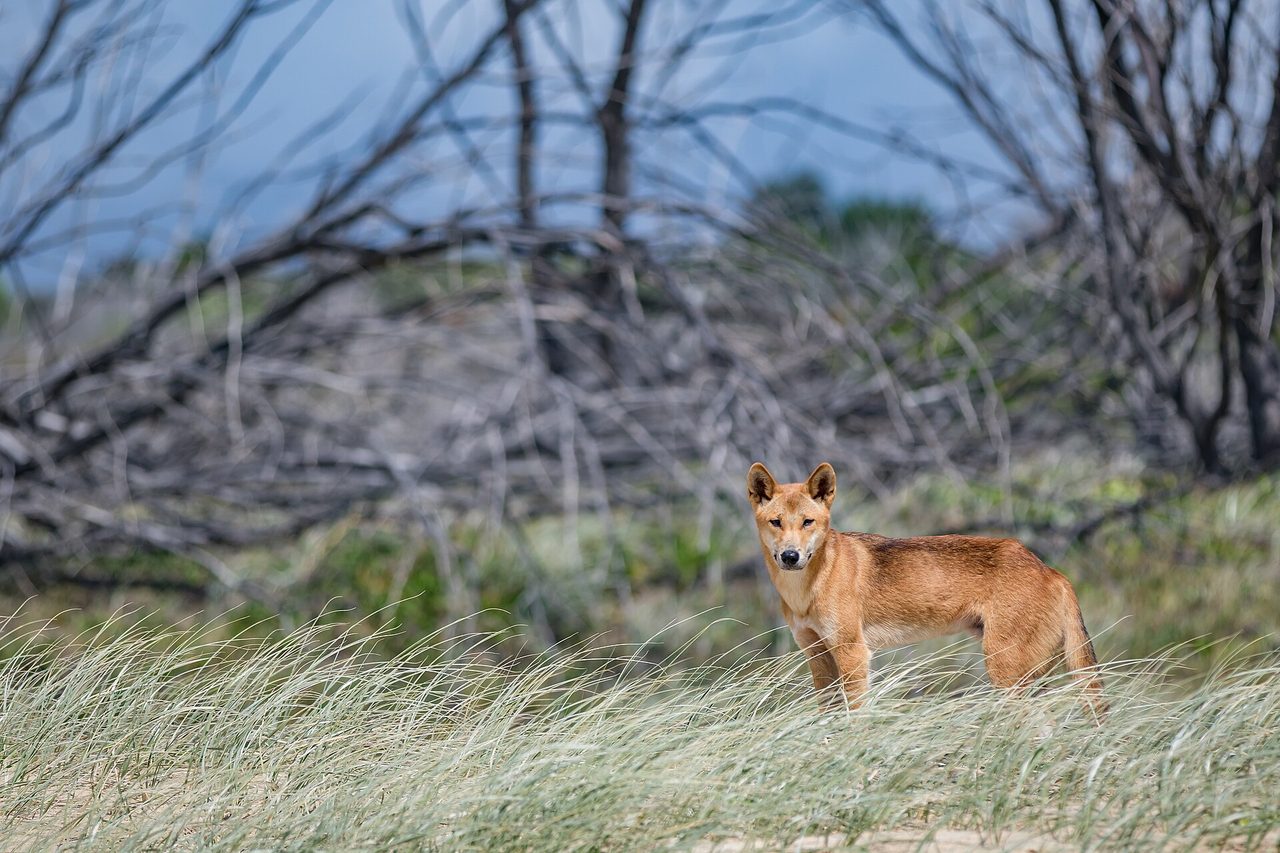
Photo: Newretreads / Wikimedia Commons (CC BY-SA 4.0)
In brief
The dingo is Australia's native wild dog and apex predator, historically classified as Vulnerable due to widespread persecution and hybridisation with domestic dogs — though it was removed from the IUCN Red List in 2019 following taxonomic reclassification, and new genomic research suggests pure dingoes are more numerous than previously feared.
Also in Animals A to Z · Animals that start with D
How you can help
You can support the related appeal — read its purpose, recipient status and fund terms first — or give once to where it is needed most. Sharing accurate information helps too.
By WARN Research & Conservation TeamLast updated
The dingo (Canis lupus dingo) is Australia's largest terrestrial carnivore and the continent's only wild canid. Lean, sand-coloured, and built for endurance across vast, sun-bleached landscapes, dingoes are far more than feral dogs: genetic and fossil evidence places their ancestors arriving in Australia roughly 3,500 years ago, almost certainly brought by seafaring peoples from maritime Southeast Asia. Over millennia they became fully integrated into Australian ecosystems, shaping plant and animal communities as a keystone apex predator. They also formed deep bonds with Aboriginal peoples, featuring in Dreaming stories, rock art, and daily life long before European colonisation. Today the dingo sits at the intersection of ecology, agriculture, and identity — celebrated by conservationists, persecuted by livestock farmers, and debated by taxonomists the world over.
~3,500 yrs
Time in Australia
10–20 kg
Adult body weight
5,614 km
Length of Dingo Fence
~5,010
Estimated dingoes in Victoria
Figures sourced from IUCN Red List – Canis lupus dingo (2008 assessment), Animal Diversity Web – Canis lupus dingo, Australian Museum – Dingo and other references on this page.
Dingo: Quick Facts
| Body length | ~120 cm (including ~30 cm tail) |
|---|---|
| Shoulder height | ~60 cm |
| Weight (male) | 11.8–19.4 kg |
| Weight (female) | 9.6–16.0 kg |
| Lifespan (wild) | 5–10 years |
| Litter size | 1–10 pups (average ~5) |
| Gestation | ~63 days |
| Breeding season (Australia) | March–June |
| Diet | Carnivore: kangaroos, wallabies, rabbits, rodents, reptiles, birds |
| Habitat | Desert, savanna, tropical forest, alpine moorland |
| Social structure | Flexible — solitary to family packs of 3–12 |
Scientific Classification
| Kingdom | Animalia |
|---|---|
| Phylum | Chordata |
| Class | Mammalia |
| Order | Carnivora |
| Family | Canidae |
| Genus | Canis |
| Species | Canis lupus |
| Subspecies | Canis lupus dingo |
Conservation Status
- IUCN Status
- Removed from IUCN Red List (2019); previously assessed as Vulnerable (A2e) in 2008 due to hybridisation-driven population decline. Vulnerable under state legislation in Victoria (Flora and Fauna Guarantee Act 1988).
- Population
- Estimated 10,000–50,000 mature pure individuals across Australia; Victoria estimated at ~5,010 (90% CI: 2,710–9,050, January 2024 assessment)
- Trend
- Decreasing in fragmented south-eastern populations; broadly stable in arid interior and north
- Assessed
- 2008 (last IUCN formal assessment, prior to 2019 removal); 2024 (Victorian state assessment)
- CITES
- Not listed. Canis lupus dingo is specifically excluded from CITES appendices, unlike some other Canis lupus populations (e.g. Mexican wolf, listed under Appendix I).
The dingo's formal IUCN status is contested. It was assessed as Vulnerable (A2e) in 2008 due to hybridisation-driven population decline estimated at over 30% of pure individuals. In 2019 the IUCN/SSC Canid Specialist Group voted to reclassify the dingo as a feral domestic dog and removed it from active Red List assessment — a decision disputed by many field ecologists. The 2024 Australasian Mammal Taxonomy Consortium position statement similarly classifies it as Canis familiaris. Victoria lists the dingo as Vulnerable under the Flora and Fauna Guarantee Act 1988.
Did you know?
Dingoes cannot bark persistently like domestic dogs — instead they communicate through wolf-like howls, yelps, and whimpers. A dingo can rotate its wrists to a degree that allows it to turn door handles, open latches, and climb trees — a dexterity that surprises most people encountering one for the first time.
Key Facts: Dingo
- Dingoes arrived in Australia roughly 3,500 years ago, introduced by people from maritime Southeast Asia, and have never been wild-caught from other wolf populations.
- As Australia's apex predator, dingoes regulate kangaroo numbers and suppress introduced mesopredators such as red foxes and feral cats, benefiting native small mammals.
- The world's longest terrestrial fence — more than 5,614 km — was built specifically to exclude dingoes from south-eastern livestock country, isolating populations and reducing genetic diversity.
- New high-resolution genomic studies (2023–2024) overturn decades of dogma: the vast majority of wild canids tested across most of Australia carry predominantly pure dingo ancestry.
- Hybridisation with domestic dogs remains the principal long-term genetic threat, particularly in south-eastern Australia where isolation fragments populations.
- Dingoes hold profound cultural significance for many Aboriginal Australians — they were tamed, kept as companions, and buried with ceremony, evidence of a relationship spanning thousands of years.
What is a dingo, and how is it classified?
The dingo occupies an unusual and contested place in the animal kingdom. Formally recognised as the subspecies Canis lupus dingo, it is most closely related to ancient semi-domestic dogs from East and Southeast Asia rather than to any modern domestic breed. Taxonomic debate has never fully settled: some authorities treat it as Canis dingo, a full species; others classify it within the domestic dog lineage as Canis familiaris. In 2024, the Australasian Mammal Taxonomy Consortium updated Australian mammal taxonomy to use Canis familiaris for the dingo, though Canis lupus dingo remains widely used in scientific and conservation literature. In 2019, the IUCN/SSC Canid Specialist Group voted to treat the dingo as a feral domestic dog and removed it from the Red List — a decision that remains controversial among ecologists who point to thousands of years of independent evolution in Australia. Earlier, the IUCN had listed it as Vulnerable (category A2e) owing to population decline from hybridisation and persecution. Regional governments in Australia, including Victoria, continue to recognise it as a threatened taxon on state legislation. Physically, the dingo is a medium-sized canid: males weigh between 11.8 and 19.4 kg, females between 9.6 and 16.0 kg; both sexes stand roughly 60 cm at the shoulder and measure around 120 cm in total body length including the tail. The coat is typically golden-yellow but ranges through red, tan, black-and-tan, and pale cream. Crucially, dingoes cannot bark persistently; instead they howl in a manner closer to wolves than to domestic dogs.
Where do dingoes live, and what habitats do they use?
Dingoes are found across almost the entire Australian continent, from tropical rainforests and coastal wetlands in the north to the searing deserts of the interior and the alpine moorlands of the south-eastern highlands. Their core stronghold today is the arid and semi-arid interior and the tropical north, where human settlement is sparse and large-scale lethal control is less intensive. South of the Dingo Fence — the world's longest terrestrial barrier at more than 5,614 km, stretching from Queensland through New South Wales and into South Australia — dingo populations are greatly reduced and fragmented. Beyond mainland Australia, a closely related population called the New Guinea Singing Dog persists in the highlands of Papua New Guinea, and scattered dingo-type dogs are documented in parts of Southeast Asia including Thailand, Borneo, and Indonesia, pointing to the ancient dispersal route of the ancestral population. Within their range, dingoes are habitat generalists, adapting their behaviour to seasonal resource availability. In the desert interior they follow waterholes and exploit nomadic irruptions of rodents and kangaroos after rainfall events. In tropical savannas they regulate populations of macropods. In montane areas they prey on wallabies, wombats, and introduced ungulates. Home range sizes vary enormously — from around 10–50 km² in resource-rich coastal and suburban areas to over 1,000 km² in the most arid desert zones, reflecting the vast differences in prey and water availability across the continent.
What do dingoes eat, and how do they hunt?
Dingoes are opportunistic apex predators and generalist carnivores. Their diet is overwhelmingly meat-based and shifts according to what prey is locally abundant. In arid interior habitats, kangaroos and red kangaroos form the backbone of the diet; in tropical and sub-tropical areas, wallabies, feral pigs, and wombats dominate. When large prey is scarce, dingoes readily take rabbits, rodents, lizards, birds, insects, and carrion. They are also capable scavengers and will exploit livestock carcasses. Hunting strategy scales with prey size. Solitary dingoes routinely tackle prey up to twice their own body weight, including agile wallabies. When targeting large prey such as red kangaroos or feral pigs, dingoes cooperate in family packs of three to twelve individuals, employing relay-chase techniques and coordinated ambush. Pack cohesion is strongest during the pup-rearing season and weakens outside breeding periods. Dingoes occupy a keystone predator role that structurally changes Australian ecosystems. Where dingo populations are healthy, kangaroo densities are lower, enabling grass and understorey vegetation to recover; this in turn benefits native small mammals, reptiles, and ground-nesting birds. Research published in peer-reviewed ecology journals has shown that where dingoes are removed by baiting, red fox and feral cat activity increases markedly, with cascading harm to smaller native animals. The ecological argument for dingo conservation is therefore not merely sentimental but grounded in decades of field evidence.
Why are dingoes threatened, and what are the main dangers they face?
The dingo faces a suite of interconnected threats, most of them human-caused. Lethal control is the most immediate and widespread. Across pastoral Australia, government and landholder-funded programs deploy 1080 (sodium fluoroacetate) poison baits, traps, and shooting to protect sheep and cattle. Hundreds of thousands of poison baits are laid every year; while primarily intended for feral pigs, foxes, and wild dogs, these inevitably kill dingoes. The practice is legal in all Australian states outside of conservation estates. The Dingo Fence, maintained since the early twentieth century, physically fragments populations in south-eastern Australia, preventing gene flow and leaving isolated groups vulnerable to inbreeding depression. Hybridisation with domestic and feral dogs poses the other major long-term threat. When dingo packs are disrupted by culling — removing breeding adults and breaking social structure — surviving individuals are more likely to mate with domestic dogs, diluting the genetic integrity of the population. Early studies estimated that fewer than 1–4% of dingoes in south-eastern Australia were genetically pure; however, landmark genomic research published in 2023 using high-resolution whole-genome sequencing found that 87% of canids sampled in Victoria were pure dingoes, challenging the scale of hybridisation previously assumed. Nonetheless, localised populations — particularly in the Big Desert of north-west Victoria where fewer than 20 individuals may remain — face genuine extinction risk at a regional scale. Habitat loss from land clearing and altered fire regimes also degrades dingo habitat.
What is the dingo's relationship with Indigenous Australians, and why does it matter?
The dingo's arrival in Australia approximately 3,500 years ago almost certainly coincided with the arrival of new human groups from Southeast Asia, and from those first encounters a profound relationship developed. Archaeological evidence shows that Aboriginal Australians tamed dingo pups, rearing them within communities, using them as hunting companions, bed warmers, and protectors. Skeletal remains found at burial sites across southern Australia reveal that dingoes were sometimes interred with ceremony comparable to that afforded to human family members, indicating deep social bonds. Research published in 2022 in the journal Animals documented the intensive socialisation processes Aboriginal communities employed — raising pups from very young ages, integrating them fully into domestic life, and maintaining a semi-domestic population across the continent at the time of European contact in 1788. In 2026, archaeologists reported on a millennium-old dingo ritually buried by Barkindji ancestors along the Baaka (Darling) River, with the burial mound subsequently tended and fed with river mussel shells for centuries. Rock art at sites including the Wollemi wilderness area and the Burrup Peninsula depicts dingoes in scenes that speak to their spiritual as well as practical importance. In Dreaming stories, the dingo appears as an ancestral being, a guide, and a relative. For many Aboriginal communities today, the dingo remains a totem animal and its conservation is inseparable from the protection of cultural heritage. Understanding this history matters for policy: management decisions made without recognition of the dingo's deep cultural significance risk erasing something irreplaceable alongside any ecological harm.
What WARN Does
WARN publishes this guide for education and is developing support through assessed animal-welfare grants. A species range, source citation or photograph does not establish a recipient or funding agreement. Check /about/where-your-money-goes/#grant-register for published grant and payment records; records not yet published must not be read as zero activity. Browse /appeals/ for the purposes currently available to support.
Apex predators like the dingo are the silent architects of healthy ecosystems — when they disappear, whole food webs unravel. WARN's conservation partners work to protect keystone species and the habitats that sustain them. Supporting WARN helps keep those ecosystems intact.
How can I help save the dingo?
Explore practical ways to support the dingo, from everyday choices and sharing reliable information to reviewing a related appeal before giving.
Explore ways to support
Read the related appeal’s purpose, recipient status and fund terms. Choose an affordable gift after checking what is proposed and what has been reported.
Ease the pressures
Avoid the wildlife trade and souvenirs, never buy wild animals as pets, and choose sustainable, habitat-friendly products — the threats behind the dingo's decline fall when demand does.
Spread the word
Share accurate, sourced information about the dingo. Wider awareness is what turns concern into lasting protection.
Dingo: Frequently Asked Questions
How can I help save the dingo?
Is the dingo a dog or a wolf?
How long have dingoes lived in Australia?
Are most dingoes in Australia hybrids with domestic dogs?
What is the Dingo Fence and why does it exist?
What do dingoes eat?
Where do dingoes live?
Are dingoes dangerous?
How long do dingoes live?
How big is a dingo?
Sources & References
Population figures, conservation status and biological facts on this page are drawn from authoritative scientific and intergovernmental sources.
- IUCN Red List – Canis lupus dingo (2008 assessment)
- Animal Diversity Web – Canis lupus dingo
- Australian Museum – Dingo
- Wildlife Victoria – Dingoes conservation status
- ARI Victoria – Dingoes research
- PNAS – Ancient genomes reveal dingo population structure (2024)
- PMC – Genome-wide variant analyses reveals admixture in dingoes (2023)
- PMC – Role of socialisation in taming of dingoes by Aboriginal Australians (2022)
- National Museum of Australia – Arrival of the dingo
- Scientific Reports – New dates on dingo bones from Madura Cave (2018)
- AMTC – Position statement on the taxonomy of the dingo (2024)
- Australian Museum – Millennium-old dingo burial at Baaka (Darling) River (2026)
Terms used on this page
Plain-English definitions, from our wildlife and conservation glossary.
Latest Dingo Stories
Quick, fact-checked reads on the dingo — amazing facts, key questions and the threats it faces.
Species
Why Are Dugongs Disappearing — and What's Being Done to Save Them?
Dugongs are vanishing from waters where they once thrived, declared functionally extinct in China and critically endangered in East Africa. Here's why — and the work that offers hope.
Read the storySpecies
12 Amazing Facts About Koalas (They Are Not Bears, and They Have Fingerprints)
Fingerprints indistinguishable from ours, 20 hours of sleep a day, and a diet that would poison most animals. Twelve koala facts.
Read the storySpecies
12 Amazing Facts About Kangaroos (They Cannot Walk Backwards)
Tendons that work like springs, a tail used as a fifth leg, and the ability to pause a pregnancy. Twelve verified kangaroo facts.
Read the storyExplore more animals
Discover more animals, their habitats and their conservation status in the WARN wildlife-guide library.