Wildlife Guide · North America & East Asia
Elk (Wapiti)
Cervus canadensis
The bugling giant of North America's wild mountains
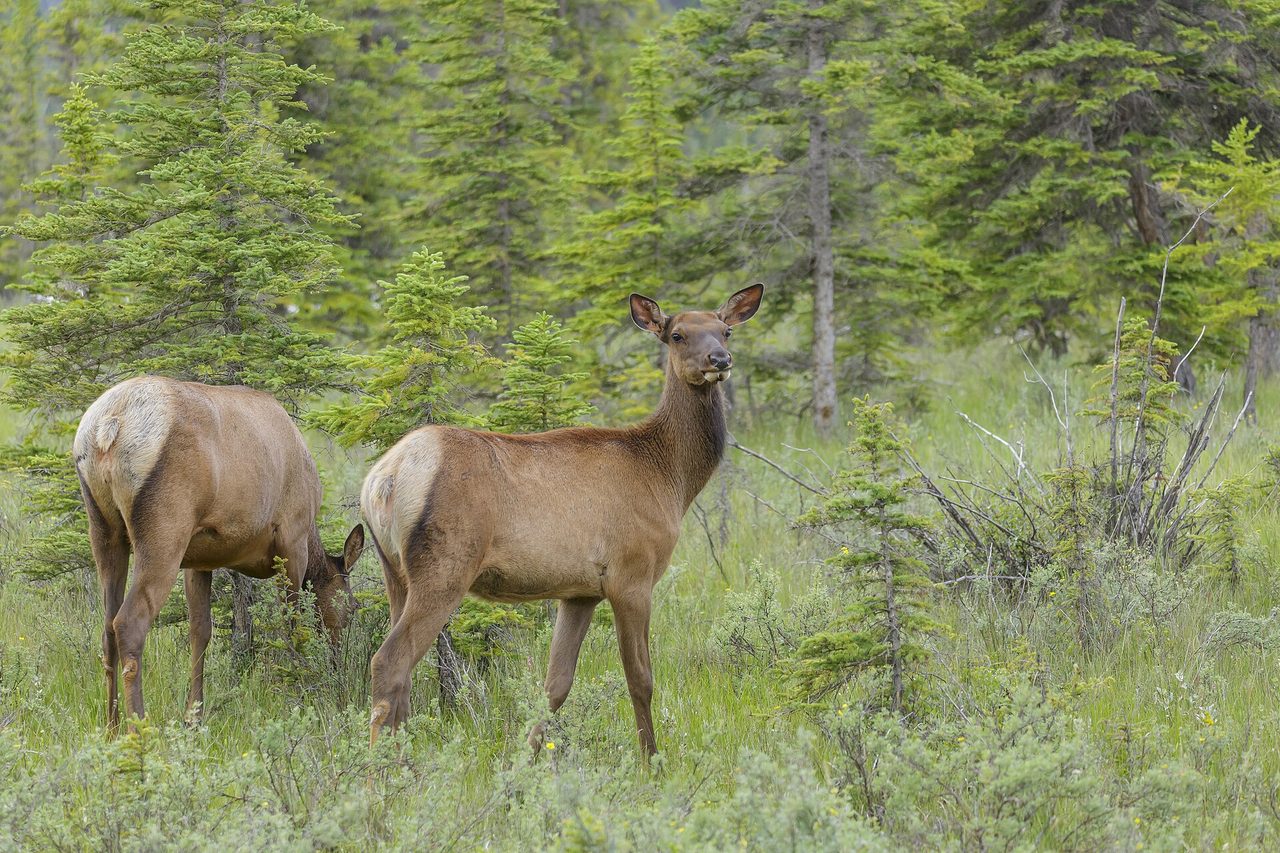
Photo: Thomas Fuhrmann / Wikimedia Commons (CC BY-SA 4.0)
In brief
The elk (Cervus canadensis) is a Least Concern deer species numbering over one million in North America, renowned for its towering antlers, powerful bugle call, and remarkable recovery from near-extinction in the early twentieth century.
Also in Animals A to Z · Animals that start with E
By WARN Research & Conservation TeamLast updated
The elk, or wapiti — a name derived from the Shawnee and Cree word meaning "white rump" — is one of the largest members of the deer family Cervidae and one of the most iconic large mammals in North America. Towering bulls can weigh more than 450 kg (1,000 lb) and carry sweeping antlers that grow nearly a metre across, while their haunting bugles echo across alpine meadows each autumn. Once reduced to barely 41,000 individuals around 1907 through unregulated hunting and habitat loss, elk have staged a remarkable recovery thanks to regulated hunting seasons, national parks, and coordinated wildlife management. Today, more than one million free-ranging elk roam North America, making their story one of conservation's great success narratives. Relatives also persist across Central and East Asia.
1 million+
Wild elk in North America
450 kg
Maximum bull body weight
2.5 cm/day
Peak antler growth rate
~41,000
Population at 1907 low point
Figures sourced from IUCN Red List — Cervus canadensis (2022 assessment, taxon ID 55997823), U.S. Fish & Wildlife Service — Cervus canadensis species profile, NatureServe Explorer — Cervus canadensis and other references on this page.
Elk (Wapiti): Quick Facts
| Also known as | Wapiti |
|---|---|
| Shoulder height | 1.3–1.5 m (bulls) |
| Weight | 225–450 kg (cows to large bulls) |
| Antler span | Up to ~1 m |
| Lifespan (wild) | 10–13 years |
| Gestation | ~245 days |
| Diet | Grasses, forbs, shrubs, bark |
| Predators | Wolves, mountain lions, grizzly bears |
Scientific Classification
| Kingdom | Animalia |
|---|---|
| Phylum | Chordata |
| Class | Mammalia |
| Order | Artiodactyla |
| Family | Cervidae |
| Genus | Cervus |
| Species | Cervus canadensis |
Conservation Status
- IUCN Status
- Least Concern
- Population
- Over 1 million in North America; Tian Shan wapiti ~50,000; additional tens of thousands across other Asian subspecies
- Trend
- Increasing (North America); variable or declining for some Asian subspecies
- Assessed
- 2022
- CITES
- Not listed (Bactrian deer Cervus elaphus bactrianus is listed on Appendix II under its legacy scientific name)
North American population recovered from ~41,000 in 1907 to over one million through regulated hunting and habitat protection. Asian subspecies face greater pressure from poaching and habitat loss.
Did you know?
A bull elk's bugle — one of the loudest and most haunting calls in the animal kingdom — spans from a rumbling 150 Hz grunt to a flute-like whistle reaching 4,000 Hz, yet it carries clearly across several kilometres of mountain terrain.
Key Facts: Elk (Wapiti)
- Elk were hunted to near-extinction by 1907 but recovered to over one million animals through strict wildlife management and national park protection.
- Bull elk grow and shed a full set of antlers every year; antlers are the fastest-growing tissue in the animal kingdom, adding up to 2.5 cm per day at peak summer growth.
- The bugling call of a bull elk can travel several kilometres and reaches frequencies up to 4,000 Hz — unusually high for such a large animal.
- Elk are a keystone prey species: their grazing shapes plant communities, and their presence drives trophic cascades that influence everything from beavers to songbirds.
- Several Asian subspecies — including the Tian Shan wapiti of Xinjiang and Kazakhstan — remain far less secure than their North American cousins.
- Public wildlife literacy is vital: understanding why apex prey species matter helps build the societal support that funds long-term conservation efforts worldwide.
What is an elk, and how does it differ from other deer?
The elk (Cervus canadensis), commonly called wapiti in scientific and Canadian contexts, is the second-largest member of the deer family Cervidae, surpassed in size only by the moose. Adult bulls typically stand 1.3–1.5 m at the shoulder and weigh 320–450 kg, though exceptional individuals exceed 500 kg. Cows are noticeably smaller, averaging 225–275 kg. Both sexes display the species' signature buff-golden body coat with a darker neck mane and a distinctive pale rump patch — the "white rump" that gave the animal its Algonquian name.
Unlike white-tailed and mule deer, which are more solitary, elk are highly social ungulates that form large herds, particularly outside the rut. Only bulls grow antlers, and a mature bull's rack can span nearly a metre and weigh 18 kg or more. These antlers are multi-tined, with a main beam and six or more points per side in prime adults. The species is sometimes confused with the unrelated European red deer (Cervus elaphus), and North American colonists initially applied the name "elk" to it by mistake — in Europe, "elk" means moose. Taxonomically, Cervus canadensis historically encompassed six North American subspecies; four survive today (Rocky Mountain elk, Roosevelt elk, Tule elk, and Manitoba elk), while the Eastern elk and Merriam's elk are extinct, plus several Asian subspecies across Siberia, Kazakhstan, China, and Mongolia.
Where do elk live, and what do they eat?
Elk occupy a remarkable diversity of habitats, from lush Pacific rainforests along the Pacific Northwest coast to high alpine meadows, sagebrush steppes, and ponderosa pine forests in the Rocky Mountains. Their optimal habitat combines productive grasslands or clearings for foraging with closed-canopy forest nearby for thermal shelter and predator cover. Seasonal elevation migration is characteristic: in spring and summer, herds move to high mountain meadows to take advantage of nutritious new growth; in autumn and winter, they descend to sheltered valley floors where snow depth is manageable.
Elk are highly adaptable grazers and browsers. In summer they prefer grasses, sedges, and forbs, which provide high protein and moisture. As winter approaches and green forage disappears, elk shift to browsing on shrubs, willows, aspens, and dried grasses, supplementing with bark when necessary. A large bull may consume 9–11 kg of forage daily.
In Asia, Tian Shan wapiti (C. c. songaricus) inhabit mountain ranges across Xinjiang in China, Kazakhstan, and Kyrgyzstan, preferring subalpine meadows and coniferous forest edges similar to those their North American relatives favour. Altai wapiti (C. c. sibiricus) range across Russia, Mongolia, and northern China. All Asian populations face greater pressure from habitat loss and poaching than their North American counterparts.
How do elk behave during the rut?
Few wildlife spectacles match the North American elk rut, which unfolds from early September through mid-October. As daylight shortens and testosterone surges, bulls undergo a dramatic physical and behavioural transformation. Their necks swell with muscle, they shed the velvet from their now-hardened antlers, and they begin issuing one of the most extraordinary sounds in the natural world: the bugle.
An elk bugle opens with a deep, resonant grunt around 150 Hz, rises to a piercing, flute-like scream reaching up to 4,000 Hz, and ends with a series of grunts. The call can carry several kilometres and registers far above the typical frequency range of most large mammals. Bulls bugle to proclaim territory, challenge rivals, and attract cows. Dominant bulls assemble harems of five to twenty cows, which they vigilantly guard against competing males.
When bugling fails to settle a dispute, bulls spar by locking antlers and driving against each other. Serious fights can result in broken antlers or, rarely, injury or death. Between conflicts, bulls dig and wallow in mud pits, urinating into them and rolling to coat their coats in a pungent scent that cows find attractive. Gestation lasts approximately 245 days; cows give birth in late May or June to a single spotted calf, which can walk within hours of birth and is weaned by late summer.
What threats do elk face, and how were they saved from extinction?
Before European colonisation, an estimated 10 million elk ranged across most of North America. Unregulated commercial hunting, conversion of grasslands to agriculture, and relentless competition with domestic livestock drove populations to a catastrophic low of roughly 41,000 animals by 1907. The Eastern elk (C. c. canadensis) and Merriam's elk (C. c. merriami) were driven entirely to extinction.
The recovery that followed was a landmark in wildlife management. The 1872 establishment of Yellowstone National Park created a critical refuge. Legislation outlawing commercial big-game hunting, the introduction of regulated hunting seasons, and decades of reintroduction programmes steadily rebuilt herds. Today the North American population exceeds one million.
Despite this recovery, ongoing threats include chronic wasting disease (CWD), a fatal prion disease spreading through deer-family species; vehicle collisions; habitat fragmentation from roads and energy development; and the loss of winter range to housing. Climate change is shifting vegetation zones upward, potentially compressing high-elevation summer habitat. In Asia, Asian subspecies face additional pressures from poaching for antler velvet used in traditional medicine markets, and from heavy livestock grazing in mountain habitats. The wolf reintroduction to Yellowstone in 1995 demonstrated that predator-prey dynamics are essential to ecological health: elk herds that were unchecked by predators had over-grazed riverside willows, reducing beaver populations and degrading stream habitats.
What ecological role do elk play, and why do they matter globally?
Elk function as a keystone prey species in the ecosystems they inhabit. Through grazing and browsing, a herd of elk shapes plant community structure, influencing which tree and shrub species dominate a landscape and how dense the understorey becomes. Their selective foraging can open gaps in forest canopy, creating habitat for ground-nesting birds and diverse wildflowers.
The connection between elk, wolves, and riparian vegetation in Yellowstone has become one of ecology's most-studied trophic cascades. After wolves were extirpated from Yellowstone in the 1920s, elk grazed freely along riverbanks, stripping willows and aspens that stabilised stream banks. When wolves were reintroduced in 1995, elk altered both their numbers and their behaviour — avoiding lingering in open valley bottoms — allowing willows to recover, beaver populations to rebound, and stream channels to stabilise. Cooler, better-oxygenated water supported larger fish populations. This cascade illustrated how a single prey species can mediate an entire watershed's health.
Elk also serve as important hosts for a range of parasites and as prey for wolves, mountain lions, grizzly bears, and coyotes, underpinning the food webs of North America's most biodiverse ecosystems. Their cultural significance to Indigenous peoples across North America — as a food source, a spiritual symbol, and a measure of land health — adds a social dimension to their ecological importance. Understanding these roles reinforces why protecting wild habitats everywhere, not only where a given species lives, sustains the biodiversity that all life depends upon.
What WARN Does
WARN does not currently operate elk conservation projects, as WARN's wildlife rescue and habitat work is focused in its partner-network countries — regions outside the elk's primary range. This guide is offered as free educational content. Raising public awareness about species like the elk helps build the broad constituency for wildlife protection that benefits animals everywhere, including those in WARN's active programme countries.
The elk's recovery shows what determined conservation effort can achieve — but wild habitats remain under pressure worldwide. Supporting WARN helps protect the ecosystems and wildlife communities that share our planet, ensuring future generations can experience the wonder of animals like the elk.
Elk (Wapiti): Frequently Asked Questions
What is the difference between an elk and a wapiti?
How fast do elk antlers grow?
Why do bull elk bugle?
How many elk are there in the world today?
Are elk dangerous to humans?
Is chronic wasting disease a serious threat to elk?
What do elk eat?
Where do elk live?
How long do elk live?
How big is an elk?
Sources & References
Population figures, conservation status and biological facts on this page are drawn from authoritative scientific and intergovernmental sources.
- IUCN Red List — Cervus canadensis (2022 assessment, taxon ID 55997823)
- U.S. Fish & Wildlife Service — Cervus canadensis species profile
- NatureServe Explorer — Cervus canadensis
- Yellowstone National Park — Elk (NPS)
- Elk — Wikipedia (overview, subspecies, range)
- Wildlife Informer — Elk population by state (2024 data)
Terms used on this page
Plain-English definitions, from our wildlife and conservation glossary.
Latest Elk (Wapiti) Stories
Quick, fact-checked reads on the elk (wapiti) — amazing facts, key questions and the threats it faces.
Species
Slow Loris: Why the Internet's Favourite Pet Is a Conservation Disaster
The slow loris looks like a cartoon character — and that has nearly destroyed the species. Here is the truth behind the viral videos.
Read the storyGuides
Sun Bear vs Moon Bear: The Two Most Trafficked Asian Bears
The sun bear and the Asiatic black bear (moon bear) are the two most commonly trafficked bears in Asia — for the pet trade, for traditional medicine and for bear-bile farming. Here is how to tell them apart.
Read the storySpecies
12 Amazing Facts About the Asian Elephant
From a 22-month pregnancy to a trunk with tens of thousands of muscles, here are 12 surprising, science-backed facts about Asia's largest land animal.
Read the storyExplore more animals
Discover more animals, their habitats and their conservation status in the WARN wildlife-guide library.