Wildlife Guide · India & Nepal
Gaur
Bos gaurus (Hamilton, 1827)
The largest wild cattle on Earth — forest bison of India and South-east Asia.
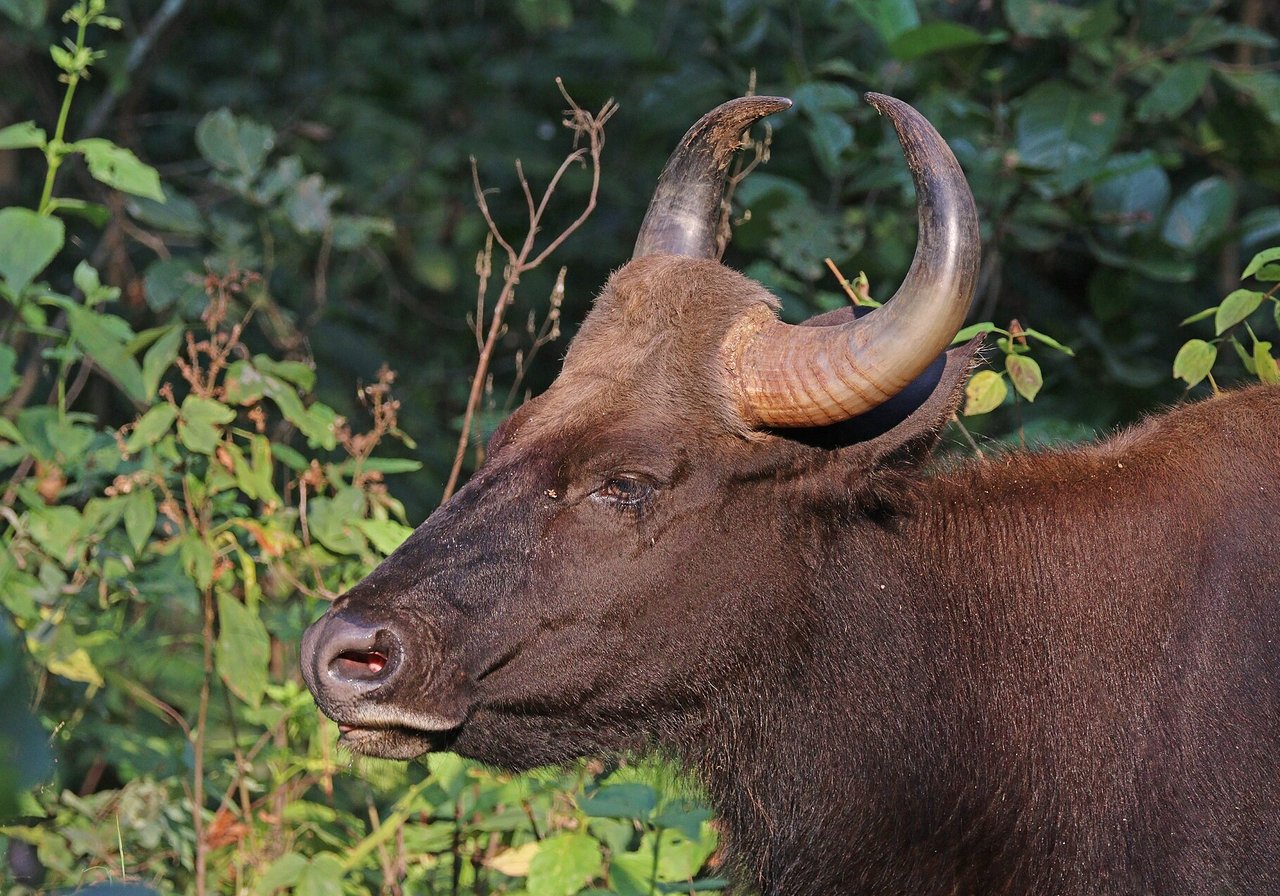
Source: Wikimedia Commons
In brief
The gaur (Bos gaurus) is a Vulnerable forest bovid — the largest wild cattle species, ranging from India through Malaysia; threatened by habitat loss, bushmeat hunting and agricultural encroachment.
Also in Animals A to Z · Animals that start with G
How you can help
You can symbolically adopt an orangutan from £5 a month — a donation to WARN’s orangutan welfare and conservation appeal, with a personalised certificate you can keep or give as a gift — or give once to where it is needed most.
By WARN Research & Conservation TeamLast updated
The gaur is the largest living bovid — bulls reach 1,000 kg with a muscular black body, white stockings on the lower legs and massive curved horns. Bos gaurus ranges across forest and woodland from India and Nepal through Myanmar, Thailand and Malaysia to Vietnam. Gaurs graze forest clearings and browse woodland vegetation, forming herds led by mature females. Listed as Vulnerable by the IUCN, populations are declining from habitat loss, hunting for bushmeat and conflict with expanding agriculture. In Malaysia and Indonesia, gaur persist in rainforest fragments where WARN partners work on forest protection.
Vulnerable
IUCN Red List status (2016 assessment)
1,000 kg
Maximum weight — large bulls
~21,000
Estimated mature individuals globally
Appendix I
CITES listing — commercial trade banned
Figures sourced from IUCN Red List — Bos gaurus, Encyclopaedia Britannica — gaur, Wildlife Institute of India — gaur .
Gaur: Quick Facts
| Weight | 600–1,000 kg (bulls); cows roughly half |
|---|---|
| Distinctive feature | White stockings on lower legs |
| Habitat | Tropical and subtropical forest clearings |
| Range | India to Malaysia and western Indonesia |
| Population | Roughly 21,000 mature individuals |
| CITES | Appendix I |
Scientific Classification
| Kingdom | Animalia |
|---|---|
| Phylum | Chordata |
| Class | Mammalia |
| Order | Artiodactyla |
| Family | Bovidae |
| Genus | Bos |
| Species | Bos gaurus (Hamilton, 1827) |
Conservation Status
- IUCN Status
- Vulnerable (IUCN, 2016). Roughly 21,000 mature individuals.
- Population
- Roughly 21,000 mature individuals; ~15,000 in India
- Trend
- Decreasing
- Assessed
- 2016
- CITES
- Appendix I
Largest living wild bovid; Malaysia and Indonesia hold important South-east Asian populations.
Key Facts: Gaur
- Gaur are the largest living bovid — bulls can exceed 1,000 kg.
- White stockings on the lower legs distinguish gaurs from other Asian bovids.
- Gaurs inhabit forest clearings and woodland from India to Malaysia.
- Tiger predation on gaur calves and subadults is documented across India.
- Habitat loss and bushmeat hunting are the primary threats.
- Malaysia and Indonesia hold important South-east Asian gaur populations.
The largest wild cattle
The gaur belongs to the genus Bos alongside cattle, wild yaks and banteng. Bos gaurus is the heaviest living wild bovid — bulls stand 1.7–2.2 m at the shoulder and weigh 600–1,000 kg. Cows are roughly half the size. The coat is dark brown to black; lower legs are white or pale, creating 'stocking' markings. Horns curve upward and inward, reaching 85 cm in large bulls.
Gaurs inhabit tropical and subtropical forest, woodland and bamboo thickets from India and Nepal through Myanmar, Thailand, Cambodia, Laos, Vietnam, Malaysia and western Indonesia. They graze grasses in forest clearings and glades, browse leaves and shoots, and visit salt licks. Herds of 8–20 females and young are led by an older female; mature bulls are often solitary.
Domestic gayal or mithun — kept by indigenous communities in India and Myanmar — may descend from gaur domestication or hybridisation, though the relationship remains debated.
Forest ecology and predator interactions
Gaurs are diurnal, foraging in early morning and late afternoon in forest openings. They avoid dense closed canopy where movement is restricted. Forest clearings maintained by elephants, fire and natural treefall create grazing habitat gaurs depend on.
Tigers prey on gaur calves and subadults — among the largest prey tigers regularly hunt. Documented kills of adult gaur by tigers occur but are uncommon. Dholes and leopards take calves. Gaurs defend young by forming protective circles with horns facing outward.
As large grazers and browsers, gaurs shape forest vegetation. Their grazing maintains grassland patches in forest; their browsing influences woody plant composition. Declining gaur populations alter forest ecology in reserves across India and South-east Asia.
Threats across the range
Habitat loss is the primary threat. Forest clearance for agriculture, logging, rubber and oil palm plantations removes gaur habitat across South-east Asia. In India, mining and infrastructure development fragment forest reserves. Gaurs require large forest areas with access to clearings and water — fragmented landscapes cannot support viable herds.
Hunting for bushmeat and trophies persists across Myanmar, Cambodia, Laos and Malaysia. Snares kill gaurs indiscriminately in Southeast Asian forests. In India, retaliatory killing after crop raiding occurs where forest meets farmland.
Disease from domestic cattle contact — including foot-and-mouth disease — can devastate gaur herds. Domestic livestock grazing inside protected areas brings disease risk and competition for forage.
Conservation and protected areas
The IUCN lists gaur as Vulnerable with an estimated 21,000 mature individuals and a decreasing population trend. India holds the largest population — roughly 15,000 in the Western Ghats, central India and north-eastern forests. Kaziranga, Nagarahole and Bandipur national parks support significant herds.
South-east Asian populations are smaller and more fragmented. Malaysia's Taman Negara and Royal Belum State Park hold important herds. Indonesia's gaur populations on Sumatra and Java are severely reduced. CITES Appendix I bans commercial international trade.
Anti-poaching patrols, corridor protection between reserves and reducing livestock incursion into protected areas are priority actions. Community engagement in buffer zones reduces retaliatory killing and bushmeat demand.
What WARN Does
WARN publishes this guide for education and is developing support through assessed animal-welfare grants. A species range, source citation or photograph does not establish a recipient or funding agreement. Check /about/where-your-money-goes/#grant-register for published grant and payment records; records not yet published must not be read as zero activity. Browse /appeals/ for the purposes currently available to support.
If this guide helps you understand wildlife and the pressures it faces, a gift to WARN supports habitat protection and free public education in our partner countries.
How can I help save the gaur?
Explore practical ways to support the gaur, from everyday choices and sharing reliable information to reviewing a related appeal before giving.
Explore ways to support
Read the related appeal’s purpose, recipient status and fund terms. Choose an affordable gift after checking what is proposed and what has been reported.
Ease the pressures
Avoid the wildlife trade and souvenirs, never buy wild animals as pets, and choose sustainable, habitat-friendly products — the threats behind the gaur's decline fall when demand does.
Spread the word
Share accurate, sourced information about the gaur. Wider awareness is what turns concern into lasting protection.
Gaur: Frequently Asked Questions
How can I help save the gaur?
What is the largest wild cattle species?
Are gaurs the same as bison?
Do tigers hunt gaur?
Are gaurs endangered?
Where do gaurs live?
What do gaurs eat?
Are gaurs dangerous?
How long do gaurs live?
How big is a gaur?
Sources & References
Population figures, conservation status and biological facts on this page are drawn from authoritative scientific and intergovernmental sources.
Terms used on this page
Plain-English definitions, from our wildlife and conservation glossary.
Latest Gaur Stories
Quick, fact-checked reads on the gaur — amazing facts, key questions and the threats it faces.
Species
Why Are Orangutans Endangered? Palm Oil, Deforestation and the Rescue Crisis in Borneo
Orangutans are endangered because of a single dominant cause: deforestation. All three remaining species have been reduced to small, fragmented populations in what remains of Borneo's and Sumatra's lowland and peat-swamp forests — and the crisis is getting worse, not better.
Read the storyBriefings
Borneo Deforestation and Palm Oil: The Wildlife Crisis in the World's Third Largest Island
Borneo is one of the most biodiverse places on Earth and one of the most rapidly deforested. More than half of the island's lowland forest has been lost in 40 years — a scale of destruction that has produced a permanent wildlife rescue crisis in Indonesia and Malaysia, two of WARN's partner-network countries.
Read the storyBriefings
Pangolin Rescue: Why the World's Most Trafficked Mammal Needs Help in Malaysia
Pangolins are the most trafficked mammal on the planet — and Malaysia sits at the heart of the smuggling routes. Here is why pangolin rescue is now urgent.
Read the storyExplore more animals
Discover more animals, their habitats and their conservation status in the WARN wildlife-guide library.