Wildlife Guide · South-east Asia & China
Gibbon
Family Hylobatidae — ~20 species in 4 genera (Hylobates, Hoolock, Nomascus, Symphalangus)
The singing lesser apes of Asian rainforest — acrobats of the canopy, vanishing as forests fall.
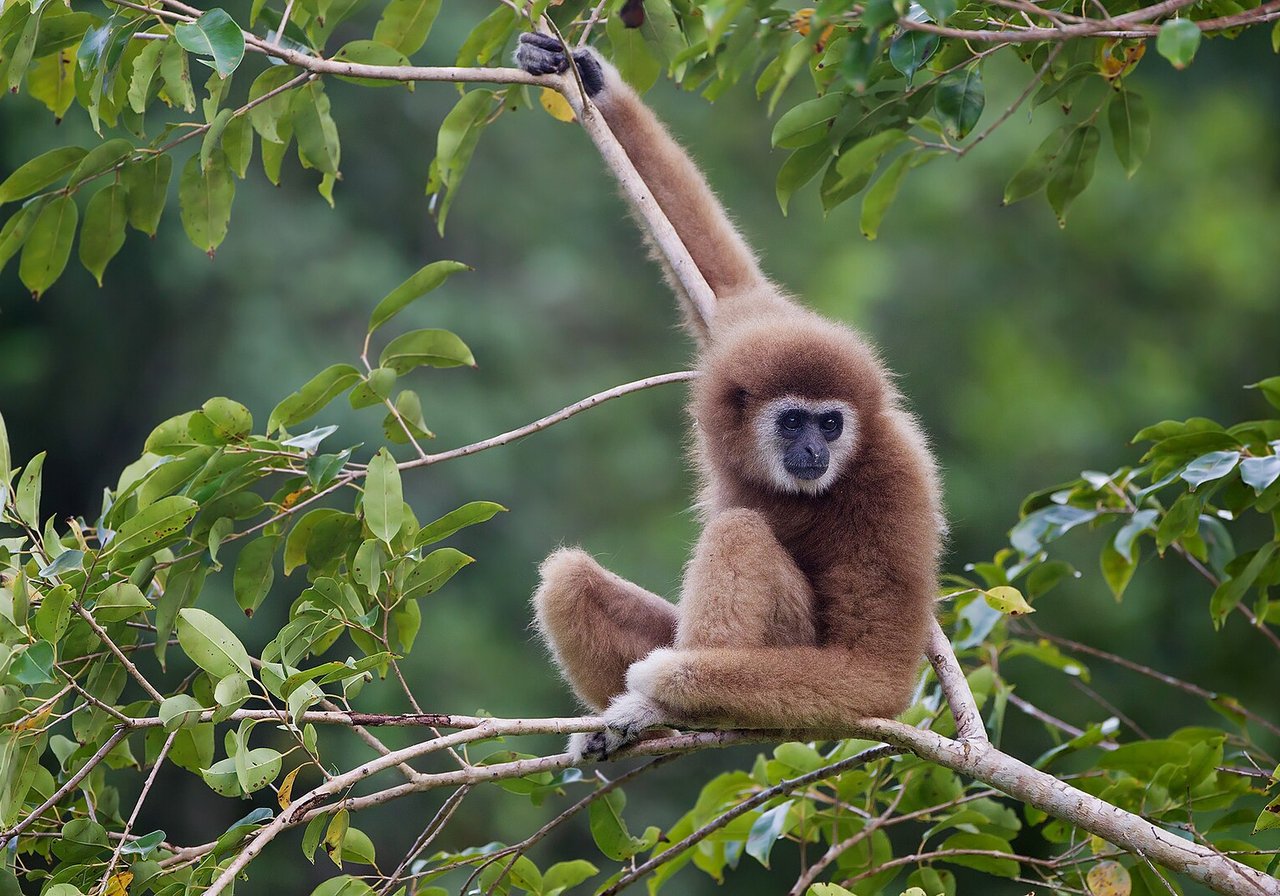
Source: Wikimedia Commons
In brief
Gibbons are tailless lesser apes of South-east Asian rainforest, brachiating through the canopy in monogamous family groups; most species are Endangered or Critically Endangered due to habitat loss and the illegal pet trade.
Also in Animals A to Z · Animals that start with G
By WARN Research & Conservation TeamLast updated
Gibbons are small apes of the family Hylobatidae, native to the tropical and subtropical forests of South-east Asia. Unlike monkeys, gibbons are tailless apes — placing them closer to orangutans, gorillas and chimpanzees than to tailed primates. They are celebrated for brachiation: swinging hand-over-hand through the canopy at speeds exceeding 50 km/h. Roughly 20 gibbon species are recognised, grouped into four genera. Most are Endangered or Critically Endangered due to deforestation, the illegal pet trade and hunting. Gibbons live in monogamous family groups and defend territories with spectacular dawn duets that carry for kilometres through the forest.
~20
Recognised gibbon species
50+ km/h
Brachiation speed through the canopy
Appendix I
CITES listing — commercial trade banned
Endangered
Status of most species on the IUCN Red List
Figures sourced from IUCN Red List — Hylobatidae assessments, Gibbon Conservation Alliance, CITES — Checklist of CITES Species .
Gibbon: Quick Facts
| Common name | Gibbon (lesser ape) |
|---|---|
| Species | ~20 recognised species |
| Tail | Absent — like all apes |
| Social unit | Monogamous family group |
| Locomotion | Brachiation through the canopy |
| CITES | Appendix I — all species |
Scientific Classification
| Kingdom | Animalia |
|---|---|
| Phylum | Chordata |
| Class | Mammalia |
| Order | Primates |
| Suborder | Haplorhini |
| Family | Hylobatidae (gibbons) |
Conservation Status
- IUCN Status
- Most species Endangered or Critically Endangered. Hainan gibbon (Nomascus hainanus) is Critically Endangered with fewer than 40 individuals.
- Population
- Varies by species — from fewer than 40 (Hainan) to tens of thousands (some Hylobates)
- Trend
- Decreasing for most species due to habitat loss
- Assessed
- Varies by species (IUCN Red List ongoing)
- CITES
- Appendix I — all gibbon species
Key Facts: Gibbon
- Gibbons are lesser apes — tailless, like orangutans and chimpanzees, unlike monkeys.
- They brachiate hand-over-hand through the canopy, covering up to 10 m per swing.
- Monogamous pairs defend territories with loud dawn duets that identify the species.
- Most gibbon species are Endangered or Critically Endangered due to deforestation.
- Infants are taken from the wild for the illegal pet trade after mothers are killed.
- Gibbons need intact primary forest — they cannot survive in oil palm or logged woodland.
Lesser apes of the canopy
Gibbons belong to the superfamily Hominoidea alongside great apes and humans, but form their own family, Hylobatidae. They are the smallest apes — typically 5–10 kg — with extraordinarily long arms, hook-shaped hands and reduced thumbs adapted for swinging. Unlike great apes, gibbons do not build nests; they sleep sitting upright in trees.
Four genera are recognised: Hylobates (white-handed and agile gibbons), Hoolock (western and eastern hoolock gibbons of India and Myanmar), Nomascus (crested gibbons of Vietnam, Laos and China) and Symphalangus (siamang, the largest gibbon). Each species has a distinctive song, allowing identification by ear alone.
Threats and the pet trade
Deforestation is the primary threat. South-east Asia has lost vast areas of lowland rainforest to oil palm, rubber, logging and dam construction. Gibbons cannot cross open ground between forest fragments; isolated groups face inbreeding and local extinction. Hunting for food and traditional medicine persists in some areas. The illegal pet trade is particularly cruel: adult gibbons are shot to capture dependent infants, which are sold as pets or for tourist photo props. Gibbons are poor pets — they need vast enclosures, lifelong pair bonds and specialist diets. Most confiscated gibbons cannot be released and require lifetime sanctuary care.
Conservation and recovery
CITES lists all gibbon species on Appendix I, banning commercial international trade. Protected areas and wildlife corridors are essential for connecting fragmented populations. Captive breeding programmes at zoos and sanctuaries support reintroduction efforts for species such as the Hainan gibbon — the world's rarest ape, with fewer than 40 individuals. Community-based forest patrols and ecotourism that values living gibbons over dead ones have helped stabilise some populations. WARN's orangutan work in Indonesia and Malaysia overlaps gibbon range, where shared habitat protection benefits all arboreal apes.
What WARN Does
WARN publishes this guide for education and is developing support through assessed animal-welfare grants. A species range, source citation or photograph does not establish a recipient or funding agreement. Check /about/where-your-money-goes/#grant-register for published grant and payment records; records not yet published must not be read as zero activity. Browse /appeals/ for the purposes currently available to support.
If this guide helps you understand wildlife and the pressures it faces, a gift to WARN supports habitat protection and free public education in our partner countries.
Gibbon: Frequently Asked Questions
Are gibbons monkeys or apes?
How many gibbon species are there?
Why do gibbons sing?
Are gibbons endangered?
Where do gibbons live?
Are gibbons dangerous?
How big is a gibbon?
Sources & References
Population figures, conservation status and biological facts on this page are drawn from authoritative scientific and intergovernmental sources.
Terms used on this page
Plain-English definitions, from our wildlife and conservation glossary.
Latest Gibbon Stories
Quick, fact-checked reads on the gibbon — amazing facts, key questions and the threats it faces.
Guides
How Much Does It Cost to Rescue an Orangutan?
Orangutan rescue spans emergency extraction, years of forest-school rehabilitation and soft release — each stage carries real costs. Here is what UK donors actually fund.
Read the storySpecies
12 Amazing Facts About Tigers (That Sound Made Up But Aren't)
From striped skin and swimming big cats to a roar you can hear three kilometres away, here are 12 verified facts about the world's largest cat.
Read the storySpecies
How Big, Fast and Strong Is a Tiger? The Numbers Explained
Tigers are the largest cats alive, with a bite force around 1,000 PSI and short-burst speeds up to 65 km/h. Here are the real measurements.
Read the storyExplore more animals
Discover more animals, their habitats and their conservation status in the WARN wildlife-guide library.
Social life and song
Gibbons live in monogamous family groups of two to six individuals — an adult pair and their offspring. Pairs defend territories of roughly 20–50 hectares through loud vocal duets performed at dawn. The male and female sing coordinated phrases that can carry over two kilometres. These songs advertise pair bonds, deter rivals and help biologists census wild populations.
Young gibbons remain with their parents for six to ten years, learning territory boundaries and song structure. This slow life history makes populations vulnerable to hunting and habitat loss — removing one breeding pair can eliminate a territory for a generation.