Wildlife Guide · China (Sichuan, Gansu, Shaanxi, Hubei)
Golden Snub-Nosed Monkey
Rhinopithecus roxellana (Milne-Edwards, 1870)
China's blue-faced mountain ghost — a cold-hardy monkey that survives where snow covers the forest floor.
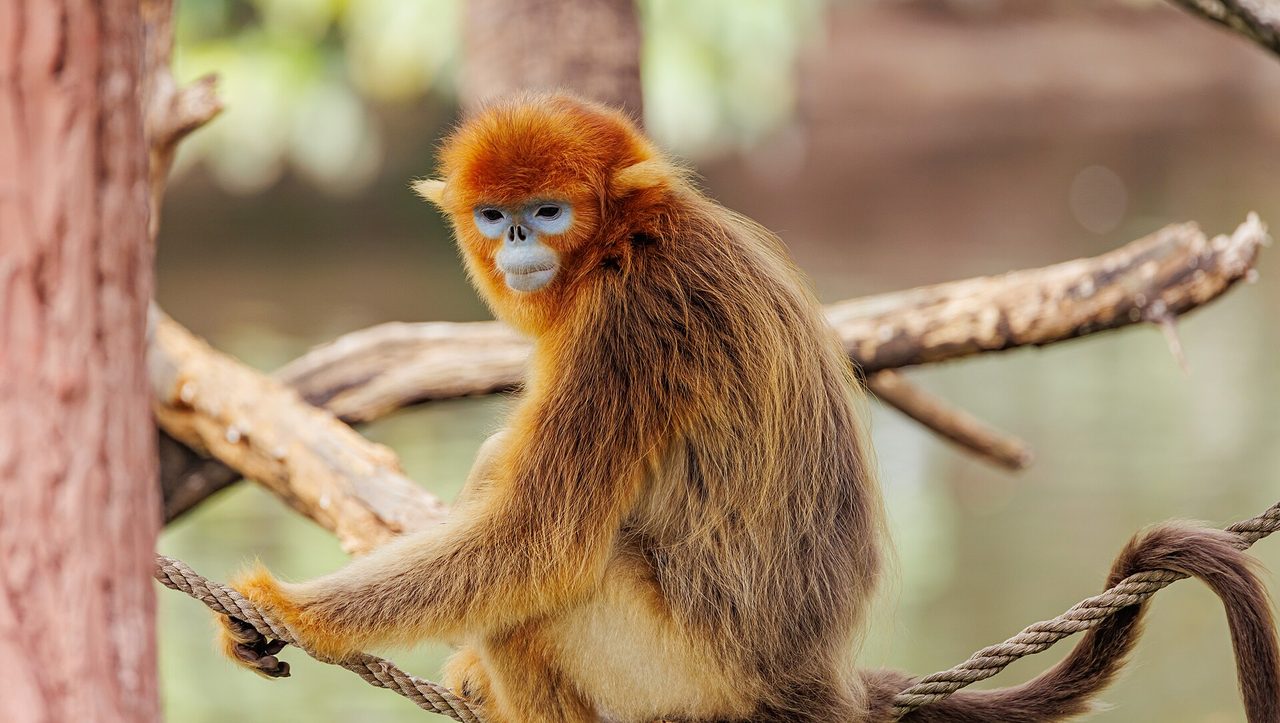
Photo: Dinkun Chen / Wikimedia Commons (CC BY-SA 4.0)
In brief
The golden snub-nosed monkey (Rhinopithecus roxellana) is an Endangered Old World monkey of central China's mountain forests, famous for its golden fur, pale blue face and upturned nose; it lives in large social groups and is protected under CITES Appendix I.
Also in Animals A to Z · Animals that start with G
How you can help
You can symbolically adopt an orangutan from £5 a month — a donation to WARN’s orangutan welfare and conservation appeal, with a personalised certificate you can keep or give as a gift — or give once to where it is needed most.
By WARN Research & Conservation TeamLast updated
The golden snub-nosed monkey (Rhinopithecus roxellana) is a large Old World monkey found only in the high mountain forests of central China, where it is adapted to winters far colder than most primates tolerate. Named for its stumpy, upturned nose and thick golden coat, it lives in enormous multilevel societies of up to 200 individuals that split into smaller foraging bands by day. The IUCN lists it as Endangered: logging, road building and climate shifts continue to shrink the temperate forest it needs. It is one of five snub-nosed monkey species — all restricted to China and neighbouring countries — and a flagship for Asian primate conservation.
Endangered
IUCN Red List status (2015 assessment)
~15,000
Estimated mature individuals (IUCN)
−50°C
Winter lows tolerated in high-elevation range
Appendix I
CITES listing — no commercial international trade
Figures sourced from IUCN Red List — Rhinopithecus roxellana, Encyclopaedia Britannica — snub-nosed monkey, Wikipedia — Golden snub-nosed monkey .
Golden Snub-Nosed Monkey: Quick Facts
| IUCN status | Endangered |
|---|---|
| Range | Central China — montane forest |
| Group size | Up to 200 in a band; smaller foraging units by day |
| Diet | Mainly leaves, lichens, bark, seeds and seasonal fruit |
| Distinctive trait | Golden fur, blue face, upturned snub nose |
| CITES | Appendix I |
Scientific Classification
| Kingdom | Animalia |
|---|---|
| Phylum | Chordata |
| Class | Mammalia |
| Order | Primates |
| Suborder | Haplorhini |
| Family | Cercopithecidae |
| Subfamily | Colobinae |
| Genus | Rhinopithecus |
| Species | Rhinopithecus roxellana (Milne-Edwards, 1870) |
Conservation Status
- IUCN Status
- Endangered (IUCN 2015) — decreasing population trend; habitat fragmentation is the primary threat.
- Population
- ~15,000 mature individuals (IUCN 2015 estimate)
- Trend
- Decreasing
- Assessed
- 2015
- CITES
- Appendix I
Four other Rhinopithecus snub-nosed species are even rarer; protecting montane forest benefits the entire genus.
Did you know?
Golden snub-nosed monkey bands sometimes sleep packed together on bare branches in sub-zero mountain winters — huddling for warmth when snow covers the forest floor.
Key Facts: Golden Snub-Nosed Monkey
- Found only in mountain forests of central China — Sichuan, Gansu, Shaanxi and Hubei provinces.
- One of five snub-nosed monkey species, all in East Asia and among the world's rarest primates.
- Lives in large groups that fission into smaller foraging units during the day.
- Thick golden fur and a stumpy nose are adaptations to cold, high-elevation winters.
- Endangered mainly from habitat loss, forest fragmentation and disturbance from tourism and infrastructure.
- Listed on CITES Appendix I — not a pet; wild populations need connected montane forest.
What is a golden snub-nosed monkey?
Golden snub-nosed monkeys belong to the genus Rhinopithecus — the snub-nosed or golden monkeys — a group of large colobine monkeys restricted to the mountains of China and northern Vietnam. Rhinopithecus roxellana is the golden snub-nosed species: adults carry long, shaggy golden pelage, a pale blue-grey face and a distinctive short, forward-tilting nose that reduces frostbite risk in freezing air.
Males are heavier than females, with larger canines and brighter facial skin in the breeding season. Unlike many tropical monkeys, this species ranges above 1,500 metres and encounters snow for several months each year — one of the few primates adapted to temperate montane forest.
Searchers often confuse it with the golden monkey of Rwanda (Cercopithecus kandti) or the golden lion tamarin of Brazil — entirely different species on other continents. This page covers Rhinopithecus roxellana only.
Diet and cold-forest ecology
Golden snub-nosed monkeys are mainly folivorous — they eat lichens, bark, leaves, buds, seeds and fruit depending on season. Lichens and bark become critical in winter when fresh leaves are scarce, which is why intact old-growth forest with diverse epiphytes matters.
They travel through mixed conifer-broadleaf forest, moving between lower valleys in harsh weather and higher slopes in summer. Long limbs and a tail used for balance let them cross gaps between trees on steep terrain.
Because they depend on specific montane plants, even modest logging or bamboo harvesting can remove food sources for entire bands. Climate change may shift tree lines and fruiting patterns faster than the monkeys can adapt.
Threats and conservation
The IUCN lists the golden snub-nosed monkey as Endangered with a decreasing population trend. Habitat loss from logging, agriculture, hydropower dams and road construction fragments mountain forest into patches too small for large bands. Tourism that feeds or harasses monkeys for photographs disrupts natural foraging and spreads disease.
China has established reserves such as Shennongjia and Zhouzhi where populations are monitored and protected, and captive breeding programmes support research — but wild habitat connectivity remains the bottleneck. All Rhinopithecus species are on CITES Appendix I.
Snub-nosed monkeys illustrate a wider Asian primate crisis: the black, grey, Tonkin and Myanmar snub-nosed species are even rarer, several Critically Endangered.
What WARN Does
WARN publishes this golden snub-nosed monkey guide as free public education. China lies outside the countries where WARN's partners work partner countries, but the threats here — deforestation, fragmentation and illegal wildlife trade — mirror those facing primates in Indonesia, Malaysia and Brazil. Understanding why montane forest connectivity matters helps build support for habitat work everywhere.
If this guide helps you understand one of Asia's most extraordinary primates, a gift to WARN supports habitat protection and anti-trafficking education for primates worldwide.
How can I help save the golden snub-nosed monkey?
Explore practical ways to support the golden snub-nosed monkey, from everyday choices and sharing reliable information to reviewing a related appeal before giving.
Explore ways to support
Read the related appeal’s purpose, recipient status and fund terms. Choose an affordable gift after checking what is proposed and what has been reported.
Ease the pressures
Avoid the wildlife trade and souvenirs, never buy wild animals as pets, and choose sustainable, habitat-friendly products — the threats behind the golden snub-nosed monkey's decline fall when demand does.
Spread the word
Share accurate, sourced information about the golden snub-nosed monkey. Wider awareness is what turns concern into lasting protection.
Golden Snub-Nosed Monkey: Frequently Asked Questions
How can I help save the golden snub-nosed monkey?
Why is it called a snub-nosed monkey?
Where do golden snub-nosed monkeys live?
How many golden snub-nosed monkeys are left?
Are golden snub-nosed monkeys endangered?
Can you keep a golden snub-nosed monkey as a pet?
What is the difference between a golden snub-nosed monkey and a golden monkey?
What do golden snub-nosed monkeys eat?
How long do golden snub-nosed monkeys live?
How big is a golden snub-nosed monkey?
Sources & References
Population figures, conservation status and biological facts on this page are drawn from authoritative scientific and intergovernmental sources.
Terms used on this page
Plain-English definitions, from our wildlife and conservation glossary.
Explore more animals
Discover more animals, their habitats and their conservation status in the WARN wildlife-guide library.
Social life in the mountains
Golden snub-nosed monkeys form some of the largest primate societies on Earth. A single band may contain 200 or more individuals organised into several one-male units — a dominant male with several females and young — that travel and forage together within a wider 'band' structure.
By day the band splits into smaller subgroups to feed; at night troops reunite and sleep huddled on branches for warmth. Vocal duets and loud chorus calls carry across valleys, helping separated units stay in contact in misty forest.
Alloparenting is common: females other than the mother carry and groom infants, strengthening alliances within the one-male unit. Long childhoods and slow reproduction mean population recovery after disturbance takes decades.