Wildlife Guide · North America & Europe
Grey Wolf
Canis lupus
The original wolf, ancestor of every dog, persecuted to the brink and slowly clawing its way back.
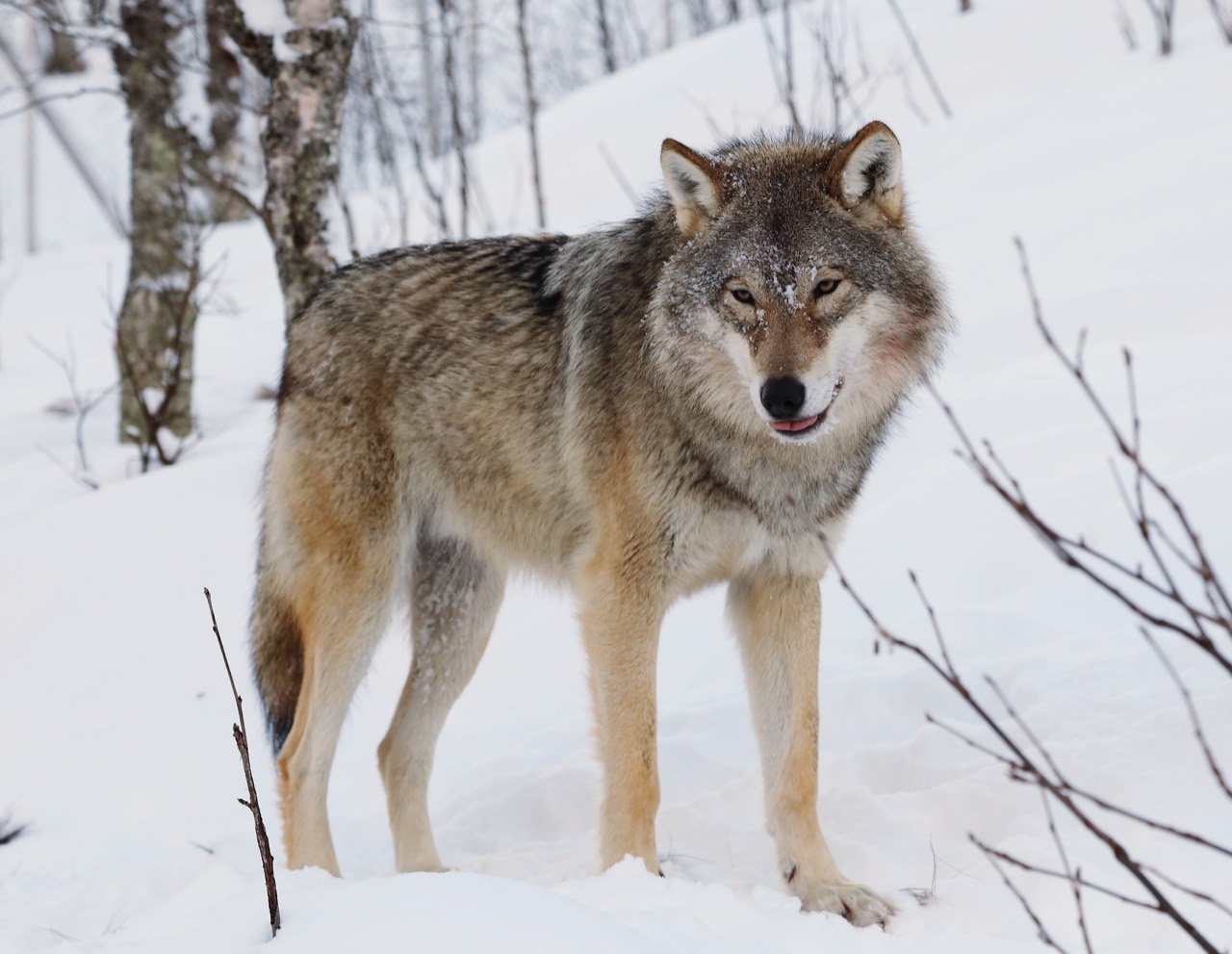
Source: Wikimedia Commons via Wikipedia “Wolf”
In brief
The grey wolf (Canis lupus) is the largest wild dog and the ancestor of the domestic dog; it is listed as Least Concern globally with an estimated 200,000–250,000 in the wild, but remains locally endangered or extinct across much of its former range.
Also in Animals A to Z · Animals that start with G
By WARN Research & Conservation TeamLast updated
The grey wolf (Canis lupus), also called the timber wolf, is the largest wild member of the dog family and the wild ancestor of the domestic dog. Once the most widely distributed land mammal on Earth, it ranged across most of North America, Europe and Asia before centuries of trapping, poisoning and bounty hunting wiped it out from large parts of its former territory. Today the species survives across a still-vast but fragmented range, living in tight family groups called packs and surviving as a cooperative hunter of deer, elk, moose and smaller prey. Globally the grey wolf is listed as Least Concern by the IUCN, yet that headline hides a more complicated truth: in many individual countries and regions it remains endangered, reintroduced, or absent entirely. Its story is one of both relentless persecution and one of conservation's most striking recoveries.
200,000–250,000
Wolves estimated in the wild worldwide
Least Concern
Global IUCN Red List status (assessed 2023)
Up to ~13
Typical wolves in a pack, usually one family
Stable
Overall global population trend
Figures sourced from IUCN Red List: Canis lupus (Grey Wolf), assessed 2023, CITES: Wolf species listing, Wikipedia: Wolf and other references on this page.
Grey Wolf: Quick Facts
| Lifespan | About 6–8 years in the wild; can reach 13+ in captivity |
|---|---|
| Weight | Roughly 30–50 kg (66–110 lb); large northern males larger |
| Size | Body 1.0–1.6 m (3.3–5.2 ft); 60–90 cm at the shoulder |
| Diet | Carnivore: deer, elk, moose, smaller mammals, carrion |
| Gestation | About 62–63 days |
| Young | Usually 4–6 pups per litter, once a year |
| Baby name | Pup (or whelp) |
| Group name | A pack |
| Top speed | Around 50–60 km/h (31–37 mph) in short bursts |
| CITES | Appendix II (Appendix I for Bhutan, India, Nepal and Pakistan populations) |
Scientific Classification
| Kingdom | Animalia |
|---|---|
| Phylum | Chordata |
| Class | Mammalia |
| Order | Carnivora |
| Family | Canidae |
| Genus | Canis |
| Species | Canis lupus |
Conservation Status
- IUCN Status
- Least Concern
- Population
- Approximately 200,000–250,000 mature individuals worldwide
- Trend
- Stable
- Assessed
- 2023
- CITES
- Appendix II, with the Bhutan, India, Nepal and Pakistan populations listed in Appendix I
The global Least Concern listing masks wide local variation: wolves remain endangered, reintroduced, or extirpated in many individual countries and regions.
Did you know?
A single wolf howl can carry up to 10 km (6 miles) across open terrain, and packs use howling not just to regroup but to warn rival packs to keep their distance.
Key Facts: Grey Wolf
- The grey wolf is the wild ancestor of the domestic dog, and the two remain so closely related they can still interbreed.
- Wolves live in packs that are essentially families: a breeding pair and their offspring of one or more years, not a hierarchy of unrelated rivals.
- Globally the species is Least Concern with an estimated 200,000–250,000 individuals, but many regional populations are endangered, reintroduced, or locally extinct.
- Centuries of bounty hunting, poisoning and habitat loss erased wolves from much of Western Europe and the contiguous United States by the early 20th century.
- Legal protection and reintroductions, such as the 1995 return to Yellowstone, have allowed wolves to recolonise parts of their old range.
- Conflict with livestock farming remains the central challenge, making coexistence tools and habitat protection essential to lasting recovery.
Pack life and behaviour
A wolf pack is best understood as a family unit. In most cases it centres on a single breeding pair and their pups from the current and previous years, which together can number anywhere from a handful of animals to a dozen or more. The outdated idea of a constantly fighting 'alpha' jostling for dominance came from studies of unrelated captive wolves; in the wild, the breeding adults are simply the parents. Packs hold and defend a territory that can span hundreds of square kilometres, communicating through howls that carry for miles, along with scent marking and body language. Cooperative hunting lets wolves bring down prey far larger than themselves, including elk, moose and bison, though they also take smaller animals and scavenge. Young wolves often disperse at one to two years old to find mates and territory of their own, which is how the species naturally recolonises new ground.
Persecution and recovery
Few animals have been hunted with the intensity directed at the wolf. For centuries it was treated as vermin, with governments paying bounties for dead wolves and campaigns of trapping, shooting and poisoning steadily eliminating it from country after country. By the early 1900s the grey wolf had been wiped out across most of Western Europe and almost the entire contiguous United States. The turnaround came with changing attitudes and legal protection in the second half of the 20th century. Protected status, public support and deliberate reintroductions, most famously the release of wolves into Yellowstone National Park in 1995, allowed populations to rebound and disperse. Wolves have since returned naturally to countries such as France, Germany and Denmark, expanding from surviving strongholds in eastern and southern Europe.
Conservation status and ongoing threats
On a global scale the grey wolf is classified as Least Concern, reflecting its wide distribution and a worldwide population estimated at roughly 200,000 to 250,000 animals with a broadly stable trend. That status, however, applies to the species as a whole, not to every population. In many individual countries and regions wolves remain rare, endangered, or entirely absent, and recovering populations are often small and isolated. The dominant threat is conflict with livestock farmers, which drives both legal culling and illegal killing. Habitat fragmentation, road mortality, reduced wild prey and shifting legal protections all add pressure. Sustaining the wolf's recovery depends on protecting connected wild habitat and on practical coexistence measures, from livestock guarding to compensation schemes, that lower the cost of living alongside a large predator.
Grey wolf vs domestic dog vs coyote
| Trait | Grey Wolf | Domestic Dog | Coyote |
|---|---|---|---|
| Scientific name | Canis lupus | Canis lupus familiaris | Canis latrans |
| Typical weight | 30–50 kg | Varies widely by breed | 7–20 kg |
| Social structure | Family pack | Bonded to humans | Pairs or small groups |
| Primary range | N. America, Europe, Asia | Worldwide with people | North & Central America |
| IUCN status | Least Concern | Domesticated | Least Concern |
| Relationship | Wild ancestor | Descended from wolf | Close wild relative |
What WARN Does
WARN publishes this guide for education and is developing support through assessed animal-welfare grants. A species range, source citation or photograph does not establish a recipient or funding agreement. Check /about/where-your-money-goes/#grant-register for published grant and payment records; records not yet published must not be read as zero activity. Browse /appeals/ for the purposes currently available to support.
Wolves need wild, connected land to roam, hunt and raise their pups, and so do countless other species. While WARN does not yet fund wolf programmes directly, your gift to our habitat protection work defends the kind of wild spaces large predators depend on and supports our wider mission to reduce human-wildlife conflict.
Grey Wolf: Frequently Asked Questions
Are grey wolves endangered?
Is a grey wolf the same as a dog?
How big is a grey wolf?
Do wolves really have an 'alpha' leader?
What do grey wolves eat?
How fast can a grey wolf run?
Where do grey wolfs live?
Are grey wolfs dangerous?
How long do grey wolfs live?
Sources & References
Population figures, conservation status and biological facts on this page are drawn from authoritative scientific and intergovernmental sources.
Terms used on this page
Plain-English definitions, from our wildlife and conservation glossary.
Latest Grey Wolf Stories
Quick, fact-checked reads on the grey wolf — amazing facts, key questions and the threats it faces.
Species
12 Amazing Facts About Grey Wolves (And Why Alpha Wolves Aren't Real)
A howl that carries 16 km, a pack that is really a family, and the debunked study behind the 'alpha wolf' myth. Twelve verified facts.
Read the storySpecies
Wolf vs Dog: What 15,000 Years of Domestication Actually Changed
Same ancestor, very different animals. Skull shape, bite force, diet, social behaviour and why a wolfdog is not a pet.
Read the storyExplore more animals
Discover more animals, their habitats and their conservation status in the WARN wildlife-guide library.