Wildlife Guide · Europe & Asia
Hare
Lepus spp. (European hare: Lepus europaeus)
Born ready, built for speed — the hare is one of nature's most agile survivors
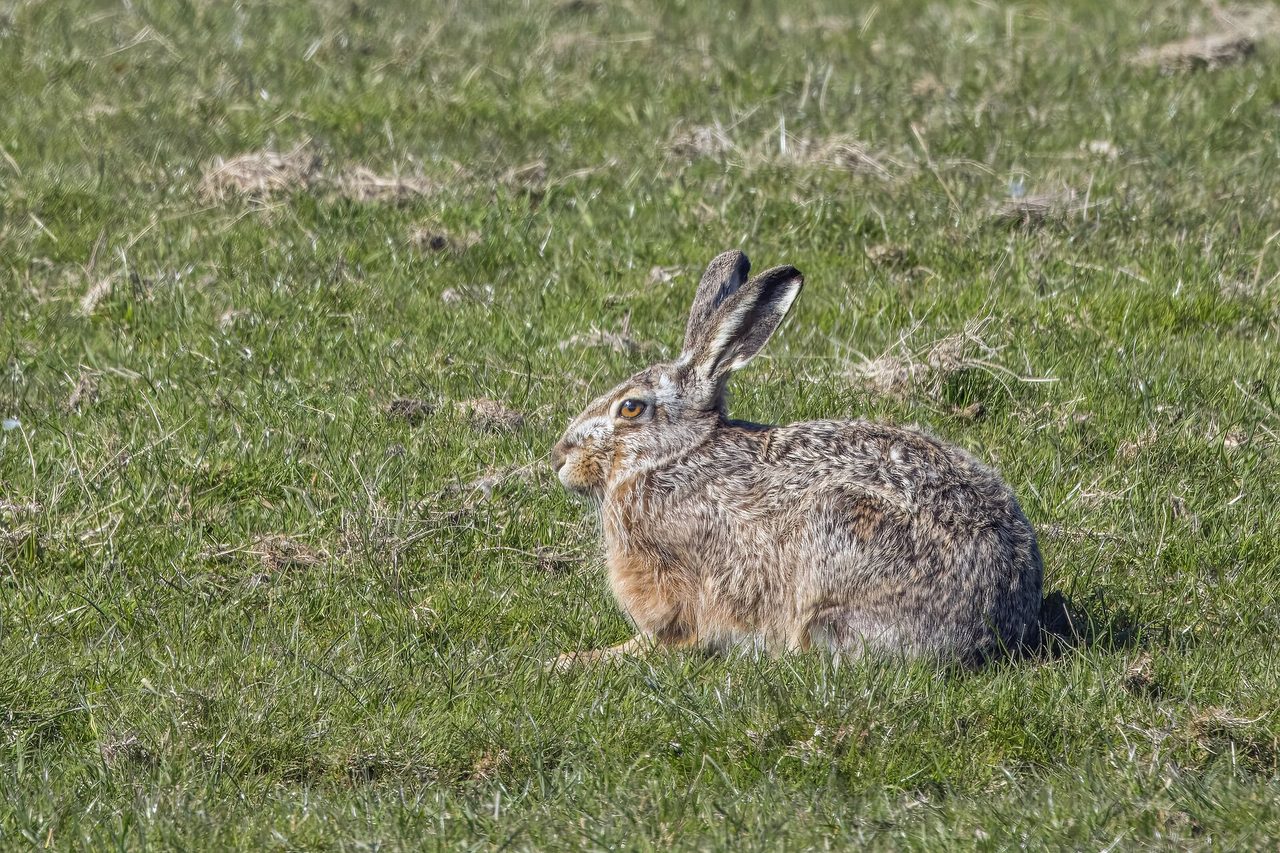
Photo: Charles J. Sharp / Wikimedia Commons (CC BY-SA 4.0)
In brief
Hares (genus Lepus, ~32 species) are large, fast-running lagomorphs found across Europe, Asia, Africa, and the Americas, most classified as Least Concern by the IUCN, though European hare populations have declined significantly since the 1960s due to agricultural intensification.
Also in Animals A to Z · Animals that start with H
By WARN Research & Conservation TeamLast updated
Hares are long-eared, swift-footed mammals belonging to the genus Lepus, which contains around 32 species distributed across every continent except Australia and Antarctica. Related to rabbits but distinctly different, hares are larger, faster, and far more independent from birth — their young, called leverets, arrive fully furred and open-eyed, ready to scatter into the grass within hours of being born. The European hare (Lepus europaeus) is perhaps the most familiar species, synonymous with open farmland across much of western Eurasia, while the snowshoe hare (Lepus americanus) drives a legendary boom-and-bust cycle through North America's boreal forests. From the Arctic tundra to African savannahs, hares have colonised almost every terrestrial biome, playing a critical role as a keystone prey species that sustains predators from foxes to eagles.
~70 km/h
Top running speed
32
Species in genus Lepus
41 days
Average gestation (European hare)
3–4
Litters per year (European hare)
Figures sourced from IUCN Red List — Lepus europaeus (European Hare), 2023 assessment, Animal Diversity Web — Lepus europaeus, Wikipedia — European hare and other references on this page.
Hare: Quick Facts
| Body length | 45–75 cm (European hare) |
|---|---|
| Weight | 2.5–6.5 kg (European hare) |
| Lifespan (wild) | Typically 1–4 years; up to 12 years recorded |
| Gestation | ~41 days (European hare) |
| Litter size | 1–4 leverets |
| Top speed | Up to 70 km/h |
| Diet | Herbivore — grasses, herbs, bark, shoots |
| Habitat | Open farmland, grassland, moorland, tundra, boreal forest |
Scientific Classification
| Kingdom | Animalia |
|---|---|
| Phylum | Chordata |
| Class | Mammalia |
| Order | Lagomorpha |
| Family | Leporidae |
| Genus | Lepus |
| Species (example) | Lepus europaeus (European hare) |
Conservation Status
- IUCN Status
- Least Concern
- Population
- No single global estimate; UK population estimated at 818,500–1,250,000 individuals
- Trend
- Decreasing across much of Europe since the 1960s
- Assessed
- 2023
- CITES
- Not listed (most Lepus species); Hispid hare (Lepus hispidus) listed on CITES Appendix I
Globally Least Concern but several European countries list the European hare as Near Threatened or Vulnerable nationally due to agricultural intensification
Did you know?
Female hares can conceive a second litter while already pregnant with the first — a rare phenomenon called superfetation that allows them to have young at almost different stages of development simultaneously.
Key Facts: Hare
- Hares belong to genus Lepus, with around 32 species found on every continent except Australia and Antarctica.
- Unlike rabbits, newborn leverets are fully furred and open-eyed at birth — a survival strategy for above-ground nesting.
- The European hare can reach speeds of up to 70 km/h, relying on endurance running rather than burrows to escape predators.
- Famous 'March boxing' behaviour is typically a female warding off an overly persistent male, not two rival males fighting.
- Snowshoe hare populations in North America follow a remarkable roughly 10-year boom-and-bust cycle tightly linked to Canada lynx numbers.
- Agricultural intensification since the 1960s has driven significant declines in European hare populations, prompting national Red List listings in several countries.
What is a hare, and how does it differ from a rabbit?
Hares and rabbits share the mammalian order Lagomorpha and the family Leporidae, but they are distinct in fundamental ways. Hares (genus Lepus) are generally larger than rabbits, with proportionally longer hind legs and longer, black-tipped ears that can reach 10 cm or more. The most striking difference lies in how their young enter the world. Rabbit kits are born blind, hairless, and entirely helpless — they spend their early weeks in an underground burrow depending fully on maternal care. Hare leverets, by contrast, are born precocial: fully furred, with open eyes, and capable of hopping within minutes of birth. This is essential because hares do not dig burrows. Instead, they give birth in a shallow surface scrape called a 'form', offering minimal physical shelter. The leveret's only real defence is its ability to freeze, scatter, or eventually run. Hares also feed differently from rabbits: while rabbits favour soft grasses and vegetables, hares are adapted to harder forage — bark, woody shoots, buds, and field crops, particularly in winter. Both animals practise caecotrophy, re-ingesting soft faecal pellets to extract maximum nutrients from tough plant material. Behaviourally, hares are generally solitary animals that come together only during the breeding season, unlike many rabbit species that live in complex social warrens.
Where do hares live, and which species are found around the world?
The approximately 32 species of Lepus have colonised a remarkable range of habitats. The European hare (Lepus europaeus) is native to open grassland, farmland, heathland, and moorland across Europe from the British Isles through the Middle East to Central Asia, and has been introduced to South America and Australia. The snowshoe hare (Lepus americanus) inhabits the boreal forests of Canada and Alaska, where it turns white in winter for camouflage. The Arctic hare (Lepus arcticus) survives on the treeless tundra of the high Arctic. In Africa, the Cape hare (Lepus capensis) ranges across open savannah and semi-desert, while the Abyssinian hare (Lepus habessinicus) occupies the Horn of Africa. The Indian hare (Lepus nigricollis) is widespread across the Indian subcontinent, including Pakistan — a country where WARN's conservation network is active. Mountain hares (Lepus timidus) are found across Scotland, Scandinavia, the Alps, and into Siberia, often sharing range with their competitor the European hare. European hares thrive from sea level to elevations above 2,800 m and prefer landscapes that mix open areas for feeding with adjacent cover from hedgerows or woodland edges. Habitat heterogeneity — a mosaic of different crop types, grassland, and field margins — is consistently identified by researchers as the key driver of high hare density.
How do hares behave, and what is the truth about 'Mad March Hares'?
Hares are primarily crepuscular and nocturnal, emerging at dawn and dusk to feed on grasses, herbs, cereal shoots, and woody vegetation. During daylight hours they rest in their form — a flattened hollow in dense vegetation — where their grizzled brown-grey fur provides remarkable camouflage. Their senses are acute: large eyes positioned laterally give near-360-degree vision, and those long ears can swivel independently to pinpoint sound from any direction. When threatened, a hare's first strategy is stillness and concealment; if that fails, explosive acceleration carries it away at up to 70 km/h, combining speed with sudden directional changes that wrong-foot most predators. The famous 'Mad March Hare' spectacle — immortalised by Lewis Carroll in Alice's Adventures in Wonderland — is not a battle between rival males as once supposed. Research has confirmed it is predominantly a female repelling an overenthusiastic suitor. During the breeding season, which peaks in late winter and spring, males pursue females relentlessly. A female who is not yet receptive rears up on her hind legs and boxes hard at the male's face and chest with her forepaws. This not only discourages premature mating but may also test the male's stamina and commitment as a mate. Successful males that persist through this assessment may then be permitted to mate. European hares can produce three to four litters per year, each of one to four leverets after a gestation of around 41 days.
What threatens hare populations, and why are European hares declining?
Despite holding a global IUCN status of Least Concern, European hare populations across the continent have undergone serious long-term declines since the 1960s, prompting several national Red Lists to classify the species as Near Threatened or Vulnerable. In Germany, Lepus europaeus is listed as Vulnerable. The primary driver is the intensification of modern agriculture: larger field sizes, the loss of field margins, hedgerows, and fallow land, the switch from spring to autumn-sown cereals, and increased pesticide and herbicide use have collectively stripped away the habitat heterogeneity that hares need. Autumn-sown crops grow tall and dense early, reducing access to short swards where leverets shelter and feed. Pesticides reduce the diversity of herbs and invertebrates that young leverets need. Mechanised harvesting directly kills leverets resting in forms hidden within crop fields. Predation by red foxes and raptors such as golden eagles and eagle owls is a significant natural mortality factor, especially during population lows. European Brown Hare Syndrome (EBHS), a haemorrhagic disease caused by a lagovirus, can cause localised mortality events. In North America, snowshoe hare populations naturally swing through roughly 10-year boom-and-bust cycles, a dynamic driven primarily by predation pressure from Canada lynx and reinforced by vegetation recovery. Climate change is an emerging concern: mountain hares that moult to white in winter face a growing camouflage mismatch as snow cover decreases, increasing their vulnerability to predators.
What is being done to help hares recover across their range?
Agri-environment schemes across Europe represent the main policy lever for hare recovery. These schemes incentivise farmers to create field margins, uncultivated buffer strips, beetle banks, and cover crops that restore the habitat heterogeneity hares require. Studies in the UK and Hungary have shown that farms enrolled in higher-tier agri-environment agreements can sustain significantly higher hare densities than intensively managed neighbours. In the UK, hare counts on farmland have been used as a biodiversity indicator under government monitoring programmes. Predator management in game-managed areas, while controversial, has been associated with higher hare densities in some studies, suggesting that predation pressure interacts with habitat quality. Researchers continue to study the epidemiology of European Brown Hare Syndrome to understand how disease interacts with habitat fragmentation. In North America, snowshoe hares are not considered at risk, but monitoring their populations provides one of ecology's clearest windows into predator-prey dynamics, informing broader wildlife management policy. Public awareness is widely considered important: farmers who understand hare ecology are more likely to adjust cultivation timing, delay mowing of field margins until after the main levereting period, and support landscape-level habitat improvements. Greater public knowledge of hare biology translates directly into more sympathetic land management decisions across millions of hectares of farmland.
What WARN Does
WARN publishes this guide for education and is developing support through assessed animal-welfare grants. A species range, source citation or photograph does not establish a recipient or funding agreement. Check /about/where-your-money-goes/#grant-register for published grant and payment records; records not yet published must not be read as zero activity. Browse /appeals/ for the purposes currently available to support.
Hares are a reminder that even common wildlife can quietly disappear when farmland loses its diversity. Supporting WARN helps fund education and rescue work that keeps the public connected to animals like the hare — and to the habitats we all share.
Hare: Frequently Asked Questions
Are hares the same as rabbits?
How fast can a hare run?
Why do hares box in spring?
What do hares eat?
Are hares endangered?
Where do hares live?
Are hares dangerous?
How long do hares live?
How big is a hare?
Sources & References
Population figures, conservation status and biological facts on this page are drawn from authoritative scientific and intergovernmental sources.
- IUCN Red List — Lepus europaeus (European Hare), 2023 assessment
- Animal Diversity Web — Lepus europaeus
- Wikipedia — European hare
- Britannica — Hare
- PMC — Long-term patterns in European brown hare population dynamics in Denmark
- Springer — Habitat requirements of the European brown hare in intensively used agriculture
Terms used on this page
Plain-English definitions, from our wildlife and conservation glossary.
Latest Hare Stories
Quick, fact-checked reads on the hare — amazing facts, key questions and the threats it faces.
Species
Slow Loris: Why the Internet's Favourite Pet Is a Conservation Disaster
The slow loris looks like a cartoon character — and that has nearly destroyed the species. Here is the truth behind the viral videos.
Read the storySpecies
The Snow Leopard: Why the Ghost of the Mountains Is Still Vulnerable
The snow leopard is one of the most elusive big cats on earth, with an estimated 4,000-6,500 individuals across twelve range states — including Pakistan, where WARN is preparing to operate. This briefing explains why the species was downlisted from Endangered to Vulnerable in 2017 and why that is not the success story it sounds like.
Read the storyGuides
Sun Bear vs Moon Bear: The Two Most Trafficked Asian Bears
The sun bear and the Asiatic black bear (moon bear) are the two most commonly trafficked bears in Asia — for the pet trade, for traditional medicine and for bear-bile farming. Here is how to tell them apart.
Read the storyExplore more animals
Discover more animals, their habitats and their conservation status in the WARN wildlife-guide library.