Wildlife Guide · United Kingdom & Europe
Grey Heron
Ardea cinerea
The patient grey angler of Britain's rivers, canals and garden ponds.
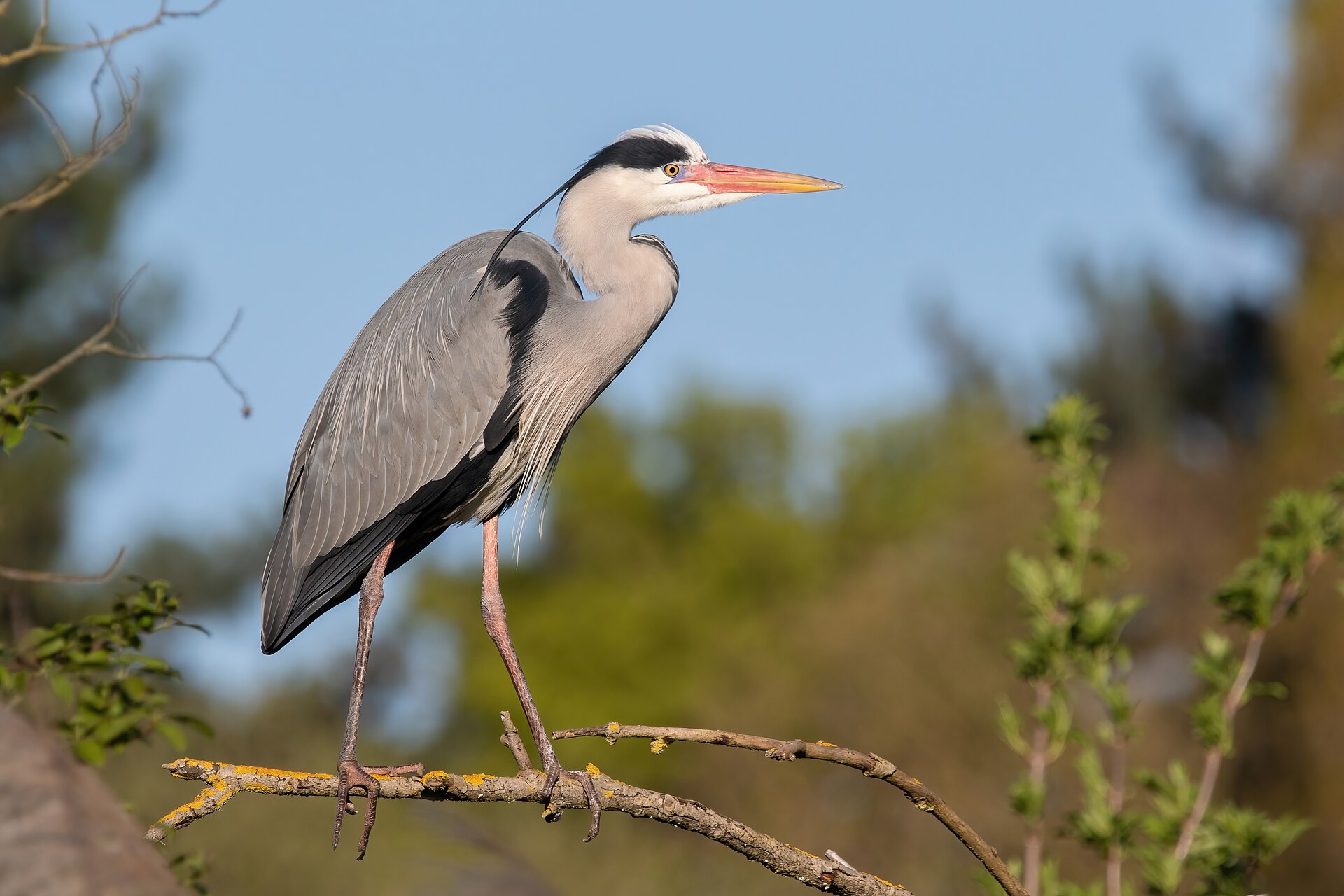
Photo: Alexis Lours / Wikimedia Commons (CC BY 4.0)
In brief
A heron is a long-legged, long-necked wading bird that hunts in shallow water; the grey heron (Ardea cinerea) is the familiar tall grey species of UK and European rivers, lakes and garden ponds, standing up to a metre high and catching fish and amphibians with its sharp bill.
Also in Animals A to Z · Animals that start with G
By WARN Research & Conservation TeamLast updated
The grey heron (Ardea cinerea) is a tall, long-legged wading bird and one of the most familiar large birds of British and European wetlands. Standing up to a metre high, it hunts by standing motionless in shallow water before striking down at fish, frogs and other small animals with its dagger-shaped bill. Grey herons are widespread across the Palearctic, from Scandinavia south to North Africa and east across Asia, and many people meet one at the edge of a river, canal, lake or even a garden pond, where the bird may help itself to ornamental fish. Adaptable and resilient, it is currently classed as Least Concern by the IUCN.
Up to ~1 m
Standing height of an adult grey heron
155–195 cm
Typical wingspan
~25 days
Incubation period for the eggs
Least Concern
IUCN Red List status
Figures sourced from Grey heron — Wikipedia, IUCN Red List — Ardea cinerea, Heron (Ardea) — Encyclopaedia Britannica and other references on this page.
Grey Heron: Quick Facts
| Common name | Grey heron |
|---|---|
| Scientific name | Ardea cinerea |
| Family | Ardeidae (herons) |
| Standing height | Up to about 1 m |
| Length | About 84–102 cm |
| Wingspan | About 155–195 cm |
| Weight | About 1–2 kg |
| Diet | Fish, amphibians, crustaceans, insects, small mammals |
| Habitat | Rivers, lakes, canals, marshes, estuaries, ponds |
| IUCN status | Least Concern |
Scientific Classification
| Kingdom | Animalia |
|---|---|
| Phylum | Chordata |
| Class | Aves |
| Order | Pelecaniformes |
| Family | Ardeidae (herons) |
| Genus | Ardea |
| Species | Ardea cinerea |
Conservation Status
- IUCN Status
- Least Concern. The grey heron is assessed by the IUCN Red List as Least Concern, reflecting an extremely large geographic range across Europe, Africa and Asia and a population that is overall large and not declining at a rate that would warrant a threatened category. It is not listed on the CITES appendices. In the UK it receives general legal protection as a wild bird.
- Population
- Not precisely known; a large global population spread across the Palearctic and beyond
- Trend
- Broadly stable (fluctuates locally with winter severity)
- Assessed
- Most recent IUCN assessment (Least Concern)
- CITES
- Not listed on CITES
Local numbers can fall after severe winters when frozen water blocks hunting, but populations typically recover. The main long-term threats are wetland loss, drainage and pollution.
Key Facts: Grey Heron
- The grey heron is a tall, grey, long-legged wading bird of UK and European wetlands, standing up to about a metre high.
- It hunts by standing still in shallow water and striking down at fish, frogs and other prey with a sharp, dagger-like bill.
- Grey herons are widespread across Europe, Africa and Asia and are common on rivers, canals, lakes and at garden ponds.
- They nest communally in treetop colonies called heronries, laying three to five eggs incubated for around 25 days.
- The IUCN lists the grey heron as Least Concern, with a large range and a generally stable population.
- It is not listed on CITES, and in the UK it is protected under wildlife legislation like other wild birds.
What does a grey heron look like?
The grey heron is unmistakable: a tall, slim wading bird with a grey back and wings, a whitish head and neck, and a bold black stripe running back from the eye into a slender black plume. The underparts are pale, marked with dark streaking down the front of the neck, and the long, powerful bill is yellowish, brightening towards pinkish-orange in the breeding season. Adults stand up to around a metre tall and measure roughly 84–102 cm from bill to tail, with a broad wingspan of about 155–195 cm. Body weight ranges from a little over one kilogram to around two kilograms. In flight the grey heron is distinctive, holding its head drawn back in an S-shape against the shoulders rather than outstretched, with the long legs trailing behind and slow, deep, bowed wingbeats. This retracted-neck flight silhouette is one of the easiest ways to tell a heron from a crane or stork, which fly with the neck extended. Young birds are duller and greyer on the head, lacking the crisp black-and-white head pattern of the adult.
Where do grey herons live and what do they eat?
Grey herons are birds of fresh and coastal waters, found wherever there are shallow margins to hunt in: rivers, streams, canals, lakes, reservoirs, marshes, flooded fields, estuaries and garden ponds. The species ranges widely across the Palearctic, from Scandinavia south to Spain, North Africa and the Middle East and east across much of temperate Asia, with related populations reaching sub-Saharan Africa and Madagascar. In Britain and much of western Europe they are present year-round, though some northern birds move south in hard winters. The grey heron is a patient, opportunistic predator. Its core diet is fish and amphibians, but it also takes crustaceans, aquatic insects, small mammals such as voles and rats, reptiles, and occasionally young birds like ducklings. The classic hunting technique is to stand statue-still in shallow water, or to stalk forward very slowly, then stab or seize prey with a lightning-fast thrust of the neck and bill. This willingness to fish almost anywhere is why herons so readily visit ornamental ponds and take prized fish.
How do grey herons breed and nest?
Grey herons are social nesters. They breed in colonies known as heronries, usually building large stick nests high in tall trees, though reedbeds, cliffs and bushes are sometimes used. In the UK breeding starts early, often from late winter, and the same heronries may be used for many years. A typical clutch is three to five pale blue-green eggs. Both the male and female share incubation, which lasts about 25 days, and both parents feed the chicks by regurgitation. The young remain in or around the nest for several weeks before fledging. Heronries can range from a single pair to dozens of nests clustered together, and the noisy, conspicuous gatherings are easy to spot once trees are bare. Outside the breeding season herons are more solitary, each bird often defending a favoured stretch of bank or shoreline. In the wild many grey herons live only a few years, with high mortality among young birds, but individuals can survive much longer; ringing records include birds living into their twenties.
Heron vs crane vs stork: how to tell them apart
| Feature | Heron (grey heron) | Crane / stork |
|---|---|---|
| Flight posture | Neck folded back in an S-shape | Neck held straight out |
| Main feeding | Stands or stalks in shallow water for fish and amphibians | Often feeds in fields, grassland or marshes; varied diet |
| Typical nesting | Colonial stick nests in treetop heronries | Cranes nest on the ground; storks often on tall structures |
| Family | Ardeidae | Gruidae (cranes) / Ciconiidae (storks) |
What WARN Does
World Animal Rescue Network does not run dedicated field projects for grey herons, which are common, widespread and classed as Least Concern, and live largely outside the countries where WARN's partners work partner countries. This guide is part of WARN's free educational work, written to help people understand and appreciate the wildlife around them. The threats that do affect herons locally, above all the loss, pollution and drainage of wetlands, are the same pressures that harm many of the rarer animals WARN does work to protect.
If guides like this deepen your love of wildlife, supporting WARN helps keep this free educational work going and protects vulnerable animals elsewhere.
Grey Heron: Frequently Asked Questions
Is a grey heron a protected bird in the UK?
Why do herons stand on one leg?
Do herons really eat fish from garden ponds?
What is the difference between a heron and a crane or stork?
What do grey herons eat?
Where do grey herons live?
Are grey herons dangerous?
How long do grey herons live?
How big is a grey heron?
Sources & References
Population figures, conservation status and biological facts on this page are drawn from authoritative scientific and intergovernmental sources.
Terms used on this page
Plain-English definitions, from our wildlife and conservation glossary.
Latest Grey Heron Stories
Quick, fact-checked reads on the grey heron — amazing facts, key questions and the threats it faces.
Species
Slow Loris: Why the Internet's Favourite Pet Is a Conservation Disaster
The slow loris looks like a cartoon character — and that has nearly destroyed the species. Here is the truth behind the viral videos.
Read the storySpecies
The Snow Leopard: Why the Ghost of the Mountains Is Still Vulnerable
The snow leopard is one of the most elusive big cats on earth, with an estimated 4,000-6,500 individuals across twelve range states — including Pakistan, where WARN is preparing to operate. This briefing explains why the species was downlisted from Endangered to Vulnerable in 2017 and why that is not the success story it sounds like.
Read the storyGuides
Sun Bear vs Moon Bear: The Two Most Trafficked Asian Bears
The sun bear and the Asiatic black bear (moon bear) are the two most commonly trafficked bears in Asia — for the pet trade, for traditional medicine and for bear-bile farming. Here is how to tell them apart.
Read the storyExplore more animals
Discover more animals, their habitats and their conservation status in the WARN wildlife-guide library.