Wildlife Guide · Pakistan
Himalayan Brown Bear
Ursus arctos isabellinus
The vanishing giant of Pakistan's roof-of-the-world plateaus.
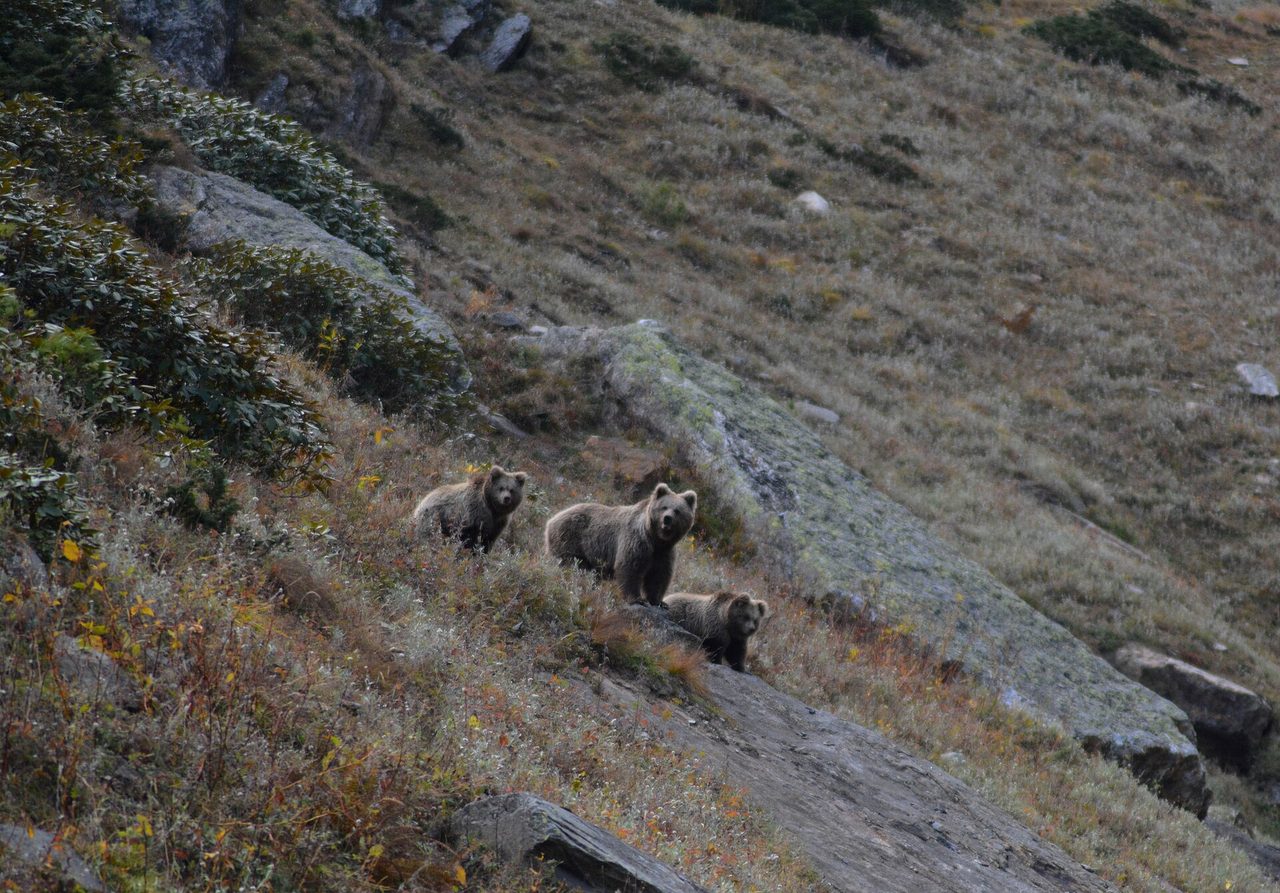
Photo: Niazulkhan / Wikimedia Commons (CC BY 4.0)
In brief
A Himalayan brown bear (Ursus arctos isabellinus) is a high-altitude subspecies of brown bear native to the western Himalayas of Pakistan, India and Nepal, recognisable by its sandy to reddish-brown coat and considered Critically Endangered within Pakistan even though the wider brown bear species is listed as Least Concern globally.
Also in Animals A to Z · Animals that start with H
By WARN Research & Conservation TeamLast updated
The Himalayan brown bear is a pale, reddish-coated subspecies of brown bear that survives on the high-altitude meadows and cold deserts of the western Himalayas. In Pakistan it clings to a handful of fragmented mountain pockets, with its last real stronghold on the Deosai Plateau. Once widespread, it now occupies only a fraction of its former range and is treated as Critically Endangered within Pakistan.
~3,000–5,500 m
Altitude range it lives at
66
Bears counted in Deosai NP and nearby valleys (2022 survey)
~150–200
Estimated remaining in Pakistan
~2%
Of former range still occupied
Figures sourced from Wikipedia — Himalayan brown bear, IUCN Red List — Ursus arctos (Brown Bear) assessment, IUCN Red List — Brown Bear assessment PDF and other references on this page.
Himalayan Brown Bear: Quick Facts
| Lifespan | ~20–30 years in the wild |
|---|---|
| Weight | Roughly 70–250 kg; males much heavier than females |
| Length | Males ~1.5–2.2 m; females ~1.4–1.8 m |
| Diet | Omnivore — grasses, roots, insects, marmots, small mammals, carrion, occasional livestock |
| Gestation | ~180–266 days total including delayed implantation |
| Young per birth | Usually 1–3 cubs, most often 2 |
| Baby name | Cub |
| Group name | A sloth or sleuth of bears (bears are mostly solitary) |
| Habitat altitude | ~3,000–5,500 m alpine meadow and cold high desert |
| CITES | Appendix II (Pakistan populations) |
Scientific Classification
| Kingdom | Animalia |
|---|---|
| Phylum | Chordata |
| Class | Mammalia |
| Order | Carnivora |
| Family | Ursidae |
| Genus | Ursus |
| Species | Ursus arctos (Linnaeus, 1758) |
| Subspecies | Ursus arctos isabellinus (Horsfield, 1826) — the Himalayan brown bear |
Conservation Status
- IUCN Status
- Not separately assessed by the IUCN at subspecies level; the brown bear species (Ursus arctos) is Least Concern, while Pakistan treats this subspecies as Critically Endangered
- Population
- No reliable rangewide estimate; Pakistan is thought to hold ~150–200, with 66 counted in and around Deosai National Park in a 2022 survey
- Trend
- Decreasing in Pakistan and across the southern Himalayan range
- Assessed
- 2017 (species-level IUCN assessment); 2022 (Deosai survey count)
- CITES
- CITES Appendix II for Pakistan populations (the species is on Appendix I for Bhutan, China, Mexico and Mongolia)
The Himalayan brown bear is a subspecies and has no standalone IUCN Red List assessment, so the global Least Concern status of the brown bear species badly overstates its security in Pakistan, where it is regarded as Critically Endangered.
Did you know?
Despite being one of the smaller-bodied brown bear subspecies, the Himalayan brown bear is genetically ancient — research places it as an early offshoot of the brown bear lineage, distinct from the bears that later gave rise to grizzlies and polar bears.
Key Facts: Himalayan Brown Bear
- It is a subspecies of brown bear (Ursus arctos isabellinus), described by Horsfield in 1826, adapted to cold, treeless high mountains.
- Pakistan's population is tiny and fragmented, with its main refuge on the Deosai Plateau in Gilgit-Baltistan.
- The whole brown bear species is Least Concern globally (~110,000 animals), but the Himalayan subspecies in Pakistan is regarded as Critically Endangered.
- Major threats are poaching for body parts, the illegal capture of cubs as pets and for 'dancing bear' use, retaliatory killing over livestock, and habitat loss.
- Like all brown bears it hibernates through the harsh winter, typically denning from roughly October until April or May.
- It is an omnivore, eating grasses, roots, insects, marmots and other small mammals, and occasionally livestock.
Why it is endangered in Pakistan
Although brown bears as a species are abundant across the northern hemisphere, the Himalayan brown bear sits at the southern, most fragile edge of that range. In Pakistan it is reduced to small, isolated subpopulations scattered across Gilgit-Baltistan, Chitral and adjoining ranges, with the Deosai Plateau holding the most viable group. Low numbers, slow reproduction and the physical isolation of mountain valleys mean each pocket is vulnerable to local extinction. National assessments in Pakistan therefore treat the bear as Critically Endangered, a far harsher rating than the species' global Least Concern status, because the figures that matter here are the few hundred animals left inside the country, not the worldwide total.
Behaviour and ecology
This is a creature of extremes, living higher than almost any other bear, on alpine meadows, scree slopes and cold high-altitude desert between roughly 3,000 and 5,500 metres. It is a generalist omnivore, grazing on grasses and roots, digging out marmots and other burrowing rodents, raiding insect colonies, and taking carrion or livestock when the chance arises. To survive brutal winters it hibernates in dens for several months, usually emerging in spring lean and hungry. Cubs are born during the winter den period, tiny and helpless, and stay with their mother for two years or more, which keeps population growth slow and recovery from losses painfully gradual.
Threats: poaching, pet cubs and 'dancing bears'
The pressures on this bear are overwhelmingly human. Bears are killed for their fur, claws and internal organs, which feed an illegal trade in body parts, including bile prized in some traditional remedies. Cubs are especially valuable alive: orphaned or stolen young are trafficked as exotic pets and, in parts of South Asia, exploited as 'dancing bears' or baiting animals, a cruel use that condemns the animal to a short, painful life. On top of this, herders sometimes kill bears in retaliation for attacks on sheep and goats, and expanding grazing, infrastructure and disturbance steadily shrink the quiet high ground the bears need.
What rescue and protection involve
Protecting this subspecies means work on several fronts at once. Maintaining safe, undisturbed core habitat such as Deosai is essential, alongside anti-poaching patrols and tighter enforcement against the trade in cubs and body parts. Where bears are confiscated from the pet or performance trade, they need lifelong sanctuary care, because animals raised in captivity usually cannot return to the wild. Just as important is defusing conflict with herders through guarding, compensation and education, so that a bear seen near livestock is reported rather than shot. Each of these depends on trained local teams operating in remote, hard-to-reach mountains.
Himalayan brown bear vs Tibetan brown bear (blue bear)
| Feature | Himalayan brown bear | Tibetan brown bear (blue bear) |
|---|---|---|
| Subspecies | Ursus arctos isabellinus | Ursus arctos pruinosus |
| Main range | Western Himalayas: Pakistan, India, Nepal | Eastern Tibetan Plateau, China |
| Coat | Sandy to reddish / isabelline brown | Darker brown, often with bluish-grey tones and pale collar |
| Habitat | High alpine meadow and cold desert ~3,000–5,500 m | High Tibetan plateau grassland and shrubland |
| Status note | Critically Endangered within Pakistan | Poorly known; CITES Appendix II |
| CITES | Appendix II (Pakistan populations) | Appendix II |
What WARN Does
WARN publishes this guide for education and is developing support through assessed animal-welfare grants. A species range, source citation or photograph does not establish a recipient or funding agreement. Check /about/where-your-money-goes/#grant-register for published grant and payment records; records not yet published must not be read as zero activity. Browse /appeals/ for the purposes currently available to support.
By funding rescue and anti-trafficking partners on the ground in Pakistan, you help give confiscated cubs lifelong sanctuary and protect the last Himalayan brown bears of the Deosai high country.
Himalayan Brown Bear: Frequently Asked Questions
Are Himalayan brown bears dangerous?
How many Himalayan brown bears are left?
Why is the Himalayan brown bear endangered?
What is a baby Himalayan brown bear called?
Where do himalayan brown bears live?
What do Himalayan brown bears eat?
Sources & References
Population figures, conservation status and biological facts on this page are drawn from authoritative scientific and intergovernmental sources.
- Wikipedia — Himalayan brown bear
- IUCN Red List — Ursus arctos (Brown Bear) assessment
- IUCN Red List — Brown Bear assessment PDF
- Gilgit-Baltistan Forests, Wildlife & Environment — Himalayan Brown Bear Survey 2022 (Deosai)
- IUCN/IBA International Association for Bear Research and Management — Brown bear (Ursus arctos)
- Animal Diversity Web — Ursus arctos (life history, reproduction)
- CITES — Appendices listing for Ursus arctos
Terms used on this page
Plain-English definitions, from our wildlife and conservation glossary.
Latest Himalayan Brown Bear Stories
Quick, fact-checked reads on the himalayan brown bear — amazing facts, key questions and the threats it faces.
Species
12 Amazing Facts About the Himalayan Brown Bear, the Real Animal Behind the Yeti Legend
From a 650,000-year-old lineage to its last stronghold on Pakistan's Deosai Plateau, here are 12 striking facts about the rare Himalayan brown bear.
Read the storySpecies
How Big Is a Himalayan Brown Bear — and How Many Are Left?
How large, how long-lived, how many remain and whether they're dangerous: clear, sourced answers to the most-asked questions about the Himalayan brown bear.
Read the storySpecies
Why Is the Himalayan Brown Bear Endangered — and What's Being Done?
Poaching, the cub trade and shrinking high-altitude habitat have pushed the Himalayan brown bear to the edge in Pakistan. Here's why — and what gives it hope.
Read the storyExplore more animals
Discover more animals, their habitats and their conservation status in the WARN wildlife-guide library.