Wildlife Guide · Sub-Saharan Africa
Hyena
Crocuta crocuta (Erxleben, 1777)
Africa's misunderstood predator — matriarchal, vocal and far more successful than lions at hunting.
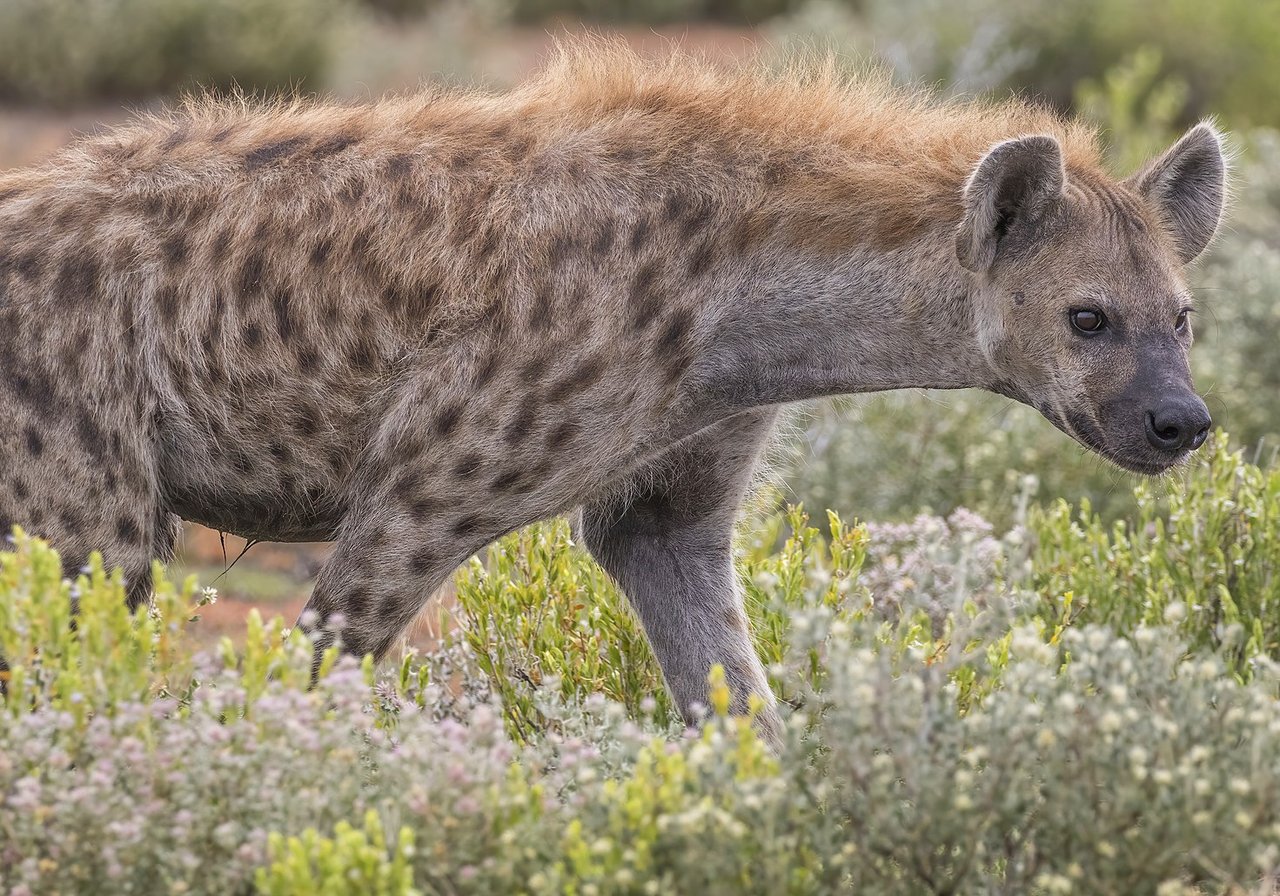
Source: Wikimedia Commons
In brief
The spotted hyena (Crocuta crocuta) is Africa's most common large carnivore, living in matriarchal clans on the savanna; listed as Least Concern, it is a skilled hunter — not merely a scavenger — facing persecution and habitat loss.
Also in Animals A to Z · Animals that start with H
By WARN Research & Conservation TeamLast updated
The spotted hyena is Africa's most common large carnivore and one of the most successful hunters on the savanna — yet it suffers from centuries of misrepresentation as a cowardly scavenger. Spotted hyenas live in clans of up to 80 individuals with a strict female-dominated hierarchy; females are larger and more aggressive than males, an rarity among mammals. They hunt in coordinated groups, taking zebra, wildebeest and antelope, and communicate through an extraordinary repertoire of whoops, giggles and groans. Listed as Least Concern, spotted hyenas remain widespread but face persecution from farmers and decline where prey and habitat disappear.
Least Concern
IUCN Red List status (2014 assessment)
47,000
Estimated mature individuals (IUCN minimum)
80
Maximum clan size
Appendix II
CITES listing
Figures sourced from IUCN Red List — Crocuta crocuta, CITES — Checklist of CITES Species, IUCN Hyaena Specialist Group .
Hyena: Quick Facts
| Weight | 40–90 kg (females larger than males) |
|---|---|
| Social unit | Clan of up to 80 individuals |
| Diet | Carnivorous — hunts and scavenges |
| Distinctive feature | Sloping back; powerful jaws |
| Vocalisation | Whoops, giggles, groans — individually distinct |
| CITES | Appendix II |
Scientific Classification
| Kingdom | Animalia |
|---|---|
| Phylum | Chordata |
| Class | Mammalia |
| Order | Carnivora |
| Family | Hyaenidae |
| Genus | Crocuta |
| Species | Crocuta crocuta (Erxleben, 1777) |
Conservation Status
- IUCN Status
- Least Concern (IUCN, 2014). Striped and brown hyenas Near Threatened.
- Population
- 47,000–87,000 mature spotted hyenas
- Trend
- Stable or slightly decreasing
- Assessed
- 2014
- CITES
- Appendix II
Key Facts: Hyena
- Spotted hyenas are skilled hunters, not just scavengers — they kill most of their own prey.
- Females are larger and dominant over males — a rare reversal among mammals.
- Hyena clans can contain up to 80 individuals with complex social hierarchies.
- Their 'laugh' is a stress signal, not amusement — each hyena has a unique voice.
- Spotted hyenas have the strongest jaws relative to size of any mammalian carnivore.
- Persecution by farmers and decline of prey are the main threats.
Three hyena species
Four hyena species exist, in three genera. The spotted hyena (Crocuta crocuta) is the largest and most social, ranging across sub-Saharan Africa.
The striped hyena (Hyaena hyaena) is smaller, more solitary, and ranges from North Africa through the Middle East to India — listed as Near Threatened. The brown hyena (Parahyaena brunnea) is restricted to southern Africa and is Near Threatened. The aardwolf (Proteles cristata) is a hyena relative that eats termites. This guide focuses on the spotted hyena, the species most associated with African savanna and the one most frequently searched.
Matriarchal society and communication
Spotted hyena clans are led by an alpha female and her allies. Females inherit rank above males and invest heavily in their offspring — hyena mothers produce exceptionally rich milk, and cubs compete fiercely.
Clan members cooperate for nursing position from birth. Clan members cooperate to defend territory, raise cubs communally in a shared den, and hunt together. Communication is sophisticated: whoops carry individual identity over several kilometres; giggles signal submission or stress during feeding competition; groans and grunts coordinate group movement. Research in the Maasai Mara and Ngorongoro Crater has revealed hyena intelligence comparable to some primates.
Hunting and ecology
Contrary to popular belief, spotted hyenas kill 60–95% of the food they eat, depending on the population. They hunt zebra, wildebeest, Thomson's gazelle and other ungulates, often working in groups to isolate weak or young animals. Their powerful jaws can crush bone, allowing them to extract marrow and nutrients other predators leave. Hyenas compete with lions — sometimes losing kills to larger prides, sometimes stealing lion kills through mobbing behaviour. As both predator and scavenger, hyenas clean carcasses and reduce disease spread, playing an essential ecological role.
Conservation and persecution
The IUCN lists the spotted hyena as Least Concern with an estimated 47,000–87,000 mature individuals and a stable or slightly decreasing trend. Persecution remains significant: farmers shoot and poison hyenas suspected of killing livestock, though hyenas more often scavenge dead animals than kill healthy cattle. Habitat loss and depletion of wild prey from bushmeat hunting reduce hyena numbers in West and Central Africa. CITES Appendix II regulates international trade. Education correcting the 'cowardly scavenger' stereotype helps build public support for hyena conservation.
What WARN Does
WARN publishes this hyena guide as free public education. African savanna carnivores face the same habitat and prey depletion pressures that drive our work against bushmeat hunting and illegal wildlife trade in partner countries.
If this guide helps you understand wildlife and the pressures it faces, a gift to WARN supports habitat protection and free public education in our partner countries.
Hyena: Frequently Asked Questions
Are hyenas dogs or cats?
Do hyenas only scavenge?
Why do hyenas laugh?
Are hyenas dangerous to humans?
How many hyena species are there?
What do hyenas eat?
Where do hyenas live?
How long do hyenas live?
How big is a hyena?
Sources & References
Population figures, conservation status and biological facts on this page are drawn from authoritative scientific and intergovernmental sources.
Terms used on this page
Plain-English definitions, from our wildlife and conservation glossary.
Latest Hyena Stories
Quick, fact-checked reads on the hyena — amazing facts, key questions and the threats it faces.
Explore more animals
Discover more animals, their habitats and their conservation status in the WARN wildlife-guide library.