Wildlife Guide · Pakistan
Indus River Dolphin
Platanista minor
A nearly blind freshwater dolphin that swims on its side through the murk of the Indus.
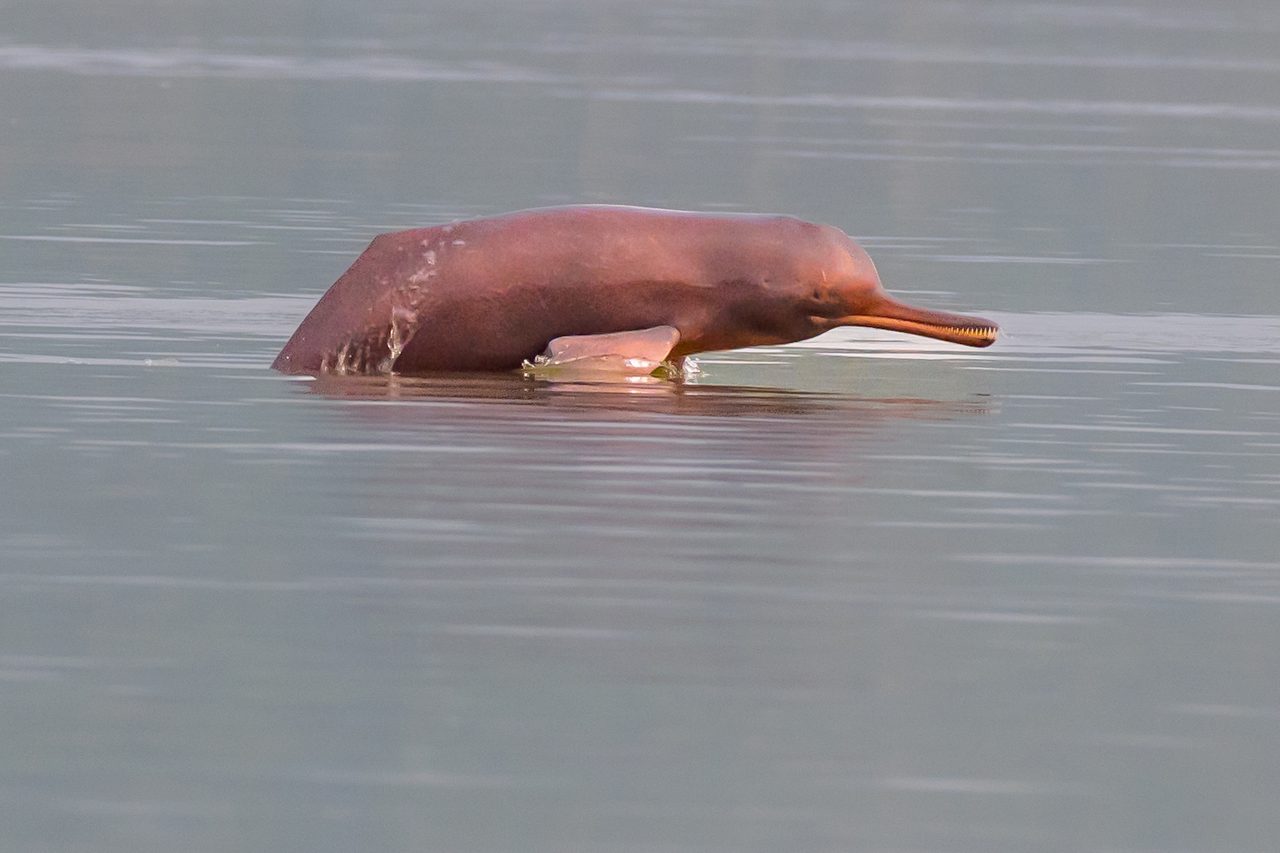
Photo: Munshi Abul Barakat / Wikimedia Commons (CC BY 4.0)
In brief
The Indus River dolphin (Platanista minor), or bhulan, is a small, nearly blind freshwater dolphin found only in the Indus River system of Pakistan; it is the national mammal of Pakistan and is classified as Endangered, with fewer than about 2,000 mature individuals remaining.
Also in Animals A to Z · Animals that start with I
How you can help
You can support the related appeal — read its purpose, recipient status and fund terms first — or give once to where it is needed most. Sharing accurate information helps too.
By WARN Research & Conservation TeamLast updated
The Indus River dolphin, known locally as the bhulan, is one of the world's rarest freshwater dolphins and the national mammal of Pakistan. Functionally blind, it navigates the cloudy waters of the Indus River system almost entirely by echolocation, often swimming on its side. Once spread across some 3,400 km of river, it now survives in a fragmented range carved up by irrigation barrages and water diversion.
~1,987
Mature individuals counted in the 2017 survey (IUCN, 2021)
Endangered
IUCN Red List status, assessed 2021
~80%
Decline in its historical river range
Appendix I
CITES listing — strictest protection
Figures sourced from IUCN Red List — Platanista minor (Indus River Dolphin), Endangered, assessed 2021, WWF — Indus River Dolphin species profile, WWF-Pakistan — Indus River Dolphin programme and other references on this page.
Indus River Dolphin: Quick Facts
| Lifespan | Up to ~30 years (older individuals recorded) |
|---|---|
| Weight | ~70-110 kg |
| Length | Males ~2-2.2 m; females ~2.4-2.6 m |
| Diet | Catfish, carp, prawns and other bottom invertebrates (carnivore) |
| Gestation | ~8-9 months |
| Young per birth | 1 calf (~70 cm at birth) |
| Baby name | Calf |
| Group name | Pod (usually seen alone or in small loose groups) |
| Vision | Functionally blind — no crystalline eye lens; uses echolocation |
| CITES | Appendix I |
Scientific Classification
| Kingdom | Animalia |
|---|---|
| Phylum | Chordata |
| Class | Mammalia |
| Order | Artiodactyla (Cetacea) |
| Family | Platanistidae |
| Genus | Platanista |
| Species | Platanista minor (Owen, 1853) |
Conservation Status
- IUCN Status
- Endangered
- Population
- ~1,987 mature individuals (2017 survey, reported in the 2021 IUCN assessment)
- Trend
- Decreasing
- Assessed
- 2021
- CITES
- Appendix I
Long listed as a subspecies of the South Asian river dolphin; recognised as a full species (Platanista minor) in 2021. A tiny remnant population persists in the Beas River, India, but the species is overwhelmingly confined to Pakistan's Indus River system.
Did you know?
The Indus River dolphin usually swims on its side, dragging a flipper along the riverbed — a strange habit that helps it find prey it cannot see.
Key Facts: Indus River Dolphin
- It is the national mammal of Pakistan and survives almost entirely within the Indus River system there, with a tiny remnant in India's Beas River.
- It is functionally blind — it lacks a crystalline eye lens and relies on echolocation to hunt in murky water.
- Adults typically swim on their side, trailing a flipper along the riverbed to detect prey.
- Females are larger than males, reaching about 2.4-2.6 m versus roughly 2-2.2 m for males.
- Irrigation barrages have split the population into isolated subpopulations and divert the water it depends on.
- After near-collapse, conservation work has helped numbers recover from a few hundred to close to 2,000, but the species remains Endangered.
Why it is endangered
The Indus River dolphin is threatened above all by the engineering of its own river. Since the 19th century, a network of dams and irrigation barrages has been built across the Indus, chopping a once-continuous range of roughly 3,400 km into fragmented stretches and reducing the species' distribution by around 80 percent. These barrages block movement between subpopulations and divert huge volumes of water into canals, where dolphins regularly become stranded as flows drop. Additional pressures include entanglement in fishing nets, water pollution, and historical hunting for meat and oil. The IUCN assessed the species as Endangered in 2021, noting an estimated population of about 1,987 mature individuals and a continuing decline driven by escalating demand for Indus water.
Behaviour and ecology
This is a dolphin built for a world without light. Living in heavily silt-laden water, it has lost the use of functional eyes — it has no crystalline lens and can likely only sense light direction and intensity — and instead 'sees' through a near-constant stream of echolocation clicks. It commonly swims on one side, sweeping a flipper near the bottom to find prey, then rights itself to breathe. Its diet is made up of bottom-dwelling fish such as catfish and carp along with prawns and other invertebrates. The body is stocky and brownish-grey, with a long tooth-lined beak, a bulging forehead, tiny pinhole eyes, and a low ridge rather than a tall dorsal fin.
Reproduction and life cycle
Indus River dolphins reproduce slowly, which makes recovery from population crashes difficult. After a gestation of roughly 8-9 months, a female gives birth to a single calf measuring around 70 cm at birth. The calf nurses for up to about a year and stays closely associated with its mother during early life. Animals are thought to live up to around 30 years, with exceptional individuals recorded older. Because reproduction is slow and the population is small and fragmented, even modest losses from canal stranding or net entanglement can have an outsized effect on the species' long-term survival.
What rescue and protection involve
Protecting the bhulan is as much about water management as about the animals themselves. Front-line conservation centres on rescuing dolphins that become trapped in irrigation canals when barrage gates divert flow, then safely returning them to the main river. It also means patrolling against illegal fishing and harmful net use, monitoring populations through coordinated surveys, securing minimum environmental flows past barrages, and working with riverside communities whose livelihoods are tied to the same water. Because the species lives only in one river system, the health of the Indus dolphin is a direct indicator of the health of the river that millions of people also depend on.
Indus River dolphin vs Ganges River dolphin
| Feature | Indus River dolphin | Ganges River dolphin |
|---|---|---|
| Scientific name | Platanista minor | Platanista gangetica |
| Local name | Bhulan | Susu / shushuk |
| Main range | Indus River system, Pakistan | Ganges-Brahmaputra-Meghna system, India/Bangladesh/Nepal |
| Vision | Functionally blind (no eye lens) | Functionally blind (no eye lens) |
| IUCN status | Endangered (2021) | Endangered |
| Taxonomy | Recognised as a separate species in 2021 | Recognised as a separate species in 2021 |
What WARN Does
WARN publishes this guide for education and is developing support through assessed animal-welfare grants. A species range, source citation or photograph does not establish a recipient or funding agreement. Check /about/where-your-money-goes/#grant-register for published grant and payment records; records not yet published must not be read as zero activity. Browse /appeals/ for the purposes currently available to support.
Every gift to WARN's habitat work helps fund the Pakistan-based partner teams who pull stranded bhulan from irrigation canals and keep the Indus flowing for its last dolphins.
How can I help save the indus river dolphin?
Explore practical ways to support the indus river dolphin, from everyday choices and sharing reliable information to reviewing a related appeal before giving.
Explore ways to support
Read the related appeal’s purpose, recipient status and fund terms. Choose an affordable gift after checking what is proposed and what has been reported.
Ease the pressures
Avoid the wildlife trade and souvenirs, never buy wild animals as pets, and choose sustainable, habitat-friendly products — the threats behind the indus river dolphin's decline fall when demand does.
Spread the word
Share accurate, sourced information about the indus river dolphin. Wider awareness is what turns concern into lasting protection.
Indus River Dolphin: Frequently Asked Questions
How can I help save the indus river dolphin?
How many Indus River dolphins are left?
Why is the Indus River dolphin blind?
What do Indus River dolphins eat?
How big are Indus River dolphins?
Are Indus River dolphins dangerous to humans?
What is a baby Indus River dolphin called and how is it born?
Sources & References
Population figures, conservation status and biological facts on this page are drawn from authoritative scientific and intergovernmental sources.
- IUCN Red List — Platanista minor (Indus River Dolphin), Endangered, assessed 2021
- WWF — Indus River Dolphin species profile
- WWF-Pakistan — Indus River Dolphin programme
- NOAA Fisheries — Indus River Dolphin
- Braulik et al. (2021), taxonomic revision recognising Platanista minor as a separate species
- CITES — Appendices (Platanista listed in Appendix I)
Terms used on this page
Plain-English definitions, from our wildlife and conservation glossary.
Latest Indus River Dolphin Stories
Quick, fact-checked reads on the indus river dolphin — amazing facts, key questions and the threats it faces.
Species
11 Amazing Facts About the Indus River Dolphin, the Bhulan That Swims on Its Side
From swimming sideways to hunting in total darkness, here are 11 surprising facts about the Indus River dolphin, one of the world's rarest freshwater dolphins.
Read the storySpecies
Indus River Dolphin vs Ganges River Dolphin: What's the Difference?
They look nearly identical and both are blind, but the Indus and Ganges river dolphins are now classed as separate species. Here's how to tell them apart.
Read the storySpecies
Why Is the Indus River Dolphin Blind? How a Dolphin Learned to See With Sound
The Indus River dolphin has eyes but cannot see images. Here's why it lost its sight and how echolocation lets it hunt in total darkness.
Read the storyExplore more animals
Discover more animals, their habitats and their conservation status in the WARN wildlife-guide library.