Wildlife Guide · Australia
Kangaroo
Macropus and Osphranter spp.
The world's largest marsupial, hopping across Australia with a joey in the pouch.
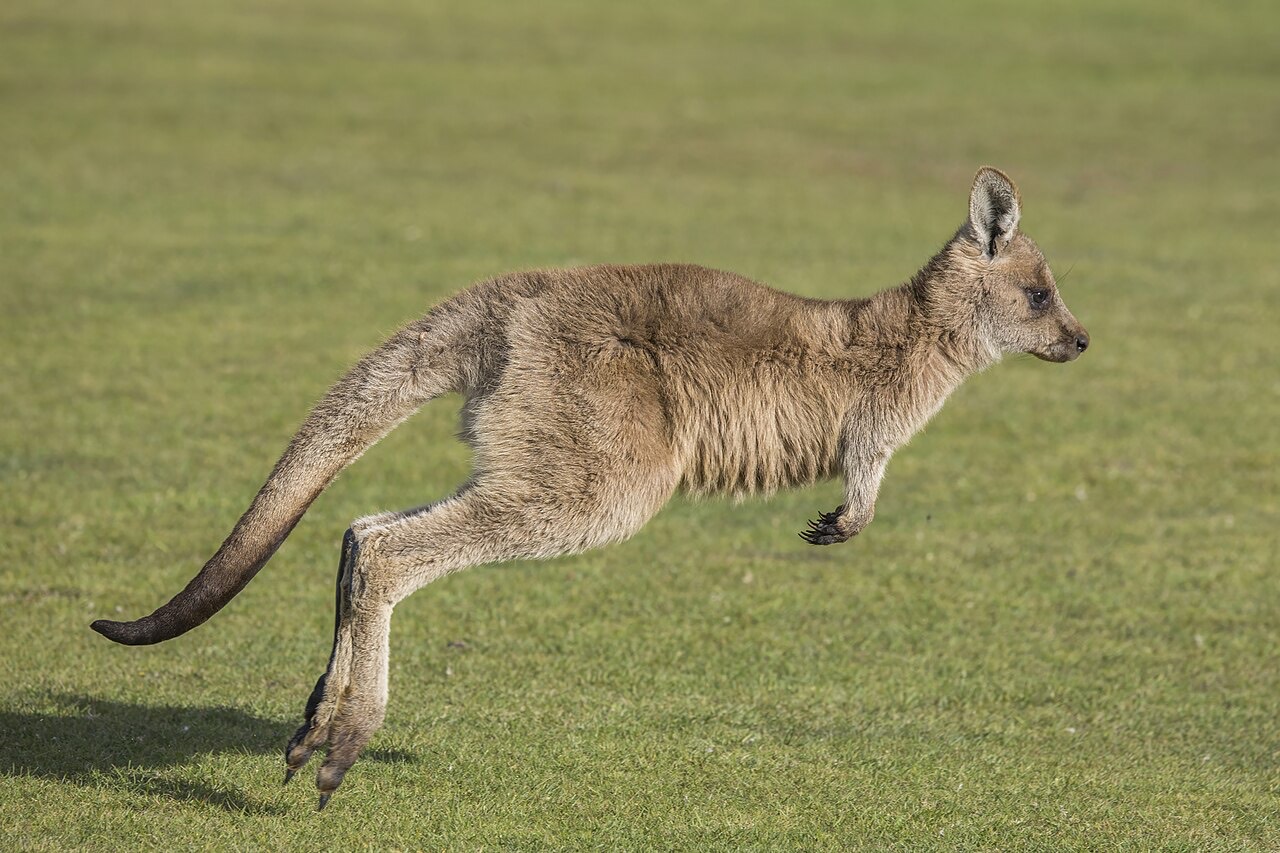
Source: Wikimedia Commons via Wikipedia “Kangaroo”
In brief
A kangaroo is a large hopping marsupial native to Australia and the world's biggest marsupial, carrying its young, called a joey, in a pouch; the main kangaroo species are widespread and assessed as Least Concern.
Also in Animals A to Z · Animals that start with K
By WARN Research & Conservation TeamLast updated
Kangaroos are large, hopping marsupials found only in Australia and are the biggest marsupials alive today. The name is usually applied to the four largest species in the family Macropodidae: the red kangaroo, eastern grey kangaroo, western grey kangaroo, and antilopine kangaroo. These plant-eaters travel by powerful two-footed hops, balance on a thick muscular tail, and raise tiny, jellybean-sized young called joeys inside a forward-opening pouch. Most kangaroo species are abundant and listed as Least Concern, but they sit at the centre of ongoing debates about welfare, commercial harvesting, and government-managed culling.
4
Large species commonly called kangaroos
~90 kg
Weight of a large male red kangaroo (about 200 lb)
>70 km/h
Top hopping speed in short bursts
~50
Smaller related macropod species in the same family
Figures sourced from IUCN Red List - Red Kangaroo (Osphranter rufus), Wikipedia - Kangaroo, Wikipedia - Red kangaroo and other references on this page.
Kangaroo: Quick Facts
| Lifespan | About 6 years in the wild; 20+ years possible in captivity |
|---|---|
| Weight | Large male red kangaroo up to ~90 kg (200 lb) |
| Size | Largest males stand up to ~2 m (6.5 ft) tall |
| Diet | Herbivore, mainly grasses and other low plants |
| Gestation | About 1 month (roughly 30-34 days) |
| Young | Usually one joey at a time |
| Baby name | Joey |
| Group name | Mob (also court or troupe) |
| Top speed | Bursts over 70 km/h; cruising ~20-25 km/h |
| CITES | Not listed on CITES appendices |
Scientific Classification
| Kingdom | Animalia |
|---|---|
| Phylum | Chordata |
| Class | Mammalia |
| Infraclass | Marsupialia |
| Order | Diprotodontia |
| Family | Macropodidae |
| Genera | Macropus and Osphranter |
Conservation Status
- IUCN Status
- Least Concern (for the four large kangaroo species)
- Population
- Tens of millions across Australia; the large species number in the millions
- Trend
- Stable for the main kangaroo species
- Assessed
- 2016 (red kangaroo, Osphranter rufus, assessed 2014)
- CITES
- Not listed on CITES appendices
Status varies across the ~50 species in family Macropodidae; most are Least Concern, but a few relatives such as the black wallaroo are Near Threatened.
Did you know?
Female kangaroos can hit pause on pregnancy: through embryonic diapause they keep a tiny embryo on hold until the joey in the pouch is ready to leave, letting them breed efficiently in Australia's unpredictable climate.
Key Facts: Kangaroo
- Kangaroos are marsupials found only in Australia and are the largest living marsupials.
- The term usually refers to four big species: red, eastern grey, western grey, and antilopine kangaroos.
- They move by hopping on two hind legs, using a muscular tail for balance, and can briefly exceed 70 km/h.
- Females raise a tiny joey in a pouch; after birth the joey nurses and grows in the pouch for around eight to nine months.
- Most kangaroo species are common and listed as Least Concern, though the black wallaroo is Near Threatened, so status varies across the wider group.
- Kangaroos are not threatened with extinction, but commercial harvesting and government culling raise ongoing animal-welfare questions.
What is a kangaroo?
A kangaroo is a hopping marsupial mammal in the family Macropodidae, a name meaning "big foot." In everyday use the word kangaroo describes the four largest members of the family: the red kangaroo (Osphranter rufus), the eastern grey kangaroo (Macropus giganteus), the western grey kangaroo (Macropus fuliginosus), and the antilopine kangaroo (Osphranter antilopinus). Around fifty smaller relatives, including wallabies, wallaroos, and tree-kangaroos, belong to the same family. The red kangaroo is the largest of all, with big males standing up to about two metres tall and weighing roughly ninety kilograms. As marsupials, kangaroos give birth to extremely undeveloped young that complete their early growth attached to a teat inside the mother's pouch.
How kangaroos hop, eat, and live
Kangaroos are built for energy-efficient hopping. Long elastic tendons in their hind legs store and release energy like springs, letting them cover ground cheaply at cruising speeds of about 20 to 25 km/h and reach more than 70 km/h in short sprints. The thick tail acts as a fifth limb for balance and, when moving slowly, as a prop. They are grazers, feeding mainly on grasses and other low plants, and can survive long dry spells by being active in the cooler parts of the day. Kangaroos are social and gather in groups known as mobs, which can number ten or more animals and offer extra eyes to watch for danger.
The pouch, the joey, and reproduction
A newborn kangaroo is blind, hairless, and smaller than a grape after a gestation of only about a month. Guided by instinct, it climbs through the mother's fur into the pouch, latches onto a teat, and continues developing there for roughly eight to nine months before making its first short trips outside. Many female kangaroos can also pause the development of a tiny embryo until conditions improve or the current joey leaves the pouch, an adaptation called embryonic diapause that helps them breed efficiently in a harsh, unpredictable climate. A young kangaroo is called a joey, and even after it leaves the pouch it may keep returning to nurse for some time.
Conservation, welfare, and the culling debate
Unlike many smaller macropods, the large kangaroo species have generally thrived alongside farming and remain widespread and abundant; the red and grey kangaroos are all assessed as Least Concern. Because their numbers can be very high, several Australian states run regulated commercial harvests and government-approved population-control programs, and kangaroos are sometimes culled to protect crops, pasture, and habitat. These practices are legal and managed, but they are also the subject of serious animal-welfare discussion, particularly around humane killing methods and the fate of dependent joeys. Drought, bushfire, vehicle collisions, and habitat change also affect local populations, so management aims to balance healthy ecosystems with humane treatment.
The four large kangaroo species at a glance
| Species | Scientific name | IUCN status | Where it lives |
|---|---|---|---|
| Red kangaroo | Osphranter rufus | Least Concern | Arid and semi-arid inland Australia |
| Eastern grey kangaroo | Macropus giganteus | Least Concern | Eastern and southeastern Australia |
| Western grey kangaroo | Macropus fuliginosus | Least Concern | Southern and western Australia |
| Antilopine kangaroo | Osphranter antilopinus | Least Concern | Tropical savannas of northern Australia |
What WARN Does
The World Animal Rescue Network does not fund hands-on kangaroo projects. Kangaroos live only in Australia, which is outside WARN's current funded countries. At this launch stage we are honest about that scope: this guide is educational and search-focused content that supports WARN's broader mission of global wildlife awareness and accurate, welfare-minded information. It is not a claim that WARN runs or funds kangaroo conservation or rescue work in Australia.
If you would like to help, read /appeals/ and choose a purpose that matches your intentions. WARN is raising funds towards assessed support; donations do not guarantee a treatment or rescue. Sharing accurate information is another welcome way to help.
Kangaroo: Frequently Asked Questions
Are kangaroos endangered?
Where do kangaroos live?
What is a baby kangaroo called?
How fast can a kangaroo hop?
What is the largest kangaroo?
What do kangaroos eat?
Are kangaroos dangerous?
How long do kangaroos live?
How big is a kangaroo?
Sources & References
Population figures, conservation status and biological facts on this page are drawn from authoritative scientific and intergovernmental sources.
Terms used on this page
Plain-English definitions, from our wildlife and conservation glossary.
Latest Kangaroo Stories
Quick, fact-checked reads on the kangaroo — amazing facts, key questions and the threats it faces.
Explore more animals
Discover more animals, their habitats and their conservation status in the WARN wildlife-guide library.