Wildlife Guide · Europe & Asia
Common Kestrel
Falco tinnunculus
The hovering falcon that hunts by the glow of vole urine.
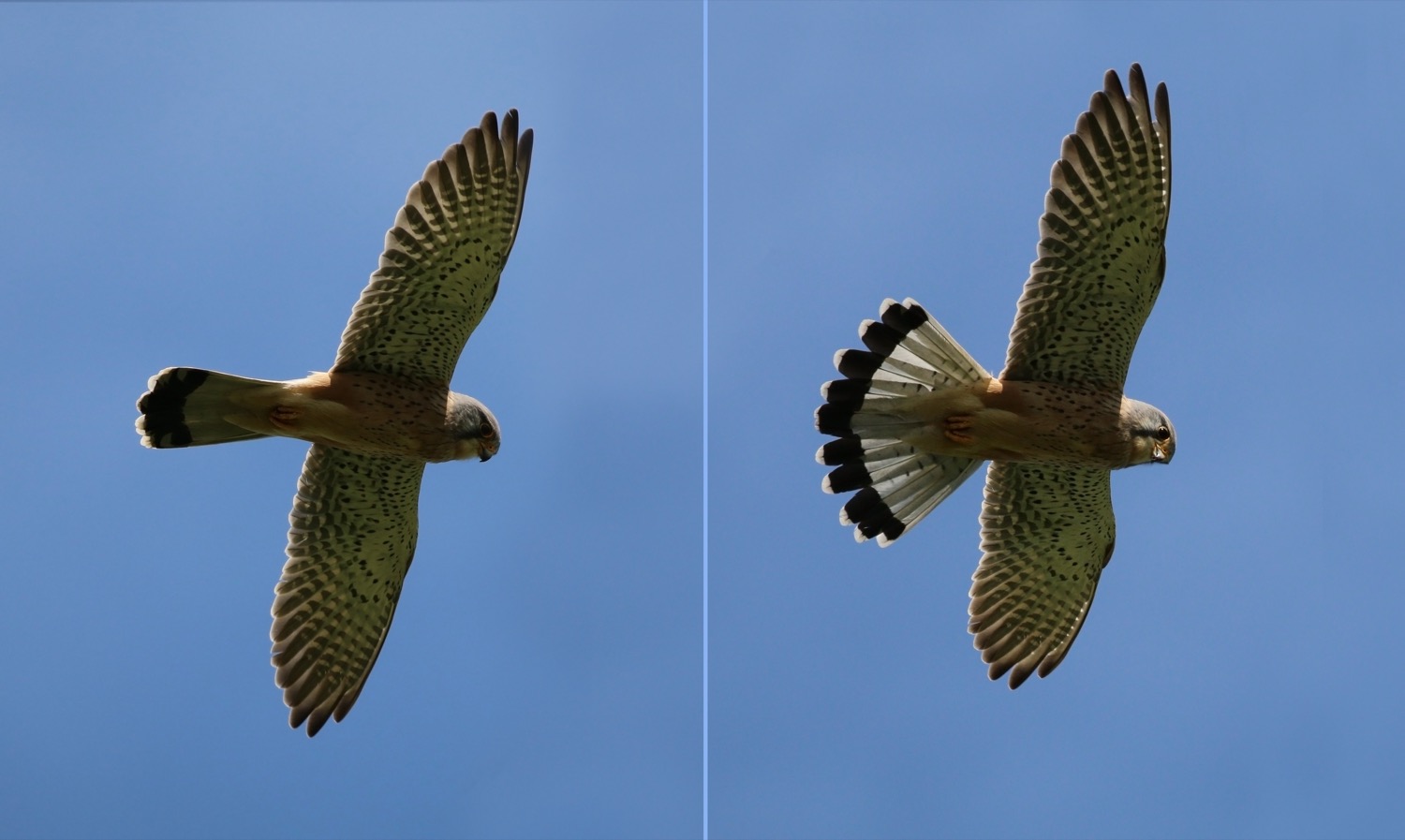
Source: Wikimedia Commons — “Kestrel (Falco tinnunculus) male in flight composite cr” by Charles J. Sharp, CC BY-SA 4.0
In brief
A common kestrel (Falco tinnunculus) is a small falcon of Europe, Asia and Africa, famous for hovering in mid-air to hunt voles, mice and large insects. Reddish-brown above with pointed wings, it can detect ultraviolet light reflected by rodent urine trails. The IUCN lists it as Least Concern.
Also in Animals A to Z · Animals that start with C
By WARN Research & Conservation TeamLast updated
The common kestrel (Falco tinnunculus) is a small, widespread falcon of Europe, Asia and Africa, best known for hanging motionless in mid-air as it hunts. Hold its head still against a buffeting wind, fan its tail, and it can hover for long stretches above a roadside verge or rough field, scanning the grass below for voles and mice. Once it locks on, it drops in stages onto its prey. Reddish-brown above with a dark-tipped tail, the kestrel is one of the most familiar birds of prey across the British countryside and beyond, often glimpsed beside motorways. Remarkably, it can see ultraviolet light, which helps it find rodents by their urine trails.
65-82 cm
Wingspan
32-39 cm
Body length
3-7
Eggs per clutch
Least Concern
IUCN Red List status
Figures sourced from Common kestrel - Wikipedia, IUCN Red List - Falco tinnunculus, CITES - Appendices (Falconidae, Appendix II) and other references on this page.
Common Kestrel: Quick Facts
| Common name | Common kestrel (windhover) |
|---|---|
| Scientific name | Falco tinnunculus |
| Family | Falconidae (falcons) |
| Body length | 32-39 cm |
| Wingspan | 65-82 cm |
| Weight | Male approx. 155 g; female approx. 184 g |
| Diet | Mainly voles, mice and shrews; also insects and small birds |
| Clutch size | 3-7 eggs |
| Range | Europe, Asia and Africa |
| IUCN status | Least Concern |
Scientific Classification
| Kingdom | Animalia |
|---|---|
| Phylum | Chordata |
| Class | Aves |
| Order | Falconiformes |
| Family | Falconidae |
| Genus | Falco |
| Species | Falco tinnunculus |
Conservation Status
- IUCN Status
- Least Concern on the IUCN Red List. The common kestrel has an extremely large range across Europe, Asia and Africa and a large global population, so it does not approach the thresholds for a threatened category. Despite this, the species has declined regionally, including in the UK, largely owing to the loss of rough grassland and agricultural intensification that reduce its small-mammal prey.
- Population
- Large global population; the European breeding population alone is estimated in the order of one to two million pairs.
- Trend
- Stable globally overall, but declining in parts of the range, including the UK.
- Assessed
- Assessed as Least Concern in the most recent IUCN Red List evaluation.
- CITES
- CITES Appendix II (all Falco species are listed, regulating international trade).
Because kestrel breeding success closely tracks natural cycles in vole abundance, local numbers can fluctuate sharply from year to year independently of longer-term trends.
Key Facts: Common Kestrel
- The common kestrel is a small falcon famous for hovering in place while hunting, holding its head perfectly steady against the wind.
- It feeds mainly on small mammals such as voles, mice and shrews, supplemented by insects, small birds and reptiles.
- Kestrels can see near-ultraviolet light, letting them detect the urine trails rodents leave around their burrows.
- The species is widespread across Europe, Asia and Africa and is classed as Least Concern by the IUCN.
- It is one of the most familiar British birds of prey, often seen hovering above motorway verges and rough grassland.
- Like all falcons, the kestrel is listed under CITES Appendix II, which regulates international trade in the species.
Why does a kestrel hover?
Hovering is the kestrel's signature hunting technique and the reason for its old country name, the windhover. By facing into the wind and making constant fine adjustments with its wings and fanned tail, the bird holds its head almost perfectly still in the air, typically around 10 to 20 metres above the ground. A steady head means a steady gaze, so the kestrel can scan the grass below for the tiny movements of a vole or mouse without the image blurring. When prey is spotted, it usually drops in stages, pausing at lower heights to reassess before the final plunge with talons outstretched. Hovering is energetically costly, so kestrels also hunt from perches such as fence posts, telegraph poles and roadside wires, especially in colder weather or when there is little wind to ride. The technique is so effective over open, grassy ground that motorway verges, with their long uncut grass and thriving vole populations, have become some of the best places in Britain to watch a kestrel at work.
How does a kestrel see ultraviolet vole trails?
Kestrels possess a striking sensory advantage: they can see into the near-ultraviolet part of the spectrum, beyond the range of human vision. Voles and other small rodents scent-mark their runways and burrow entrances with urine and droppings, and these deposits reflect ultraviolet light. To a kestrel's eyes, a well-used vole highway can therefore stand out as a glowing trail against the surrounding vegetation, revealing where prey is concentrated even before an animal appears. This lets the bird judge which patches of grassland are worth the effort of hovering over and which are likely to be empty. Combined with exceptionally sharp overall vision, ultraviolet sensitivity makes the kestrel a highly efficient hunter of cryptic, fast-moving mammals. Vole numbers naturally rise and fall in multi-year cycles, and kestrel breeding success tends to track these fluctuations closely, with more young raised in good vole years. This intimate link between predator and prey is one reason the kestrel is so often used as an indicator of the health of open farmland and grassland habitats.
What does a kestrel look like and how big is it?
The common kestrel is a slim, long-tailed falcon measuring about 32 to 39 centimetres from bill to tail, with a wingspan of roughly 65 to 82 centimetres. Females are larger than males on average, weighing around 184 grams against the male's 155 grams or so. The sexes also differ in plumage. Males have a blue-grey head and tail, a warm chestnut back spotted with black, and a single black band near the tail tip. Females and young birds are more uniformly reddish-brown above, barred with darker brown, and lack the grey head. In flight the kestrel shows pointed wings and a long tail, and its hovering habit usually identifies it at a glance. Its call is a shrill, repeated kee-kee-kee. The species is widespread and adaptable, breeding from open countryside and moorland to farmland, marshes and the edges of towns and cities, where it will nest on ledges and in old buildings. It does not build a nest of its own, instead using tree holes, cliff ledges, old crow nests or nest boxes.
Kestrel vs sparrowhawk: how to tell them apart
| Feature | Common kestrel | Sparrowhawk |
|---|---|---|
| Group | Falcon (Falconidae) | Hawk (Accipitridae) |
| Hunting style | Hovers over open ground | Fast, low dashes after birds in cover |
| Wing shape | Long and pointed | Short, broad and rounded |
| Main prey | Voles and other small mammals | Small and medium birds |
| Typical setting | Open fields and motorway verges | Woodland edges, hedgerows and gardens |
What WARN Does
WARN does not run dedicated field projects for the common kestrel, which across most of its huge range is a widespread and resilient bird far from the countries where WARN's partners work. This guide is part of WARN's free educational work to help people understand and value wildlife. The pressures that locally reduce kestrel numbers, chiefly the loss of rough grassland and the intensification of farming, are the very same habitat threats that endanger many of the animals WARN does protect on the ground.
If learning about the windhover brought you a moment of wonder, you can pass that on by supporting WARN's free educational work and the animals it protects.
Common Kestrel: Frequently Asked Questions
Can kestrels really see ultraviolet light?
How long do kestrels live?
Where do kestrels nest?
Where do common kestrels live?
Are common kestrels dangerous?
How big is a common kestrel?
What do kestrels eat?
Sources & References
Population figures, conservation status and biological facts on this page are drawn from authoritative scientific and intergovernmental sources.
Terms used on this page
Plain-English definitions, from our wildlife and conservation glossary.
Latest Common Kestrel Stories
Quick, fact-checked reads on the common kestrel — amazing facts, key questions and the threats it faces.
Species
Slow Loris: Why the Internet's Favourite Pet Is a Conservation Disaster
The slow loris looks like a cartoon character — and that has nearly destroyed the species. Here is the truth behind the viral videos.
Read the storySpecies
The Snow Leopard: Why the Ghost of the Mountains Is Still Vulnerable
The snow leopard is one of the most elusive big cats on earth, with an estimated 4,000-6,500 individuals across twelve range states — including Pakistan, where WARN is preparing to operate. This briefing explains why the species was downlisted from Endangered to Vulnerable in 2017 and why that is not the success story it sounds like.
Read the storyGuides
Sun Bear vs Moon Bear: The Two Most Trafficked Asian Bears
The sun bear and the Asiatic black bear (moon bear) are the two most commonly trafficked bears in Asia — for the pet trade, for traditional medicine and for bear-bile farming. Here is how to tell them apart.
Read the storyExplore more animals
Discover more animals, their habitats and their conservation status in the WARN wildlife-guide library.