Wildlife Guide · Europe & Asia
Common Kingfisher
Alcedo atthis
A jewel of the riverbank that hunts by diving headfirst for fish.
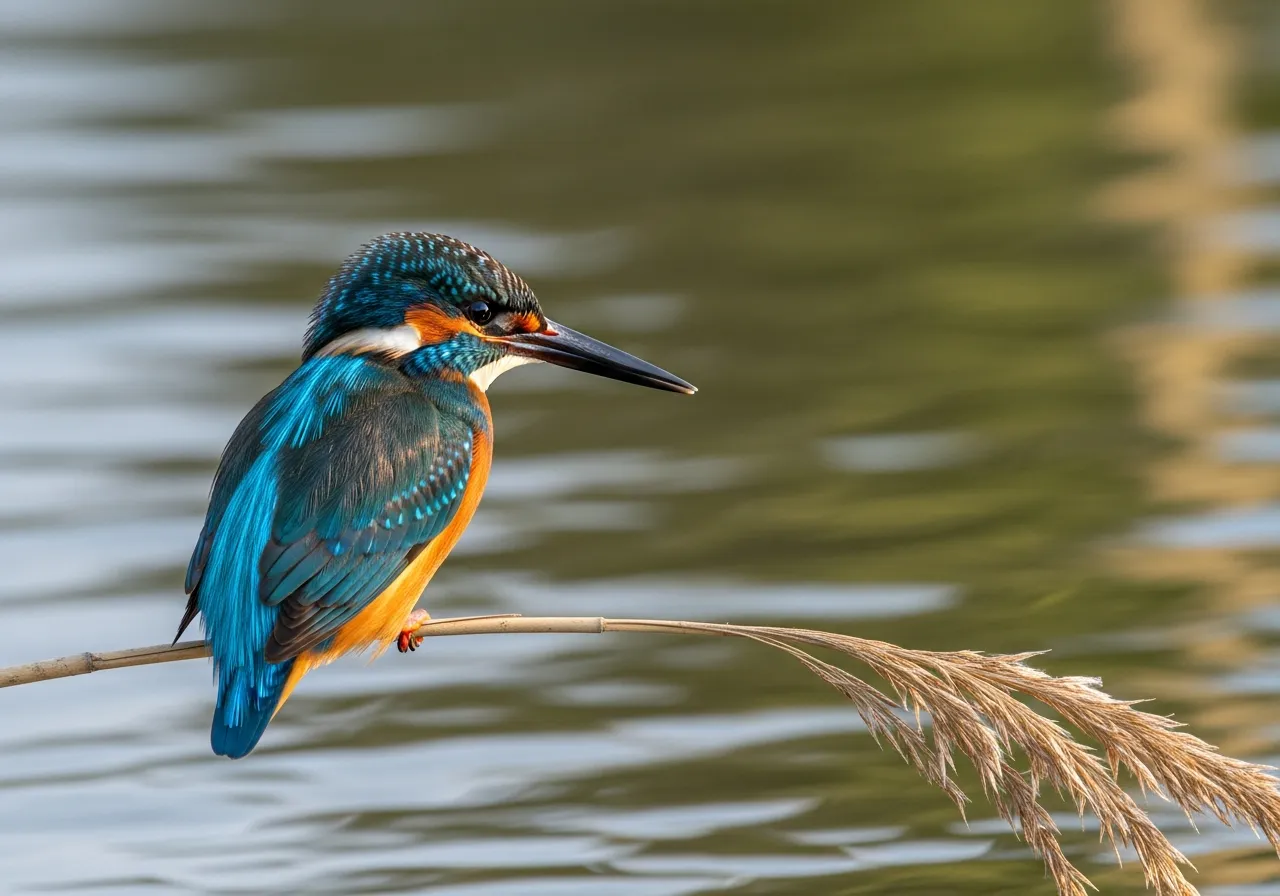
Source: Global Animal Guide (WARN)
In brief
A kingfisher is a small, brilliantly coloured bird that hunts by diving headfirst into water for fish. The common kingfisher (Alcedo atthis) of Europe, Asia and North Africa is electric-blue above and orange below, with a long, dagger-like bill, and nests in tunnels dug into riverbanks.
Also in Animals A to Z · Animals that start with C
By WARN Research & Conservation TeamLast updated
The common kingfisher (Alcedo atthis) is a small, vivid blue-and-orange bird of clear rivers, streams and lakes across Europe, Asia and North Africa. Barely larger than a sparrow, it perches over water and plunges headfirst to seize small fish in its long, dagger-shaped bill. Its dazzling colours come not from pigment but from the microscopic structure of its feathers, which scatter light. Despite the name, it belongs to a large, varied family (Alcedinidae) of more than a hundred kingfisher species worldwide, many of which do not eat fish at all. The common kingfisher is globally assessed as Least Concern, though it depends on clean water and can suffer in harsh winters.
16-17 cm
Body length, about sparrow-sized
100+
Kingfisher species worldwide (family Alcedinidae)
Up to ~1 m
Length of a nesting tunnel dug into a bank
Least Concern
Global IUCN Red List status
Figures sourced from Common kingfisher - Wikipedia, IUCN Red List - Alcedo atthis, Kingfisher - Encyclopaedia Britannica and other references on this page.
Common Kingfisher: Quick Facts
| Common name | Common kingfisher (river kingfisher, Eurasian kingfisher) |
|---|---|
| Scientific name | Alcedo atthis |
| Family | Alcedinidae (kingfishers) |
| Body length | About 16-17 cm, roughly sparrow-sized |
| Diet | Mainly small fish, plus aquatic insects and invertebrates |
| Habitat | Clear, slow rivers, streams, canals, lakes and ponds with earth banks |
| Range | Europe, much of Asia and North Africa |
| Nesting | Tunnel dug into a vertical earth bank near water |
| IUCN status | Least Concern (not CITES-listed) |
| Notable trait | Structural blue colour and headfirst diving |
Scientific Classification
| Kingdom | Animalia |
|---|---|
| Phylum | Chordata |
| Class | Aves |
| Order | Coraciiformes |
| Family | Alcedinidae |
| Genus | Alcedo |
| Species | Alcedo atthis |
Conservation Status
- IUCN Status
- The common kingfisher (Alcedo atthis) is listed as Least Concern on the IUCN Red List and is not included on the CITES appendices. It has a very large global range across Europe, Asia and North Africa and a large overall population. It is not considered globally threatened, but it is closely tied to clean fresh water and natural riverbanks, so local populations can decline where rivers are polluted, silted or heavily engineered, and numbers fall sharply after severe winters when waters freeze.
- Population
- Very large and widespread; no precise global figure, with multiple geographic races across its range
- Trend
- Stable overall at the global scale, with marked local fluctuations driven by winter severity and water quality
- Assessed
- Assessed by the IUCN as Least Concern (most recent published assessment; see IUCN Red List for the current entry)
- CITES
- Not listed on CITES
Because it hunts by sight and nests in earth banks, the kingfisher is a useful indicator of clean water and healthy, natural rivers.
Key Facts: Common Kingfisher
- The common kingfisher is a small riverbank bird of Europe, Asia and North Africa that dives headfirst to catch small fish.
- Its glowing blue is a structural colour created by feather microstructure scattering light, not by blue pigment.
- It nests in tunnels excavated into vertical earth banks beside water.
- It belongs to a worldwide family of more than 100 kingfisher species, not all of which fish.
- Globally it is assessed as Least Concern, but it is sensitive to water pollution and freezes in cold winters.
- Clean rivers, stable banks and healthy fish stocks are the keys to its survival.
What does a kingfisher look like and how big is it?
The common kingfisher is a compact, big-headed, short-tailed bird about 16-17 cm long, only a little larger than a house sparrow but heavier and more thickset. Its upperparts are an intense, shifting blue-green, with a brilliant electric-blue stripe down the back that flashes as the bird flies low and fast over water. The cheeks and underparts are a rich chestnut-orange, set off by a white throat and a white patch on each side of the neck. The bill is long, straight and dagger-shaped; females typically show an orange-red base to the lower bill, while the male's bill is all black, one of the few visible differences between the sexes. The legs and feet are short and bright red. Much of the colour is structural: tiny features in the feathers scatter and reflect blue light rather than relying on blue pigment, which is why the bird seems to change shade with the angle of view. Juveniles are similar to adults but duller, with greener upperparts and darker legs. In flight the kingfisher is unmistakable, often glimpsed only as a streak of blue vanishing along a stream.
How does a kingfisher catch fish?
Kingfishers are sit-and-wait hunters. A bird will choose a low perch, a branch, reed or post overhanging clear, slow-moving water, and watch intently for prey below. When it spots a small fish near the surface, it dives in a fast, near-vertical plunge, folding its wings and entering the water with barely a splash. The eyes are protected as it strikes, and it seizes the fish in its bill rather than spearing it. Back on the perch, the bird often beats the fish against the branch to stun it before swallowing it head-first, so the fins fold flat. Where perches are scarce, a kingfisher can also hover briefly over open water before diving. Its diet is mainly small fish such as minnows and sticklebacks, supplemented by aquatic insects, larvae, tadpoles and freshwater shrimps. Clear water is essential: the bird hunts by sight, so silt, pollution or turbulence that clouds a river makes fishing difficult. A kingfisher may swallow many small fish a day, and the indigestible bones and scales are later coughed up as pellets, much as owls do.
Where do kingfishers live and nest?
The common kingfisher is widespread across Europe, much of Asia and parts of North Africa, with several geographic races. It favours clear, slow-flowing or still fresh water, lowland rivers, streams, canals, lakes and ponds with overhanging perches and, crucially, vertical earth banks. In colder regions, populations may move to estuaries, sheltered coasts and unfrozen waters in winter, since the bird cannot fish through ice and hard winters can cause heavy losses. Kingfishers are strongly territorial, each defending a stretch of waterway, and pairs nest in a tunnel that they dig themselves into a steep, bare bank close to water. The burrow can be up to about a metre long and ends in a nesting chamber where the female lays a clutch of glossy white eggs, often six or seven. Both parents incubate and then ferry a steady stream of small fish to the growing chicks. In good conditions a pair may raise two or even three broods in a season, which helps the species recover quickly after the population crashes that follow severe winters.
Common kingfisher vs the wider kingfisher family
| Feature | Common kingfisher (Alcedo atthis) | Wider family (Alcedinidae) |
|---|---|---|
| Size | Small, about 16-17 cm, sparrow-sized | From tiny to large (e.g. kookaburras are crow-sized) |
| Diet | Mainly small fish | Varies: fish, insects, reptiles, small mammals |
| Habitat | Clear fresh water with earth banks | Rivers, forests, woodland and dry country worldwide |
| Number of species | One species | More than 100 species across the globe |
| Hunts in water? | Yes, dives headfirst for fish | Many do not; some rarely go near water |
What WARN Does
WARN does not run field projects dedicated to the common kingfisher, which lives mostly outside the countries where WARN and its partners work. This guide is part of WARN's free educational mission to help people understand and value wild animals. The threats that shape the kingfisher's fortunes, polluted and silted rivers, lost wetlands and degraded banks, are the same pressures of habitat loss and water quality that affect many of the animals WARN does protect, so learning about one riverbank bird sheds light on the health of freshwater life everywhere.
If this jewel of the riverbank brightened your day, a small gift helps keep WARN's free wildlife education flowing and supports the animals in our care.
Common Kingfisher: Frequently Asked Questions
Is the common kingfisher endangered?
Why is the kingfisher so blue?
What do kingfishers eat?
How does a kingfisher dive without hurting itself?
Where do kingfishers build their nests?
Where do common kingfishers live?
Are common kingfishers dangerous?
How long do common kingfishers live?
How big is a common kingfisher?
Sources & References
Population figures, conservation status and biological facts on this page are drawn from authoritative scientific and intergovernmental sources.
Terms used on this page
Plain-English definitions, from our wildlife and conservation glossary.
Latest Common Kingfisher Stories
Quick, fact-checked reads on the common kingfisher — amazing facts, key questions and the threats it faces.
Species
Slow Loris: Why the Internet's Favourite Pet Is a Conservation Disaster
The slow loris looks like a cartoon character — and that has nearly destroyed the species. Here is the truth behind the viral videos.
Read the storySpecies
The Snow Leopard: Why the Ghost of the Mountains Is Still Vulnerable
The snow leopard is one of the most elusive big cats on earth, with an estimated 4,000-6,500 individuals across twelve range states — including Pakistan, where WARN is preparing to operate. This briefing explains why the species was downlisted from Endangered to Vulnerable in 2017 and why that is not the success story it sounds like.
Read the storyGuides
Sun Bear vs Moon Bear: The Two Most Trafficked Asian Bears
The sun bear and the Asiatic black bear (moon bear) are the two most commonly trafficked bears in Asia — for the pet trade, for traditional medicine and for bear-bile farming. Here is how to tell them apart.
Read the storyExplore more animals
Discover more animals, their habitats and their conservation status in the WARN wildlife-guide library.