Wildlife Guide · New Zealand
Kiwi
Apteryx spp.
New Zealand's ancient, flightless icon — a bird that evolved to live like a mammal
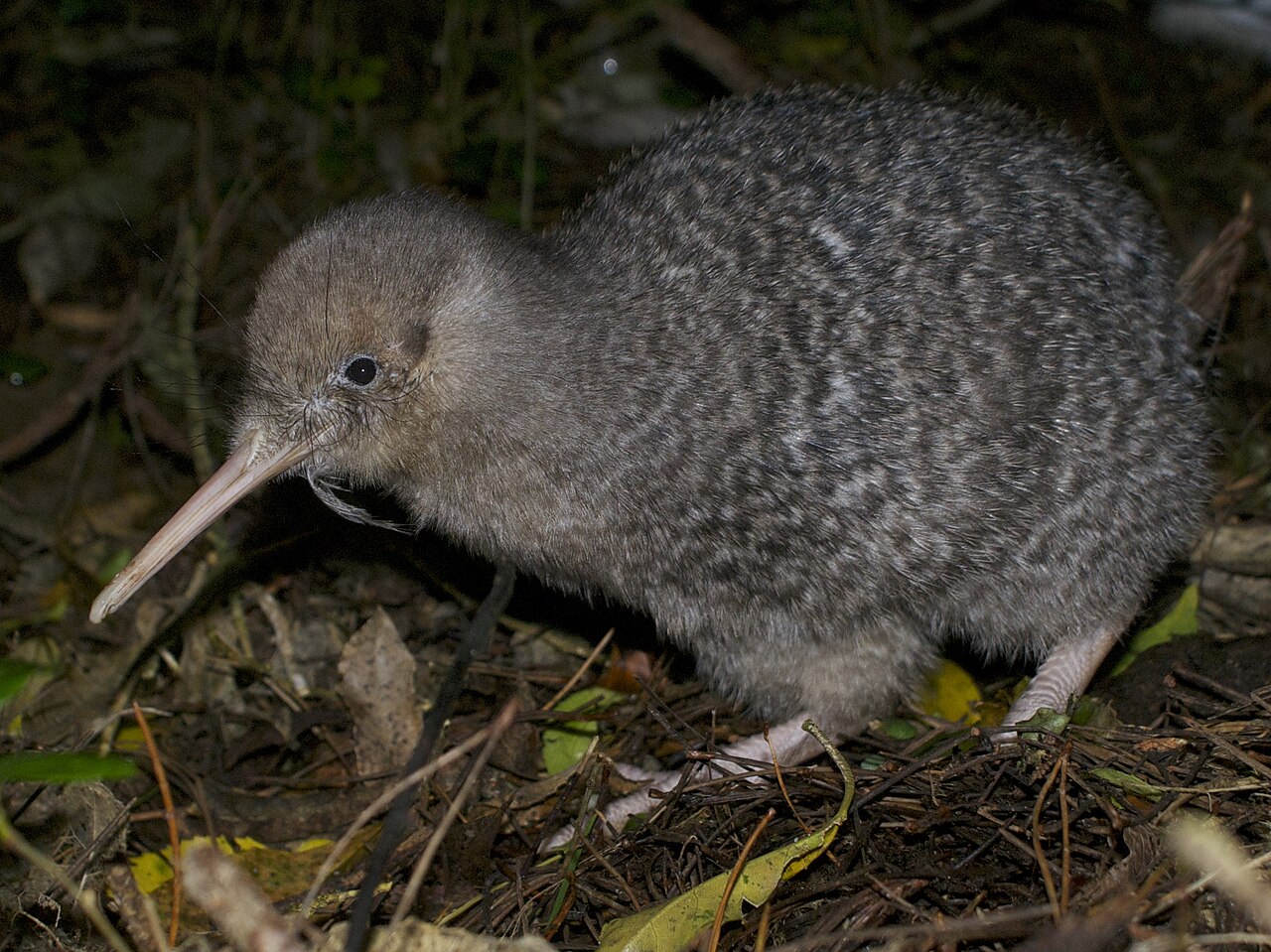
Photo: Kimberley Collins / Wikimedia Commons (CC BY-SA 4.0)
In brief
The kiwi is a flightless, nocturnal bird unique to New Zealand — all five species are threatened, with an estimated 68,000 individuals remaining and unmanaged populations declining at roughly 2 percent per year.
Also in Animals A to Z · Animals that start with K
By WARN Research & Conservation TeamLast updated
The kiwi is one of the most extraordinary birds on Earth. Sole members of the family Apterygidae, the five recognised species of the genus Apteryx are endemic to New Zealand — they exist nowhere else in the world. Flightless, nocturnal, and roughly the size of a domestic chicken, kiwi have spent tens of millions of years evolving in almost complete isolation, developing traits found in no other bird: nostrils at the tip of the beak rather than the base, hair-like feathers, vestigial wings hidden beneath their plumage, and a sense of smell sharp enough to detect earthworms buried several centimetres underground. An egg that can constitute up to 20 percent of the female's body weight is another record-breaker. Deeply embedded in Māori culture and named a national symbol of New Zealand, the kiwi is today under severe pressure from introduced predators, with all five species listed as threatened on the IUCN Red List.
~68,000
Total wild kiwi remaining
20%
Egg as share of female body weight
2%
Annual decline in unmanaged populations
20–30 yrs
Typical wild lifespan
Figures sourced from IUCN Red List — Apteryx mantelli (North Island Brown Kiwi), BirdLife International — North Island Brown Kiwi Species Factsheet, BirdLife International — Okarito Kiwi Species Factsheet and other references on this page.
Kiwi: Quick Facts
| Type | Flightless ratite bird |
|---|---|
| Species count | 5 recognised species |
| Height | 25–55 cm (depending on species) |
| Weight | 1–3.5 kg (depending on species) |
| Lifespan | 20–30 years in the wild; up to 50 in managed settings |
| Diet | Earthworms, invertebrates, berries, seeds |
| Habitat | Forests, scrubland, grassland edges (New Zealand only) |
| Activity | Nocturnal |
| Incubation | 63–92 days (primarily by the male in most species) |
| Conservation status | All 5 species threatened (IUCN) |
Scientific Classification
| Kingdom | Animalia |
|---|---|
| Phylum | Chordata |
| Class | Aves |
| Order | Apterygiformes |
| Family | Apterygidae |
| Genus | Apteryx |
Conservation Status
- IUCN Status
- Varies: Vulnerable (4 species) / Near Threatened (1 species)
- Population
- ~68,000 total across all five species
- Trend
- Decreasing (2% per year in unmanaged areas; stable or increasing under management)
- Assessed
- 2017–2022 (varies by species)
- CITES
- Appendix I
All five species are endemic to New Zealand. The Okarito kiwi (rowi) is the rarest, with approximately 700 individuals as of 2024. The little spotted kiwi is Near Threatened; the remaining four species are Vulnerable.
Did you know?
A female kiwi's egg can make up 20 percent of her entire body weight — the equivalent of a human mother carrying a toddler as a single baby. Despite this extraordinary burden, the male does almost all of the 63–92 day incubation in most kiwi species, losing significant body weight in the process.
Key Facts: Kiwi
- All five kiwi species are listed as threatened on the IUCN Red List, ranging from Near Threatened (little spotted kiwi) to Vulnerable (North Island brown kiwi, great spotted kiwi, southern brown kiwi, Okarito kiwi).
- The kiwi is the only bird known to have nostrils at the tip of its bill, giving it an exceptional sense of smell used to locate prey underground.
- A kiwi egg can weigh up to 20 percent of the female's body mass — proportionally the largest egg of any bird species on Earth.
- Introduced predators — especially stoats, dogs, cats and ferrets — are the primary threat; up to 95 percent of unmanaged kiwi chicks do not survive to six months of age.
- Conservation programmes such as Operation Nest Egg have dramatically improved survival rates, raising chick survival from around 5 percent to 65 percent for programme-raised birds.
- The Okarito kiwi (rowi) was rescued from just 165 birds in the mid-1990s to approximately 700 by 2024 through intensive predator management and captive-rearing, demonstrating what sustained effort can achieve.
What is a kiwi, and why is it so unusual?
The kiwi belongs to the ancient bird group known as ratites — flightless birds that also includes ostriches, emus, cassowaries and rheas. However, kiwi diverged along a remarkable evolutionary path after New Zealand separated from the supercontinent Gondwana roughly 80 million years ago. In the absence of land mammals, kiwi filled the ecological niche of small nocturnal foragers, evolving traits that more closely resemble a mammal than a typical bird.
Their wings have been reduced to tiny, finger-length remnants entirely hidden beneath their plumage — so small as to be functionally invisible. Their feathers are loose and hair-like, lacking the interlocking barbules found in flying birds. Most striking of all, the nostrils are positioned at the very tip of the long, flexible bill rather than at the base near the skull — an arrangement unique in the bird world. Combined with an unusually large olfactory bulb in the brain, this makes the kiwi the only bird that relies primarily on smell rather than sight or hearing to locate food. Earthworms, beetle larvae, spiders, fallen fruit and even crayfish are tracked by scent alone, often from beneath the surface.
Kiwi also have a body temperature of around 38 °C — significantly lower than most birds and closer to the mammalian range — and their bone structure is denser and less hollow than in flying birds. Five species are currently recognised: the North Island brown kiwi (Apteryx mantelli), the great spotted kiwi (Apteryx haastii), the little spotted kiwi (Apteryx owenii), the southern brown kiwi or tokoeka (Apteryx australis), and the Okarito kiwi or rowi (Apteryx rowi).
Where do kiwi live, and what habitat do they need?
Kiwi are found exclusively across New Zealand's North and South Islands and several offshore islands, occupying a range of habitat types that varies by species. The North Island brown kiwi, the most widespread and numerous species with an estimated 26,000 individuals, inhabits native forests, pine plantations, scrubland, and even farmland edges across the northern North Island. Its ability to persist in modified habitats makes it relatively resilient compared to other species.
The great spotted kiwi is confined to the northwest of the South Island — principally the Nelson Lakes, Paparoa Range, and Arthur's Pass areas — where it favours montane beech forests and subalpine scrub at elevations up to 1,500 metres. The southern brown kiwi occurs in Fiordland and on Stewart Island (Rakiura), New Zealand's third-largest island, where populations have fared better partly because stoat density is naturally lower.
The Okarito kiwi is restricted to a narrow strip of lowland rainforest on the West Coast of the South Island near Okarito Lagoon — one of the most geographically limited distributions of any bird in New Zealand. The little spotted kiwi was once found throughout the South Island but mainland populations were extirpated by introduced predators; today the species survives primarily on predator-free offshore islands, most notably Kapiti Island north of Wellington, where roughly 1,200 individuals live.
All kiwi require dense cover for daytime shelter — burrows, hollow logs, dense root systems, or thick vegetation. Territory sizes range from around 2 hectares for some North Island brown kiwi pairs to over 40 hectares for great spotted kiwi in more sparsely productive upland terrain.
Why are kiwi threatened with extinction?
Every one of the five kiwi species is classified as threatened on the IUCN Red List, and the cumulative wild population of approximately 68,000 birds represents a catastrophic decline from an estimated 12 million before Polynesian and European settlement. The primary driver of ongoing decline is predation by introduced mammals — species that evolved alongside birds in other parts of the world but to which kiwi have no meaningful defence.
Stoats are the most lethal threat to kiwi chicks. In years when beech trees produce heavy seed crops (called mast years), rodent populations explode and are followed by a surge in stoat numbers. Research by New Zealand's Department of Conservation has established that up to 95 percent of kiwi chicks in unmanaged areas do not survive to six months of age, with stoats responsible for the majority of deaths. Adult kiwi are more vulnerable to dogs and ferrets; a single uncontrolled dog can eliminate an entire local kiwi population within days.
Habitat loss compounded these pressures over more than 150 years. Lowland forests — the most productive kiwi habitat — were cleared extensively for agriculture and urban development, fragmenting populations and pushing birds into smaller, more isolated patches where genetic diversity can decline. Road strikes kill a meaningful number of birds each year in areas where kiwi ranges overlap with human settlement.
In unmanaged areas, populations decline at roughly 2 percent annually — the equivalent of losing around 20 birds every week across the country. Without sustained intervention, modelling suggests kiwi could be functionally extinct on mainland New Zealand within decades.
How do kiwi reproduce, and what makes their eggs exceptional?
Kiwi reproduction is as extraordinary as every other aspect of their biology. Pairs form long-term monogamous bonds that can persist for 20 years or more, meeting in shared nesting burrows every few nights during the breeding season, which typically runs from June to March. Males are highly territorial and advertise their presence with loud, distinctive calls — the shrill, repeated 'kee-wee' of the North Island brown kiwi is one of New Zealand's most recognisable sounds.
The female's egg is proportionally the largest of any bird relative to body size. A female North Island brown kiwi weighing around 2.6 kg produces an egg of up to 450 grams — approximately 15–20 percent of her body weight. For comparison, a hen's egg is about 3 percent of the chicken's mass. The egg is rich in yolk and produces an unusually well-developed chick: kiwi hatchlings emerge with a full coat of feathers and are largely independent within days, requiring no parental feeding.
In most kiwi species, incubation is carried out primarily by the male, who can lose significant body weight during the 63–92 day incubation period. The little spotted kiwi and North Island brown kiwi are incubated solely by the male, while the great spotted kiwi, rowi and tokoeka share incubation duties between both parents to varying degrees. Females commonly lay more than one egg per season and great spotted kiwi occasionally lay two eggs per clutch.
This slow reproductive rate — typically one chick per pair per year even under ideal conditions — means populations recover very slowly from losses and makes predation pressure especially damaging at the population level.
What conservation efforts are protecting kiwi today?
New Zealand has developed some of the world's most sophisticated bird conservation programmes specifically for kiwi. The cornerstone is Operation Nest Egg, a captive head-starting programme in which wild eggs and very young chicks are collected and raised in predator-free facilities until they reach approximately 1,200 grams — the size at which they can withstand a stoat attack. Programme-raised birds achieve around 65 percent survival to adulthood compared to just 5 percent for wild-reared chicks in unmanaged areas, making it one of the most successful conservation interventions of its kind.
At landscape scale, the aerial application of the biodegradable pesticide 1080 (sodium fluoroacetate) to suppress stoats, rats and possums has proven highly effective. Studies tracking radio-tagged kiwi through 1080 operations have confirmed that the birds are not harmed by the bait, while chick survival in the first season following treatment rises substantially. Extensive trapping networks maintained by community volunteer groups supplement aerial operations in many areas.
Predator-free islands serve as critical insurance populations. The transfer of little spotted kiwi to Kapiti Island in 1912 from just five individuals has grown into a population of around 1,200 birds — a founding stock now used to seed additional island and fenced sanctuaries. The Okarito kiwi (rowi) increased from approximately 165 birds in the 1990s to around 700 by 2024 through a combination of Operation Nest Egg and intensive predator control, demonstrating what a focused, multi-decade programme can achieve.
New Zealand's Department of Conservation continues to expand kiwi recovery through predator management, population monitoring, and community engagement. The long-term national goal is the creation of large predator-free zones across both main islands through the Predator Free 2050 initiative.
What WARN Does
WARN does not currently run projects in New Zealand and this guide is offered as free educational content to raise awareness of one of the world's most remarkable threatened birds. Understanding why island endemics are so vulnerable to introduced predators — and how targeted intervention can reverse declines — informs conservation thinking globally, including in WARN's partner countries where similar pressures affect native wildlife.
Every dollar that supports habitat protection and predator control helps ensure that ancient, irreplaceable creatures like the kiwi — birds that have lived on islands for millions of years — are not lost to threats introduced in the last few centuries. Supporting WARN's habitat work keeps the knowledge, funding, and passion for wildlife alive.
Kiwi: Frequently Asked Questions
How many kiwi are left in the wild?
Can kiwi fly?
Why does the kiwi lay such a large egg?
What is the biggest threat to kiwi survival?
What do kiwi eat?
Where do kiwis live?
Are kiwis dangerous?
How long do kiwis live?
How big is a kiwi?
Sources & References
Population figures, conservation status and biological facts on this page are drawn from authoritative scientific and intergovernmental sources.
- IUCN Red List — Apteryx mantelli (North Island Brown Kiwi)
- BirdLife International — North Island Brown Kiwi Species Factsheet
- BirdLife International — Okarito Kiwi Species Factsheet
- BirdLife International — Great Spotted Kiwi Species Factsheet
- New Zealand Department of Conservation — Kiwi facts
- Smithsonian's National Zoo — North Island Brown Kiwi
- Kiwi genome provides insights into evolution of a nocturnal lifestyle (PMC)
Terms used on this page
Plain-English definitions, from our wildlife and conservation glossary.
Explore more animals
Discover more animals, their habitats and their conservation status in the WARN wildlife-guide library.