Wildlife Guide · Australia & Tasmania (introduced)
Kookaburra
Dacelo novaeguineae
Australia's loudest alarm clock — and one of nature's most effective snake hunters
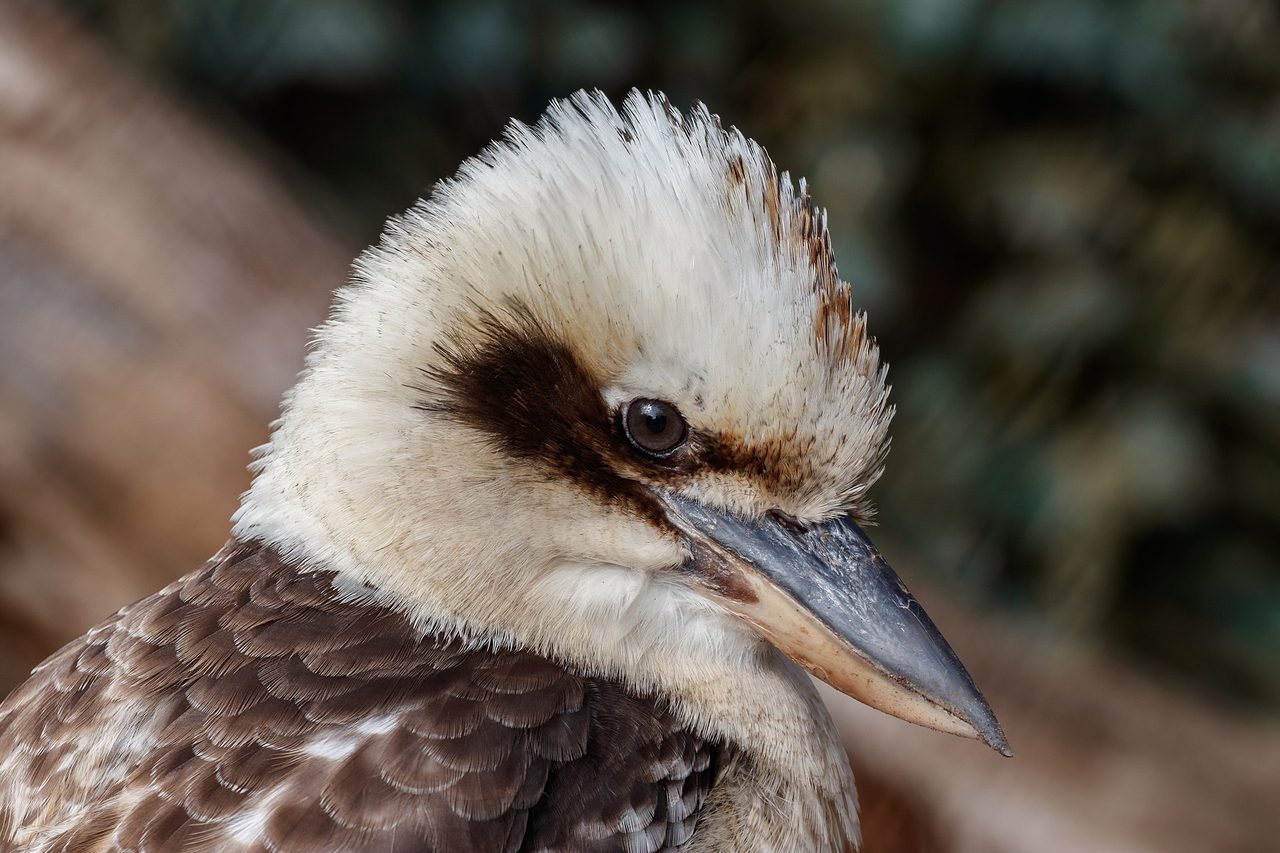
Photo: H. Zell / Wikimedia Commons (CC BY-SA 3.0)
In brief
The laughing kookaburra (Dacelo novaeguineae) is the world's largest kingfisher, native to eastern Australia, and is famous for its loud, cackling territorial call often described as human laughter.
Also in Animals A to Z · Animals that start with K
By WARN Research & Conservation TeamLast updated
The laughing kookaburra is the world's largest kingfisher, a stocky, brown-and-white bird famous for the raucous, human-like laughter it belts across Australian bushland at dawn and dusk. Weighing up to 465 g and measuring around 45 cm from bill-tip to tail, it is instantly recognisable by its massive, dagger-shaped bill and chocolate-brown eye-stripe. Unlike most kingfishers, which plunge-dive for fish, the kookaburra is a terrestrial ambush predator — dropping from a perch to seize lizards, snakes, mice, and large insects on the ground. It inhabits open eucalyptus woodland, forest edges, farmland, and suburban parks across eastern Australia, and has been deliberately introduced to Tasmania, south-western Australia, Kangaroo Island, and parts of New Zealand. Its iconic call has become one of the most recognisable sounds on Earth.
45 cm
Body length
~65 million
Estimated global population
Up to 20 years
Maximum lifespan
3.86 million km²
Native range area
Figures sourced from IUCN Red List – Dacelo novaeguineae (2024 assessment), BirdLife DataZone – Laughing Kookaburra species factsheet, Animal Diversity Web – Dacelo novaeguineae and other references on this page.
Kookaburra: Quick Facts
| Body length | 39–45 cm (15–18 in) |
|---|---|
| Weight | Up to 465 g (16 oz) |
| Wingspan | Approximately 65 cm (25 in) |
| Clutch size | 2–3 white eggs |
| Incubation period | 24–29 days |
| Lifespan | 15–20 years |
| Diet | Reptiles, rodents, large insects, small birds |
| Habitat | Open eucalyptus woodland, farmland, suburban parks |
Scientific Classification
| Kingdom | Animalia |
|---|---|
| Phylum | Chordata |
| Class | Aves |
| Order | Coraciiformes |
| Family | Alcedinidae |
| Genus | Dacelo |
| Species | Dacelo novaeguineae |
Conservation Status
- IUCN Status
- Least Concern
- Population
- Approximately 65 million individuals
- Trend
- Decreasing
- Assessed
- 2024
- CITES
- Not listed
The 2024 IUCN assessment records the population trend as decreasing. Citizen-science monitoring (Birdata) recorded a ~50% fall in survey sightings in south-eastern Australia between 2000 and 2019, driven by woodland clearing and loss of hollow-bearing trees.
Did you know?
The genus name Dacelo is simply an anagram of Alcedo — the Latin word for kingfisher — coined in 1815 by English zoologist William Elford Leach, who rearranged the letters to give the world's largest kingfisher its own distinct genus name.
Key Facts: Kookaburra
- The laughing kookaburra is the largest kingfisher in the world, yet rarely eats fish — it prefers reptiles, rodents, and large insects.
- Its iconic call is used to declare and defend territory; family groups chorus together at sunrise and sunset in a coordinated display.
- Kookaburras are cooperative breeders: adult offspring from previous seasons act as helpers, assisting the dominant pair with incubation, chick-feeding, and nest defence.
- Despite a global population estimated at around 65 million individuals, the IUCN's 2024 assessment records the overall trend as decreasing, with citizen-science data showing a ~50% fall in survey sightings across south-eastern Australia between 2000 and 2019.
- Mature trees with natural hollows are essential for nesting; competition with introduced common mynas and European starlings for these hollows is an increasing pressure.
- The species was deliberately introduced to south-western Australia, Tasmania, Kangaroo Island, and New Zealand in the late nineteenth and early twentieth centuries, where it remains established but is not native.
What is a kookaburra?
The laughing kookaburra (Dacelo novaeguineae) belongs to the family Alcedinidae — the kingfishers — and sits within the tree-kingfisher subfamily Halcyoninae. The genus name Dacelo is an anagram of Alcedo, the Latin word for kingfisher, coined by English zoologist William Elford Leach in 1815. The species was first formally described in 1783 by French naturalist Johann Hermann, who mistakenly attributed the specimen to New Guinea; its specific epithet novaeguineae reflects that geographical error — the bird is not naturally found in New Guinea at all.
At 39–45 cm in length and up to 465 g in weight, the laughing kookaburra dwarfs every other kingfisher on Earth. Its plumage is a patchwork of brown, white, and grey: dark brown upperparts, a cream-white breast, a rufous-orange band across the lower back and tail, and a bold dark-brown mask running from the base of the bill through each eye. Males display small blue patches on the rump — the clearest field mark distinguishing the sexes. The bill itself is formidable: up to 10 cm long, heavy, and laterally compressed to grip slippery or struggling prey. Two subspecies are recognised: the nominate D. n. novaeguineae across most of the range, and the smaller D. n. minor in Cape York Peninsula south to Cooktown.
Where do kookaburras live?
The laughing kookaburra's native range spans eastern and south-eastern Australia, covering Queensland, New South Wales, Victoria, and South Australia, with range extending into parts of Western Australia. It reaches its highest densities in open eucalyptus woodland and dry sclerophyll forest — habitats that offer tall, hollow-bearing trees for nesting alongside open ground where prey can be spotted from a perch. The species is notably adaptable: it thrives equally in rural farmland, river-margin scrub, and well-treed urban parks and gardens, making it one of Australia's most familiar suburban birds.
Kookaburras are entirely sedentary — a breeding pair and its family helpers occupy the same territory year-round, rarely wandering beyond a few kilometres. Territory sizes range from roughly 100 to 400 hectares of woodland, depending on prey availability and tree-hollow density.
During the late nineteenth and early twentieth centuries, kookaburras were deliberately released into south-western Western Australia, Tasmania, Kangaroo Island, and parts of New Zealand to control snakes. The New Zealand population is restricted to Kawau Island in the Hauraki Gulf and adjacent North Island mainland, and numbers fewer than 500 birds. These introduced populations are self-sustaining, though ecologists note they compete with native hollow-nesting species in areas where the kookaburra is not indigenous.
How does the kookaburra hunt and what does it eat?
The kookaburra's hunting method is elegant in its simplicity: it perches motionless on a branch, fence post, or power line, scans the ground below with sharp binocular vision, then drops in a swift, silent dive to pin prey with its bill. It kills prey by seizing it firmly and then thrashing it violently against a hard surface — a branch, rock, or the ground — to stun or destroy it before swallowing it whole or in large pieces.
This smashing technique is especially important when tackling snakes. The kookaburra grips the snake just behind the head, flips it sideways, and whacks it repeatedly until it is immobilised. Although some popular accounts claim kookaburras are immune to snake venom, the evidence is contested; the prevailing view is that their mechanical kill technique — combined with a beak and heavily feathered body that offers little exposed skin to bite — provides the primary protection.
The diet is broad: lizards and skinks make up a substantial proportion; venomous snakes including juvenile brown snakes and tiger snakes are taken opportunistically; large insects such as grasshoppers, beetles, and cicadas are common prey; earthworms, mice, small birds, and nestlings round out the menu. Fish are taken only rarely, despite the kookaburra's kingfisher heritage. Prey is detected by sight, so kookaburras are mostly inactive in low light and heavy rain.
How do kookaburras breed and raise their young?
The laughing kookaburra is one of Australia's best-studied cooperative breeders. A typical social group consists of a dominant monogamous pair and up to six helper birds — adult offspring from previous breeding seasons, of either sex — that assist with every stage of reproduction. Breeding runs from September through January, coinciding with the Australian spring and summer.
Nests are excavated in natural tree hollows (most commonly in large eucalypts) or in arboreal termite mounds, which provide insulation and structural stability. The female lays two or three white, nearly spherical eggs over several days. Incubation lasts approximately 24–29 days and is shared by the female, the male, and the helpers on a rotating schedule. Chicks hatch altricial — naked and helpless — and are brooded continuously for the first week. All group members bring food to the nest.
Fledglings leave the hollow at about 36 days old but depend on the group for food for several more weeks. A genetic study of 140 nestlings confirmed the mating system to be overwhelmingly monogamous, with no cases of extra-group parentage detected. Helper birds gain breeding experience and eventually inherit or win their own territories. Competition with introduced European starlings and common mynas for suitable hollows is an increasingly recognised pressure, particularly in fragmented suburban landscapes.
Why is the kookaburra in regional decline despite being common?
The laughing kookaburra is classified as Least Concern on the IUCN Red List (assessed 15 June 2024), with an estimated global population of approximately 65 million individuals across a range of 3.86 million km². Yet the 2024 IUCN assessment records the overall population trend as decreasing, and this trajectory is most visible at finer scales.
Citizen-science monitoring data (Birdata) recorded a fall of roughly 50 percent in kookaburra sightings across south-eastern Australia between 2000 and 2019, with the reporting rate dropping from 25% to 15% over the same period — a signal corroborated by structured surveys in the Murray-Darling Basin and Brigalow Belt, regions that have experienced intensive land clearing for agriculture. Only about 15 percent of Australia's original woodland cover remains, and kookaburras are particularly sensitive to the loss of large, old trees bearing natural hollows. Without these hollows, cooperative breeding groups cannot form or persist.
Urban expansion does not uniformly harm kookaburras: suburbs that retain mature street trees and garden vegetation can actually support healthy densities. However, the removal of hollow-bearing trees during development, combined with nest-site competition from introduced starlings and mynas, erodes breeding success in precisely the peri-urban fringe where woodland clearing is most rapid. Poisoning events and secondary rodenticide exposure also pose localised risks.
Public awareness — knowing why old trees matter, and why removing hollow-bearing eucalypts has consequences beyond timber — is among the most effective tools for slowing regional declines.
What WARN Does
WARN does not currently run field projects for the laughing kookaburra, and this guide is offered as free educational content to support awareness of Australian wildlife. The kookaburra's story illustrates a broader truth that resonates across all of WARN's work: healthy ecosystems depend on the retention of old-growth habitat features — such as hollow-bearing trees — that take centuries to form and only moments to destroy. Understanding these dependencies anywhere in the world reinforces the conservation case for protecting forests and woodlands wherever WARN does operate.
Woodland habitats the kookaburra depends on face the same pressures — clearing, fragmentation, and loss of ancient hollow-bearing trees — that threaten wildlife across WARN's partner regions. Every contribution to WARN helps fund the habitat protection work that keeps ecosystems intact for species everywhere.
Kookaburra: Frequently Asked Questions
Why do kookaburras laugh?
Is the kookaburra the largest kingfisher in the world?
Are kookaburras dangerous to people?
How do kookaburras kill snakes?
What is cooperative breeding in kookaburras?
What do laughing kookaburras eat?
Where do laughing kookaburras live?
How long do laughing kookaburras live?
How big is a laughing kookaburra?
Sources & References
Population figures, conservation status and biological facts on this page are drawn from authoritative scientific and intergovernmental sources.
- IUCN Red List – Dacelo novaeguineae (2024 assessment)
- BirdLife DataZone – Laughing Kookaburra species factsheet
- Animal Diversity Web – Dacelo novaeguineae
- San Diego Zoo Library – Laughing Kookaburra Fact Sheet
- The Conversation – Citizen scientists count nearly 2 million birds and reveal a possible kookaburra decline
- ResearchGate – Social and mating system of cooperatively breeding laughing kookaburras
Terms used on this page
Plain-English definitions, from our wildlife and conservation glossary.
Latest Kookaburra Stories
Quick, fact-checked reads on the kookaburra — amazing facts, key questions and the threats it faces.
Species
Why Are Dugongs Disappearing — and What's Being Done to Save Them?
Dugongs are vanishing from waters where they once thrived, declared functionally extinct in China and critically endangered in East Africa. Here's why — and the work that offers hope.
Read the storySpecies
12 Amazing Facts About Koalas (They Are Not Bears, and They Have Fingerprints)
Fingerprints indistinguishable from ours, 20 hours of sleep a day, and a diet that would poison most animals. Twelve koala facts.
Read the storySpecies
12 Amazing Facts About Kangaroos (They Cannot Walk Backwards)
Tendons that work like springs, a tail used as a fifth leg, and the ability to pause a pregnancy. Twelve verified kangaroo facts.
Read the storyExplore more animals
Discover more animals, their habitats and their conservation status in the WARN wildlife-guide library.