Wildlife Guide · Africa & Middle East
Leopard
Panthera pardus (Linnaeus, 1758) and clouded-leopard lineage (Neofelis)
The most adaptable big cat — rosetted hunters from African savanna to Himalayan forest.
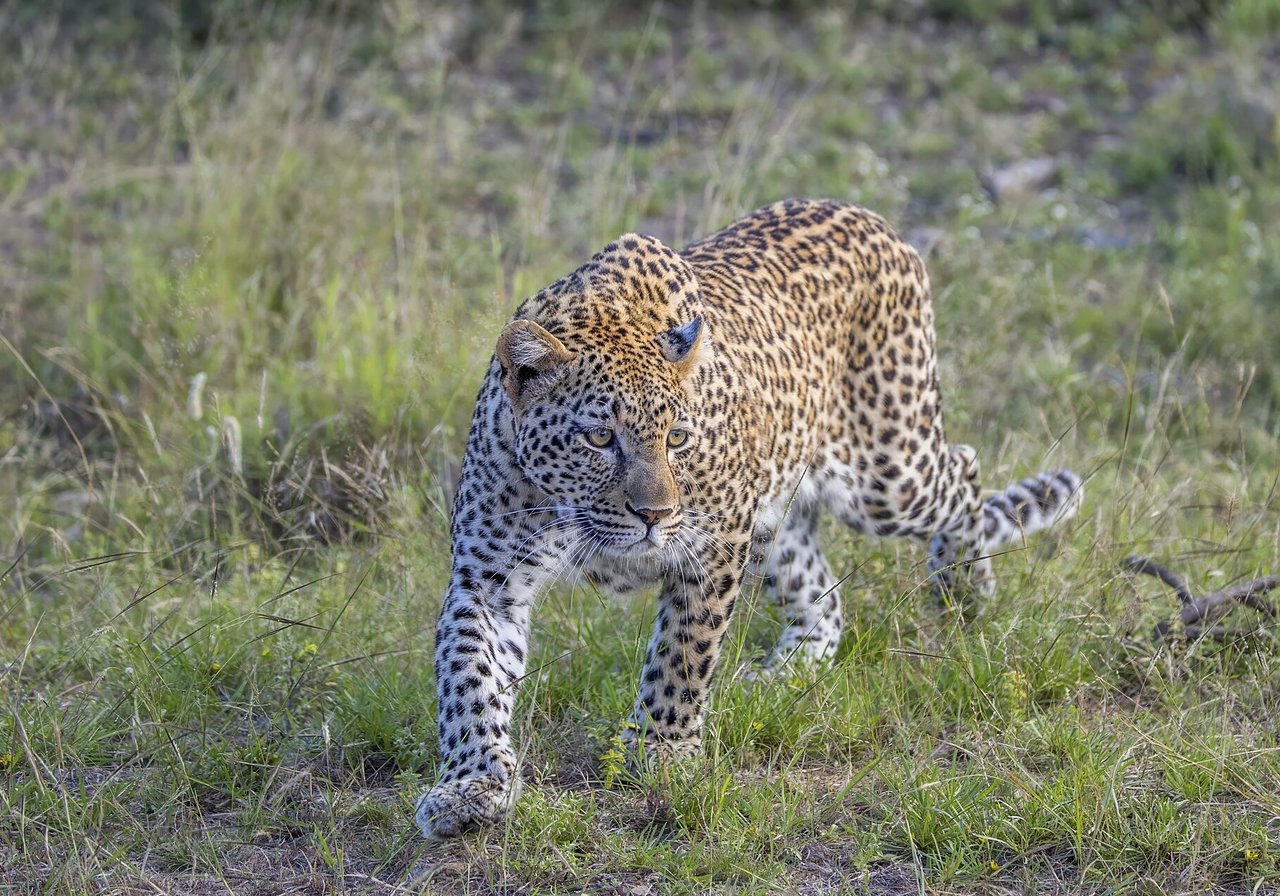
Source: Wikimedia Commons
In brief
Leopards are spotted Panthera cats of Africa and Asia — Vulnerable (Panthera pardus) — plus clouded leopards and snow leopards as distinct species covered in separate WARN guides.
Also in Animals A to Z · Animals that start with L
By WARN Research & Conservation TeamLast updated
Leopards are large spotted cats of the genus Panthera, found across Africa and much of Asia. The African and Indian leopard (Panthera pardus) is listed as Vulnerable by the IUCN, declining from habitat loss, prey depletion and conflict with livestock owners. Clouded leopards and snow leopards belong to separate lineages but share the leopard name in common English. Leopards are extraordinarily adaptable — surviving in rainforest, desert margins and suburban edges where prey persists. They are powerful climbers, often storing kills in trees beyond the reach of lions and hyenas. This page is the leopard family hub — see WARN guides for clouded leopard and snow leopard.
Vulnerable
IUCN status — African/Indian leopard (2021)
9
Recognised leopard subspecies (debated)
Endangered
Clouded leopard; snow leopard Vulnerable
CITES I
All leopard species — commercial trade banned
Figures sourced from IUCN Red List — Panthera pardus, Panthera — leopard conservation, Snow Leopard Trust .
Leopard: Quick Facts
| Species | Panthera pardus plus clouded & snow leopards |
|---|---|
| Related guides | Clouded leopard, snow leopard |
| Coat | Rosettes; melanistic forms occur |
| Habitat | Savanna, forest, mountains — highly adaptable |
| Main threats | Habitat loss, prey depletion, skin trade |
| CITES | Appendix I — all leopard species |
Scientific Classification
| Kingdom | Animalia |
|---|---|
| Class | Mammalia |
| Order | Carnivora |
| Family | Felidae |
| Genus | Panthera (P. pardus); Neofelis (clouded leopards) |
Conservation Status
- IUCN Status
- Panthera pardus Vulnerable; clouded leopard Vulnerable–Endangered; snow leopard Vulnerable.
- Population
- Varies — rough global leopard estimate under 250,000; snow leopard 2,710–3,386 mature individuals
- Trend
- Decreasing for Panthera pardus and clouded leopards
- Assessed
- 2021 (Panthera pardus)
- CITES
- Appendix I — all leopard species
Key Facts: Leopard
- The African and Indian leopard (Panthera pardus) is Vulnerable and declining.
- Clouded leopards and snow leopards are separate species — not subspecies of Panthera pardus.
- Leopards are the most widespread big cat — found from Senegal to Sri Lanka.
- They are exceptional climbers, often caching kills in trees.
- WARN guides cover clouded leopard and snow leopard in detail.
- Skin trade, prey loss and retaliatory killing are major threats.
Panthera pardus and the leopard complex
The leopard most people picture — golden coat with black rosettes — is Panthera pardus, ranging across sub-Saharan Africa, the Middle East, India, South-east Asia and historically into parts of Europe. Nine subspecies are recognised, though taxonomy shifts with genetic studies. Melanistic 'black panthers' are leopards (in Africa and Asia) or jaguars (in the Americas) with increased dark pigment — not a separate species.
Clouded leopards (genus Neofelis) occupy South-east Asian rainforest with cloud-like spot patterns and the longest canine teeth relative to body size among cats. The snow leopard (Panthera uncia) inhabits Central Asian mountains — thick fur, long tail for balance and Endangered/Vulnerable status depending on assessment. WARN treats clouded leopard and snow leopard as dedicated species guides linked from this hub.
Understanding the split prevents confusion: 'leopard' in everyday speech may mean Panthera pardus, clouded leopard, snow leopard or even the colloquial 'panther' for melanistic individuals.
Ecology and behaviour
Leopards are solitary, territorial carnivores hunting deer, antelope, wild pig, baboons and smaller prey. Night vision, stealth and explosive acceleration make them effective ambush hunters. In trees they rest safely and hoist kills — a 50 kg impala carried up a trunk demonstrates extraordinary strength.
Home ranges vary from 30 km² for females in prey-rich forest to over 400 km² for males in arid landscapes. Scent marking and scrape piles communicate occupancy. Females raise cubs alone in dense cover for roughly 18 months.
Where lions and tigers exist, leopards shift toward nocturnal activity and tree use — niche partitioning that lets multiple big cats coexist. In India and Pakistan — WARN partner regions — leopards enter human-dominated landscapes when natural prey declines, raising conflict.
Threats and trade
Leopard populations are declining across much of range. Habitat fragmentation removes cover and prey. Snares set for bushmeat kill leopards incidentally. Retaliatory shooting and poisoning follow livestock losses — especially where governance is weak.
Illegal trade in leopard skins persists for ceremonial dress, decoration and traditional medicine in some regions. CITES Appendix I prohibits commercial international trade in all leopard species. Enforcement varies; a single skin can fetch thousands on black markets.
Clouded leopards face additional pressure from deforestation for palm oil and logging across Malaysia and Indonesia — WARN partner countries. Snow leopards lose prey to overgrazing and are killed in retaliation for livestock predation across Central Asia.
Leopards and people
Leopards have lived alongside humans for millennia — feared, revered and depicted in art from ancient Egypt to Mughal miniatures. Today coexistence requires livestock protection (predator-proof pens, guard dogs), fair compensation schemes and protected corridors linking forest fragments.
Melanistic leopards — 'black panthers' — capture public imagination but face the same threats as spotted individuals. Ecotourism that values living leopards supports anti-poaching in reserves from Sri Lanka to South Africa.
Readers searching 'leopard' should explore WARN's clouded leopard and snow leopard guides for species-level detail on South-east Asian forest cats and Himalayan specialists.
What WARN Does
WARN publishes free education on big cats and habitat protection. Clouded leopards share threatened forest with partners in Malaysia and Indonesia; leopard conflict reduction principles apply wherever wild cats overlap human communities.
If this guide helps you understand wildlife and the pressures it faces, a gift to WARN supports habitat protection and free public education in our partner countries.
Leopard: Frequently Asked Questions
Are leopards endangered?
What is a black panther?
How is a clouded leopard different from a leopard?
Where do snow leopards live?
Why do leopards climb trees?
Are leopards dangerous?
How long do leopards live?
How big is a leopard?
What do leopards eat?
Sources & References
Population figures, conservation status and biological facts on this page are drawn from authoritative scientific and intergovernmental sources.
Terms used on this page
Plain-English definitions, from our wildlife and conservation glossary.
Latest Leopard Stories
Quick, fact-checked reads on the leopard — amazing facts, key questions and the threats it faces.
Species
Slow Loris: Why the Internet's Favourite Pet Is a Conservation Disaster
The slow loris looks like a cartoon character — and that has nearly destroyed the species. Here is the truth behind the viral videos.
Read the storySpecies
The Snow Leopard: Why the Ghost of the Mountains Is Still Vulnerable
The snow leopard is one of the most elusive big cats on earth, with an estimated 4,000-6,500 individuals across twelve range states — including Pakistan, where WARN is preparing to operate. This briefing explains why the species was downlisted from Endangered to Vulnerable in 2017 and why that is not the success story it sounds like.
Read the storyGuides
Sun Bear vs Moon Bear: The Two Most Trafficked Asian Bears
The sun bear and the Asiatic black bear (moon bear) are the two most commonly trafficked bears in Asia — for the pet trade, for traditional medicine and for bear-bile farming. Here is how to tell them apart.
Read the storyExplore more animals
Discover more animals, their habitats and their conservation status in the WARN wildlife-guide library.