Wildlife Guide · North Atlantic Ocean & Eastern North America
Lobster
Family Nephropidae
The armoured, blue-blooded crustacean that moults to grow, regrows lost claws and can live for decades.
Source: Global Animal Guide (WARN)
In brief
A lobster is a large clawed marine crustacean of the family Nephropidae, including the American and European lobsters. It grows by moulting its hard shell, can regenerate lost claws, has blue copper-based blood, and may live an estimated 45 to 50 years in the wild.
Also in Animals A to Z · Animals that start with L
By WARN Research & Conservation TeamLast updated
Lobsters are large, long-lived marine crustaceans of the family Nephropidae, the group of true "clawed" lobsters that includes the American lobster (Homarus americanus) and the European lobster (Homarus gammarus). Encased in a hard exoskeleton they must shed to grow, these bottom-dwelling decapods are built around a pair of unequal front claws, long sensory antennae and copper-rich blue blood. They walk the cold rocky floors of the Atlantic, scavenging and hunting in the dark, and they are famous both for their longevity and for the rare colour mutations - blue, calico, split and albino - that periodically go viral when one turns up in a fishing trap. Where they have been assessed, clawed lobsters are not classed as threatened, though they remain heavily fished and sensitive to warming, acidifying seas.
45-50 yrs
Estimated wild lifespan
20.15 kg
Heaviest recorded (44.4 lb)
10 legs
Decapod: 8 walking + 2 claws
1 in 2M
Odds of a blue lobster
Figures sourced from Wikipedia - Lobster, Wikipedia - American lobster (Homarus americanus), Wikipedia - European lobster (Homarus gammarus) and other references on this page.
Lobster: Quick Facts
| Common name | Lobster (clawed lobster) |
|---|---|
| Family | Nephropidae |
| Order | Decapoda (crustaceans) |
| Diet | Omnivore: molluscs, worms, fish, crustaceans, algae |
| Habitat | Cold Atlantic sea floors, rocky to muddy bottoms |
| Estimated lifespan | About 45-50 years in the wild |
| Heaviest recorded | 20.15 kg (44.4 lb), Nova Scotia |
| Limbs | 10 (8 walking legs + 2 claws) |
| Blood | Blue (copper-based haemocyanin) |
| IUCN status | Least Concern where assessed; not CITES-listed |
Scientific Classification
| Kingdom | Animalia |
|---|---|
| Phylum | Arthropoda |
| Class | Malacostraca |
| Order | Decapoda |
| Family | Nephropidae |
| Example genus | Homarus |
| Example species | Homarus americanus, Homarus gammarus |
Conservation Status
- IUCN Status
- Clawed lobsters (family Nephropidae) are not assessed as a threatened group. The two best-known species, the American lobster (Homarus americanus) and European lobster (Homarus gammarus), are both listed as Least Concern on the IUCN Red List. Some less-studied species in the family are data deficient. Clawed lobsters are not listed under CITES. Main pressures are intensive fishing, ocean warming and acidification.
- Population
- No single global population figure; abundant and commercially fished across the North Atlantic, with stocks managed regionally.
- Trend
- Varies by species and region; major fished stocks are managed and broadly stable, though sensitive to warming and acidification.
- Assessed
- Least Concern listings as published on the IUCN Red List for Homarus americanus and Homarus gammarus
- CITES
- Not listed in the CITES Appendices (clawed lobsters).
Key Facts: Lobster
- Lobsters are clawed crustaceans of the family Nephropidae; the best-known are the American lobster (Homarus americanus) and the European lobster (Homarus gammarus).
- They grow by moulting - shedding the entire hard exoskeleton - and can regenerate claws and legs lost to predators or fights over successive moults.
- Their blood is blue because it carries oxygen using copper-based haemocyanin rather than the iron-based haemoglobin found in vertebrates.
- Rare colour mutations make headlines: blue lobsters occur in roughly 1 in 2 million, calico and orange around 1 in 30 million, and albino around 1 in 100 million.
- Where evaluated, clawed lobsters are listed as Least Concern by the IUCN and are not CITES-listed, but they are intensively fished and exposed to warming, acidifying seas.
- True clawed lobsters are not the same as spiny (rock) lobsters, which lack the large front claws.
What a lobster is and how to recognise one
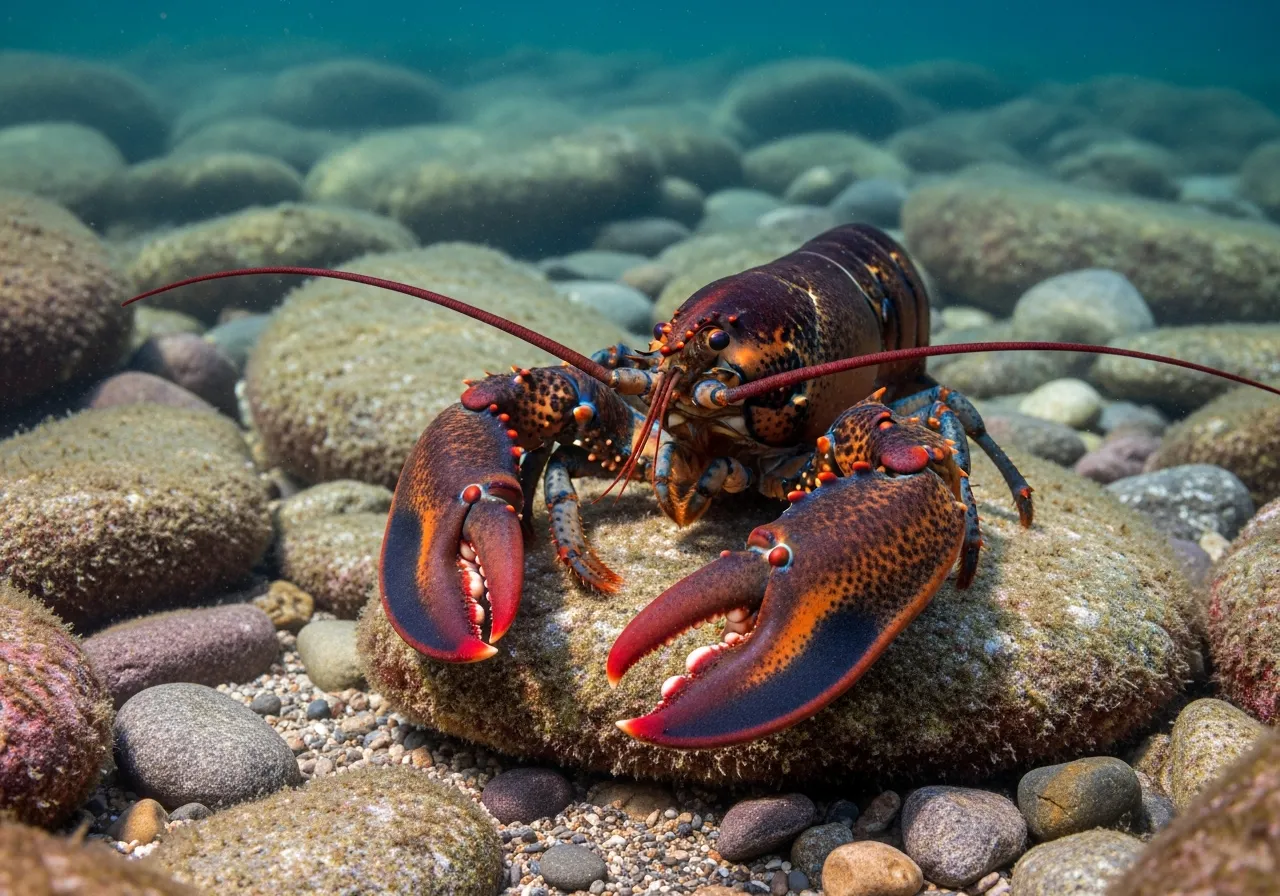
A lobster is a large marine crustacean in the family Nephropidae, part of the order Decapoda ('ten-footed'). The body divides into a fused head-and-thorax (the cephalothorax), protected by a shield-like carapace, and a muscular segmented tail or abdomen - the part most people picture on a plate. Lobsters have eight walking legs plus a front pair modified into large claws, giving the ten limbs of a decapod. The two claws are usually unequal: a heavy 'crusher', studded with rounded nodules for breaking shells, and a slimmer 'cutter' or pincer with sharper edges for tearing prey. Long, mobile antennae and smaller antennules act as the lobster's main sense organs in murky water, while compound eyes on stalks detect movement and dim light. The American lobster can reach about 64 cm (25 in) in length, and the heaviest lobster on record weighed 20.15 kg (44.4 lb), landed off Nova Scotia. Importantly, these clawed lobsters differ from 'spiny' or 'rock' lobsters, which belong to separate families and lack the big front claws.
Moulting, regeneration and a very long life
Because a lobster's armour cannot stretch, it can only grow by moulting - backing out of its old shell and expanding a soft new one underneath before it hardens. Young lobsters moult often, sometimes around ten times a year, slowing to once every few years as they mature; a single moult can raise body weight by roughly 40 to 50 per cent. Moulting is dangerous: studies cited on the species' Wikipedia entry note that an estimated 10 to 15 per cent of lobsters die of exhaustion during the process, and a freshly moulted lobster is soft and highly vulnerable until its shell sets. Moulting also powers regeneration - a lobster that loses a claw or leg can regrow it gradually over successive moults. Combined with slow, indeterminate growth, this lets lobsters reach great ages: individuals are thought to live an estimated 45 to 50 years in the wild, though precise ageing is difficult because each moult erases hard structures that might otherwise record age.
Blue blood, rare colours and life on the sea floor
Lobsters live on rocky, sandy and muddy bottoms of cold Atlantic waters, from the shallows down beyond the continental shelf, sheltering in crevices by day and foraging by night. They are opportunistic omnivores, taking molluscs, worms, other crustaceans, fish and some algae, and scavenging when they can. Their blood runs blue rather than red because it uses haemocyanin, a copper-based oxygen carrier, instead of iron-based haemoglobin. Live lobsters are typically mottled greenish-brown or, in the European species, a dark blue - the bright 'lobster red' only appears after cooking, when heat unmasks the pigment astaxanthin. Genuine colour mutations are spectacularly rare and reliably go viral: blue lobsters appear in roughly 1 in 2 million, calico and orange forms around 1 in 30 million, split-coloured 'half-and-half' lobsters near 1 in 50 million, and ghostly albino lobsters about 1 in 100 million. Such oddities are usually returned to the sea or sent to public aquariums rather than eaten.
Conservation status and pressures
As a group, clawed lobsters are not assessed as threatened: both the American lobster and the European lobster are listed as Least Concern on the IUCN Red List, and clawed lobsters are not listed under CITES. Some less-studied members of the family remain data deficient, meaning there is too little information to judge their status. That relative security depends on management. Lobsters are among the most valuable fished invertebrates in the North Atlantic, and stocks are guarded by rules such as minimum and maximum size limits, protection of egg-bearing females, escape vents in traps and seasonal closures. Longer-term, warming and acidifying seas pose real concerns: rising temperatures can shift lobster ranges and stress larvae, while more acidic water can hamper shell formation. Healthy lobster populations therefore rest on continued science-based fisheries management and on tackling the broader pressures of climate change and habitat loss.
What WARN Does
World Animal Rescue Network does not run field projects for lobsters. Our role here is educational: we publish clear, sourced explainers so readers understand these animals and the pressures - overfishing, warming seas and ocean acidification - that affect marine wildlife. By making accurate science easy to find, we aim to help people appreciate crustaceans and support responsible, well-managed seas.
Support World Animal Rescue Network's free, fact-checked wildlife education. Your gift helps us research and publish accurate guides like this one, so more people can understand and value the world's animals.
Lobster: Frequently Asked Questions
Why is lobster blood blue?
How long do lobsters live?
How big can a lobster get?
How rare is a blue lobster?
Can lobsters regrow their claws?
Are lobsters endangered?
What do lobsters eat?
Where do lobsters live?
Are lobsters dangerous?
Sources & References
Population figures, conservation status and biological facts on this page are drawn from authoritative scientific and intergovernmental sources.
Terms used on this page
Plain-English definitions, from our wildlife and conservation glossary.
Explore more animals
Discover more animals, their habitats and their conservation status in the WARN wildlife-guide library.