Wildlife Guide · Europe & Asia
Magpie
Pica pica
The brilliant black-and-white corvid that recognises itself in a mirror.
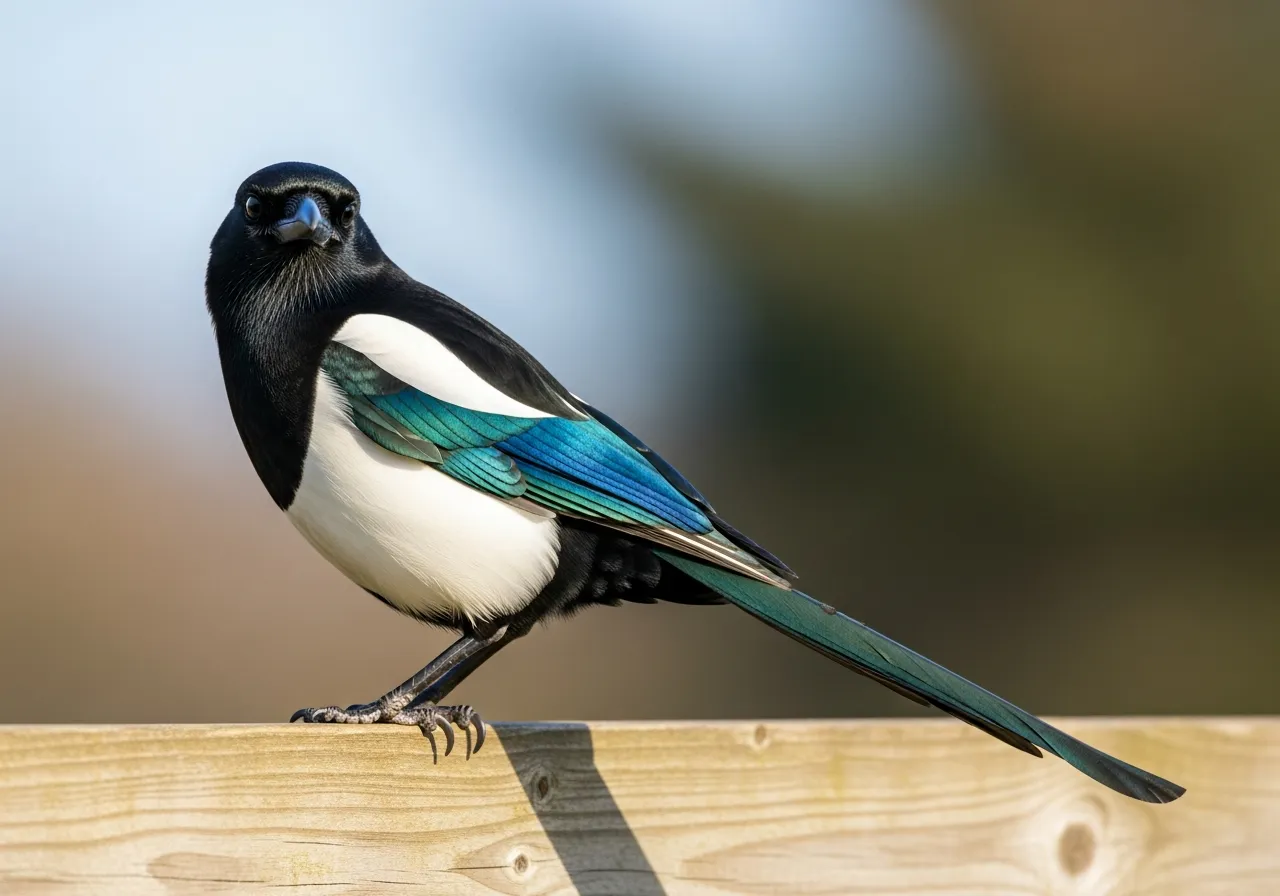
Source: Global Animal Guide (WARN)
In brief
A magpie is a large black-and-white bird in the crow family (Corvidae). The Eurasian magpie, Pica pica, is famous for its long iridescent tail, loud chattering call and exceptional intelligence — it is one of the few non-mammals known to recognise itself in a mirror.
Also in Animals A to Z · Animals that start with M
By WARN Research & Conservation TeamLast updated
The Eurasian magpie (Pica pica) is a large, unmistakable member of the crow family, instantly recognised by its bold black-and-white plumage and long, iridescent tail that shimmers green and blue in sunlight. Found across Europe, much of temperate Asia and North Africa, it thrives in farmland, woodland edges, parks and towns. Magpies are among the most intelligent of all animals: they store food, solve problems, and are one of the very few non-mammal species shown to pass the mirror self-recognition test. In British folklore they carry the old rhyme "one for sorrow", yet their adaptability and sharp wits have made them a familiar and successful bird almost everywhere people live.
44-46 cm
Body length, over half of it tail
52-62 cm
Wingspan
5-6
Eggs in a typical European clutch
1 of few
Non-mammals to pass the mirror test
Figures sourced from Eurasian magpie - Wikipedia, IUCN Red List, Magpie - Encyclopaedia Britannica and other references on this page.
Magpie: Quick Facts
| Common name | Eurasian magpie (common magpie) |
|---|---|
| Scientific name | Pica pica |
| Family | Corvidae (crows and jays) |
| Body length | 44-46 cm (tail over half of this) |
| Wingspan | 52-62 cm |
| Diet | Omnivore: insects, seeds, fruit, carrion, scraps, eggs |
| Typical clutch | 5-6 eggs |
| Range | Europe, temperate Asia, North Africa |
| IUCN status | Least Concern |
| Notable trait | Passes the mirror self-recognition test |
Scientific Classification
| Kingdom | Animalia |
|---|---|
| Phylum | Chordata |
| Class | Aves |
| Order | Passeriformes |
| Family | Corvidae |
| Genus | Pica |
| Species | Pica pica |
Conservation Status
- IUCN Status
- Least Concern. The Eurasian magpie has a very large global range and a big, stable population, and it adapts readily to farmland, suburban and urban habitats. It is not considered threatened anywhere across its range.
- Population
- Not precisely counted, but the global population is very large and numbers in the tens of millions of mature individuals.
- Trend
- Stable
- Assessed
- Assessed as Least Concern in the most recent IUCN Red List evaluation.
- CITES
- Not listed on the CITES appendices.
As a highly adaptable generalist, the magpie thrives alongside people; the conservation concern lies less with this species than with the specialist wildlife displaced by the same habitat changes magpies tolerate well.
Key Facts: Magpie
- The Eurasian magpie (Pica pica) is a corvid — a member of the crow and jay family — not a bird of prey.
- It is one of only a handful of non-mammal species shown to recognise itself in a mirror, a marker of self-awareness.
- Its long tail makes up more than half its total body length and gleams iridescent green and blue.
- Magpies are highly adaptable omnivores, eating insects, seeds, fruit, scraps and occasionally eggs or nestlings.
- The IUCN lists the Eurasian magpie as Least Concern, with a large and stable global population.
- In British folklore the magpie features in the counting rhyme 'one for sorrow, two for joy'.
What does a magpie look like?
The Eurasian magpie is a striking, pied corvid measuring 44-46 cm from beak to tail tip, with a wingspan of roughly 52-62 cm. At a glance it appears simply black and white, but in good light the black areas glow with an iridescent sheen of green, blue and purple, especially across the long, wedge-shaped tail that accounts for more than half the bird's length. The shoulders and belly are clean white, the wings show a flash of blue-green, and the stout black bill and legs complete the look. Males and females are alike, though males average slightly larger. In flight the magpie reveals broad white wing patches and a trailing tail, alternating bursts of flapping with short glides. Its voice is just as distinctive: a harsh, rattling, machine-gun-like 'chacker-chacker' chatter that often signals alarm or announces the bird long before it is seen. Juveniles resemble adults but have shorter tails and duller plumage in their first months.
How intelligent are magpies?
Magpies are among the most intelligent animals on Earth. Like other corvids, they have a brain that is large relative to body size, and they show problem-solving, planning and excellent memory — they can cache food in hundreds of locations and recover it later. Most remarkably, the Eurasian magpie is one of the very few non-mammal species demonstrated to pass the mirror self-recognition test. In landmark experiments, magpies marked with a coloured spot on the throat — visible only in a mirror — tried to remove the mark from their own bodies, suggesting they recognised the reflection as themselves rather than another bird. This places them in a small club alongside great apes, dolphins and elephants. Magpies also recognise individual human faces, can count to a degree, and have been observed in behaviour that resembles using tools and even apparent 'funeral' gatherings around dead companions. Their curiosity and boldness, sometimes mistaken for thieving 'shiny-object' habits, are really signs of an inquisitive, fast-learning mind.
Where do magpies live and what do they eat?
Eurasian magpies range right across temperate Europe and Asia, from Britain and Iberia eastward, with populations also in North Africa. They are supremely adaptable, equally at home in open farmland, woodland edges, hedgerows, suburban gardens, parks and city centres — almost anywhere that offers trees or tall shrubs for nesting and open ground for foraging. They do not migrate, holding territories year-round, and outside the breeding season may gather in loose flocks. Magpies are true omnivores. Their diet shifts with the seasons and includes insects and other invertebrates, seeds, grain, berries and fruit, carrion, household scraps and, in spring, the eggs and nestlings of other birds — a habit that draws criticism but has little measurable effect on overall songbird numbers. They build large, domed stick nests, often with a roof, usually high in a tree or tall hedge. A typical European clutch is five or six eggs, incubated by the female while the male provisions her, and pairs frequently stay together across years.
Magpie vs crow vs jackdaw: telling corvids apart
| Feature | Magpie | Carrion crow | Jackdaw |
|---|---|---|---|
| Plumage | Black and white, iridescent | All glossy black | Grey nape, pale eye |
| Tail | Very long, wedge-shaped | Short, square | Short |
| Size | Medium, slim | Large, bulky | Small |
| Voice | Harsh rattling chatter | Deep 'caw' | Sharp 'tchack' |
What WARN Does
World Animal Rescue Network does not run field projects specifically for the Eurasian magpie, which is a widespread and thriving species well outside the countries where WARN's partners work. This guide is part of WARN's free educational mission: helping people understand and value wildlife. The threats that quietly reshape magpie habitats — hedgerow and woodland loss, intensive land use and shrinking green space — are the same pressures that endanger many of the animals WARN does protect.
If this guide deepened your appreciation of the natural world, a small gift helps WARN keep protecting the vulnerable animals that need it most.
Magpie: Frequently Asked Questions
Is a magpie a member of the crow family?
Why do magpies like shiny objects?
Can magpies really recognise themselves in a mirror?
What does the rhyme 'one for sorrow' mean?
How long do magpies live?
What do eurasian magpies eat?
Where do eurasian magpies live?
Are eurasian magpies dangerous?
How big is an eurasian magpie?
Sources & References
Population figures, conservation status and biological facts on this page are drawn from authoritative scientific and intergovernmental sources.
Terms used on this page
Plain-English definitions, from our wildlife and conservation glossary.
Latest Magpie Stories
Quick, fact-checked reads on the magpie — amazing facts, key questions and the threats it faces.
Species
Slow Loris: Why the Internet's Favourite Pet Is a Conservation Disaster
The slow loris looks like a cartoon character — and that has nearly destroyed the species. Here is the truth behind the viral videos.
Read the storySpecies
The Snow Leopard: Why the Ghost of the Mountains Is Still Vulnerable
The snow leopard is one of the most elusive big cats on earth, with an estimated 4,000-6,500 individuals across twelve range states — including Pakistan, where WARN is preparing to operate. This briefing explains why the species was downlisted from Endangered to Vulnerable in 2017 and why that is not the success story it sounds like.
Read the storyGuides
Sun Bear vs Moon Bear: The Two Most Trafficked Asian Bears
The sun bear and the Asiatic black bear (moon bear) are the two most commonly trafficked bears in Asia — for the pet trade, for traditional medicine and for bear-bile farming. Here is how to tell them apart.
Read the storyExplore more animals
Discover more animals, their habitats and their conservation status in the WARN wildlife-guide library.