Wildlife Guide · Indonesia & Malaysia
Malayan Tapir
Tapirus indicus
The biggest tapir on Earth, and the only one in Asia, wearing black-and-white camouflage into a shrinking rainforest.
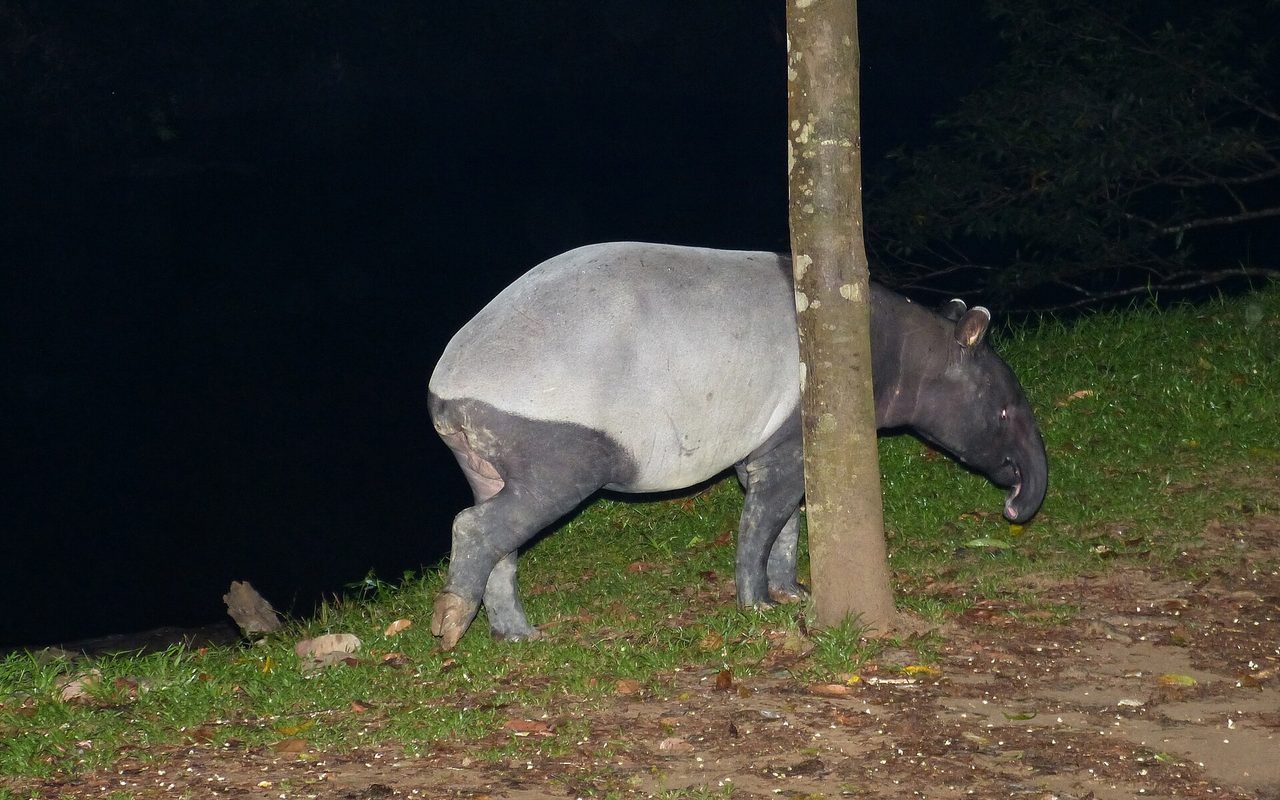
Photo: Bernard DUPONT from FRANCE / Wikimedia Commons (CC BY-SA 2.0)
In brief
A Malayan tapir is a large, plant-eating mammal native to the rainforests of Sumatra and Peninsular Malaysia. It is the biggest of the five tapir species and the only tapir found in Asia, recognisable by its black-and-white "saddle" coat and short, flexible snout.
Also in Animals A to Z · Animals that start with M
How you can help
You can support the related appeal — read its purpose, recipient status and fund terms first — or give once to where it is needed most. Sharing accurate information helps too.
By WARN Research & Conservation TeamLast updated
The Malayan tapir (Tapirus indicus) is the largest of the world's tapir species and the only one found outside the Americas, surviving in the rainforests of Sumatra and Peninsular Malaysia. Its bold black-and-white pattern looks conspicuous by day but breaks up the animal's outline in moonlit forest. Classed as Endangered by the IUCN, it is squeezed by deforestation, road deaths and snares, with fewer than 2,500 mature individuals thought to remain.
Up to ~540 kg
Weight of the largest tapir species
Fewer than 2,500
Mature individuals left in the wild (IUCN)
~13 months
Gestation, among the longest of any land mammal
CITES Appendix I
Highest level of trade protection
Figures sourced from IUCN Red List: Tapirus indicus (Malayan tapir), CITES Appendices (Tapiridae listed in Appendix I), Animal Diversity Web: Tapirus indicus and other references on this page.
Malayan Tapir: Quick Facts
| Lifespan | ~25-30 years (mid-30s in captivity) |
|---|---|
| Weight | 250-320 kg typical; up to ~540 kg |
| Length / Height | 1.8-2.5 m long; 0.9-1.1 m at the shoulder |
| Diet | Herbivore: leaves, shoots, twigs, fruit, aquatic plants (100+ species) |
| Gestation | About 390-410 days (~13 months) |
| Young per birth | Usually one calf, roughly every two years |
| Baby name | Calf |
| Group name | Largely solitary; no established collective noun |
| CITES | Appendix I |
| IUCN status | Endangered (decreasing) |
Scientific Classification
| Kingdom | Animalia |
|---|---|
| Phylum | Chordata |
| Class | Mammalia |
| Order | Perissodactyla |
| Family | Tapiridae |
| Genus | Tapirus |
| Species | Tapirus indicus (Desmarest, 1819) |
Conservation Status
- IUCN Status
- Endangered
- Population
- Fewer than 2,500 mature individuals
- Trend
- Decreasing
- Assessed
- Assessed for the IUCN Red List (listed Endangered since 2008)
- CITES
- Appendix I
Decline is driven mainly by loss and fragmentation of lowland rainforest for plantations and development, plus road deaths and snaring. Slow reproduction (a single calf roughly every two years after a ~13-month gestation) limits recovery.
Did you know?
Newborn Malayan tapirs look nothing like their parents: they are dark with white stripes and spots, often likened to a watermelon on legs, and only develop the adult black-and-white "saddle" at around six months old.
Key Facts: Malayan Tapir
- It is the largest tapir species and the only tapir native to Asia, living in Sumatra (Indonesia) and Peninsular Malaysia.
- Adults typically weigh 250-320 kg and can reach about 540 kg, measuring up to 2.5 m long.
- The bold black-and-white coat is camouflage: it disrupts the body outline in dappled, moonlit forest.
- Calves are born dark reddish-brown with white stripes and spots that fade by about six months of age.
- Tapirs are strong swimmers and can walk along riverbeds, using the snout like a snorkel.
- The IUCN lists it as Endangered with a decreasing trend, driven mainly by habitat loss from palm oil and other plantations, road deaths and snaring.
What a Malayan tapir is, and why it stands out
The Malayan tapir is a hoofed, herbivorous mammal more closely related to horses and rhinoceroses than to pigs, despite its bulky build. It is the only one of the five living tapir species found in Asia, all the others being native to Central and South America, and it is also the largest, with big individuals approaching 540 kg. Its most famous feature is its colour pattern: black at the front and rear with a large white or pale-grey patch wrapping over the back and flanks. Counter-intuitively, this high-contrast pattern is thought to be camouflage, breaking up the animal's recognisable shape in the broken light of the forest floor at night. A short, mobile snout, formed from the nose and upper lip, is used like a finger to pull leaves and shoots into the mouth.
Behaviour and ecology
Malayan tapirs are mostly solitary, nocturnal and crepuscular, browsing on the leaves, buds, twigs, fruit and aquatic plants of well over 100 plant species. By feeding across a wide area and depositing seeds in their dung, they act as important seed dispersers and "gardeners" of the rainforest. They are closely tied to water, wallowing to cool down and escape parasites, and are accomplished swimmers that can submerge and walk along the bottom of rivers. Females give birth to a single calf after a gestation of roughly 13 months, one of the longest of any land mammal, and usually breed only once every couple of years, which makes populations slow to recover from losses.
Why it is Endangered
The IUCN classifies the Malayan tapir as Endangered, with fewer than 2,500 mature individuals and a population trend that is decreasing. The core driver is the loss and fragmentation of lowland tropical forest, much of it cleared for oil palm and rubber plantations, logging and other development. As forest is broken into smaller patches, tapirs are forced to cross roads, where vehicle collisions kill animals, and they are caught in snares set for other wildlife. Although they are not the primary target of most hunters, poaching and the wildlife trade add further pressure. Because females reproduce slowly, even modest losses each year can tip local populations into decline.
What rescue and protection involve
Helping Malayan tapirs centres on keeping forest intact and connected, reducing deaths from roads and snares, and caring for the individuals that are injured, orphaned or displaced. On the ground this means anti-snare patrols, wildlife crossings and signage on roads that cut through tapir habitat, and rescue teams able to respond when a tapir is hit by a vehicle or strays into plantations and villages. Rescued and orphaned animals may need months of veterinary care and rehabilitation before release, and some become long-term residents or breeding animals where release is not safe. Community education matters too, since local goodwill is what keeps tapirs alive in the human-dominated landscapes around protected forest.
Malayan tapir vs. the four American tapirs
| Feature | Malayan tapir | American tapirs (e.g. lowland, Baird's, mountain, Kabomani) |
|---|---|---|
| Region | Asia (Sumatra, Peninsular Malaysia) | Central & South America |
| Coat | Black with a large white/pale 'saddle' | Mostly uniform brown to dark grey or reddish |
| Size | Largest tapir; up to ~540 kg | Smaller; roughly 150-300 kg depending on species |
| IUCN status | Endangered | Vulnerable to Endangered, varying by species |
| Distinction | Only tapir found outside the Americas | All confined to the Americas |
What WARN Does
WARN publishes this guide for education and is developing support through assessed animal-welfare grants. A species range, source citation or photograph does not establish a recipient or funding agreement. Check /about/where-your-money-goes/#grant-register for published grant and payment records; records not yet published must not be read as zero activity. Browse /appeals/ for the purposes currently available to support.
A Malayan tapir lives or dies by the forest around it. By backing WARN's vetted local rescue partners in Indonesia and Malaysia, your gift helps fund the snare patrols, road-safety work and rehabilitation that give this Endangered giant a future in its own rainforest.
How can I help save the malayan tapir?
Explore practical ways to support the malayan tapir, from everyday choices and sharing reliable information to reviewing a related appeal before giving.
Explore ways to support
Read the related appeal’s purpose, recipient status and fund terms. Choose an affordable gift after checking what is proposed and what has been reported.
Ease the pressures
Avoid the wildlife trade and souvenirs, never buy wild animals as pets, and choose sustainable, habitat-friendly products — the threats behind the malayan tapir's decline fall when demand does.
Spread the word
Share accurate, sourced information about the malayan tapir. Wider awareness is what turns concern into lasting protection.
Malayan Tapir: Frequently Asked Questions
How can I help save the malayan tapir?
How long do Malayan tapirs live?
What do Malayan tapirs eat?
How big is a Malayan tapir?
Are Malayan tapirs dangerous to humans?
How many Malayan tapirs are left?
What is a baby Malayan tapir called?
Where do malayan tapirs live?
Sources & References
Population figures, conservation status and biological facts on this page are drawn from authoritative scientific and intergovernmental sources.
Terms used on this page
Plain-English definitions, from our wildlife and conservation glossary.
Latest Malayan Tapir Stories
Quick, fact-checked reads on the malayan tapir — amazing facts, key questions and the threats it faces.
Species
12 Amazing Facts About the Malayan Tapir, Asia's Black-and-White Forest Giant
From its watermelon-patterned calves to its snorkel-like snout, the Malayan tapir is one of the rainforest's strangest survivors. Here are 12 facts worth knowing.
Read the storySpecies
How Big Is a Malayan Tapir? Size, Weight and Why It's the Largest Tapir
The Malayan tapir is the heavyweight of the tapir world. Here's exactly how long, tall and heavy it gets, and how it compares with its American cousins.
Read the storySpecies
Why Are Malayan Tapirs Endangered, and What's Being Done to Save Them?
Fewer than 2,500 mature Malayan tapirs remain, and the population is still falling. Here's what's driving the decline, and the work giving this forest giant a future.
Read the storyExplore more animals
Discover more animals, their habitats and their conservation status in the WARN wildlife-guide library.