Wildlife Guide · Pakistan
Markhor
Capra falconeri
The wild mountain goat with corkscrew horns — and one of conservation's rare success stories.
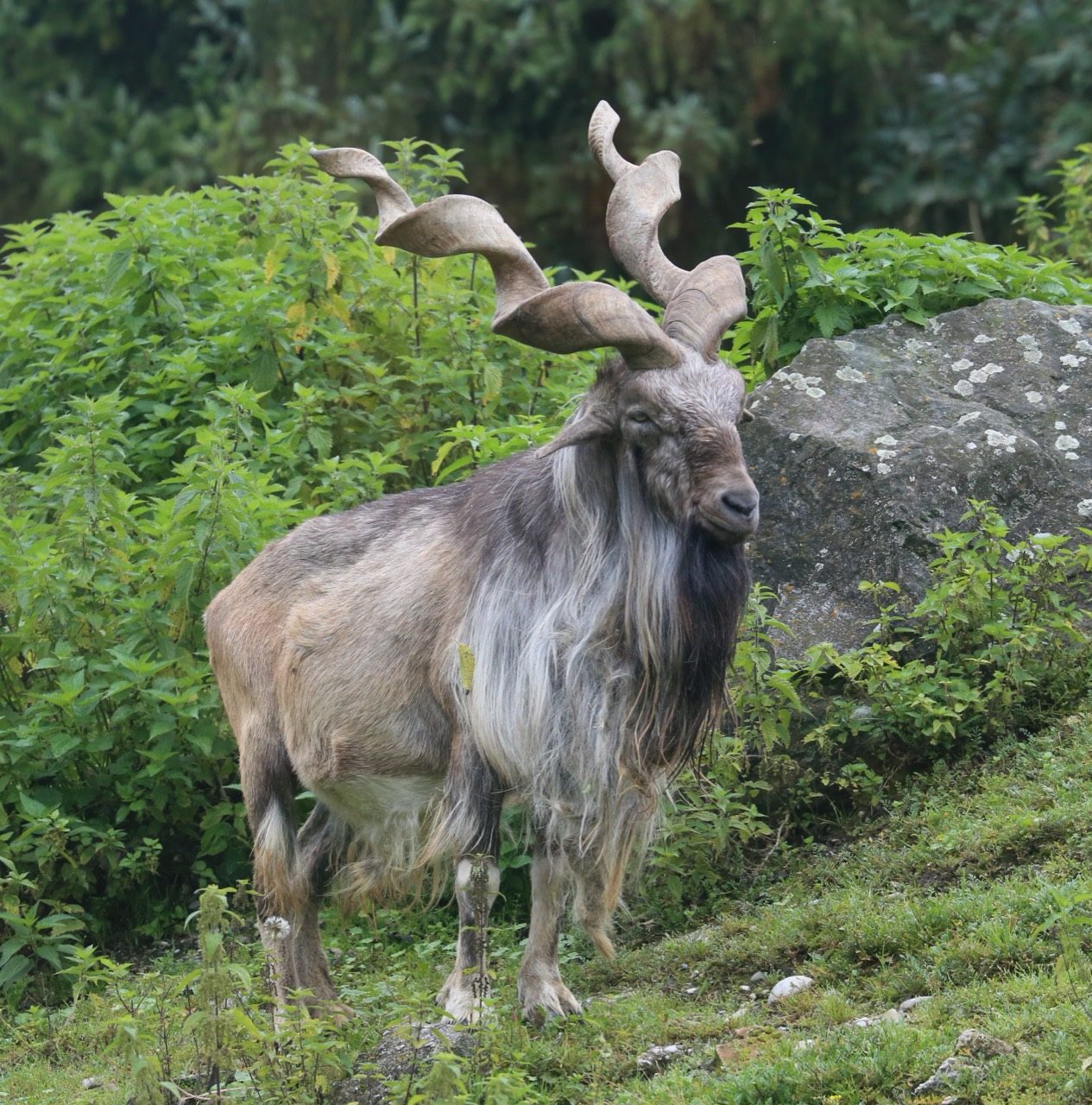
Source: Wikimedia Commons via Wikipedia “Markhor”
In brief
A markhor (Capra falconeri) is a large wild goat native to the mountains of Central and South Asia, famous for the males' long, twisting corkscrew horns; it is Pakistan's national animal and is currently listed by the IUCN as Near Threatened.
Also in Animals A to Z · Animals that start with M
How you can help
You can support the related appeal — read its purpose, recipient status and fund terms first — or give once to where it is needed most. Sharing accurate information helps too.
By WARN Research & Conservation TeamLast updated
The markhor is a large wild goat of the rugged mountains of Central and South Asia, instantly recognised by the spectacular spiralling horns of the males. Pakistan's national animal, it was once pushed toward the brink by hunting and habitat loss. Today, community-led conservation has helped its numbers recover enough for the IUCN to downlist it from Endangered to Near Threatened.
~160 cm
Longest male horns (corkscrew-shaped)
5,000–6,000
Estimated total population
Near Threatened
IUCN status (downlisted from Endangered in 2015)
3
Recognised subspecies
Figures sourced from IUCN Red List — Capra falconeri (Markhor), 2015 assessment, IUCN SSC Caprinae Specialist Group — Markhor conservation success story (2024), CITES — Appendices listing for Capra falconeri and other references on this page.
Markhor: Quick Facts
| Lifespan | ~11–13 years in the wild |
|---|---|
| Weight | Males ~80–110 kg; females ~32–50 kg |
| Length / Height | Head-body 132–186 cm; shoulder height 65–115 cm |
| Horns | Spiral/corkscrew; males up to ~160 cm, females up to ~25 cm |
| Diet | Herbivore — grazes grasses, browses leaves and twigs |
| Gestation | ~135–170 days (about 4.5–5.5 months) |
| Young per birth | Usually 1–2 kids, occasionally 3 |
| Baby name | Kid |
| Group name | Herd (females and young; mature males mostly solitary) |
| CITES | Appendix I |
Scientific Classification
| Kingdom | Animalia |
|---|---|
| Phylum | Chordata |
| Class | Mammalia |
| Order | Artiodactyla |
| Family | Bovidae |
| Subfamily | Caprinae |
| Genus | Capra |
| Species | Capra falconeri (Wagner, 1839) — 3 recognised subspecies |
Conservation Status
- IUCN Status
- Near Threatened
- Population
- Roughly 5,000–6,000 individuals; largest subpopulation (Chitral, Pakistan) exceeds 1,000 mature individuals
- Trend
- Increasing / stabilised in key areas
- Assessed
- 2015
- CITES
- Appendix I
Downlisted from Endangered to Near Threatened in the 2015 IUCN assessment after community-based conservation reversed declines. Gains are recent and the total population remains modest, so continued protection is needed.
Did you know?
A male markhor's spectacular horns can grow to around 160 cm — longer than many adult humans are tall — twisting like a corkscrew, which is why the animal is sometimes nicknamed the "screw-horn goat."
Key Facts: Markhor
- The markhor is the world's largest wild goat species and the national animal of Pakistan.
- Males grow dramatic spiral or corkscrew horns that can reach around 160 cm; females have much shorter horns.
- It lives on steep, rocky mountain slopes from roughly 600 to 3,600 metres, moving between elevations with the seasons.
- Community-based conservation programmes in Pakistan turned local people from poachers into custodians, helping populations recover.
- The IUCN downlisted the markhor from Endangered to Near Threatened in 2015 after numbers stabilised and rose.
- It is a vital prey animal for the endangered snow leopard, making its recovery important for the wider mountain ecosystem.
Why the markhor was threatened
For decades the markhor was driven down by unregulated hunting, poaching for its prized horns and meat, competition with domestic livestock for grazing, and human disturbance across its narrow mountain range. By the late 20th century several subpopulations had collapsed and the species was classified as Endangered. Because markhor live in small, fragmented groups on isolated mountain massifs, local losses could not easily be replaced by animals moving in from elsewhere, leaving the species especially fragile.
Behaviour and ecology
Markhor are superbly adapted to vertical terrain, using their cloven, rubbery-soled hooves to cross cliffs that deter most predators. Females and young live in herds of roughly nine animals, while mature males are largely solitary outside the winter rut, when they clash horns to compete for mates. They graze on grasses in spring and summer and switch to browsing leaves, twigs and shrubs in autumn and winter, sometimes rearing onto their hind legs to reach branches. As one of the few large prey animals in their range, they help sustain predators such as the snow leopard.
A community conservation success
Pakistan's community-based trophy-hunting and conservation model, developed from the 1990s, gives mountain villages a direct financial stake in keeping markhor alive. A large majority of the revenue from a small number of tightly regulated, science-quota permits flows back to local communities, funding schools, clinics and ranger patrols, while villagers monitor and protect the herds. The result has been a marked turnaround: poaching fell, numbers grew by an estimated fifth over a decade in key areas, and the largest subpopulation in Chitral now exceeds 1,000 mature animals — the evidence behind the 2015 downlisting.
What protecting markhor involves
Securing the markhor's future means sustained, on-the-ground work: trained local rangers patrolling against poaching, careful population counts to set safe quotas, managing competition with domestic goats and sheep, and keeping migration corridors open between mountain blocks. Because the gains are recent and the total population is still modest, this protection has to be continuous — a single bad season of poaching or disease can undo years of recovery in a small subpopulation.
Markhor subspecies at a glance
| Subspecies | Scientific name | Where found | Horn shape |
|---|---|---|---|
| Astor (Kashmir) markhor | Capra falconeri falconeri | Northern Pakistan (incl. Chitral, Gilgit-Baltistan) | Open, flat, loosely twisting spiral |
| Kabul (straight-horned) markhor | Capra falconeri megaceros | Afghanistan and adjoining Pakistan | Tight, close-set corkscrew |
| Bukharan (Tajik) markhor | Capra falconeri heptneri | Tajikistan, Uzbekistan, Turkmenistan | Long, gently spiralling |
What WARN Does
WARN publishes this guide for education and is developing support through assessed animal-welfare grants. A species range, source citation or photograph does not establish a recipient or funding agreement. Check /about/where-your-money-goes/#grant-register for published grant and payment records; records not yet published must not be read as zero activity. Browse /appeals/ for the purposes currently available to support.
The markhor's recovery proves what happens when mountain communities are backed to protect their own wildlife. By supporting WARN, you help fund local partners in Pakistan who keep that work going — patrol by patrol, herd by herd.
How can I help save the markhor?
Explore practical ways to support the markhor, from everyday choices and sharing reliable information to reviewing a related appeal before giving.
Explore ways to support
Read the related appeal’s purpose, recipient status and fund terms. Choose an affordable gift after checking what is proposed and what has been reported.
Ease the pressures
Avoid the wildlife trade and souvenirs, never buy wild animals as pets, and choose sustainable, habitat-friendly products — the threats behind the markhor's decline fall when demand does.
Spread the word
Share accurate, sourced information about the markhor. Wider awareness is what turns concern into lasting protection.
Markhor: Frequently Asked Questions
How can I help save the markhor?
How long do markhor live?
What do markhor eat?
How big do markhor get?
Are markhor dangerous to humans?
How many markhor are left?
Why is the markhor Pakistan's national animal, and why was it threatened?
What is a baby markhor called?
Sources & References
Population figures, conservation status and biological facts on this page are drawn from authoritative scientific and intergovernmental sources.
- IUCN Red List — Capra falconeri (Markhor), 2015 assessment
- IUCN SSC Caprinae Specialist Group — Markhor conservation success story (2024)
- CITES — Appendices listing for Capra falconeri
- Animal Diversity Web — Capra falconeri
- Population status, threats and conservation of Kashmir Markhor, Chitral Gol National Park, Pakistan (peer-reviewed)
- Population status of Heptner's markhor in Tajikistan — Oryx (Cambridge Core)
Terms used on this page
Plain-English definitions, from our wildlife and conservation glossary.
Latest Markhor Stories
Quick, fact-checked reads on the markhor — amazing facts, key questions and the threats it faces.
Species
12 Amazing Facts About the Markhor, the Corkscrew-Horned Wild Goat
From spiral horns longer than a person is tall to one of conservation's rare comeback stories, here are 12 standout facts about the markhor.
Read the storySpecies
How Big Is a Markhor? Size, Weight and Those Giant Corkscrew Horns
The markhor is the largest wild goat on Earth. Here is exactly how big it gets — height, weight and the record-setting spiral horns.
Read the storySpecies
Markhor vs Ibex: How to Tell These Wild Mountain Goats Apart
Both are wild mountain goats with impressive horns, but the markhor and the ibex differ in size, horn shape and range. Here's how to tell them apart.
Read the storyExplore more animals
Discover more animals, their habitats and their conservation status in the WARN wildlife-guide library.