Wildlife Guide · Tropical and subtropical oceans worldwide — Atlantic, Pacific and Indian
Marlin
Makaira nigricans (Lacepède, 1802)
Billfish giants of the tropics — Vulnerable to longlines, sport fishing and bycatch.
Source: Wikimedia Commons
In brief
The blue marlin (Makaira nigricans) is a Vulnerable billfish of tropical oceans, declining from longline bycatch and overfishing; white and striped marlin face similar pressures.
Also in Animals A to Z · Animals that start with M
How you can help
You can support the related appeal — read its purpose, recipient status and fund terms first — or give once to where it is needed most. Sharing accurate information helps too.
By WARN Research & Conservation TeamLast updated
Marlin are among the largest and most spectacular billfish — powerful predators with spear-like bills, towering dorsal fins and metallic blue colouration. The blue marlin, reaching over 450 kg, roams tropical and subtropical oceans worldwide. Listed as Vulnerable by the IUCN, blue marlin populations have declined from decades of overfishing by longline fleets targeting tuna and swordfish. Marlin are caught as bycatch on tuna longlines — often dead on arrival — and targeted by sport fisheries that release some catches but kill trophy fish. White marlin and striped marlin face similar pressures. All marlin species are slow-growing and late-maturing, making recovery from depletion difficult.
Vulnerable
IUCN Red List status — blue marlin (2019)
450 kg
Maximum weight — large female blue marlin
5 m
Maximum length including bill
Appendix II
CITES listing — blue marlin
Figures sourced from IUCN Red List — Makaira nigricans, ICCAT — billfish bycatch reports, Billfish Foundation — conservation .
Marlin: Quick Facts
| Weight | Up to 450 kg (blue marlin females) |
|---|---|
| Length | Up to 5 m including bill |
| Speed | Bursts exceeding 110 km/h |
| IUCN status | Vulnerable — decreasing |
| Main threat | Longline bycatch on tuna fisheries |
| CITES | Appendix II (blue marlin) |
Scientific Classification
| Kingdom | Animalia |
|---|---|
| Phylum | Chordata |
| Class | Actinopterygii |
| Order | Istiophoriformes |
| Family | Istiophoridae |
| Genus | Makaira |
| Species | Makaira nigricans (Lacepède, 1802) |
Conservation Status
- IUCN Status
- Vulnerable (IUCN, 2019). Decreasing population from longline bycatch and overfishing.
- Population
- No reliable global count; declining across major ocean basins
- Trend
- Decreasing
- Assessed
- 2019
- CITES
- Appendix II (blue marlin)
Key Facts: Marlin
- Blue marlin are Vulnerable — declining from longline bycatch and directed fishing.
- Marlin are caught incidentally on tuna and swordfish longlines worldwide.
- Sport fishing targets marlin — catch-and-release reduces but does not eliminate mortality.
- Marlin are slow-growing — maturity at 2–4 years; recovery from overfishing takes decades.
- White marlin is Near Threatened; striped marlin is Data Deficient.
- Circle hooks and fishery closures reduce marlin bycatch on longlines.
Giants of the billfish family
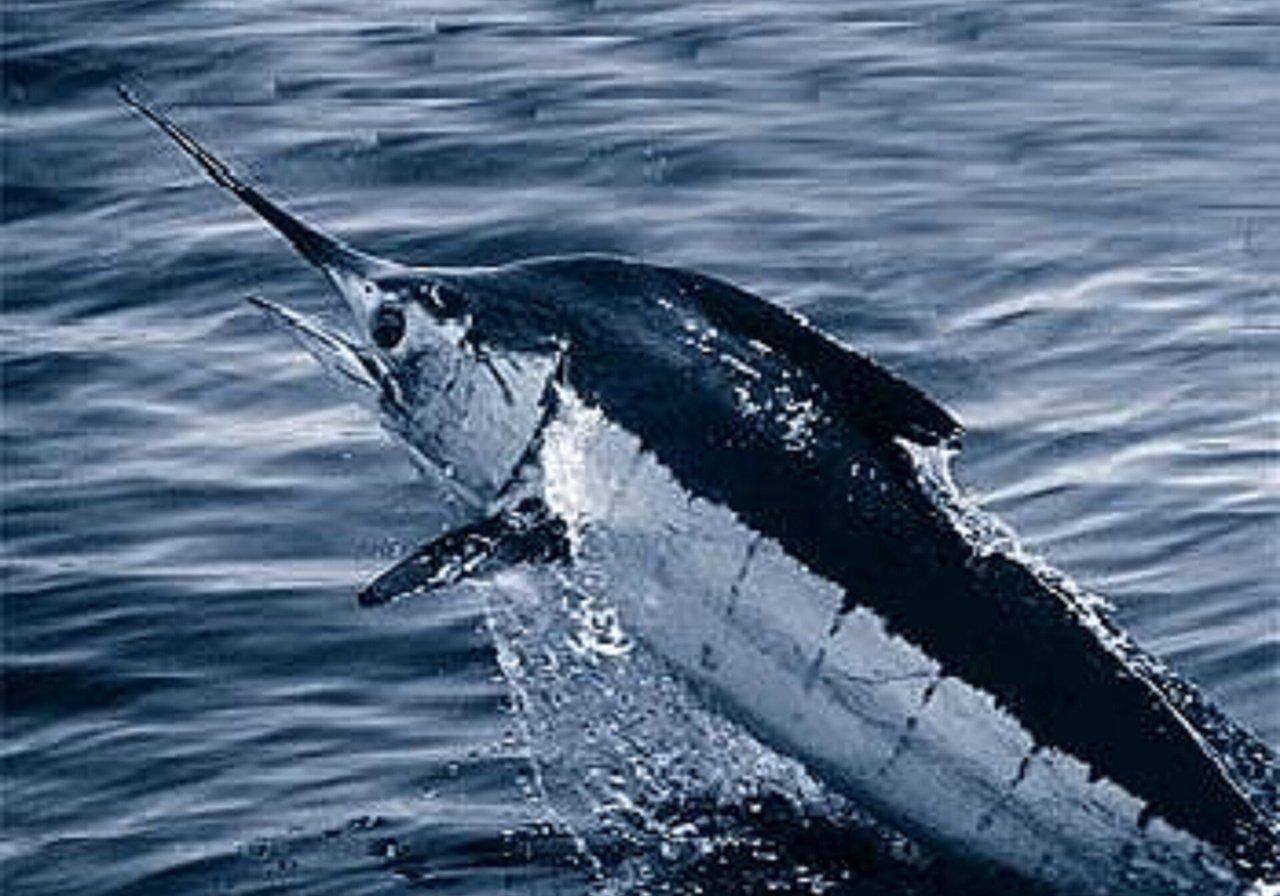
Marlin belong to family Istiophoridae alongside sailfish and spearfish. The blue marlin — Makaira nigricans in the Atlantic and Indo-Pacific — is the largest, with females exceeding 450 kg and 5 metres including bill. Metallic blue-black upper body, silver flanks and a rigid, sail-like dorsal fin define the species.
Marlin use their bills to stun tuna, mackerel, squid and dorado — slashing through schools or striking individual prey. They are among the fastest fish, capable of bursts exceeding 110 km/h. Endothermy maintains muscle and eye temperature for high-performance hunting in cool deep water.
White marlin (Kajikia albida) and striped marlin (Kajikia audax) are smaller relatives. Black marlin (Istiompax indica) of the Indo-Pacific is the heaviest bony fish recorded — over 700 kg.
Longline bycatch crisis
The primary threat to marlin is incidental capture on pelagic longlines set for tuna and swordfish. Hundreds of thousands of hooks deployed daily across tropical oceans catch marlin alongside target species. Most marlin are dead when lines are retrieved — discarded or landed as low-value byproduct.
ICCAT and other regional fisheries bodies require some bycatch mitigation — circle hooks, dehooking tools, release protocols — but compliance and observer coverage remain insufficient. Estimated blue marlin bycatch in the Atlantic alone exceeds thousands of tonnes annually.
Directed marlin fisheries — commercial harpoon and gillnet — add mortality in the Pacific and Indian Oceans. Data reporting is poor; IUU fishing compounds uncertainty.
Sport fishing and trophy pressure
Marlin are premier sport fish — the centrepiece of tournaments from Kona to Cairns. Billfish tournaments historically killed all catches for weigh-in; modern events increasingly practice tag-and-release. Tagging programmes provide migration data — blue marlin cross entire ocean basins.
Catch-and-release is not mortality-free. Fight duration, hook location and handling stress kill a proportion of released fish — estimates range from 5% to 30% depending on methods. Circle hooks in the jaw reduce deep-hooking mortality compared with J-hooks.
Trophy fishing removes the largest, most fecund females — disproportionately impacting breeding stock. Minimum size limits and slot limits protect spawning-capable individuals.
Conservation status and management
The IUCN lists blue marlin as Vulnerable with a decreasing population trend. White marlin is Near Threatened. Striped marlin is Data Deficient — insufficient data for assessment despite heavy fisheries pressure. Black marlin is Data Deficient.
CITES Appendix II regulates international trade in blue marlin parts. Regional management through ICCAT, IOTC and WCPFC sets bycatch limits and retention bans in some fisheries. Retention bans — requiring marlin to be released — reduce landings but not necessarily hooking mortality.
Time-area closures around spawning grounds, mandatory observer coverage and gear modification offer the best prospects for reducing mortality while maintaining tuna fisheries.
Protecting billfish for the future
Marlin are apex predators — indicators of healthy open-ocean ecosystems. Their decline signals unsustainable extraction from pelagic food webs shared with tuna, sharks and turtles.
Consumers can reduce marlin mortality indirectly by choosing pole-and-line tuna, supporting fisheries with bycatch limits and avoiding seafood from IUU sources. Anglers should use circle hooks, minimise fight time and support tournaments with mandatory release.
WARN publishes this marlin guide as free public education about billfish caught in the crossfire of industrial longline fisheries — Vulnerable giants whose recovery depends on bycatch reform across the world's tuna fleets.
What WARN Does
WARN publishes this marlin guide as free public education. Billfish bycatch on tuna longlines is a hidden crisis — reducing it protects marlin, sharks and ocean ecosystem integrity.
If this guide helps you understand wildlife and the pressures it faces, a gift to WARN supports habitat protection and free public education in our partner countries.
How can I help save the marlin?
Explore practical ways to support the marlin, from everyday choices and sharing reliable information to reviewing a related appeal before giving.
Explore ways to support
Read the related appeal’s purpose, recipient status and fund terms. Choose an affordable gift after checking what is proposed and what has been reported.
Ease the pressures
Avoid the wildlife trade and souvenirs, never buy wild animals as pets, and choose sustainable, habitat-friendly products — the threats behind the marlin's decline fall when demand does.
Spread the word
Share accurate, sourced information about the marlin. Wider awareness is what turns concern into lasting protection.
Marlin: Frequently Asked Questions
How can I help save the marlin?
Are marlin endangered?
Why are marlin declining?
What is marlin bycatch?
Do sport fishermen kill marlin?
Where do marlins live?
Are marlins dangerous?
How long do marlins live?
How big is a marlin?
What do marlins eat?
Sources & References
Population figures, conservation status and biological facts on this page are drawn from authoritative scientific and intergovernmental sources.
Terms used on this page
Plain-English definitions, from our wildlife and conservation glossary.
Explore more animals
Discover more animals, their habitats and their conservation status in the WARN wildlife-guide library.