Wildlife Guide · Southern Africa & Kalahari Desert
Meerkat
Suricata suricatta
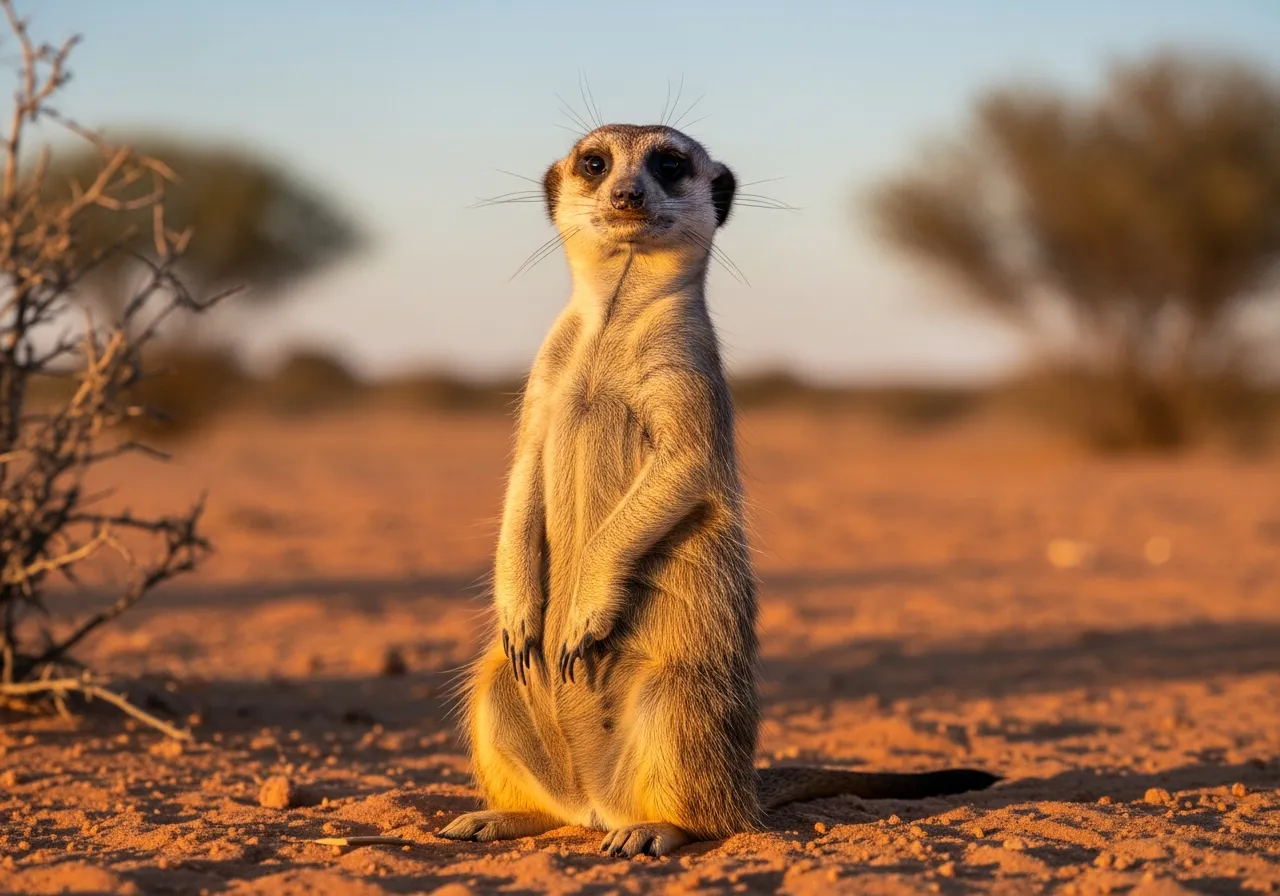
The Kalahari's cooperative sentinel, where every member takes a turn standing guard.
Source: Global Animal Guide (WARN)
In brief
A meerkat (Suricata suricatta) is a small, highly social mongoose native to the arid Kalahari and southern Africa. It lives in cooperative groups of up to about thirty, posts sentinels to watch for predators, and feeds mainly on insects, scorpions and other small prey.
Also in Animals A to Z · Animals that start with M
By WARN Research & Conservation TeamLast updated
The meerkat (Suricata suricatta) is a small, highly social mongoose of southern Africa's arid Kalahari and surrounding scrublands. Weighing under a kilogram, it lives in cooperative groups, often called mobs or gangs, of roughly two to thirty animals that share burrows, raise pups together and defend a common territory. Meerkats are famous for their sentinel behaviour: while the group forages, one member stands tall on a mound or bush, watching the sky and ground for predators and giving distinct alarm calls. They eat mostly insects, scorpions and other small prey, and show some resistance to scorpion venom. The IUCN lists the meerkat as Least Concern.
~1 kg
Adult weight
2–30
Group size
60–70
Days gestation
LC
IUCN status
Figures sourced from IUCN Red List: Suricata suricatta (Meerkat), Wikipedia: Meerkat, CITES: Checklist of CITES species and other references on this page.
Meerkat: Quick Facts
| Scientific name | Suricata suricatta |
|---|---|
| Common name | Meerkat (suricate) |
| Size | Head-and-body ~24–35 cm; tail ~17–25 cm |
| Weight | ~0.6–1 kg |
| Lifespan | ~5–15 years wild; 20+ in captivity |
| Diet | Mainly insects, scorpions and other small prey |
| Habitat | Arid savanna, scrub and semi-desert |
| Range | Botswana, Namibia, South Africa; edge of Angola |
| Gestation | ~60–70 days; 3–7 pups |
| Group name | Mob or gang (2–30 members) |
Scientific Classification
| Kingdom | Animalia |
|---|---|
| Phylum | Chordata |
| Class | Mammalia |
| Order | Carnivora |
| Family | Herpestidae (mongooses) |
| Genus | Suricata |
| Species | Suricata suricatta |
Conservation Status
- IUCN Status
- Least Concern. The meerkat is widespread and common across arid southern Africa and is not considered at risk of extinction. It is not listed on the CITES appendices.
- Population
- Not quantified; common and widespread across its range
- Trend
- Stable
- Assessed
- 2015
- CITES
- Not listed on CITES
Meerkats live mostly outside protected areas as well as within them. Localised pressures include habitat change, drought and persecution, but the species as a whole is secure.
Key Facts: Meerkat
- Meerkats are small mongooses, weighing under a kilogram, native to the arid Kalahari and southern Africa.
- They live in cooperative groups of roughly 2 to 30, sharing burrows and raising pups together.
- Sentinels take turns standing guard and give distinct alarm calls for aerial versus ground threats.
- Their diet is largely insects, scorpions and other small prey, and they tolerate some scorpion venom.
- A dominant pair produces most pups, while subordinate group members help feed and protect them.
- The IUCN classifies the meerkat as Least Concern, and it is not listed on CITES.
What meerkats look like and where they live
Meerkats are slender, ground-dwelling mongooses, measuring roughly 24 to 35 cm in head-and-body length with a thin, tapering tail of about 17 to 25 cm. Adults typically weigh between 0.6 and 1 kg. Their coarse, sandy-to-grizzled coats carry faint dark bands across the back, and dark patches around the eyes act like built-in sunglasses, cutting glare so they can scan a bright desert sky. Long, curved claws make them efficient diggers. They are found across the arid zones of southern Africa, principally in Botswana, Namibia and South Africa, with the range barely reaching south-western Angola. Meerkats favour open, dry country with sparse woody vegetation: savanna, scrubland and semi-desert where firm or sandy soils allow extensive burrow systems. Those burrows, often shared with ground squirrels, provide shelter from extreme heat, cold nights and predators, with multiple entrances and deep chambers.
Living in a mob: cooperation and sentinels
Meerkats are among the most cooperative of mammals. A group, popularly called a mob or gang, contains roughly 2 to 30 individuals centred on a dominant breeding pair. Most pups are born to that pair, while subordinate adults act as helpers, babysitting, feeding young and sharing guard duty in a system biologists call cooperative breeding. The behaviour they are best known for is sentinel duty: while the rest of the group forages with heads down, one animal climbs to a raised spot and stands sentry, scanning for danger. Sentinels give different alarm calls depending on whether a threat comes from the air, such as a raptor, or the ground, such as a jackal, and the calls even signal urgency. Group living also means warmth on cold mornings, shared pup-rearing, and many eyes and ears, all of which help meerkats survive in an exposed, predator-rich landscape.
Diet, scorpions and venom resistance
Meerkats are mainly insectivores, foraging by scratching and digging through sand and leaf litter for beetles, larvae, butterflies and moths, spiders, centipedes and other invertebrates. They also take small reptiles, amphibians, birds, eggs and occasionally plant material such as roots and fruit. Scorpions are a notable part of the menu, and meerkats handle them with skill, rapidly biting and rubbing the prey in sand to remove the stinger before eating. They have some physiological resistance to scorpion venom, allowing them to tackle prey that would harm many other animals, though a sting can still be dangerous. Pups are not born knowing how to handle such dangerous food; adults teach them, first bringing dead prey, then disabled prey, and finally live prey as the youngsters gain skill, an example of active teaching that is rare in the animal world. Foraging is near-constant because their small bodies store little fat and must be refuelled daily.
Meerkat vs other mongooses
| Feature | Meerkat | Typical mongoose |
|---|---|---|
| Family | Herpestidae | Herpestidae |
| Build | Slender, often stands upright | Low-slung, stays on all fours |
| Social structure | Highly cooperative mobs of 2–30 | Solitary to loosely social, varies |
| Sentinel duty | Regular, organised guarding | Uncommon or absent |
| Range | Arid southern Africa | Africa and Asia, many habitats |
What WARN Does
WARN does not currently run dedicated field projects for meerkats, which live outside the countries where our partners work and remain classified as Least Concern. This guide is part of WARN's free educational and awareness work, helping people understand the wildlife that shares our planet. The same pressures that shape arid ecosystems, including habitat loss, land-use change and a warming climate, also affect the animals WARN does protect, so building public understanding of species like the meerkat supports wildlife conservation more broadly.
If you value clear, science-based wildlife guides like this one, a small gift helps WARN keep protecting habitats and the animals that depend on them.
Meerkat: Frequently Asked Questions
Are meerkats dangerous to humans?
What do meerkats eat?
Why do meerkats stand up on their hind legs?
Are meerkats endangered?
How long do meerkats live?
Are meerkats immune to scorpion venom?
Where do meerkats live?
How big is a meerkat?
Sources & References
Population figures, conservation status and biological facts on this page are drawn from authoritative scientific and intergovernmental sources.
Terms used on this page
Plain-English definitions, from our wildlife and conservation glossary.
Latest Meerkat Stories
Quick, fact-checked reads on the meerkat — amazing facts, key questions and the threats it faces.
Explore more animals
Discover more animals, their habitats and their conservation status in the WARN wildlife-guide library.