Wildlife Guide · United Kingdom and Ireland & Western and Central Europe
European Mole
Talpa europaea
The velvet-furred earthworm hunter that engineers the soil beneath our feet.
Source: Global Animal Guide (WARN)
In brief
The European mole (Talpa europaea) is a small, burrowing insectivorous mammal with velvety fur, tiny eyes and powerful spade-like forepaws. It lives almost entirely underground, hunting earthworms in self-dug tunnels across Europe and western Asia, and is best known for the molehills it pushes to the surface.
Also in Animals A to Z · Animals that start with E
By WARN Research & Conservation TeamLast updated
The European mole (Talpa europaea) is a small, almost blind insectivore built entirely for life underground. Its cylindrical body, velvety fur and outsized spade-shaped forepaws let it shift soil with remarkable power, carving tunnel networks through gardens, pastures and woodland across much of Europe and into western Asia. Moles spend almost their whole lives below the surface, hunting earthworms in their tunnels, so they are rarely seen alive. Most people know them only by the molehills they leave behind. Despite their reputation as garden nuisances, moles aerate soil, control invertebrate pests and are listed as Least Concern by the IUCN, with stable populations across their broad range.
11-16 cm
Head-and-body length
70-130 g
Adult body weight
~50%
Of body weight eaten in food daily
3-5 yrs
Typical lifespan
Figures sourced from Wikipedia: European mole, IUCN Red List: Talpa europaea, Encyclopaedia Britannica: Mole (mammal) and other references on this page.
European Mole: Quick Facts
| Common name | European mole (also common mole, northern mole) |
|---|---|
| Scientific name | Talpa europaea |
| Type | Burrowing insectivorous mammal |
| Head-and-body length | About 11-16 cm |
| Weight | About 70-130 g |
| Diet | Earthworms, insect larvae and other soil invertebrates |
| Daily food intake | Roughly half its body weight |
| Lifespan | Typically 3-5 years |
| Range | Europe and western Asia; absent from Ireland |
| IUCN status | Least Concern (stable) |
Scientific Classification
| Kingdom | Animalia |
|---|---|
| Phylum | Chordata |
| Class | Mammalia |
| Order | Eulipotyphla |
| Family | Talpidae |
| Genus | Talpa |
| Species | Talpa europaea |
Conservation Status
- IUCN Status
- Least Concern on the IUCN Red List. The European mole is widespread and common across Europe and western Asia, with a large and stable population and no significant threats at the species level. It is not listed on the CITES appendices. Localised declines can occur where intensive agriculture, soil compaction, drainage or pesticide use reduce earthworm abundance, and moles have historically been trapped as agricultural pests and for their fur.
- Population
- Not globally quantified; tens of millions in Britain alone (commonly estimated at around 35-40 million in the UK)
- Trend
- Stable
- Assessed
- 2016
- CITES
- Not listed
Population figures are broad estimates; moles are hard to census because they live almost entirely underground, so densities are usually inferred from molehill counts and habitat.
Key Facts: European Mole
- The European mole is a subterranean insectivore, not a rodent, and spends almost its entire life underground.
- Its broad, outward-facing forepaws act like spades, letting it tunnel with great force through soil.
- Earthworms are its staple food; moles even store paralysed worms in underground larders for lean times.
- Molehills are simply the spoil heaps of excavated earth pushed up from tunnels below.
- Velvety fur that lies flat in any direction lets a mole move forwards and backwards through tight tunnels.
- The species is listed as Least Concern by the IUCN, with a large and stable population.
What does a European mole look like and how is it adapted to digging?
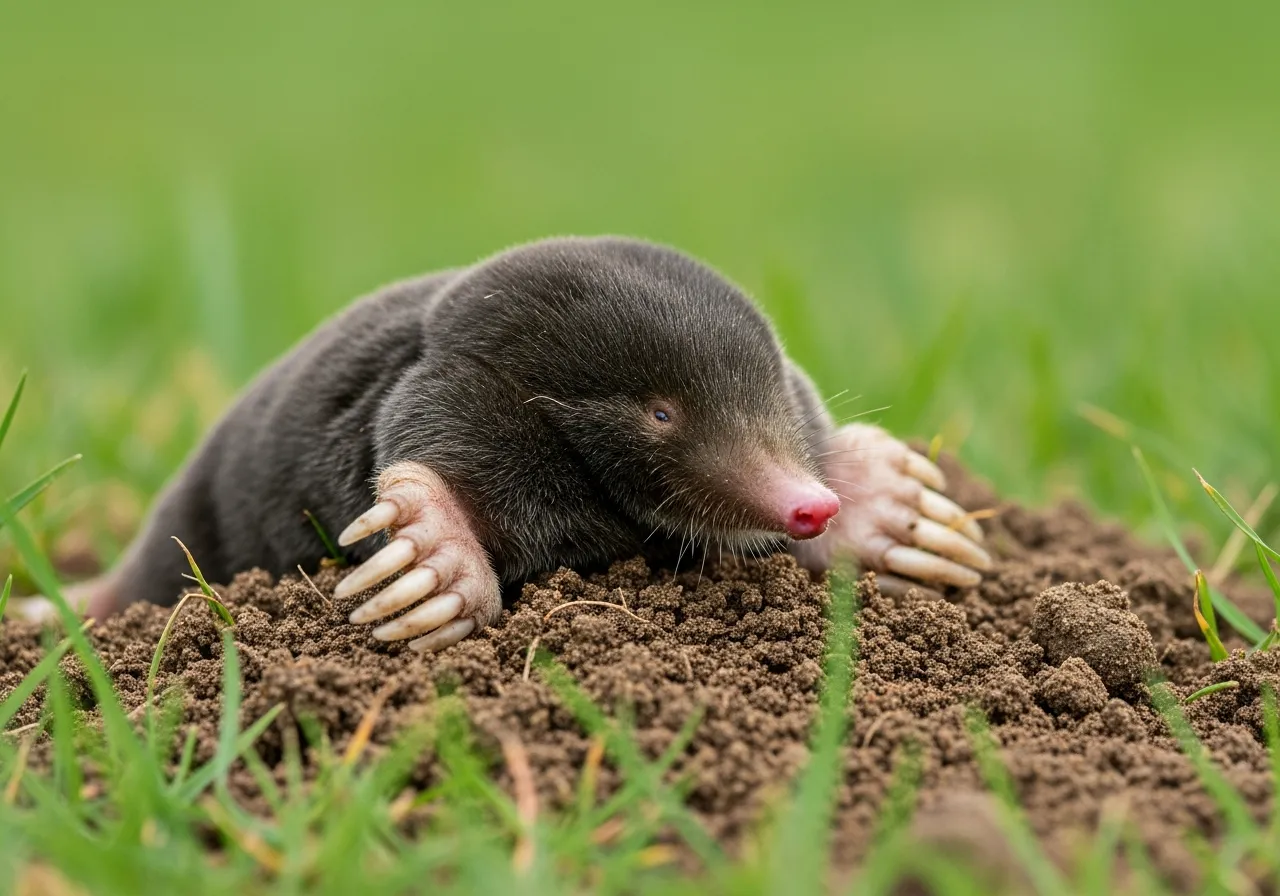
The European mole is unmistakable in the hand, though seldom seen. It has a stout, cylindrical body 11-16 cm long, weighing roughly 70-130 g, with a short, club-shaped tail and no obvious neck. Its most striking feature is the pair of broad, paddle-like front paws, turned permanently outwards and tipped with strong claws. Powered by heavy shoulder and chest muscles, these act as living spades, pushing soil sideways as the mole drives forward. The fur is short, dense and velvety, and crucially has no set direction of lie, so it offers no resistance whether the animal moves head-first or reverses down a tunnel. Eyes are minute, around a millimetre across and hidden in the fur, giving only basic light detection; there are no external ear flaps. To compensate, the mole relies on an acute sense of touch and smell, including sensitive whiskers and a snout packed with tactile receptors that detect the tiny vibrations of prey moving through the soil. Every part of its anatomy is a refinement for a life spent burrowing in darkness.
What do moles eat, and why are earthworms so important?
Moles are carnivores with a near-insatiable appetite. Their staple prey is the earthworm, supplemented by insect larvae, beetles, centipedes and other soil invertebrates that fall into their tunnels. Rather than actively excavating to find food, a mole patrols its permanent tunnel system like a trap-line, eating worms that have burrowed through the walls. A mole must eat frequently to survive: it consumes roughly half its body weight in food each day and can starve within a day or so if deprived. One of its more remarkable behaviours is food caching. A mole's saliva contains a toxin that paralyses earthworms without killing them, and it bites the heads to immobilise them, stockpiling living worms in underground larders. Hundreds of worms have been found in a single store, kept fresh as a reserve against hard frosts or drought when foraging is difficult. This heavy reliance on earthworms explains why moles favour deep, moist, undisturbed soils such as pasture, deciduous woodland and gardens, and why they are scarce in very sandy, acidic or waterlogged ground where worms are few.
Why do moles make molehills, and how do their tunnels work?
Molehills are the visible by-product of an invisible engineering project. As a mole digs and maintains its tunnel network, it must dispose of loosened earth, so it pushes the spoil up vertical shafts to the surface, creating the familiar conical heaps. A burrow system has two main levels: shallow surface runs used for foraging in soft, worm-rich soil, and deeper permanent tunnels that stay usable in dry or frozen conditions. The deep tunnels function as feeding traps, and a mole patrols them several times a day. Most moles are solitary and territorial, defending their networks against neighbours, though tunnels are sometimes inherited or shared after an occupant dies. Contrary to popular belief, the large mounds sometimes called fortresses are not always nests, but in cold or wet ground a mole may build a bigger chamber to raise young above the water table. Because moles aerate and mix the soil and prey on invertebrate pests, they are ecologically valuable, even where their excavations frustrate gardeners and farmers seeking a level lawn or field.
Where do European moles live and are they endangered?
The European mole has a wide distribution, ranging across most of temperate Europe and into western Asia, from Britain and southern Scandinavia south to northern Greece and east towards western Siberia. It is notably absent from Ireland, where it never naturally colonised. Within this range it is common wherever soils are deep enough to dig and rich enough in earthworms, occupying farmland, grassland, gardens, parks and woodland. The species is assessed as Least Concern on the IUCN Red List, reflecting its large numbers and stable population trend; in Britain alone the population is estimated in the tens of millions. Moles are not listed by CITES and face no significant conservation threat at the species level. Localised declines can occur where intensive agriculture, soil compaction, pesticides or drainage reduce earthworm numbers, and historically many moles were trapped for their pelts and as agricultural pests. As a widespread, adaptable native mammal, however, the European mole remains one of the success stories of life beneath the surface.
Mole vs vole: telling two common garden burrowers apart
| Feature | European mole | Vole |
|---|---|---|
| Group | Insectivore (Eulipotyphla), kin to shrews | Rodent, kin to mice |
| Diet | Earthworms and soil invertebrates | Mainly plants, roots, grasses and bark |
| Front feet | Large, outward-facing spade-like paws | Small, ordinary rodent feet |
| Eyes and ears | Tiny hidden eyes, no ear flaps | Visible eyes and small ears |
| Sign left behind | Conical molehills and raised tunnels | Surface runways and gnawed plants |
| Harm to plants | Disturbs soil but does not eat roots | Can damage roots, bulbs and stems |
What WARN Does
WARN does not run field projects specifically for the European mole, which is a widespread, Least Concern species living mostly outside the countries where WARN's partners work. This guide is part of WARN's free educational mission to help people understand wildlife accurately. The same pressures that can locally harm moles, such as habitat loss, intensive land use and pesticide-driven declines in soil life, also threaten many of the animals WARN's partners do protect.
If this guide helped you see the hidden world beneath your feet, a small gift helps keep WARN's free wildlife education and frontline animal care going.
European Mole: Frequently Asked Questions
Are moles blind?
Are moles rodents?
What do moles eat?
Why do moles make molehills?
Are moles dangerous or harmful to gardens?
Are European moles endangered?
Where do european moles live?
How long do european moles live?
How big is an european mole?
Sources & References
Population figures, conservation status and biological facts on this page are drawn from authoritative scientific and intergovernmental sources.
Terms used on this page
Plain-English definitions, from our wildlife and conservation glossary.
Explore more animals
Discover more animals, their habitats and their conservation status in the WARN wildlife-guide library.