Wildlife Guide · North America & Northern Europe
Moose
Alces alces
The largest deer on Earth — a giant of the northern wilderness
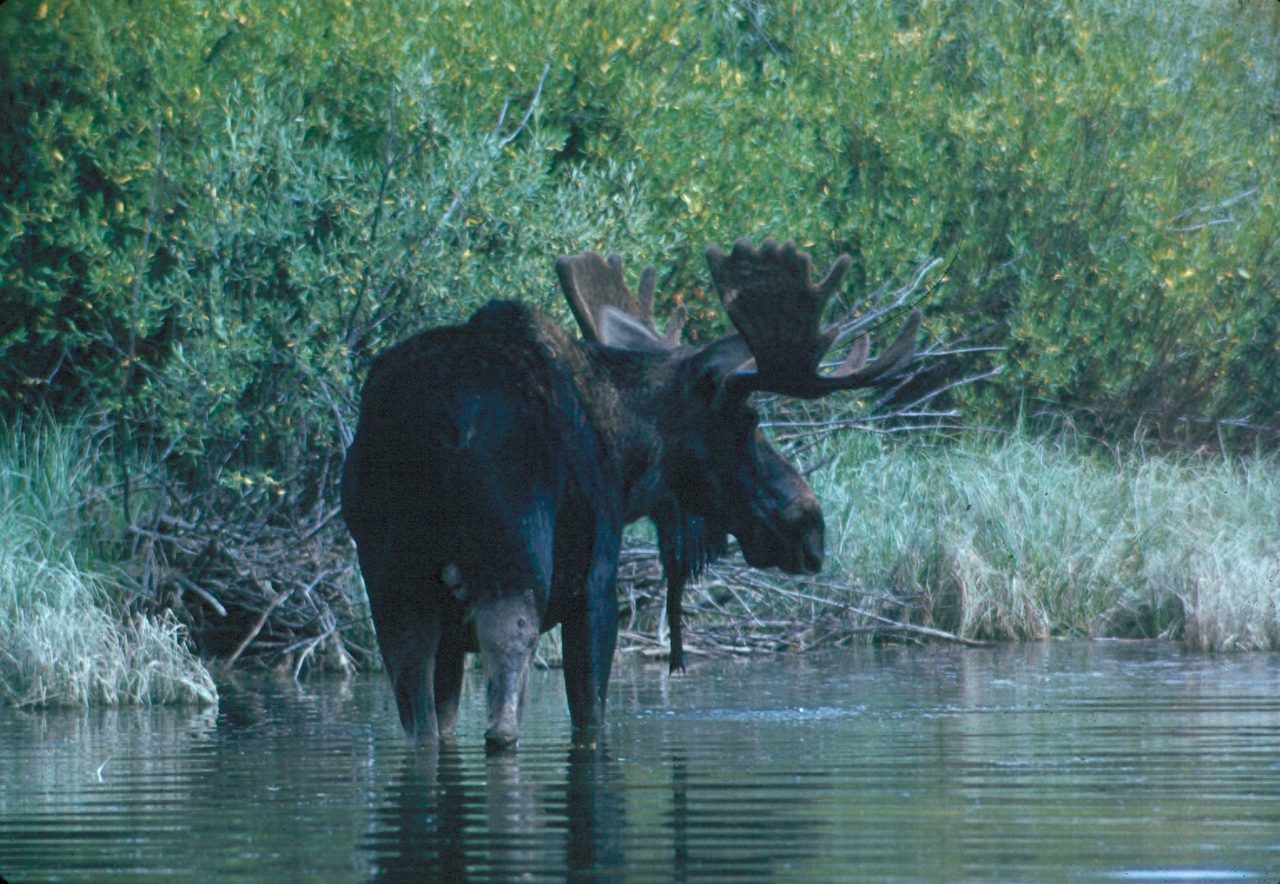
Photo: Garst, Warren, 1922-2016, photographer / Wikimedia Commons (CC BY-SA 4.0)
In brief
The moose (Alces alces) is the world's largest deer, standing up to 2.1 m (7 ft) at the shoulder and weighing up to 771 kg (1,700 lb), found across the boreal forests of North America, Northern Europe, and Russia.
Also in Animals A to Z · Animals that start with M
By WARN Research & Conservation TeamLast updated
The moose (Alces alces) is the world's largest and heaviest living deer, a creature so singular it occupies its own genus. A full-grown Alaskan bull can tip the scales at 771 kg (1,700 lb) and stand over 2.1 metres (7 ft) at the shoulder, yet move through dense boreal forest with surprising silence. Moose are circumpolar animals, roaming the taiga and mixed forests of North America — from Alaska and Canada south into the northern contiguous United States — and across Northern Europe through Russia and Siberia. With their overhanging muzzle, towering shoulder hump, and the unmistakable, wide-palmed antlers of the adult male, moose are one of the most recognisable megafauna of the Northern Hemisphere. Despite a globally stable population, localised pressures from climate change, parasites, and habitat fragmentation are pushing some regional herds into genuine decline.
771 kg
Max recorded weight (Alaskan bull)
2.1 m
Max shoulder height
~1.5 million
Estimated global population
1.8 m
Max antler spread tip-to-tip
Figures sourced from IUCN Red List — Alces alces (Hundertmark, 2016), Animal Diversity Web — Alces alces, Alaska Department of Fish and Game — Moose Species Profile and other references on this page.
Moose: Quick Facts
| Lifespan | 15–20 years (wild) |
|---|---|
| Weight | 270–771 kg (600–1,700 lb) |
| Shoulder height | 1.4–2.1 m (4.6–6.9 ft) |
| Gestation | ~231 days (range 230–240 days) |
| Litter size | 1–2 calves |
| Top speed | 55 km/h (35 mph) on land; ~9 km/h (6 mph) swimming |
| Diet | Herbivore — aquatic plants, willow, birch, aspen, conifers |
| Antler spread | Up to 1.8 m (6 ft) tip to tip |
Scientific Classification
| Kingdom | Animalia |
|---|---|
| Phylum | Chordata |
| Class | Mammalia |
| Order | Artiodactyla |
| Family | Cervidae |
| Subfamily | Capreolinae |
| Genus | Alces |
| Species | Alces alces (Linnaeus, 1758) |
Conservation Status
- IUCN Status
- Least Concern
- Population
- Approximately 1.5 million individuals worldwide (c. 1 million in North America; c. 1.2 million in Eurasia)
- Trend
- Stable globally; significant regional declines in parts of the northeastern and midwestern United States, though some populations have stabilised in recent years
- Assessed
- 2016
- CITES
- Not listed
Some North American populations under pressure from winter tick infestations, brain worm (Parelaphostrongylus tenuis), and climate-driven habitat shifts. Minnesota population fell by more than 50% from ~8,000 in 2009, but has stabilised at approximately 3,500 animals as of 2024–2025 surveys.
Did you know?
A bull moose's antlers are among the fastest-growing tissues in the animal kingdom, adding up to 2.5 cm (1 inch) every single day during the summer growing season — the equivalent of regrowing a full set of bone structures the size of a small table in just a few months.
Key Facts: Moose
- Moose are the largest living members of the deer family Cervidae, with Alaskan bulls reaching 771 kg.
- They are uniquely adapted to cold northern climates and will overheat in temperatures above about 27°C (80°F).
- Adult moose can dive up to 6 metres (20 ft) below the water surface to reach sodium-rich aquatic plants.
- Climate change is shortening winters and enabling explosive winter tick infestations that kill up to 70% of moose calves in some New England populations.
- A parasitic brain worm (Parelaphostrongylus tenuis), lethal to moose but harmless in white-tailed deer, is expanding northward as deer ranges shift with warming temperatures.
- Despite being classified as Least Concern globally, some regional populations such as Minnesota's have declined by over 50% since 2009, stabilising at around 3,500 animals in recent years.
What is a moose and how does it differ from other deer?
The moose stands in a category of its own within the family Cervidae. It is the sole living species of the genus Alces, and no other deer approaches its size. Where most deer sport pointed, branching antlers, bull moose grow broad, palmate antlers — shaped like an open hand — that can span 1.8 metres (6 ft) tip to tip and weigh over 20 kg (44 lb). These are shed and regrown every year, reaching their greatest mass when a bull is around 10–12 years old. Moose also have an unusually elongated, bulbous nose, a pronounced shoulder hump packed with muscle, and long, stilted legs perfectly designed for wading through deep snow or swampy terrain. Their dark brown coat contains hollow guard hairs that trap air and provide exceptional insulation. Both sexes display a pendant of skin called the 'bell' or dewlap hanging from the throat, the function of which is still debated but may play a role in communication during the rut. Cows, which lack antlers, weigh between 270 and 400 kg and are typically about 40% lighter than bulls. Taxonomists currently recognise up to eight subspecies, including the enormous Alaskan moose (A. a. gigas), the eastern moose (A. a. americana), the northwestern moose (A. a. andersoni), the smaller Shiras moose (A. a. shirasi) of the Rocky Mountains, and the European elk (A. a. alces) of Scandinavia and Russia.
Where do moose live and what habitat do they need?
Moose are fundamentally creatures of the cold north. Their circumpolar range covers the boreal forest (taiga) belt of North America — from Alaska and the Yukon east through Canada and south into Minnesota, Maine, New Hampshire, and the Rocky Mountain states — as well as Scandinavia, Poland, the Baltic states, and vast tracts of Russia and Siberia. They are adapted to climates where winter temperatures plunge well below freezing; in fact, moose begin to experience heat stress at temperatures above roughly 14–19°C (57–66°F) in winter and 24–27°C (75–80°F) in summer. This thermal sensitivity makes them highly sensitive to climate warming. Within their range, moose favour the interface of forest and wetland. They are closely tied to lakes, rivers, bogs, and marshes — not only for drinking water but for their aquatic food sources and thermoregulation. Dense riparian willow, birch, and aspen stands provide critical browse in summer and winter alike. Moose do not form herds; they are predominantly solitary, with home ranges that vary from roughly 25 km² in productive habitat to over 500 km² in sparse environments. Seasonal movements can be considerable: some Alaskan populations migrate vertically between mountain summer range and valley winter range, a journey of 30–80 km.
What do moose eat and how do they feed?
Moose are strict herbivores and voracious ones — an adult can consume approximately 27 kg (60 lb) of vegetation per day during summer, building critical fat reserves for the winter lean season. Their diet shifts dramatically with the seasons. In spring and summer, moose rely heavily on aquatic and semi-aquatic plants: water lilies, pondweed, horsetails, and the submerged roots and stems of emergent vegetation. These plants are rich in sodium — a mineral scarce in terrestrial plants — making water bodies essential feeding grounds. Moose are powerful swimmers, capable of diving to depths of around 5–6 metres (16–20 ft) and holding their breath for up to 50 seconds to graze underwater. Their large, prehensile upper lip and muscular nose allow them to strip leaves with efficiency. As temperatures fall, the diet shifts to terrestrial browse: willow, birch, aspen, and maple twigs, plus the bark and needles of conifers such as pine and fir. In winter, a moose may survive almost entirely on woody material, relying on a specialised gut microbiome to extract nutrition from cellulose-heavy food. Mineral licks are also visited year-round, particularly by pregnant cows seeking supplemental sodium, calcium, and magnesium in the weeks before calving.
How do moose reproduce and raise their young?
The moose rut unfolds dramatically across September and October. Bull moose, which have spent the summer in peaceful solitude, transform into aggressive competitors, thrashing vegetation, wallowing in mud and urine, and emitting deep, resonant grunts to attract cows and warn rivals. Sparring matches between bulls — antlers locked, muscles straining — can last 30 minutes or more, though outright battles to the death are rare. A dominant bull may mate with several cows during a single season before his antlers are shed in November or December, the testosterone fuelling antler retention dropping sharply after the rut. Gestation lasts approximately 230–240 days (mean around 231 days), and most calves arrive in mid- to late May. First-time cows typically bear a single calf; experienced cows aged 3–9 commonly produce twins. Newborns weigh 13–16 kg (28–35 lb) but gain weight at a remarkable rate — up to 1 kg per day in the first month — fuelled by cow's milk that is richer in fat and protein than that of domestic cattle. Calves are weaned at about five months. The cow is intensely protective and will charge wolves, bears, and even humans to defend her offspring. Young moose remain with their mother through their first winter, being driven off just before the next calf is born. In the wild, moose typically live 15–20 years, though few bulls survive past 15 due to the physiological cost of repeated ruts.
What threats do moose face today?
Despite a globally stable status, moose face mounting regional pressures, many tied directly to climate change. Winter ticks (Dermacentor albipictus) are the most acutely documented threat in North America. Unlike ticks that drop off a host to overwinter in the soil, winter ticks remain attached to moose all season, with a single animal sometimes carrying tens of thousands of individuals. Infested moose rub compulsively, losing much of their insulating coat and earning the name 'ghost moose' for their pale, patchy appearance. Studies in New England have recorded combined calf mortality rates of up to 70% in heavy tick years, compared to around 15% two decades ago. Crucially, shorter autumns driven by warming temperatures give ticks a longer window to seek hosts in the fall, and earlier springs mean ticks drop to the soil while conditions are still favourable for survival — a double blow that is intensifying infestations decade by decade. A separate threat comes from the brain worm Parelaphostrongylus tenuis, a nematode carried harmlessly by white-tailed deer but devastating to moose, causing neurological symptoms and death. As milder winters allow deer to expand northward into moose territory, the parasite follows. Hunting pressure, habitat fragmentation from roads and logging, and liver flukes add further stress. Minnesota's moose population illustrates the cumulative toll: numbers fell from approximately 8,000 in 2009 to a low of around 3,000, though recent surveys (2024–2025) show stabilisation at approximately 3,500 animals — still more than 50% below the 2009 peak.
What WARN Does
WARN does not currently run field projects for moose, and this guide is offered as free educational content to support public awareness of the species. WARN's active conservation partnerships focus on wildlife in its partner-network countries. Understanding how climate change reshapes the health and range of large mammals like the moose — even far from WARN's current project areas — helps build the global case for protecting intact wild habitats everywhere.
Wild habitats across the northern boreal belt face mounting pressure from deforestation, road building, and climate change. Supporting habitat protection keeps large mammals like the moose connected across the landscapes they need to survive — and strengthens the case for conservation everywhere WARN works.
Moose: Frequently Asked Questions
Is the moose the same animal as the European elk?
How dangerous are moose to humans?
Why do moose wade into lakes and rivers?
How fast can moose grow their antlers?
Are moose adapted to cold climates?
What do mooses eat?
Where do mooses live?
How long do mooses live?
How big is a moose?
Sources & References
Population figures, conservation status and biological facts on this page are drawn from authoritative scientific and intergovernmental sources.
- IUCN Red List — Alces alces (Hundertmark, 2016)
- Animal Diversity Web — Alces alces
- Alaska Department of Fish and Game — Moose Species Profile
- Washington State University — Brain worm role in moose decline (2024)
- Canadian Journal of Zoology — Winter tick calf mortality in New Hampshire and Maine (2018)
- Minnesota DNR — 2026 Aerial Moose Survey
- Britannica — Moose
Terms used on this page
Plain-English definitions, from our wildlife and conservation glossary.
Latest Moose Stories
Quick, fact-checked reads on the moose — amazing facts, key questions and the threats it faces.
Species
12 Amazing Facts About Grey Wolves (And Why Alpha Wolves Aren't Real)
A howl that carries 16 km, a pack that is really a family, and the debunked study behind the 'alpha wolf' myth. Twelve verified facts.
Read the storySpecies
12 Amazing Facts About Sea Otters (The Densest Fur on Earth, and Tool Use)
A million hairs per square inch, a favourite rock kept in a pouch, and a keystone role holding kelp forests together.
Read the storySpecies
12 Amazing Facts About Narwhals (The Tusk Is a Tooth, and It Can Sense)
A left canine that grows through the lip, ten million nerve endings, and dives past 1,500 metres. Twelve narwhal facts.
Read the storyExplore more animals
Discover more animals, their habitats and their conservation status in the WARN wildlife-guide library.