Wildlife Guide · Global oceans
Octopus
Octopoda
Eight arms, three hearts, blue blood, and one of the sharpest minds in the sea.
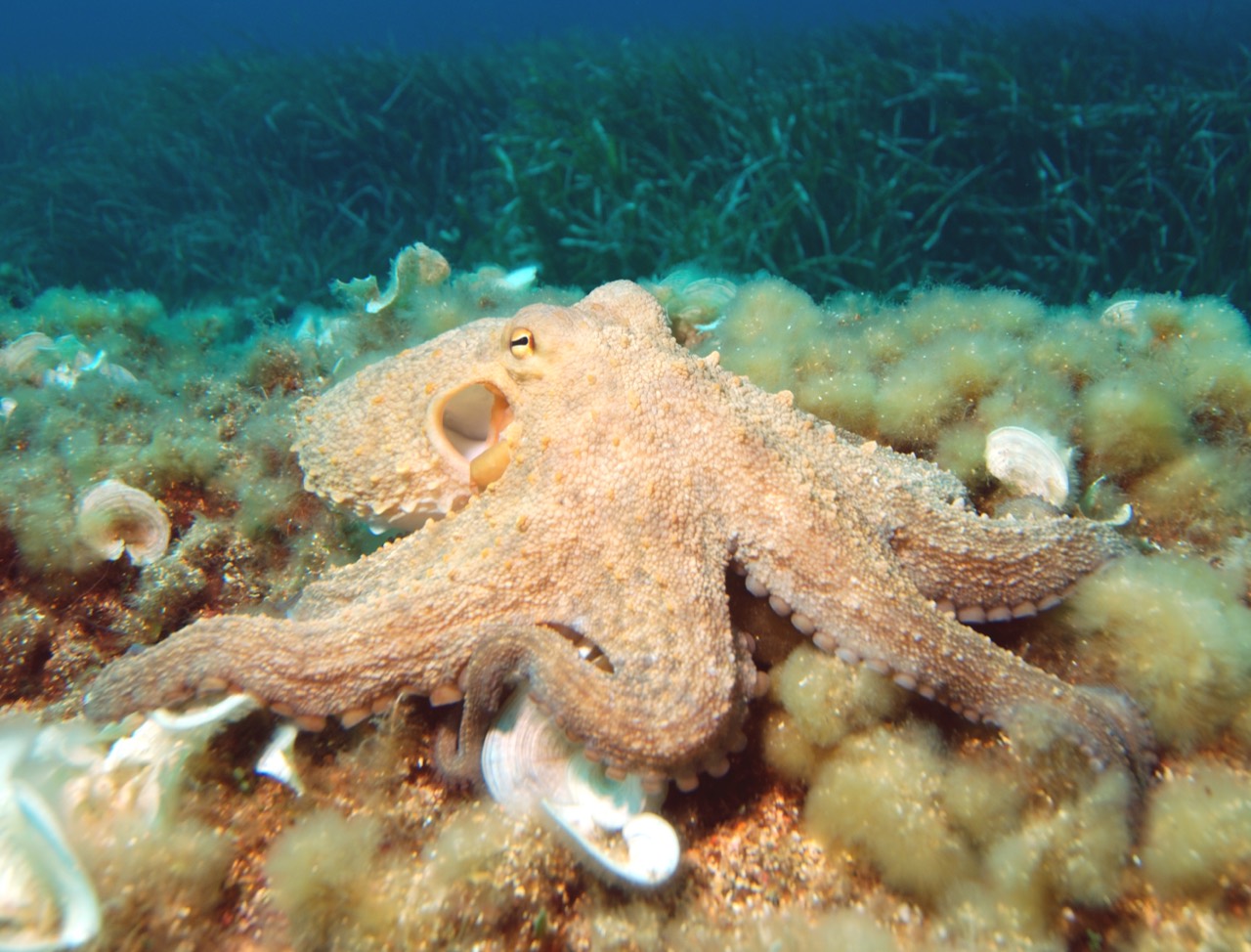
Source: Wikimedia Commons via Wikipedia “Octopus”
In brief
An octopus is a soft-bodied, eight-armed marine mollusc in the order Octopoda (about 300 species) that is highly intelligent and has three hearts and blue, copper-based blood.
Also in Animals A to Z · Animals that start with O
By WARN Research & Conservation TeamLast updated
The octopus is a soft-bodied, eight-armed mollusc belonging to the order Octopoda, which includes roughly 300 known species found in oceans worldwide. From the tiny Octopus wolfi, smaller than a coin, to the giant Pacific octopus with an arm span approaching five metres, octopuses are renowned for their problem-solving intelligence, rapid colour-changing camouflage, and unusual biology: three hearts and copper-based blue blood. Most live short lives of one to a few years, with females famously guarding their eggs until they hatch and then dying. Although many octopus species are abundant, growing commercial fishing pressure and controversial proposals to farm octopuses have raised both conservation and animal-welfare concerns.
~300
Known species in the order Octopoda
3
Hearts (two for the gills, one for the body)
8
Suckered arms (no tentacles)
1-4 yrs
Typical lifespan, depending on species
Figures sourced from Wikipedia: Octopus, IUCN Red List: Octopus vulgaris (common octopus), Smithsonian Magazine: Ten Wild Facts About Octopuses and other references on this page.
Octopus: Quick Facts
| Lifespan | About 6 months to 4 years, varying by species |
|---|---|
| Weight | Under 1 g (Octopus wolfi) to 10-50 kg (giant Pacific octopus) |
| Size | About 2.5 cm to nearly 5 m arm span |
| Diet | Carnivorous: crabs, shrimp, clams, snails, fish, and other cephalopods |
| Incubation | Roughly 2 to 10 months of egg-brooding, depending on species and temperature |
| Young | From hundreds to over 100,000 eggs per clutch (up to ~180,000 in the giant Pacific octopus) |
| Baby name | Paralarva (plural: paralarvae) |
| Group name | Informally a consortium; octopuses are mostly solitary |
| Species | Approximately 300 in the order Octopoda |
| CITES | Not listed on CITES Appendices |
Scientific Classification
| Kingdom | Animalia |
|---|---|
| Phylum | Mollusca |
| Class | Cephalopoda |
| Subclass | Coleoidea |
| Superorder | Octopodiformes |
| Order | Octopoda |
Conservation Status
- IUCN Status
- Varies by species; the order is Not Evaluated as a whole
- Population
- No global population estimate; many species abundant, some Data Deficient
- Trend
- Variable; widespread species generally stable but under growing fishing pressure
- Assessed
- Not applicable at order level
- CITES
- Not listed on CITES Appendices
Representative species such as the common octopus (Octopus vulgaris) are assessed as Least Concern on the IUCN Red List, while many deep-sea and lesser-known octopuses remain Data Deficient.
Did you know?
An octopus can taste with its arms: its suckers are packed with chemical-sensing receptors, so it literally tastes whatever it touches.
Key Facts: Octopus
- Octopuses make up the order Octopoda, with roughly 300 described species in oceans across the globe.
- They have three hearts and blue blood, which carries oxygen using the copper-rich protein haemocyanin instead of iron-based haemoglobin.
- Octopuses are among the most intelligent invertebrates, capable of problem-solving, tool use, and both short- and long-term memory.
- Specialised skin cells let them change colour and texture in seconds for camouflage and communication.
- Most octopuses are short-lived; females typically guard a single clutch of eggs and die soon after the young hatch.
- Many species are currently abundant, but rising fishing pressure and proposed octopus farming raise conservation and welfare concerns.
What is an octopus?
An octopus is a cephalopod mollusc in the order Octopoda, a group of around 300 species related to squid, cuttlefish, and nautiluses. The body has a rounded mantle housing the organs and eight muscular arms lined with sensitive, gripping suckers. Unlike squid, octopuses have no internal shell or rigid skeleton, so apart from a hard, parrot-like beak they are almost entirely soft, allowing them to squeeze through gaps barely wider than that beak. They live everywhere from shallow tide pools and coral reefs to the deep sea, and most are bottom-dwelling hunters that shelter in crevices and dens.
Three hearts, blue blood, and remarkable camouflage
Octopuses have three hearts: two branchial hearts pump blood through the gills to pick up oxygen, while a single systemic heart circulates it around the body. Their blood is blue because it uses haemocyanin, a copper-based protein, to transport oxygen efficiently in cold, low-oxygen water. Their skin contains layers of specialised cells, including pigment-filled chromatophores, that let them shift colour, pattern, and even texture almost instantly to blend into their surroundings, startle predators, or signal to other octopuses.
Intelligence and short, dramatic lives
Octopuses are widely regarded as the most intelligent invertebrates. They solve puzzles, open containers, navigate mazes, use coconut shells and rocks as shelter and tools, and show distinct individual behaviour. Much of their nervous system is distributed through their arms, which can sense and react semi-independently. Yet their lives are brief. After mating, a female lays and tirelessly tends her eggs, often forgoing food, and dies once they hatch as tiny planktonic young called paralarvae. Males also die shortly after mating, making most octopuses semelparous, reproducing only once.
Conservation, fishing, and farming
The order Octopoda has not been assessed as a whole, and conservation status varies by species; widespread species such as the common octopus are listed as Least Concern, while many lesser-known and deep-sea species remain Data Deficient. Global octopus catches have run into hundreds of thousands of tonnes, and intensifying demand has driven proposals to farm octopuses commercially. Because octopuses are intelligent, largely solitary, carnivorous animals, intensive farming raises serious animal-welfare and sustainability questions, and protecting healthy ocean habitats remains central to their long-term future.
Octopus vs Squid: Key Differences
| Feature | Octopus | Squid |
|---|---|---|
| Limbs | 8 suckered arms | 8 arms plus 2 longer feeding tentacles |
| Body support | Soft body, no internal shell (only a hard beak) | Internal stiff 'pen' (vestigial shell) |
| Fins | Usually none (a few deep-sea species have them) | Two fins on the mantle |
| Typical habitat | Seafloor, reefs, crevices, and dens | Open ocean, often in shoals |
| Body shape | Rounded, bulbous mantle | Elongated, streamlined, torpedo-like |
What WARN Does
The World Animal Rescue Network does not currently fund octopus-specific projects. At its launch stage, WARN directs hands-on funding to wildlife and animal-welfare work in partner-network countries, and octopuses are a globally distributed marine group that falls outside that funded scope. This guide is published as educational and search-focused content that supports WARN's broader mission of raising awareness for animals and the habitats they depend on. Where readers want to help, the most honest connection is supporting protection of the wild habitats that ocean and coastal wildlife rely on, rather than any claim of direct octopus rescue work.
Octopuses depend on healthy seas, reefs, and coastlines. While WARN does not run octopus-specific projects, supporting habitat protection helps safeguard the wild places that ocean and coastal wildlife need to thrive.
Octopus: Frequently Asked Questions
How many species of octopus are there?
Why does an octopus have three hearts and blue blood?
Are octopuses intelligent?
How long do octopuses live?
What is the difference between an octopus and a squid?
What do octopus eat?
Where do octopus live?
Are octopus dangerous?
How big is an octopus?
Sources & References
Population figures, conservation status and biological facts on this page are drawn from authoritative scientific and intergovernmental sources.
Terms used on this page
Plain-English definitions, from our wildlife and conservation glossary.
Latest Octopus Stories
Quick, fact-checked reads on the octopus — amazing facts, key questions and the threats it faces.
Species
12 Amazing Facts About Octopuses (Three Hearts and Nine Brains)
Blue blood, colour-changing skin in a colour-blind animal, and two-thirds of its neurons in its arms. Twelve verified octopus facts.
Read the storySpecies
How Intelligent Is an Octopus? What the Evidence Actually Shows
Tool use, maze solving, individual recognition and famous escapes — plus what a one-to-two-year lifespan means for octopus cognition.
Read the storySpecies
Octopus vs Squid: Eight Arms, Ten Limbs and Two Very Different Lives
Arms versus tentacles, reef-crawler versus open-ocean swimmer, internal shell versus none. How to tell octopus and squid apart.
Read the storyExplore more animals
Discover more animals, their habitats and their conservation status in the WARN wildlife-guide library.