Wildlife Guide · North America & United States
Virginia Opossum
Didelphis virginiana
North America's only marsupial — the unflappable, tick-munching survivor that 'plays dead' when life gets too scary.
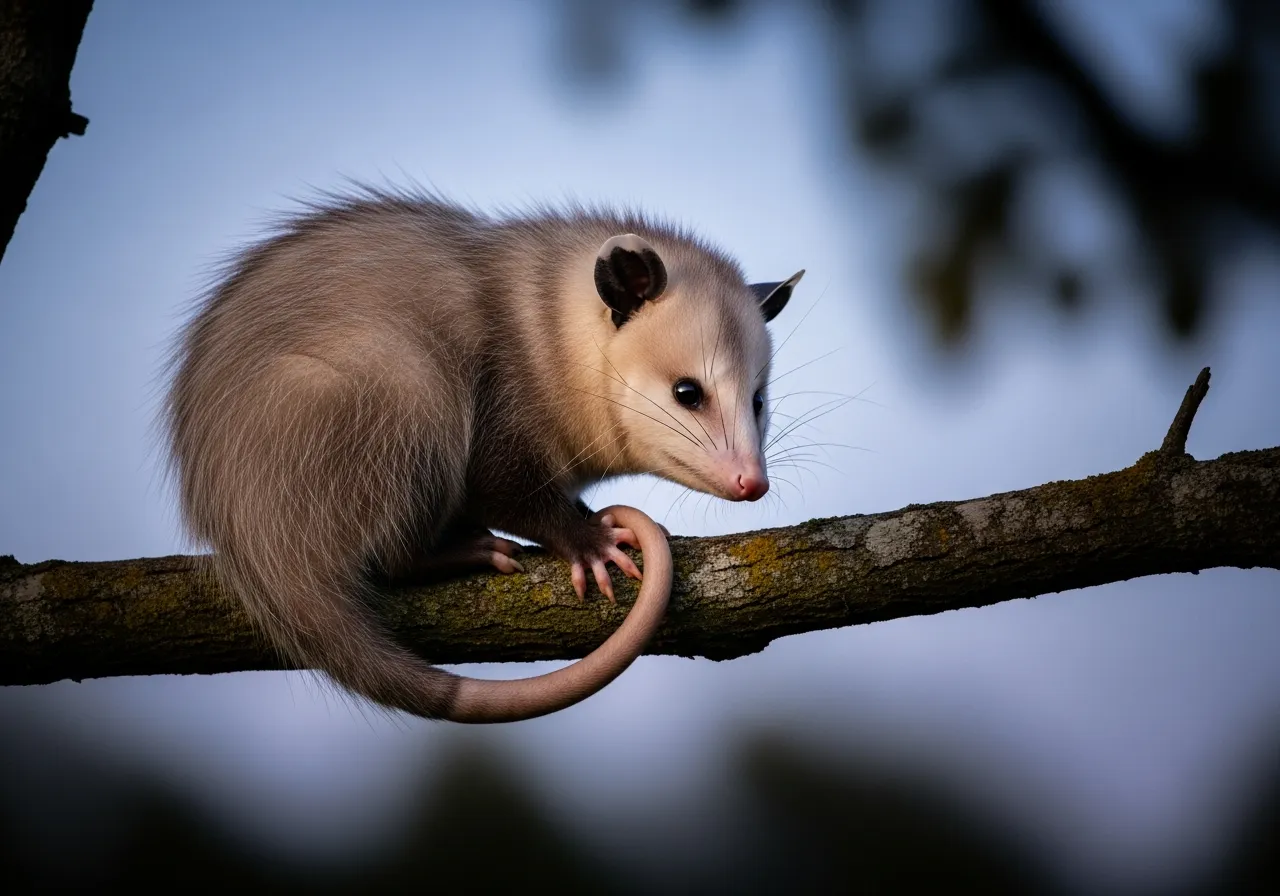
Source: Global Animal Guide (WARN)
In brief
An opossum (Didelphis virginiana, the Virginia opossum) is North America's only native marsupial — a cat-sized, pouched mammal with a pointed snout, grasping prehensile tail and grey-white fur. It is famous for "playing dead", eating ticks and pests, and resisting many snake venoms.
Also in Animals A to Z · Animals that start with V
By WARN Research & Conservation TeamLast updated
The Virginia opossum (Didelphis virginiana) is North America's only native marsupial — a cat-sized pouched mammal more closely related to kangaroos than to rats. Famous for "playing possum", a long grasping tail and an opportunistic appetite, it ranges from Central America across much of the United States and into southern Canada. Females carry tiny, undeveloped young in a fur-lined pouch, then on their backs once they outgrow it. Opossums are quiet, mostly solitary night-foragers that thrive in woodland, farmland and increasingly in towns and gardens. Often misunderstood, they are gentle, beneficial neighbours that eat ticks, slugs, carrion and pests, and they are listed as Least Concern by the IUCN.
1
Only marsupial native to North America
~50
Teeth — more than any other North American land mammal
~13 days
Gestation before tiny young crawl to the pouch
1–2 yrs
Typical lifespan in the wild
Figures sourced from Virginia opossum — Wikipedia, Opossum — Encyclopaedia Britannica, Didelphis virginiana — IUCN Red List and other references on this page.
Virginia Opossum: Quick Facts
| Common name | Virginia opossum (often "possum") |
|---|---|
| Scientific name | Didelphis virginiana |
| Type | Marsupial mammal |
| Distinction | Only marsupial native to North America |
| Size | About the size of a domestic cat |
| Diet | Omnivore — insects, carrion, fruit, small animals |
| Activity | Mainly nocturnal and solitary |
| Range | Central America to southern Canada |
| Lifespan | About 1–2 years in the wild |
| IUCN status | Least Concern |
Scientific Classification
| Kingdom | Animalia |
|---|---|
| Phylum | Chordata |
| Class | Mammalia |
| Order | Didelphimorphia |
| Family | Didelphidae |
| Genus | Didelphis |
| Species | Didelphis virginiana |
Conservation Status
- IUCN Status
- Least Concern. The Virginia opossum is widespread, common and highly adaptable across the Americas, and its range has been expanding northward into Canada. It is not considered globally threatened and is not listed by CITES.
- Population
- Not precisely quantified; abundant and widely distributed across its range.
- Trend
- Stable, with range expansion northward.
- Assessed
- Assessed as Least Concern by the IUCN Red List.
- CITES
- Not listed by CITES.
Although secure as a species, individual opossums face heavy losses from road traffic, predators, dogs and cold winters, and are often killed through misunderstanding despite being harmless and beneficial.
Key Facts: Virginia Opossum
- The Virginia opossum is the only marsupial native to North America, carrying its young in a pouch like its distant kangaroo relatives.
- "Playing possum" is an involuntary, fear-induced faint — not a clever trick — during which the animal may appear and even smell dead.
- Opossums are valuable neighbours: they eat ticks, slugs, snails, insects, carrion, rodents and fallen fruit, helping keep gardens tidy.
- They show natural resistance to the venom of many North American pit vipers, including rattlesnakes and copperheads.
- Their prehensile tail and opposable rear "thumbs" make them nimble climbers, though adults rarely hang by the tail for long.
- Listed as Least Concern by the IUCN, the species is widespread, adaptable and expanding its range northward.
What is an opossum, and is it the same as a possum?
An opossum is a marsupial — a mammal that gives birth to tiny, embryonic young that finish developing in a pouch — and the Virginia opossum (Didelphis virginiana) is the only species native to North America. In everyday North American speech it is almost always shortened to "possum", so the two words usually mean the same animal. Strictly, though, the true possums are an entirely separate group of marsupials found in Australia, New Guinea and nearby islands; they are only distantly related. About the size of a domestic cat, the Virginia opossum has coarse greyish-white fur, a pale pointed face, naked black ears, a long pink snout and a distinctive scaly, nearly hairless prehensile tail. Its hind feet bear an opposable, clawless "thumb" that helps it grip branches. With around 50 teeth, it has more than any other land mammal in North America, which it bares in a wide, hissing gape when threatened — usually pure bluff from an animal that would rather flee or faint than fight.
Why do opossums 'play dead'?
"Playing possum" is the behaviour that gives the animal its reputation, but it is not a calculated ruse. When an opossum is badly frightened and cannot escape, it can drop into an involuntary, comatose-like state — a reflex similar to fainting — that can last from minutes to a few hours. The animal keels over, its eyes glaze, its tongue lolls, its breathing and heart rate slow, and glands near the tail release a foul, decay-scented fluid. To a predator expecting live, struggling prey, the opossum convincingly seems like an unappetising corpse. Because it is a reflex rather than a decision, the opossum cannot simply choose to "wake up" and snap out of it on cue. More often, a startled opossum will first try to bluff its way out: it gapes to show its many teeth, hisses, drools and growls. Only when this bluster fails does the faint kick in. The strategy works well enough that this slow, mild-mannered animal has persisted for tens of millions of years.
What do opossums eat, and are they good for the garden?
Opossums are true omnivores and enthusiastic opportunists, eating almost anything they can find. Their menu includes insects, slugs, snails, worms, beetles, small rodents, frogs, eggs, carrion, fallen fruit, nuts and the contents of unsecured compost or bins. This scavenging habit makes them useful clean-up crew in gardens, smallholdings and woodland, removing rotting matter and garden pests that many people would rather not see. Opossums are widely noted for eating ticks they encounter while grooming, which can help reduce local tick numbers, although the scale of this benefit varies. They also have a strong natural resistance to the venom of many North American pit vipers, such as rattlesnakes and copperheads, thanks to compounds in their blood — a trait that has drawn scientific interest. Because they are immune or highly resistant to rabies far more often than most mammals (their low body temperature is thought to play a role), encounters with opossums carry comparatively little disease risk. The kindest response to a garden visitor is simply to secure rubbish and let it move on.
How do opossums raise their young?
As marsupials, opossums have an extraordinary early life. After a gestation of only about 13 days, a female gives birth to a litter of bee-sized, blind, hairless newborns — sometimes more than a dozen. Each must crawl unaided through the mother's fur to reach her pouch, latch onto one of the available teats, and continue developing there for weeks. Only those that secure a teat survive, so litter size is effectively limited by the pouch. As the young, called joeys, grow too large for the pouch, they ride clinging to the mother's back as she forages. They become independent within a few months. Opossums live fast and die young: they reach breeding age within a year and rarely survive much beyond one or two years in the wild, falling prey to vehicles, owls, foxes, dogs and cold winters that can frostbite their thin ears and tail. High reproductive output offsets these short, hazardous lives, helping keep populations stable and even expanding their range northward.
Opossum vs Australian possum
| Feature | Opossum (Americas) | Possum (Australasia) |
|---|---|---|
| Native range | North, Central and South America | Australia, New Guinea and nearby islands |
| Group | Order Didelphimorphia | Order Diprotodontia (different marsupial group) |
| Best-known trait | "Plays dead" when frightened | Often bushy-tailed tree-dwellers |
| Relationship | Only distantly related | Only distantly related |
| Common confusion | Called "possum" for short in the US | The original "possum" Down Under |
What WARN Does
World Animal Rescue Network does not run field projects specifically for the Virginia opossum, which lives across the Americas — outside the countries where WARN's partners work. This guide is part of WARN's free educational mission to help people understand and live alongside wildlife. The threats opossums face — vehicle collisions, habitat loss, persecution from misunderstanding, and harsh weather — are the same pressures that bear down on the animals WARN does protect, so accurate, compassionate information about every species supports that wider goal.
If this guide helped you see the humble opossum a little more kindly, you can help fund free wildlife education and the hands-on rescue work it supports.
Virginia Opossum: Frequently Asked Questions
Are opossums dangerous to humans or pets?
Do opossums really eat thousands of ticks?
Where do opossums live and what habitat do they prefer?
How long do opossums live?
Why do opossums hang by their tails?
What do virginia opossums eat?
How big is a virginia opossum?
Sources & References
Population figures, conservation status and biological facts on this page are drawn from authoritative scientific and intergovernmental sources.
Terms used on this page
Plain-English definitions, from our wildlife and conservation glossary.
Latest Virginia Opossum Stories
Quick, fact-checked reads on the virginia opossum — amazing facts, key questions and the threats it faces.
Species
11 Amazing Facts About the Harpy Eagle, the Rainforest's Apex Raptor
From talons as long as a grizzly bear's claws to a single chick every two to three years, here are 11 fact-checked things that make the Harpy Eagle the most powerful bird of prey in the Americas.
Read the storySpecies
12 Amazing Facts About Grey Wolves (And Why Alpha Wolves Aren't Real)
A howl that carries 16 km, a pack that is really a family, and the debunked study behind the 'alpha wolf' myth. Twelve verified facts.
Read the storySpecies
12 Amazing Facts About Axolotls (They Regrow Their Own Brains)
Limb, spinal cord and partial brain regeneration, permanent larval form, and near-extinction in the wild. Twelve facts.
Read the storyExplore more animals
Discover more animals, their habitats and their conservation status in the WARN wildlife-guide library.