Wildlife Guide · Worldwide — all continents except Antarctica
Osprey
Pandion haliaetus (Linnaeus, 1758)
The fish hawk — a global raptor built for one prey, recovered from near extinction.
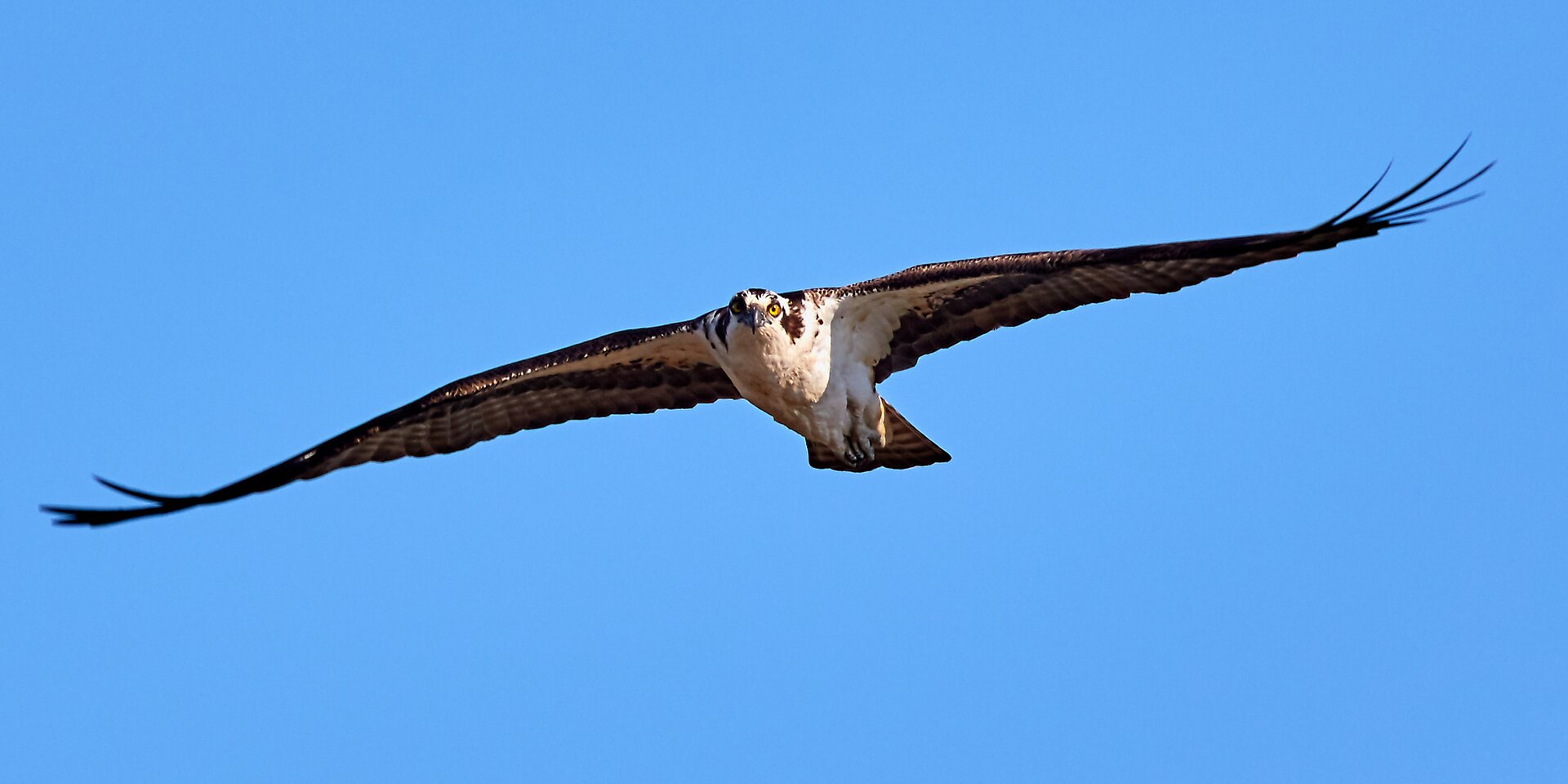
Photo: Jongsun Lee / Wikimedia Commons (CC BY 3.0)
In brief
The osprey (Pandion haliaetus) is a Least Concern fish-eating raptor found worldwide, the only member of family Pandionidae; it recovered from DDT declines and hunts by plunging feet-first into water to catch fish.
Also in Animals A to Z · Animals that start with O
By WARN Research & Conservation TeamLast updated
The osprey is a large fish-eating raptor found on every continent except Antarctica, the only species in the family Pandionidae. Ospreys hunt by hovering over water and plunging feet-first to grab fish with barbed talons and reversible outer toes — specialisations unique among raptors. Like peregrine falcons, ospreys were devastated by DDT pesticide in the mid-twentieth century before recovering after its ban. Listed as Least Concern, ospreys now nest on every continent and have adapted to artificial nesting platforms, pylons and harbour structures. They migrate enormous distances — GPS-tracked birds fly from Scotland to West Africa.
Least Concern
IUCN Red List status (2015 assessment)
99%
Diet composed of fish
460,000
Estimated mature individuals globally
Appendix II
CITES listing
Figures sourced from IUCN Red List — Pandion haliaetus, BirdLife International — Data Zone, Cornell Lab of Ornithology — osprey .
Osprey: Quick Facts
| Diet | Fish — roughly 99% of diet |
|---|---|
| Hunting | Feet-first plunge dive into water |
| Talons | Barbed pads; reversible outer toe |
| Population | ~460,000 mature individuals globally |
| Migration | Up to 8,000+ km for some populations |
| CITES | Appendix II |
Scientific Classification
| Kingdom | Animalia |
|---|---|
| Phylum | Chordata |
| Class | Aves |
| Order | Accipitriformes |
| Family | Pandionidae |
| Species | Pandion haliaetus (Linnaeus, 1758) |
Conservation Status
- IUCN Status
- Least Concern (IUCN, 2015). Recovered from DDT declines; population increasing.
- Population
- Roughly 460,000 mature individuals globally
- Trend
- Increasing
- Assessed
- 2015
- CITES
- Appendix II
Key Facts: Osprey
- Ospreys eat fish almost exclusively — roughly 99% of their diet.
- They are the only member of the family Pandionidae — a distinct raptor lineage.
- Ospreys dive feet-first into water, grabbing fish with barbed, reversible talons.
- DDT pesticide nearly wiped out ospreys before recovery after its ban.
- Ospreys nest on every continent except Antarctica, including artificial platforms.
- GPS tracking shows migrations of over 8,000 km between breeding and wintering grounds.
A raptor built for fish
The osprey occupies its own family, Pandionidae, reflecting its unique specialisations. Dense, oily plumage repels water during dives. Barbed pads on the soles grip slippery fish. The outer toe is reversible — able to point forward or backward — providing a two-by-two talon grip.
Nostrils close on impact with water. Ospreys hunt by hovering 10–40 m above water, then plunging feet-first, sometimes submerging completely. They carry fish head-first for aerodynamic flight. Roughly 99% of the diet is fish, typically 15–30 cm long.
No other raptor hunts this way — ospreys are convergent specialists, sometimes called 'fish hawks' but taxonomically separate from true hawks.
Global range and migration
Four subspecies range across the world. Pandion haliaetus haliaetus breeds across Eurasia and winters in Africa and South-east Asia. P. h. carolinensis breeds in North America, wintering in Central and South America. P. h. ridgwayi is resident in the Caribbean; P. h. cristatus in Australasia. Ospreys are long-distance migrants — GPS-tracked birds from Scotland fly over 8,000 km to West Africa. They return to the same nest site annually, often mating for life. Nests are large stick structures on cliffs, trees, pylons, buoys and purpose-built platforms.
DDT recovery and nesting platforms
Ospreys shared the peregrine falcon's fate during the DDT era — eggshell thinning caused nesting failure across North America and Europe. After DDT was banned in the 1970s, populations rebounded. Conservationists accelerated recovery by installing artificial nesting platforms on poles, buoys and harbour structures. Ospreys readily adopted these, expanding into areas where natural nest sites were scarce. Today the global population exceeds 460,000 mature individuals. Ospreys nest near humans more readily than most large raptors, making them ambassadors for wetland and coastal conservation.
Conservation and modern threats
The IUCN lists the osprey as Least Concern with an increasing global population. Modern threats include entanglement in fishing line and nets, rodenticide and pesticide accumulation, wind turbine collisions near coastal migration routes, and habitat loss of wetlands and clean waterways. Clean water supports fish stocks that sustain ospreys — making them indicators of aquatic ecosystem health. CITES Appendix II regulates international trade. Protecting wetlands, reducing fishing gear discard and maintaining nest platforms support osprey populations worldwide.
What WARN Does
WARN publishes this osprey guide as free public education. The osprey recovery from DDT extinction demonstrates that removing the cause of decline allows species to rebound — a principle that applies across conservation.
If this guide helps you understand wildlife and the pressures it faces, a gift to WARN supports habitat protection and free public education in our partner countries.
Osprey: Frequently Asked Questions
What do ospreys eat?
Are ospreys eagles or hawks?
Why did ospreys nearly go extinct?
How do ospreys catch fish?
Do ospreys migrate?
Where do ospreys live?
Are ospreys dangerous?
How long do ospreys live?
How big is an osprey?
Sources & References
Population figures, conservation status and biological facts on this page are drawn from authoritative scientific and intergovernmental sources.
Terms used on this page
Plain-English definitions, from our wildlife and conservation glossary.
Explore more animals
Discover more animals, their habitats and their conservation status in the WARN wildlife-guide library.