Wildlife Guide · Sub-Saharan Africa & East Africa
Ostrich
Struthio camelus
The world's largest bird — flightless, fast, and built for the open savanna.
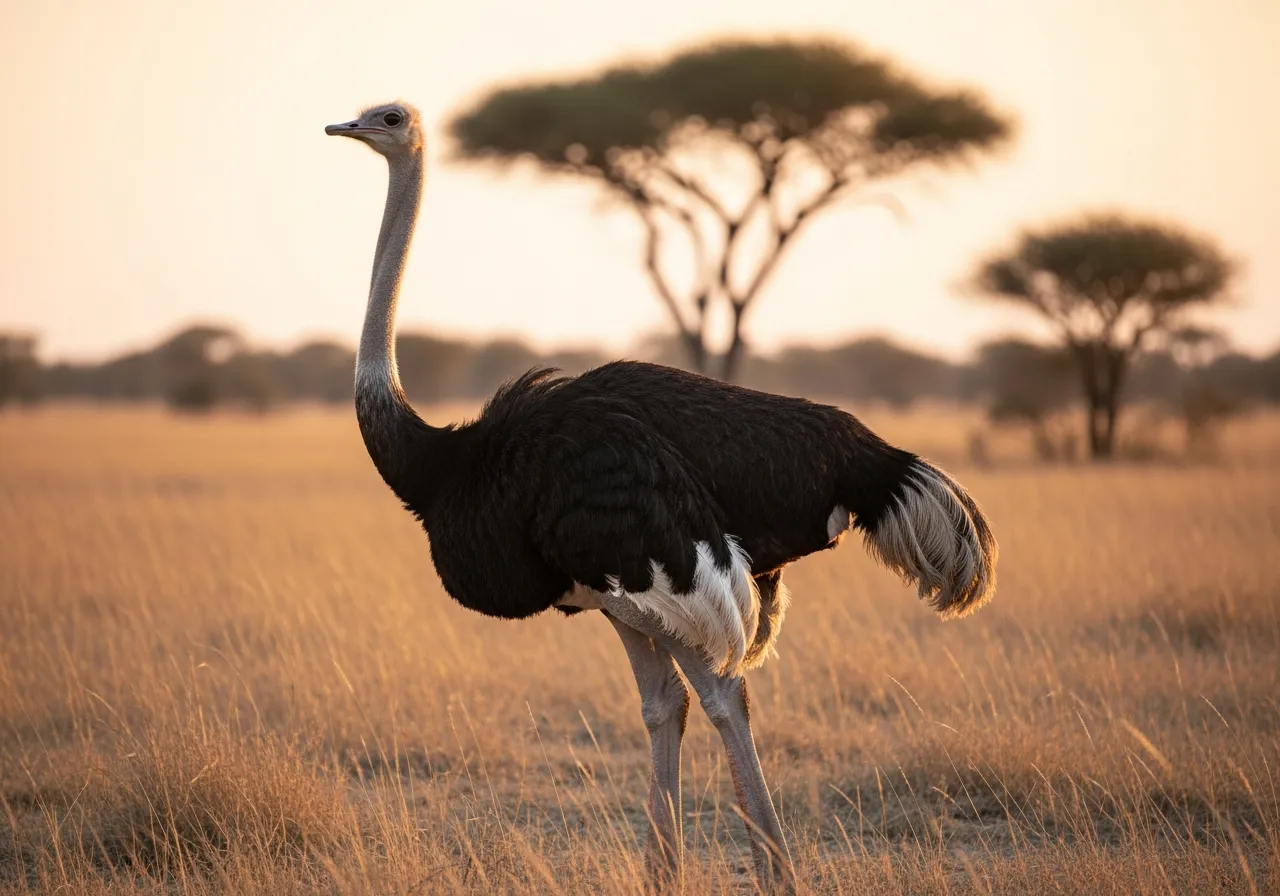
Source: Global Animal Guide (WARN)
In brief
An ostrich (Struthio camelus) is the world's largest and heaviest living bird, a flightless African species standing over two metres tall. Built for running rather than flight, it is the fastest bird on land at around 70 km/h and lays the biggest eggs of any living bird.
Also in Animals A to Z · Animals that start with O
By WARN Research & Conservation TeamLast updated
The ostrich (Struthio camelus) is the largest and heaviest living bird on Earth. Native to the savannas and semi-arid plains of Africa, it cannot fly, but its long, muscular legs make it the fastest bird on land, sprinting at around 70 km/h. A grown male stands well over two metres tall and may weigh more than 100 kg. Ostriches also lay the largest eggs of any living bird, each roughly the weight of two dozen hen's eggs. With huge eyes, just two toes per foot, and a diet of plants and small animals, the ostrich is a striking example of how birds adapt to life on the ground rather than in the air.
~2.7 m
Height of a large male — the tallest living bird
~70 km/h
Top running speed — the fastest bird on land
~1.4 kg
Weight of a single egg — the largest of any living bird
2
Toes per foot — unique among birds
Figures sourced from Wikipedia — Common ostrich, Wikipedia — Somali ostrich, IUCN Red List and other references on this page.
Ostrich: Quick Facts
| Common name | Common ostrich |
|---|---|
| Scientific name | Struthio camelus |
| IUCN status | Least Concern (common ostrich); Somali ostrich Vulnerable |
| Height | Up to ~2.7 m (males); ~1.7–1.9 m (females) |
| Weight | Roughly 90–130 kg |
| Top speed | Around 70 km/h — fastest bird on land |
| Egg weight | ~1.4 kg — largest egg of any living bird |
| Toes per foot | 2 (unique among birds) |
| Diet | Mainly plants; some insects and small animals |
| Range | Savannas and semi-arid plains of Africa |
Scientific Classification
| Kingdom | Animalia |
|---|---|
| Phylum | Chordata |
| Class | Aves |
| Order | Struthioniformes |
| Family | Struthionidae |
| Genus | Struthio |
| Species | Struthio camelus |
Conservation Status
- IUCN Status
- The common ostrich (Struthio camelus) is listed as Least Concern on the IUCN Red List, reflecting its wide range across Africa and large overall population, though some regional populations have declined through hunting and habitat loss. The Somali ostrich (Struthio molybdophanes), recognised as a distinct species in 2014, is separately assessed as Vulnerable.
- Population
- Not precisely known; the common ostrich remains widespread and numerous across its African range, including farmed populations worldwide.
- Trend
- Common ostrich broadly stable overall with local declines; Somali ostrich decreasing.
- Assessed
- 2018 (IUCN assessment of the common ostrich)
- CITES
- Listed on CITES (Appendix I for the West African / Sahel population Struthio camelus; populations otherwise not Appendix-listed for the species as a whole).
Status differs sharply between the two ostrich species: the common ostrich is of low conservation concern, while the Somali ostrich faces real pressure and is classed as Vulnerable.
Key Facts: Ostrich
- The common ostrich (Struthio camelus) is the largest and heaviest living bird in the world.
- It is flightless but is the fastest running bird, reaching around 70 km/h on the open plains.
- Ostriches lay the largest eggs of any living bird — each weighs roughly 1.4 kg.
- They are the only birds with just two toes on each foot, an adaptation for fast running.
- The common ostrich is listed as Least Concern by the IUCN, but the closely related Somali ostrich is assessed as Vulnerable.
- They have the largest eyes of any land vertebrate, around 5 cm across.
What does an ostrich look like and how big is it?
The ostrich is unmistakable: a towering, long-necked bird with a small head, large expressive eyes, and a body carried high on two powerful bare legs. Males are the larger sex, standing up to about 2.7 metres tall and weighing in excess of 100 kg, with bold black body plumage offset by white wing and tail feathers. Females and younger birds are smaller and a more muted greyish-brown, which helps camouflage them on the nest. The long neck and legs are largely bare, ranging from pinkish to bluish-grey depending on the population. Each foot bears just two toes — unique among birds — with the larger inner toe ending in a stout, hoof-like nail that aids both running and defence. The eyes are enormous, around 5 cm in diameter, the largest of any land vertebrate, giving the ostrich excellent long-distance vision across open country. Though the wings are useless for flight, they are far from redundant: ostriches spread them for balance and steering while sprinting, in courtship displays, and to shade their chicks from the harsh African sun.
How fast can an ostrich run, and why can't it fly?
The ostrich is the fastest bird on land, capable of sustained speeds around 70 km/h and short bursts that are faster still. Its whole body is built for this: long, spring-like legs, reduced toes that concentrate force, and lightweight feathers. Flightlessness is not a failing but an evolutionary trade-off. Ostriches belong to the ratites, an ancient group of flightless birds that also includes emus, rheas, cassowaries and kiwis. Unlike flying birds, ratites lack a keeled breastbone to anchor large flight muscles, so their wings cannot generate lift. Instead, evolution invested in size, stamina and speed. On the open savanna, where there are few places to hide, outrunning a predator such as a lion or cheetah is a more reliable strategy than escaping into the air. A running ostrich can also deliver a formidable forward kick with its clawed foot, powerful enough to deter most attackers. Good eyesight and height let it spot danger early, and ostriches often graze alongside zebras and antelopes, the herds acting as extra early-warning systems against approaching predators.
What do ostriches eat, and how do they breed?
Ostriches are mainly herbivorous, feeding on seeds, grasses, leaves, roots, flowers and fruit, with occasional insects, small reptiles and other small animals. Like many birds they swallow grit and small stones, which collect in the gizzard and help grind up tough plant matter. They can go for long periods without drinking, taking much of the moisture they need from their food — a valuable trait in dry habitats. Breeding revolves around a communal nest, which is simply a shallow scrape in the ground. A dominant 'major' hen lays her eggs there, and several minor hens add theirs, so a single nest may hold many eggs, of which around twenty are typically incubated. The dominant female incubates by day, when her paler plumage blends with the sun-bleached ground, and the black male takes over at night. Incubation lasts roughly six weeks. The chicks are well developed at hatching and can run within days, but they remain vulnerable to predators, and family groups sometimes merge into large crèches tended by a few adults.
Common ostrich vs Somali ostrich
| Feature | Common ostrich | Somali ostrich |
|---|---|---|
| Scientific name | Struthio camelus | Struthio molybdophanes |
| IUCN status | Least Concern | Vulnerable |
| Neck and thigh colour | Pinkish to reddish (especially in breeding males) | Bluish-grey, brighter blue in breeding males |
| Preferred habitat | Open savanna and grassland; mainly grazes | Bushier, more vegetated areas; browses more |
| Main range | Widespread across sub-Saharan Africa | Horn of Africa (Somalia, Ethiopia, Kenya) |
| Species status | Long recognised species | Recognised as a separate species in 2014 |
What WARN Does
World Animal Rescue Network does not run dedicated field projects for ostriches, which live across Africa, outside the countries where WARN's partners work. This guide is part of WARN's free educational library, written to help people understand the world's wildlife. The pressures that touch ostriches — habitat loss, conversion of wild land, and hunting — are the same forces that threaten the animals WARN does protect, so understanding one species helps make the case for all of them.
If you have enjoyed learning about the ostrich, a small gift helps WARN keep this educational library free and supports the animals our partners care for every day.
Ostrich: Frequently Asked Questions
Is an ostrich the largest bird in the world?
Can ostriches fly?
How fast can an ostrich run?
How big are ostrich eggs?
Do ostriches really bury their heads in the sand?
What do common ostrichs eat?
Where do common ostrichs live?
Are common ostrichs dangerous?
How long do common ostrichs live?
Sources & References
Population figures, conservation status and biological facts on this page are drawn from authoritative scientific and intergovernmental sources.
Terms used on this page
Plain-English definitions, from our wildlife and conservation glossary.
Latest Ostrich Stories
Quick, fact-checked reads on the ostrich — amazing facts, key questions and the threats it faces.
Explore more animals
Discover more animals, their habitats and their conservation status in the WARN wildlife-guide library.