Wildlife Guide · Africa & Asia
Panther
Colloquial term — melanistic leopards/jaguars; also used for cougar and jaguar
A name, not a species — melanistic cats and American big cats behind the panther label.
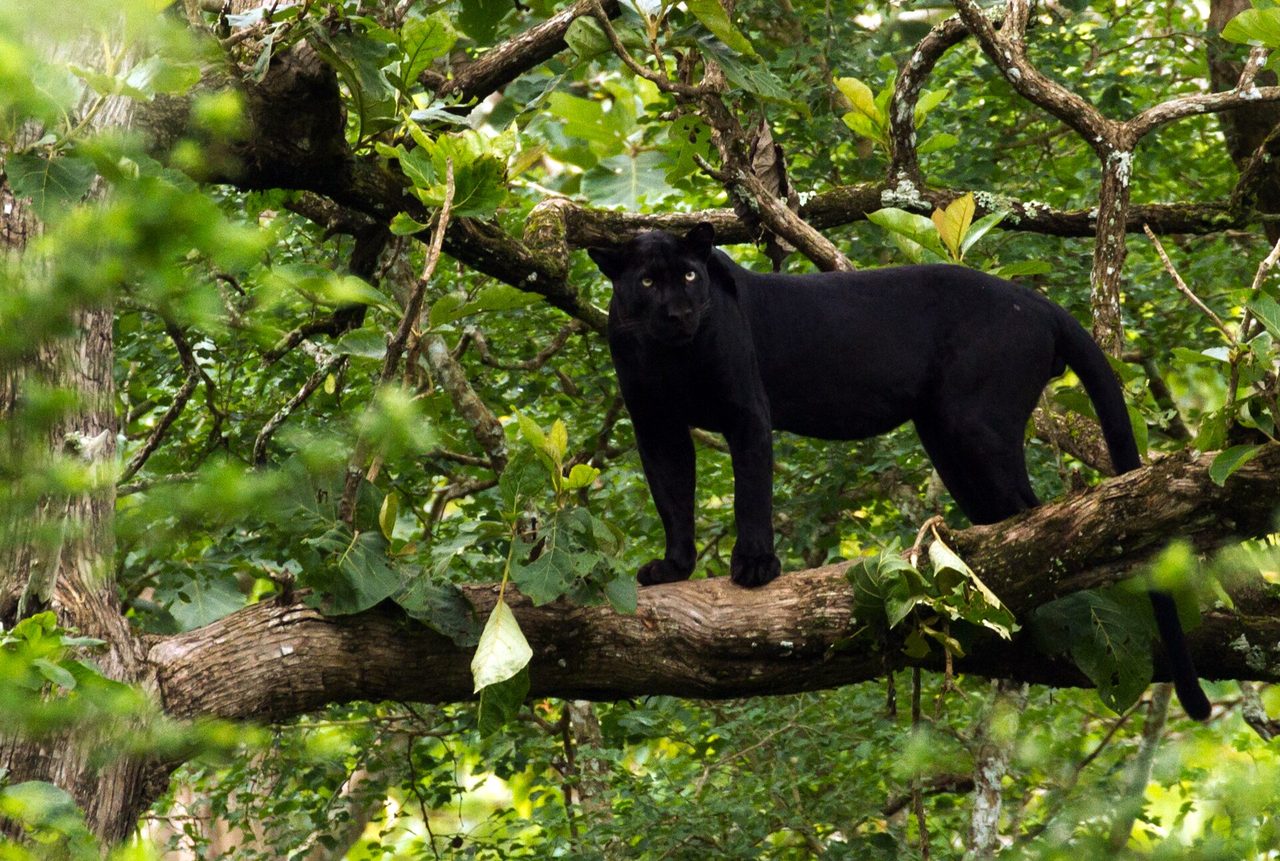
Photo: Davidvraju / Wikimedia Commons (CC BY-SA 4.0)
In brief
'Panther' is a colloquial term — not one species — referring to melanistic leopards or jaguars, cougars (including Florida panther) or large cats generally; WARN covers cougar, jaguar and leopard in dedicated guides.
Also in Animals A to Z · Animals that start with P
By WARN Research & Conservation TeamLast updated
'Panther' is not a scientific species name. In everyday English it may mean a melanistic (black-coated) leopard or jaguar, the cougar (Puma concolor — officially 'panther' in Florida), or loosely any large cat. Melanistic leopards carry excess dark pigment but retain rosette patterns visible in certain light. In the Americas, 'black panther' usually means a melanistic jaguar. The Florida panther is an Endangered cougar subpopulation. This page is the panther search hub — see WARN guides for cougar, jaguar and leopard.
0
Species named 'panther' in formal taxonomy
Endangered
Florida panther — cougar subpopulation ~200 cats
Melanism
Increased dark pigment — not a separate species
CITES I
All cats referred to as panthers — trade banned
Figures sourced from IUCN Red List — Panthera and Puma, Panthera — big cat conservation, Florida Fish and Wildlife — panther .
Panther: Quick Facts
| Taxonomy | Colloquial term — not one species |
|---|---|
| Related guides | Cougar, jaguar, leopard |
| Melanism | Dark pigment — leopards and jaguars |
| Florida panther | Endangered cougar subpopulation |
| Main threats | Habitat loss, conflict, trade |
| CITES | Appendix I — all referenced species |
Scientific Classification
| Kingdom | Animalia |
|---|---|
| Melanistic leopards | Panthera pardus |
| Melanistic jaguars | Panthera onca |
| Florida panther | Puma concolor coryi |
Conservation Status
- IUCN Status
- Varies by species referred to — jaguar Near Threatened; leopard Vulnerable; Florida panther Endangered.
- Population
- Varies — Florida panther ~120–230 adults; jaguars ~64,000
- Trend
- Decreasing for leopards and Florida panther; stable to increasing for some jaguar populations
- Assessed
- Varies by species
- CITES
- Appendix I — all big cats referenced
Key Facts: Panther
- 'Panther' is a common name — not a distinct species in taxonomy.
- Black panthers in Africa and Asia are melanistic leopards (Panthera pardus).
- Black panthers in the Americas are usually melanistic jaguars (Panthera onca).
- The Florida panther is an Endangered cougar subpopulation.
- WARN guides cover cougar, jaguar and leopard separately.
- Melanistic cats face the same threats as normally coloured individuals.
What people mean by 'panther'
'Panther' derives from Greek and Latin words for leopard but today refers to several distinct cats depending on region. In Africa and Asia, a 'black panther' is a melanistic leopard — Panthera pardus with increased dark pigment. Rosettes remain visible in direct light. Melanism occurs in roughly 11% of leopards in Malaysian forest — an adaptation that may aid nocturnal hunting in dense cover.
In Central and South America, 'black panther' usually means a melanistic jaguar — Panthera onca. Jaguars are heavier, with broader heads and more powerful bites than leopards. Melanistic jaguars occur in Amazonian rainforest where WARN partners work in Brazil and Colombia.
In North America, 'panther' often means the cougar (Puma concolor) — particularly the Florida panther subpopulation, Endangered with roughly 120–230 adults. This hub helps searchers who query 'panther' find the correct WARN species guide.
Melanism and genetics
Melanism in leopards and jaguars is controlled by a mutation in the ASIP gene — increased production of dark pigment (eumelanin) over the typical golden background. It is not albinism or a separate species. Melanistic cubs can be born to spotted parents and vice versa.
Adaptive advantage is debated: melanistic coats may improve camouflage in dense forest and at night. In open savanna, spotted coats may remain more common. Melanistic individuals breed with spotted ones — the trait persists as a polymorphism rather than a separate lineage.
Media depictions — from Bagheera in The Jungle Book to wildlife photography — popularised 'black panther' without explaining the underlying biology. Conservation messaging must treat melanistic cats as leopards or jaguars facing habitat loss and trade — not mystical separate species.
Cougar, jaguar and leopard — WARN guides
WARN publishes three guides covering cats commonly called panthers. The cougar guide covers Puma concolor — the wide-ranging American cat including the Endangered Florida panther. Cougars are not in genus Panthera — they cannot roar, purring instead.
The jaguar guide covers Panthera onca — the apex cat of Neotropical forest, Near Threatened, threatened by deforestation and conflict with ranchers in Brazil and Colombia. The leopard hub covers Panthera pardus plus links to clouded leopard and snow leopard guides.
Readers searching 'panther' should choose the guide matching their region and interest — American cougar, Neotropical jaguar or Afro-Asian leopard.
Panthers and people
Panthers — whether melanistic leopards, jaguars or Florida cougars — face the same conservation pressures as their normally coloured counterparts. Habitat loss, prey depletion, retaliatory killing and illegal skin trade threaten all large cats.
The Florida panther illustrates recovery challenges: inbreeding depression in a tiny population required introducing Texas cougars to restore genetic diversity. Highway collisions remain a leading cause of death.
Supporting habitat protection and anti-poaching benefits every large cat — spotted or melanistic — in WARN partner countries and worldwide.
What WARN Does
WARN publishes free education on big cats in partner countries Brazil and Colombia — jaguar range — and worldwide. Melanistic or spotted, all large cats need intact forest and fair coexistence with human communities.
If this guide helps you understand wildlife and the pressures it faces, a gift to WARN supports habitat protection and free public education in our partner countries.
Panther: Frequently Asked Questions
Is a panther a real species?
What is a black panther?
What is the Florida panther?
Are black panthers endangered?
Where do panthers live?
Are panthers dangerous?
How long do panthers live?
Sources & References
Population figures, conservation status and biological facts on this page are drawn from authoritative scientific and intergovernmental sources.
Terms used on this page
Plain-English definitions, from our wildlife and conservation glossary.
Latest Panther Stories
Quick, fact-checked reads on the panther — amazing facts, key questions and the threats it faces.
Species
Slow Loris: Why the Internet's Favourite Pet Is a Conservation Disaster
The slow loris looks like a cartoon character — and that has nearly destroyed the species. Here is the truth behind the viral videos.
Read the storySpecies
The Snow Leopard: Why the Ghost of the Mountains Is Still Vulnerable
The snow leopard is one of the most elusive big cats on earth, with an estimated 4,000-6,500 individuals across twelve range states — including Pakistan, where WARN is preparing to operate. This briefing explains why the species was downlisted from Endangered to Vulnerable in 2017 and why that is not the success story it sounds like.
Read the storyGuides
Sun Bear vs Moon Bear: The Two Most Trafficked Asian Bears
The sun bear and the Asiatic black bear (moon bear) are the two most commonly trafficked bears in Asia — for the pet trade, for traditional medicine and for bear-bile farming. Here is how to tell them apart.
Read the storyExplore more animals
Discover more animals, their habitats and their conservation status in the WARN wildlife-guide library.