Wildlife Guide · Antarctica & Southern Hemisphere
Penguin
Spheniscidae
Flightless seabirds of the southern seas, now squeezed by warming oceans and vanishing ice.
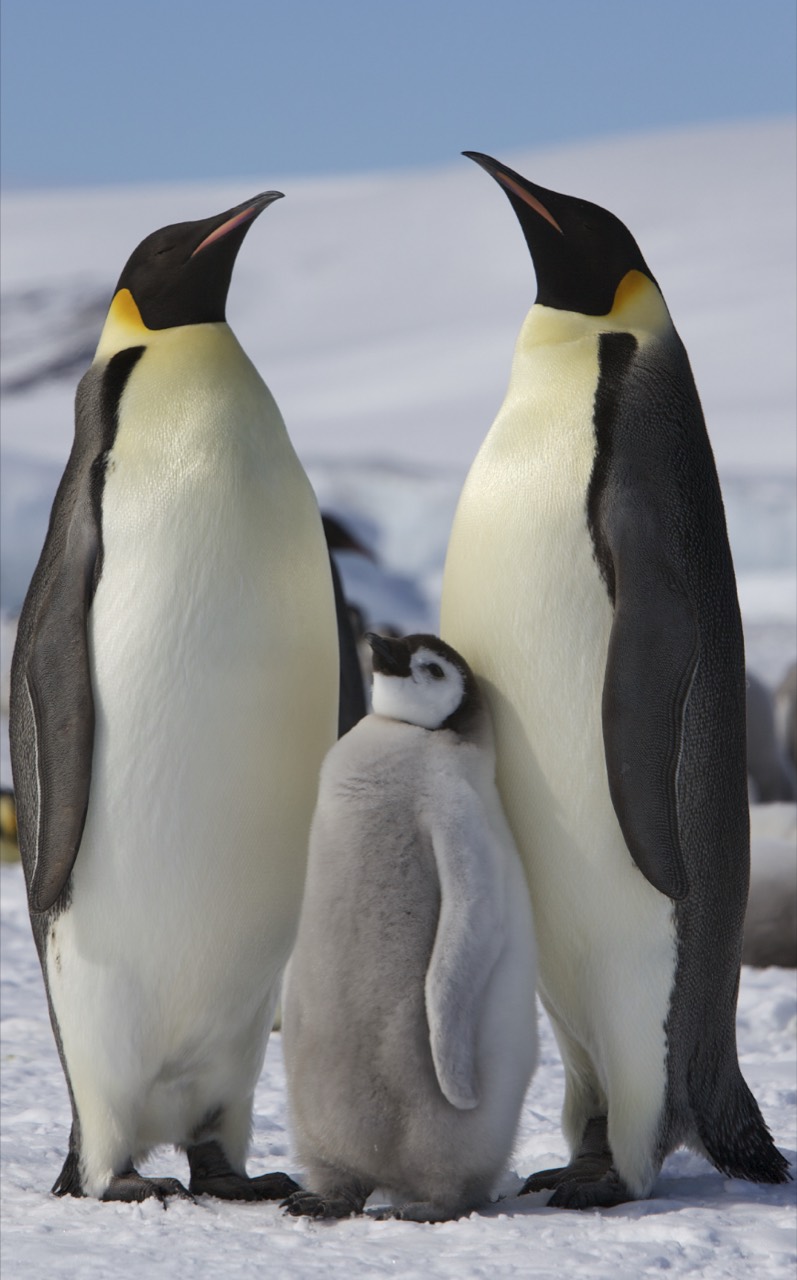
Source: Wikimedia Commons via Wikipedia “Penguin”
In brief
Penguins are flightless seabirds of the family Spheniscidae with 18 living species, found almost entirely in the Southern Hemisphere; their conservation status ranges from Least Concern to Critically Endangered, with the African penguin now Critically Endangered and the emperor penguin uplisted to Endangered in 2026.
Also in Animals A to Z · Animals that start with P
By WARN Research & Conservation TeamLast updated
Penguins are flightless seabirds in the family Spheniscidae, built for life in cold, productive seas rather than the air. The IUCN recognises 18 species, ranging from the towering emperor penguin of Antarctica to the tiny little penguin of Australia and New Zealand and the heat-tolerant Galápagos penguin near the equator. Streamlined bodies, dense waterproof feathers and flipper-like wings let them "fly" underwater, diving to chase fish, krill and squid. Most species live and breed in the Southern Hemisphere, gathering in colonies that can number in the hundreds of thousands. Conservation status varies widely across the family: some populations remain stable, while others are collapsing. The African penguin is now Critically Endangered, and in 2026 the emperor penguin was uplisted to Endangered as Antarctic sea ice retreats. Climate change, overfishing, oil pollution and disturbance of breeding sites are the dominant pressures shaping the future of these iconic birds.
18
Living species recognised by the IUCN
~9,900 pairs
African penguin breeding pairs (Critically Endangered)
~595,000
Adult emperor penguins, projected to halve by the 2080s
Up to ~36 km/h
Swimming speed of the fastest penguins underwater
Figures sourced from IUCN: Emperor penguin and Antarctic fur seal now Endangered due to climate change, IUCN Red List, IUCN Red List: African penguin (Spheniscus demersus) and other references on this page.
Penguin: Quick Facts
| Lifespan | Around 15-20 years in the wild (varies by species) |
|---|---|
| Weight | ~1 kg (little penguin) to over 20 kg (emperor penguin) |
| Size | ~30 cm to over 1 m tall depending on species |
| Diet | Carnivore: fish, krill and squid |
| Incubation | Roughly 30-65 days depending on species |
| Young | Usually 1-2 eggs per clutch |
| Baby name | Chick |
| Group name | A colony or rookery (a 'raft' in water) |
| Top speed | Up to about 36 km/h underwater in the fastest species |
| CITES | African penguin and Humboldt penguin listed on CITES Appendix I; most species not CITES-listed |
Scientific Classification
| Kingdom | Animalia |
|---|---|
| Phylum | Chordata |
| Class | Aves |
| Order | Sphenisciformes |
| Family | Spheniscidae |
| Genera | 6 (e.g. Aptenodytes, Eudyptes, Pygoscelis, Spheniscus) |
| Species | 18 living species |
Conservation Status
- IUCN Status
- Varies by species (Least Concern to Critically Endangered)
- Population
- Varies widely by species; the African penguin has fewer than ~9,900 breeding pairs, while emperor penguins number roughly 595,000 adults
- Trend
- Decreasing for most threatened species, including the African and emperor penguins
- Assessed
- 2026 (emperor penguin); 2024 (African penguin)
- CITES
- African penguin and Humboldt penguin on CITES Appendix I; most penguin species are not CITES-listed
The IUCN recognises 18 penguin species. Status differs by species: the African penguin is Critically Endangered (2024), the emperor penguin was uplisted to Endangered (2026), and others range down to Least Concern.
Did you know?
Emperor penguin fathers do the heavy lifting: the male balances the single egg on his feet under a fold of warm skin and fasts through the Antarctic winter for around two months while the female feeds at sea.
Key Facts: Penguin
- The IUCN recognises 18 penguin species, and their conservation status ranges from Least Concern to Critically Endangered.
- Penguins are flightless: their wings have evolved into stiff flippers for swimming, letting them dive and pursue prey underwater.
- Almost all penguins live in the Southern Hemisphere; the Galápagos penguin is the only species that ventures north of the equator.
- The African penguin was reassessed as Critically Endangered in 2024, with fewer than 10,000 breeding pairs remaining.
- In April 2026 the emperor penguin was uplisted from Near Threatened to Endangered as Antarctic sea ice declines.
- Climate change, overfishing, oil pollution and disturbance at breeding colonies are the leading threats across the family.
What is a penguin?
A penguin is a flightless seabird in the family Spheniscidae, the only family in the order Sphenisciformes. Penguins are unmistakable: upright posture, a tuxedo-like pattern of dark backs and pale fronts, and wings modified into rigid flippers. That body plan is a trade-off. Penguins gave up flight in the air for extraordinary control in water, where dense bones, a streamlined shape and powerful flippers make them among the most accomplished avian divers. Species range enormously in size, from the emperor penguin, which can stand over a metre tall and weigh more than 20 kg, to the little penguin, which weighs barely a kilogram. A waterproof coat of tightly packed feathers and a layer of fat insulate them against frigid seas, while a gland helps them shed excess salt from seawater.
Where penguins live
Penguins are creatures of the Southern Hemisphere. They are found around Antarctica and its surrounding islands, across the Southern Ocean, and along the coasts of South America, southern Africa, Australia and New Zealand. The popular image of penguins on Antarctic ice fits species such as the emperor and Adélie, but many penguins live in far milder places, from temperate beaches to rocky islands. The Galápagos penguin is the exception that proves the rule: living on the equator, it is the only penguin whose range crosses into the Northern Hemisphere, kept cool by nutrient-rich ocean currents. Most species breed in dense colonies on land or ice, returning to the same sites year after year, which makes the condition of those breeding grounds critical to their survival.
Threats and conservation
Penguins are among the most threatened groups of seabirds. Climate change is the overarching pressure: warming seas shift the fish and krill they depend on, and the loss of Antarctic sea ice removes the stable platform that ice-breeding species such as the emperor penguin need to raise chicks. In 2026 the emperor penguin was reassessed as Endangered after projections that its population could halve by the 2080s. Overfishing competes directly with penguins for prey, while oil spills, plastic pollution, introduced predators and human disturbance hit colonies hard. The African penguin shows how fast a decline can become a crisis: reassessed as Critically Endangered in 2024, its breeding population has fallen below 10,000 pairs. Protecting feeding grounds and breeding habitat, managing fisheries sustainably, and curbing pollution are central to keeping penguins from sliding further toward extinction.
Penguin breeding and life cycle
Most penguins are seasonal breeders that gather in large colonies. Pairs typically lay one or two eggs, and in many species both parents share incubation and chick-rearing, taking turns to fast on the nest while the other forages at sea. The emperor penguin is famous for its extreme strategy: the male incubates a single egg through the Antarctic winter, balancing it on his feet beneath a fold of skin while temperatures plunge and the female returns to the ocean to feed. Chicks are often raised in groups called crèches once they are large enough, gaining some protection from cold and predators. Penguins are long-lived for their size, with many species reaching 15 to 20 years in the wild, and they can return faithfully to the same colony and even the same nest site for much of their lives.
Selected penguin species at a glance
| Species | Main range | IUCN status | Notable trait |
|---|---|---|---|
| Emperor penguin | Antarctica | Endangered (2026) | Tallest penguin; breeds on winter sea ice |
| African penguin | Southern Africa | Critically Endangered (2024) | Fewer than ~9,900 breeding pairs remain |
| Galápagos penguin | Galápagos Islands (equator) | Endangered | Only penguin found north of the equator |
| Yellow-eyed penguin | New Zealand | Endangered | One of the rarest penguin species |
| Adélie penguin | Antarctica | Least Concern | Abundant ice-associated species |
| King penguin | Sub-Antarctic islands | Least Concern | Second-largest penguin species |
What WARN Does
This guide is educational content created by the World Animal Rescue Network to support global awareness of threatened wildlife. Penguins fall outside the countries where WARN currently funds hands-on rescue and protection work at this launch stage, so WARN does not fund penguin field programmes and we will not claim otherwise. What we can offer now is rigorously fact-checked, search-friendly information that helps people understand why penguins are declining and what threatens the world's most at-risk animals. By drawing readers in, this content supports WARN's broader mission of building public understanding of habitat loss, climate pressure and the wildlife trade, the same forces that drive the regional rescue work we do fund.
Penguins fall outside the countries where WARN currently funds field work, so we cannot honestly claim your gift pays for penguin rescue. What your donation does fund is WARN's frontline habitat protection and anti-wildlife-trade efforts in the regions we operate, tackling the same forces of habitat loss and human pressure that threaten wildlife everywhere. Support habitat protection to help us safeguard the wild places animals depend on.
Penguin: Frequently Asked Questions
How many species of penguin are there?
Are penguins endangered?
Can penguins fly?
Where do penguins live?
What do penguins eat?
Why are emperor penguins now endangered?
Are penguins dangerous?
How long do penguins live?
How big is a penguin?
Sources & References
Population figures, conservation status and biological facts on this page are drawn from authoritative scientific and intergovernmental sources.
Terms used on this page
Plain-English definitions, from our wildlife and conservation glossary.
Latest Penguin Stories
Quick, fact-checked reads on the penguin — amazing facts, key questions and the threats it faces.
Species
12 Amazing Facts About Penguins (And Why None of Them Live at the North Pole)
Solid bones, a gland that removes salt, and a species that fasts for two months on the ice. Twelve verified penguin facts.
Read the storySpecies
Penguin vs Puffin: Opposite Ends of the Earth, and Only One Can Fly
Both are black-and-white diving seabirds. One lives in the far south and cannot fly; the other lives in the far north and can.
Read the storyExplore more animals
Discover more animals, their habitats and their conservation status in the WARN wildlife-guide library.