Wildlife Guide · United Kingdom & Ireland
Pine Marten
Martes martes
The cat-sized tree-climber bringing red squirrels back to British woods.
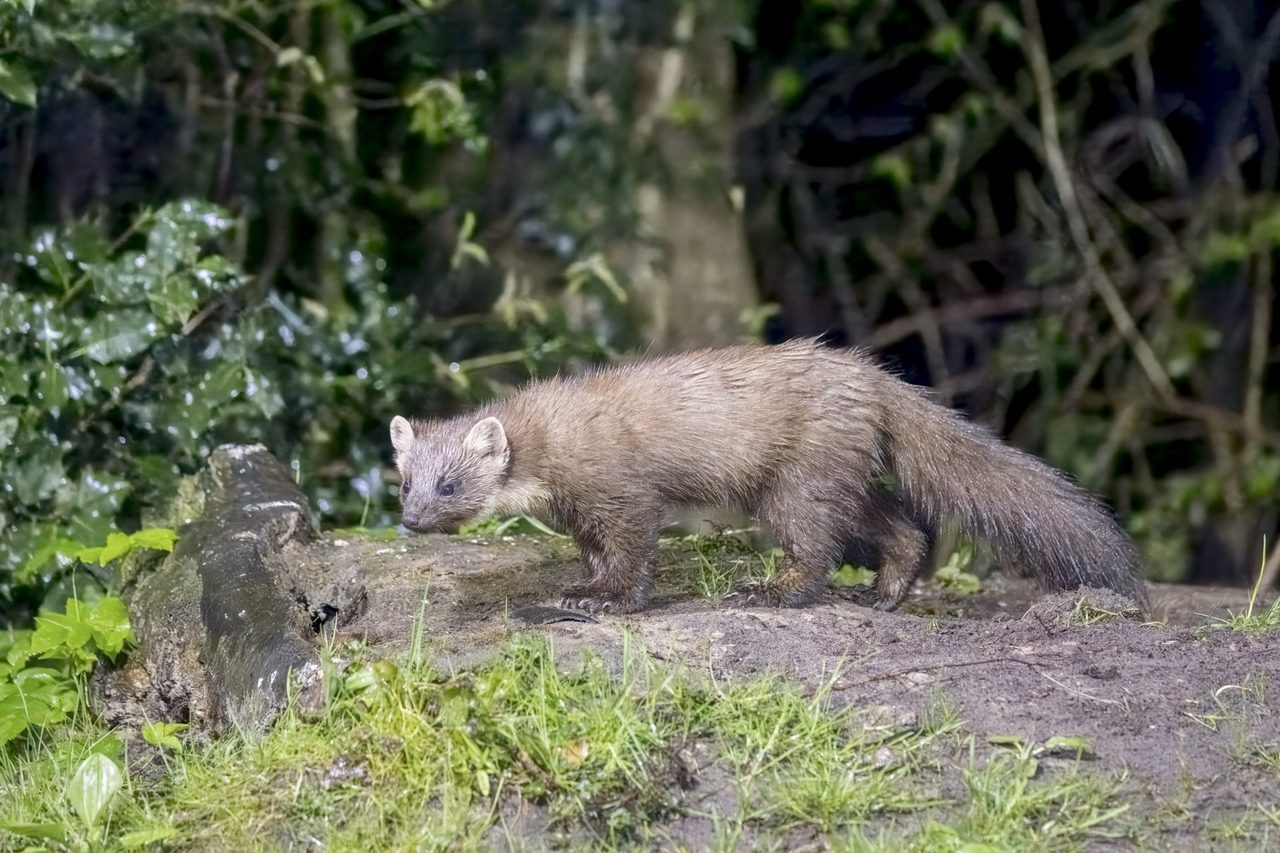
Source: Wikimedia Commons — “European pine marten (Martes martes) Drenthe 3” by Charles J. Sharp, CC BY-SA 4.0
In brief
A pine marten (Martes martes) is a cat-sized, tree-climbing member of the weasel family native to European and western Asian woodland. Chestnut-brown with a cream throat bib and bushy tail, it is rare in much of Britain but recovering, and is globally classed as Least Concern by the IUCN.
Also in Animals A to Z · Animals that start with P
By WARN Research & Conservation TeamLast updated
The pine marten (Martes martes) is a cat-sized member of the weasel family that lives in woodland and climbs with extraordinary agility. Native across much of Europe and into western Asia, it is recognised by its rich chocolate-brown coat, distinctive cream-to-orange throat bib, large rounded ears and long bushy tail. Once widespread in Britain, it was driven to near-extinction by habitat loss and persecution and survived mainly in the Scottish Highlands. It is now recovering and spreading, helped by legal protection and reintroductions. Remarkably, where pine martens return, native red squirrels often recover too, because the marten preys more heavily on invasive grey squirrels. Globally the species is classed as Least Concern.
Least Concern
Global IUCN Red List status
~1.5-1.7 kg
Typical adult body weight
Up to 53 cm
Head-and-body length, plus a ~25 cm tail
Up to 5
Kits per litter, born late March to April
Figures sourced from Wikipedia: European pine marten, IUCN Red List: Martes martes, Encyclopaedia Britannica: marten and other references on this page.
Pine Marten: Quick Facts
| Common name | Pine marten (European pine marten) |
|---|---|
| Scientific name | Martes martes |
| Family | Mustelidae (weasel family) |
| IUCN status | Least Concern (global) |
| Body length | Up to about 53 cm, plus a ~25 cm tail |
| Weight | About 1.5-1.7 kg; males larger than females |
| Diet | Omnivore: small mammals, birds, eggs, insects, frogs, fruit and berries |
| Litter | Up to 5 kits, born late March to April |
| Lifespan | Commonly 3-4 years in the wild; up to about 11 years |
| CITES | Not listed |
Scientific Classification
| Kingdom | Animalia |
|---|---|
| Phylum | Chordata |
| Class | Mammalia |
| Order | Carnivora |
| Family | Mustelidae |
| Genus | Martes |
| Species | Martes martes |
Conservation Status
- IUCN Status
- Least Concern globally on the IUCN Red List, reflecting a wide range and large overall population across Europe and western Asia. In Britain and Ireland the species is much rarer, having been reduced by historic habitat loss and persecution, and is legally protected. Populations there are now recovering and expanding, helped by woodland regrowth and reintroductions.
- Population
- No precise global figure; the population is considered large across its extensive European and western Asian range, with much smaller, recovering numbers in Britain.
- Trend
- Stable globally; recovering and expanding in Britain and Ireland.
- Assessed
- Assessed as Least Concern in the most recent IUCN Red List evaluation of the species
- CITES
- Not listed on CITES Appendices.
Continued recovery in Britain depends on protecting and connecting woodland habitat and reducing road mortality; isolated populations remain locally vulnerable.
Key Facts: Pine Marten
- The pine marten is a cat-sized woodland mustelid, identified by chocolate-brown fur and a cream-to-orange throat patch.
- Globally it is classed as Least Concern, but it remains rare across much of Britain after centuries of habitat loss and persecution.
- Populations are recovering and expanding in Scotland, England, Wales and Ireland, aided by protection and reintroductions.
- Pine martens help native red squirrels by preying more heavily on ground-foraging invasive grey squirrels.
- They are agile climbers and skilled generalists, eating small mammals, birds, eggs, insects, frogs, fruit and berries.
- Females use delayed implantation, mating in summer but giving birth the following spring.
What does a pine marten look like and how big is it?
The pine marten is roughly the size of a domestic cat but with a slimmer, more elongated body typical of the weasel family. Adults have a head-and-body length of up to about 53 cm, plus a long bushy tail of around 25 cm that aids balance during climbing. Most weigh between 1.5 and 1.7 kg, with males larger than females. The coat is a rich chocolate-brown, growing darker and thicker in winter, and the most recognisable feature is the pale throat bib, which ranges from creamy yellow to deep orange and is unique enough to help identify individuals. Other distinguishing features include large, rounded ears edged in pale fur, a pointed face and strong, semi-retractable claws. These claws, combined with the ability to rotate their hind feet, make pine martens superb climbers, able to descend tree trunks head-first. They are mostly solitary and largely nocturnal or crepuscular, though they may be active by day in quiet areas. Their long tails, dark fur and bounding gait can cause them to be mistaken for a cat or a large stoat at a glance.
What do pine martens eat and how do they live?
Pine martens are opportunistic omnivores, and their diet shifts with the seasons. They take small mammals such as voles and mice, along with birds, eggs, insects, frogs and carrion, and in late summer and autumn they eat large quantities of berries and fruit. This flexibility allows them to thrive in mixed woodland, conifer forest, scrub and rocky areas. Each animal holds a territory that it marks with droppings, or scats, often left in prominent places such as tracks, rocks or logs; these scats have a distinctive musky, slightly sweet smell. Pine martens are excellent climbers and frequently den and rest in tree cavities, old squirrel dreys, rock crevices or buildings, and they will readily use purpose-built den boxes. They are mainly solitary outside the breeding season. Breeding involves delayed implantation: mating takes place in mid to late summer, but the fertilised egg does not implant until the following late winter, so the single litter of up to five kits is born in late March or April. The young stay with their mother through the summer before dispersing.
Why are pine martens linked to red squirrel recovery?
One of the most striking findings in recent British and Irish ecology is that the return of the pine marten can help native red squirrels at the expense of invasive grey squirrels. Grey squirrels, introduced from North America, outcompete reds and carry a disease that is usually fatal to them, and they have driven red squirrels out of much of Britain. Where pine martens recolonise, however, this trend can reverse. The leading explanation is that grey squirrels, which did not evolve alongside the pine marten, spend more time foraging on the ground and are heavier and less agile in the canopy, making them easier prey. Red squirrels, native to the same woodlands as the marten, are lighter, warier and better at escaping through the treetops, so they suffer far less predation. The result is that areas with established pine marten populations often see grey squirrel numbers fall and red squirrels begin to return. This makes the pine marten a valuable native predator for woodland conservation, and a clear example of how restoring one species can ripple through an ecosystem to benefit others.
Are pine martens protected and how are they recovering?
Although the pine marten is classed as Least Concern across its wide global range, its history in Britain has been very different. Centuries of woodland clearance, trapping for fur and persecution as a perceived threat to game and poultry reduced it to scattered strongholds, chiefly in the Scottish Highlands, by the early twentieth century. The species is now legally protected in Britain and Ireland, where it is an offence to kill, injure or disturb them or to damage their resting places. Protection, the regrowth of woodland and natural spread have allowed populations to recover, and pine martens are once again expanding across Scotland and into northern England and Wales. Carefully managed reintroductions have helped re-establish the species in parts of Wales and England where it had been lost. Recovery is not guaranteed everywhere: pine martens still need large areas of connected woodland, they can be killed on roads, and isolated populations remain vulnerable. Continued habitat protection, woodland connectivity and public understanding all support the species' long-term return to landscapes it once occupied.
Pine marten vs grey squirrel: predator and prey
| Feature | Pine marten | Grey squirrel |
|---|---|---|
| Family | Weasel family (Mustelidae) | Squirrel family (Sciuridae) |
| Status in Britain | Native, rare but recovering | Invasive, introduced from North America |
| Role | Native predator | Prey, and competitor of red squirrels |
| Where it forages | Trees and ground; agile climber | Often on the ground; heavier in the canopy |
| Conservation effect | Helps red squirrels recover | Displaces native red squirrels |
What WARN Does
WARN does not run field projects specifically for the pine marten, which lives largely outside the countries where our partners work. This guide is part of our free educational work to help people understand wildlife and the pressures it faces. The threats that once nearly wiped out British pine martens, above all habitat loss and the fragmentation of forests, are the same forces harming the animals WARN's partners do protect every day.
If this guide helped you, a small gift helps us keep publishing free wildlife education and supports hands-on care for vulnerable animals in the regions where we work.
Pine Marten: Frequently Asked Questions
Is a pine marten endangered?
What is the difference between a pine marten and a stoat or weasel?
Do pine martens really help red squirrels?
Are pine martens dangerous to humans or pets?
What do pine martens eat?
Where do pine martens live?
How long do pine martens live?
How big is a pine marten?
Sources & References
Population figures, conservation status and biological facts on this page are drawn from authoritative scientific and intergovernmental sources.
Terms used on this page
Plain-English definitions, from our wildlife and conservation glossary.
Latest Pine Marten Stories
Quick, fact-checked reads on the pine marten — amazing facts, key questions and the threats it faces.
Guides
UK Animal Charities Explained: A Friendly Guide to 10 of the Biggest, and How They Differ
Who does what across UK animal welfare? A neutral, supporter-friendly guide to ten of the biggest UK animal charities — RSPCA, Dogs Trust, Battersea, Cats Protection, Blue Cross, PDSA, The Donkey Sanctuary, Brooke, Wood Green and Mayhew — with each charity's own donate link, and an honest section on where international field rescue fits in.
Read the storyGuides
What Is an Animal Sanctuary? How Sanctuaries Work, Who They Help, and How to Support One
Animal sanctuary, animal shelter, animal rescue — the terms are often used interchangeably, but they mean different things. This guide explains the difference, what life inside a sanctuary looks like, and how you can support sanctuaries in the UK and internationally.
Read the storyGuides
Fostering a Rescue Dog in the UK: A Complete Guide for New and Experienced Foster Carers
Fostering a rescue dog gives a dog in a shelter or rescue centre a temporary home while they wait for adoption — and it can make an enormous difference to their behaviour, health and chances of finding a permanent family. This guide covers how dog fostering works, what to expect, and how to get started.
Read the storyExplore more animals
Discover more animals, their habitats and their conservation status in the WARN wildlife-guide library.