Wildlife Guide · Indonesia & Malaysia
Proboscis Monkey
Nasalis larvatus
Borneo's big-nosed mangrove swimmer, found nowhere else on Earth.
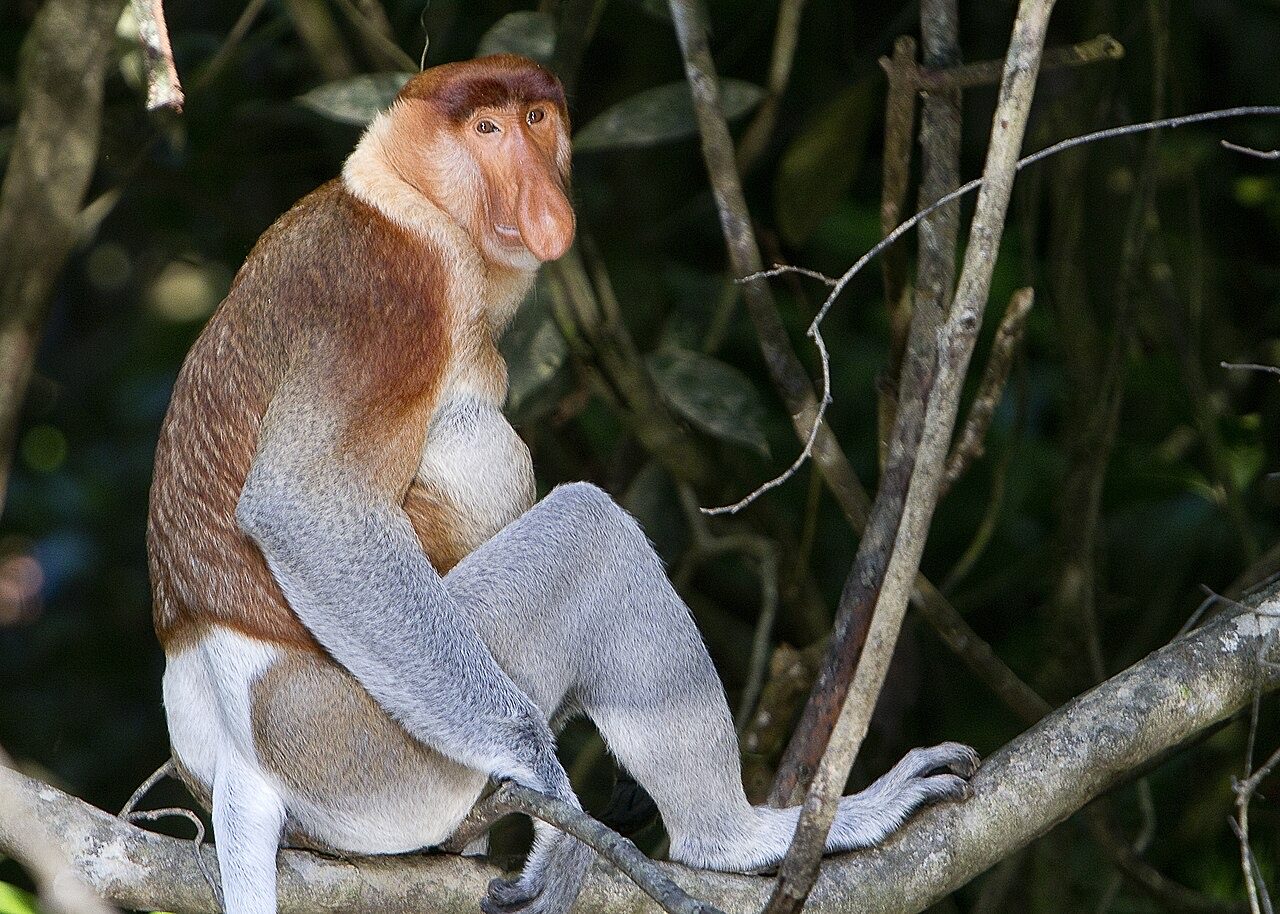
Source: Wikimedia Commons via Wikipedia “Proboscis monkey”
In brief
A proboscis monkey is a large, reddish-brown Old World monkey found only on the island of Borneo (in Indonesia, Malaysia and Brunei), famous for the male's oversized hanging nose and for living in coastal mangrove and riverside forests; the IUCN classes it as Endangered.
Also in Animals A to Z · Animals that start with P
How you can help
You can support the related appeal — read its purpose, recipient status and fund terms first — or give once to where it is needed most. Sharing accurate information helps too.
By WARN Research & Conservation TeamLast updated
The proboscis monkey (Nasalis larvatus) is a large, reddish-brown leaf-eating monkey endemic to the island of Borneo, instantly recognised by the male's huge drooping nose and round pot belly. It clings to coastal mangroves, peat-swamp forests and riverbanks, where it is one of the most accomplished swimmers among all primates. With forests cleared for oil palm and timber, the IUCN lists it as Endangered, and it is protected under CITES Appendix I.
Borneo only
The single island where this monkey lives in the wild
< 7,000
Mature individuals estimated to remain (IUCN, 2020)
>50%
Population decline over roughly the last 40 years
~30 kg
Maximum weight of a large adult male
Figures sourced from IUCN Red List - Nasalis larvatus (2020 assessment), IUCN Red List assessment PDF - Nasalis larvatus, CITES - Appendices (Nasalis larvatus, Appendix I) and other references on this page.
Proboscis Monkey: Quick Facts
| Lifespan | At least 23 years in captivity (~20-21 yr average); shorter in the wild |
|---|---|
| Weight | Males ~16-22 kg (up to ~30 kg); females ~7-12 kg |
| Length | Head-body ~66-76 cm (male), ~53-62 cm (female), plus a long tail |
| Diet | Folivore-frugivore: young leaves, unripe fruit and seeds |
| Gestation | About 166-200 days |
| Young per birth | One (single infant) |
| Baby name | Infant |
| Group name | Troop or band (one-male and bachelor groups) |
| CITES | Appendix I |
| Notable | One of the most aquatic primates; can swim and cross rivers underwater |
Scientific Classification
| Kingdom | Animalia |
|---|---|
| Phylum | Chordata |
| Class | Mammalia |
| Order | Primates |
| Family | Cercopithecidae |
| Genus | Nasalis |
| Species | Nasalis larvatus (Wurmb, 1787) |
| Subspecies | Two recognised: N. l. larvatus and N. l. orientalis |
Conservation Status
- IUCN Status
- Endangered
- Population
- Fewer than an estimated 7,000 mature individuals across Borneo (highly fragmented)
- Trend
- Decreasing
- Assessed
- 2020
- CITES
- Appendix I
Population has declined by more than 50% over roughly the last 40 years (about three generations), driven mainly by habitat loss; estimates are approximate because the range is fragmented and hard to survey.
Did you know?
Proboscis monkeys are among the best swimmers in the primate world: they have partial webbing between their fingers and toes and can swim across rivers, sometimes underwater for up to 20 metres, to dodge crocodiles and reach feeding trees.
Key Facts: Proboscis Monkey
- Proboscis monkeys are endemic to Borneo, shared by Indonesia (Kalimantan), Malaysia (Sabah and Sarawak) and Brunei - they live nowhere else in the wild.
- The IUCN Red List classifies the species as Endangered (assessed 2020), and it is listed on CITES Appendix I, the strictest trade protection.
- Males are far larger than females and grow an enormous pendulous nose; females and young have smaller, upturned noses.
- They are mangrove and riverside specialists and among the most aquatic monkeys, able to swim and even cross rivers underwater.
- Their diet is mostly leaves, unripe fruit and seeds, digested by a chambered, ruminant-like stomach full of fermenting bacteria.
- The main threats are habitat loss to oil-palm plantations, logging and coastal development, plus hunting in parts of the range.
Why the proboscis monkey is Endangered
The proboscis monkey's fate is tied directly to Borneo's lowland forests. Because it depends on mangroves, peat-swamp forest and riverbank vegetation - exactly the flat, water-rich land that is easiest to drain and convert - it has lost huge areas of habitat to oil-palm plantations, logging, shrimp farming and coastal development. The IUCN estimates the population has fallen by more than 50% over roughly the last 40 years (about three generations) and lists the species as Endangered, with fewer than an estimated 7,000 mature individuals remaining across a highly fragmented range. Surviving groups are increasingly cut off from one another along single rivers, which makes local populations vulnerable to disturbance, hunting and isolation.
Behaviour and ecology
Proboscis monkeys live in a flexible, fission-fusion society: typically one dominant male with a group of females and young, plus separate bachelor bands of males, which gather and split along the same stretch of river. They are highly arboreal but also remarkable swimmers - one of the few primates with partial webbing between the fingers and toes - and will leap from branches into rivers and swim across, sometimes underwater, to escape predators such as crocodiles or to reach feeding trees. Their bulging bellies house a specialised, multi-chambered stomach where bacteria ferment tough leaves, similar to a cow's digestion, allowing them to live on foliage, unripe fruit and seeds that other monkeys cannot process.
The remarkable nose
The species is named for the male's proboscis - a fleshy, drooping nose that can hang lower than the mouth and grows larger with age. Research suggests it is shaped by sexual selection: a bigger nose acts as a resonating chamber that amplifies the male's honking calls and may signal size and dominance to females and rivals. Females prefer larger-nosed males, and nose size correlates with body mass and the number of females a male attracts. Females and infants, by contrast, have small, neat, upturned noses, making the sexes easy to tell apart.
What rescue and protection involve
Protecting proboscis monkeys is mostly about protecting habitat. Because they cannot survive away from intact riverine and mangrove forest, conservation centres on safeguarding river corridors, restoring degraded mangroves, reducing forest conversion and maintaining connected patches so isolated groups can mix. On-the-ground work also includes monitoring populations, reducing hunting and snaring, managing wildlife tourism so it does not stress the animals, and rehabilitating individuals orphaned or displaced by land clearing. Effective action depends on local rangers, community-run reserves and sanctuary teams who know the rivers and can respond quickly.
Male vs female proboscis monkey
| Feature | Male | Female |
|---|---|---|
| Nose | Very large, pendulous, hangs over the mouth | Small and upturned |
| Weight | ~16-22 kg (up to ~30 kg) | ~7-12 kg |
| Head-body length | ~66-76 cm | ~53-62 cm |
| Coat | Brighter reddish-brown, pale rump | Similar colours, smaller build |
| Social role | Leads one-male group or joins bachelor band | Lives in one-male group with young |
What WARN Does
WARN publishes this guide for education and is developing support through assessed animal-welfare grants. A species range, source citation or photograph does not establish a recipient or funding agreement. Check /about/where-your-money-goes/#grant-register for published grant and payment records; records not yet published must not be read as zero activity. Browse /appeals/ for the purposes currently available to support.
Borneo's proboscis monkeys survive only where their mangroves and riverbanks do. A donation helps WARN fund the local rescue and ranger teams in Indonesia and Malaysia working to keep those forests - and the monkeys in them - standing.
How can I help save the proboscis monkey?
Explore practical ways to support the proboscis monkey, from everyday choices and sharing reliable information to reviewing a related appeal before giving.
Explore ways to support
Read the related appeal’s purpose, recipient status and fund terms. Choose an affordable gift after checking what is proposed and what has been reported.
Ease the pressures
Avoid the wildlife trade and souvenirs, never buy wild animals as pets, and choose sustainable, habitat-friendly products — the threats behind the proboscis monkey's decline fall when demand does.
Spread the word
Share accurate, sourced information about the proboscis monkey. Wider awareness is what turns concern into lasting protection.
Proboscis Monkey: Frequently Asked Questions
How can I help save the proboscis monkey?
How long do proboscis monkeys live?
What do proboscis monkeys eat?
How big do proboscis monkeys get?
Are proboscis monkeys dangerous to humans?
How many proboscis monkeys are left?
Why is the male's nose so big?
Where do proboscis monkeys live?
Sources & References
Population figures, conservation status and biological facts on this page are drawn from authoritative scientific and intergovernmental sources.
Terms used on this page
Plain-English definitions, from our wildlife and conservation glossary.
Latest Proboscis Monkey Stories
Quick, fact-checked reads on the proboscis monkey — amazing facts, key questions and the threats it faces.
Briefings
Kalimantan forest fires 2026: orangutans, smoke and how to help
What official reports say about Kalimantan’s forest fires, Sempurna the orangutan, smoke and wildlife rescue—and how to help through informed giving or sharing.
Read the storySpecies
10 Amazing Facts About the Proboscis Monkey, Borneo's Big-Nosed Swimmer
From a nose that doubles as a loudspeaker to a stomach that ferments leaves like a cow's, here are ten things that make Borneo's proboscis monkey one of the strangest primates alive.
Read the storySpecies
How Big Is a Proboscis Monkey, and Can It Really Swim Underwater?
Male proboscis monkeys can weigh up to about 30 kg and swim underwater for 20 metres. Here is how this big-nosed Borneo primate measures up in size, weight and aquatic skill.
Read the storyExplore more animals
Discover more animals, their habitats and their conservation status in the WARN wildlife-guide library.