Wildlife Guide · Iceland & Norway and the Faroe Islands
Atlantic Puffin
Fratercula arctica
The North Atlantic's beloved "sea parrot" — a burrow-nesting seabird whose famous bill fades each winter at sea.
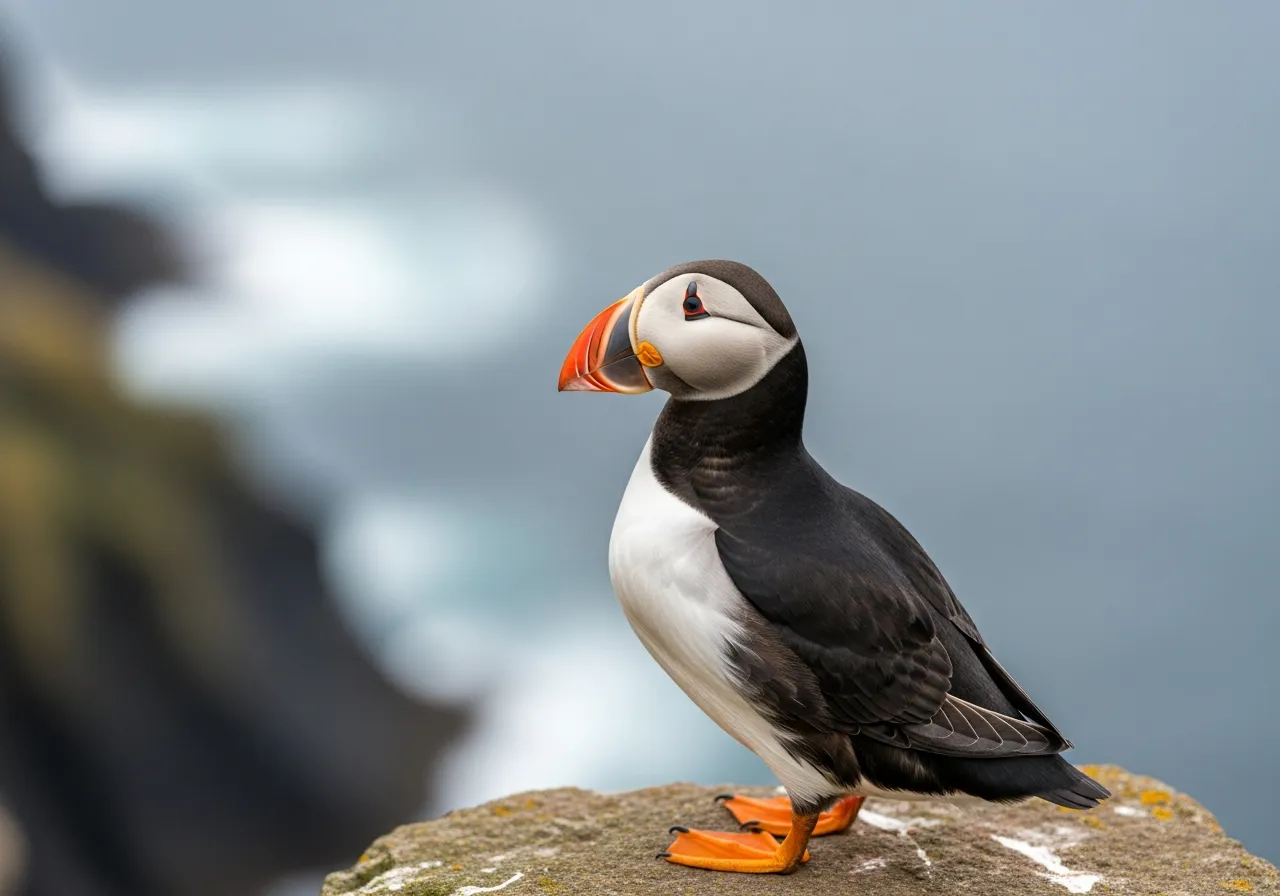
Source: Global Animal Guide (WARN)
In brief
A puffin is a small North Atlantic seabird of the auk family, best known as the Atlantic puffin (Fratercula arctica). Nicknamed the "sea parrot" for its large, colourful striped bill, it nests in clifftop burrows in summer and spends the winter alone far out at sea.
Also in Animals A to Z · Animals that start with A
How you can help
You can support the related appeal — read its purpose, recipient status and fund terms first — or give once to where it is needed most. Sharing accurate information helps too.
By WARN Research & Conservation TeamLast updated
The Atlantic puffin (Fratercula arctica) is a small, stocky seabird of the auk family, instantly recognised by its black-and-white plumage and a large, brightly striped bill that has earned it the nickname "sea parrot". It breeds in dense colonies on cliffs and grassy islands around the North Atlantic, from Iceland and Norway to Britain, Ireland, Canada and Greenland, nesting in burrows it digs or borrows. Outside the breeding season it lives entirely at sea, where its colourful bill plates are shed to a duller grey. Superb at swimming and diving, the puffin "flies" underwater to catch small fish. The IUCN lists it as Vulnerable, with European numbers in worrying decline.
12-14M
Mature individuals worldwide (IUCN)
~60%
Of the global population breeds in Iceland
1
Egg laid per pair each year
4-5 yrs
Age at which puffins first breed
Figures sourced from Atlantic puffin — Wikipedia, IUCN Red List — Fratercula arctica, Atlantic puffin — Encyclopaedia Britannica and other references on this page.
Atlantic Puffin: Quick Facts
| Common name | Atlantic puffin ("sea parrot") |
|---|---|
| Scientific name | Fratercula arctica |
| Family | Alcidae (auks) |
| Length | About 28-30 cm |
| Wingspan | About 47-63 cm |
| Weight | Roughly 400-650 g |
| Diet | Small fish: sand eels, herring, capelin, sprats |
| Clutch | 1 egg per year |
| Range | North Atlantic coasts and open ocean |
| IUCN status | Vulnerable |
Scientific Classification
| Kingdom | Animalia |
|---|---|
| Phylum | Chordata |
| Class | Aves |
| Order | Charadriiformes |
| Family | Alcidae (auks) |
| Genus | Fratercula |
| Species | Fratercula arctica |
Conservation Status
- IUCN Status
- Vulnerable. The Atlantic puffin is listed as Vulnerable on the IUCN Red List, reflecting rapid declines in its European range, which holds most of the world's birds. Although the global total is large, the species is projected to lose roughly half or more of its European population across the first two-thirds of this century, driven chiefly by reduced food availability linked to climate change.
- Population
- Roughly 12-14 million mature individuals worldwide, with around 4.8-5.8 million breeding pairs in Europe.
- Trend
- Decreasing
- Assessed
- 2021
- CITES
- Not listed on the CITES Appendices.
Iceland alone holds about 60% of the global population, so the health of North Atlantic island colonies is critical to the species' future.
Key Facts: Atlantic Puffin
- The Atlantic puffin is one of three puffin species worldwide, alongside the tufted puffin and horned puffin of the North Pacific.
- Its famous orange-and-grey bill is a breeding ornament: the bright outer plates are moulted away in winter, leaving a smaller, duller beak.
- Puffins nest in burrows on cliffs and offshore islands, laying a single egg and spending the rest of the year out at sea.
- They feed mainly on small shoaling fish such as sand eels, capelin and herring, diving and 'flying' underwater to catch them.
- The IUCN classes the species as Vulnerable, with European populations projected to fall sharply this century.
- Iceland holds roughly 60% of all Atlantic puffins, making the North Atlantic islands globally important strongholds.
What does an Atlantic puffin look like?
The Atlantic puffin is a compact, rounded seabird about 28-30 cm long with a wingspan of roughly 47-63 cm, typically weighing between 400 and 650 grams depending on region. Its plumage is sharply patterned: glossy black above and across a broad collar, with clean white underparts and pale grey face discs. Short orange legs and webbed feet complete the look. The defining feature is the bill. In the breeding season it becomes large, flattened and vividly coloured — slate-grey at the base, then a band of yellow, and bright orange-red towards the tip — framed by fleshy yellow rosettes at the gape. This brilliant beak is essentially a seasonal ornament. After breeding, the outer horny plates are shed during a moult, leaving a smaller, narrower and far duller bill for the winter. Males and females look alike, though males average slightly larger. In flight, puffins beat their small wings furiously, reaching high speeds but appearing to whirr rather than glide.
Where do puffins live and breed?
Atlantic puffins are birds of the cold and temperate North Atlantic. They breed in colonies on coastal cliffs and offshore islands, choosing grassy slopes and turf where they can excavate or occupy burrows. Iceland is the single most important country, holding around 60% of the world population, with other major colonies in Norway, the Faroe Islands, Greenland and Atlantic Canada, including Newfoundland. In Britain and Ireland, well-known colonies include the Farne Islands off Northumberland and Skomer Island off Wales, where birds return to land each spring. A pair typically reuses the same burrow year after year, digging a tunnel up to a metre or more long and lining a nest chamber at the end. Puffins are highly faithful both to their colony and to their partner. Once the breeding season ends in late summer, they abandon land entirely and disperse across the open ocean, spending the entire winter at sea, often hundreds of kilometres from any coast, before returning the following year.
What do puffins eat and how do they raise their young?
Puffins are pursuit-diving predators that feed almost exclusively on small fish. Favoured prey includes sand eels, herring, capelin and sprats, supplemented by some zooplankton. A puffin swims fast underwater using its wings for propulsion and its feet to steer, reaching considerable depths and staying submerged for up to a minute. Its specialised bill and backward-pointing spines on the tongue and palate let it hold several small fish crosswise at once, so a parent can carry a full beak-load back to the burrow without dropping its catch. Each pair lays a single white egg, which both adults incubate. The chick, known as a 'puffling', is fed in the safety of its burrow until it is ready to leave, when it departs alone at night and makes its own way to the sea. Puffins are long-lived birds that do not begin breeding until they are four or five years old, a slow life history that makes colonies sensitive to poor breeding seasons and adult losses.
Why are puffin numbers falling?
Despite a large global population, the Atlantic puffin is classified as Vulnerable because of steep, sustained declines in its European stronghold, where most of the world's birds breed. The IUCN notes that the European population is projected to fall by roughly half or more across the first two-thirds of this century. The core problem is food. Puffins depend on small shoaling fish, especially sand eels, and warming seas and shifting ocean conditions are reducing the availability and quality of this prey near many colonies. When parents cannot find enough fish, chicks starve in the burrow and breeding fails. Climate change drives much of this disruption, but puffins also face pressures from severe storms, marine pollution and oil spills, fishing that competes for the same fish stocks, and introduced predators such as rats on once-safe islands. Because puffins are slow to mature and rear just one chick a year, populations recover only slowly, so several poor seasons in a row can cause lasting decline.
Atlantic puffin vs penguin
| Feature | Atlantic puffin | Penguin |
|---|---|---|
| Family | Auk (Alcidae) | Penguin (Spheniscidae) |
| Main range | North Atlantic (Northern Hemisphere) | Mostly Southern Hemisphere |
| Can it fly? | Yes, in air and underwater | No, flightless; 'flies' only underwater |
| Bill | Large, colourful in summer | Varied, not seasonally ornamental |
| Nesting | Burrows on cliffs and islands | Open ground, colonies or burrows by species |
What WARN Does
World Animal Rescue Network does not run field projects specifically for Atlantic puffins, which breed far from the countries where WARN's partners work. This guide is part of WARN's free educational work, helping people understand the wildlife that shares our planet. The threats that drive puffins towards decline — habitat disturbance, pollution and a changing climate — are the same pressures that affect the animals WARN does protect.
If this guide deepened your love of wildlife, supporting WARN's educational and rescue work helps protect animals facing these very same threats.
How can I help save the atlantic puffin?
Explore practical ways to support the atlantic puffin, from everyday choices and sharing reliable information to reviewing a related appeal before giving.
Explore ways to support
Read the related appeal’s purpose, recipient status and fund terms. Choose an affordable gift after checking what is proposed and what has been reported.
Ease the pressures
Avoid the wildlife trade and souvenirs, never buy wild animals as pets, and choose sustainable, habitat-friendly products — the threats behind the atlantic puffin's decline fall when demand does.
Spread the word
Share accurate, sourced information about the atlantic puffin. Wider awareness is what turns concern into lasting protection.
Atlantic Puffin: Frequently Asked Questions
How can I help save the atlantic puffin?
Is a puffin a penguin?
How many types of puffin are there?
Why is the puffin's beak so colourful?
Where can I see puffins in the UK?
How long do puffins live?
What do atlantic puffins eat?
Where do atlantic puffins live?
Are atlantic puffins dangerous?
How big is an atlantic puffin?
Sources & References
Population figures, conservation status and biological facts on this page are drawn from authoritative scientific and intergovernmental sources.
Terms used on this page
Plain-English definitions, from our wildlife and conservation glossary.
Latest Atlantic Puffin Stories
Quick, fact-checked reads on the atlantic puffin — amazing facts, key questions and the threats it faces.
Explore more animals
Discover more animals, their habitats and their conservation status in the WARN wildlife-guide library.