Wildlife Guide · Western Australia & Rottnest Island
Quokka
Setonix brachyurus
The world's "happiest" marsupial is quietly struggling to survive
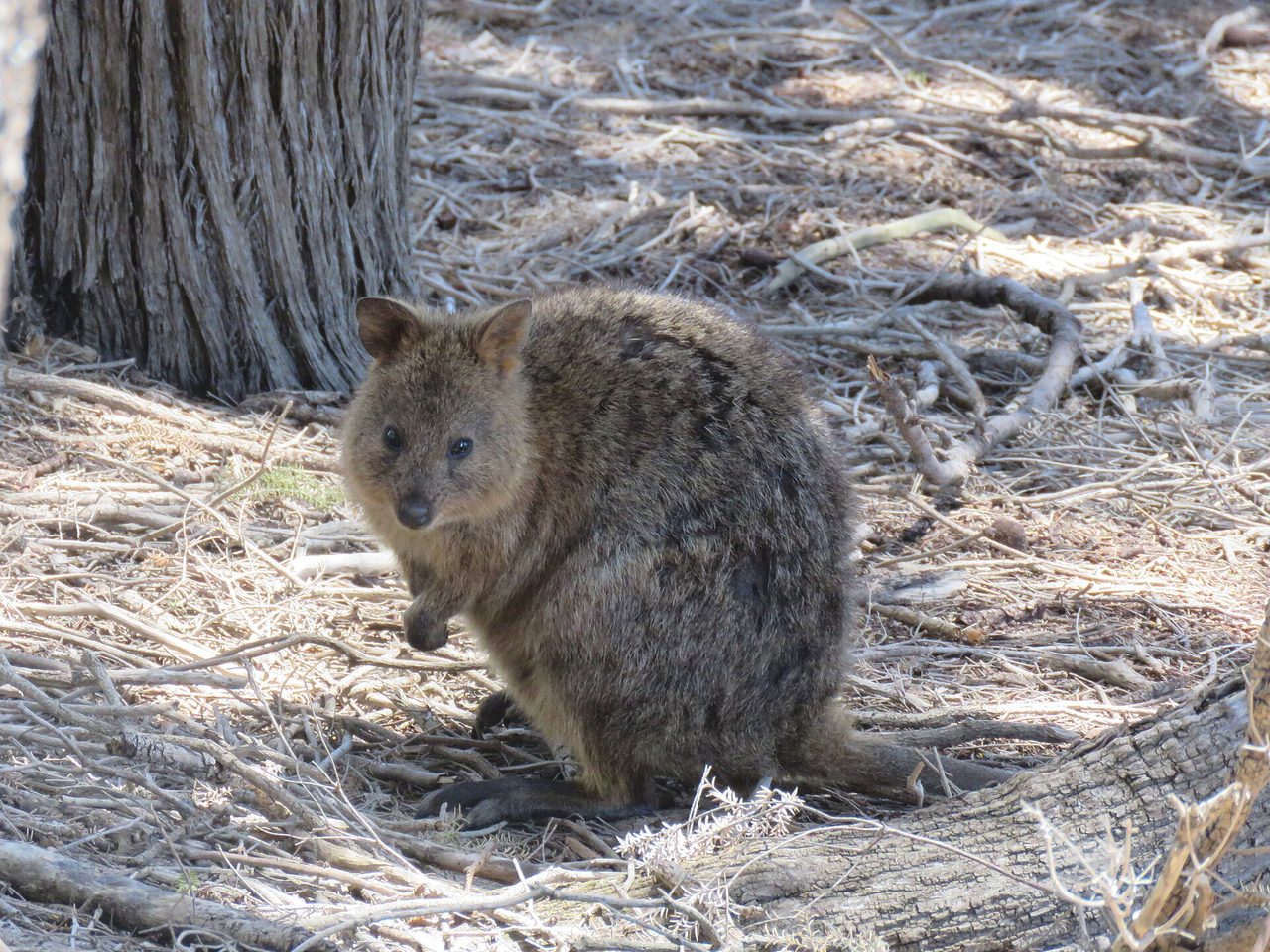
Photo: Donald Hobern / Wikimedia Commons (CC BY 2.0)
In brief
The quokka is a Vulnerable marsupial found only in south-western Western Australia, best known for its photogenic "smile" but facing serious threats from feral predators, habitat loss, and climate change.
Also in Animals A to Z · Animals that start with Q
How you can help
You can support the related appeal — read its purpose, recipient status and fund terms first — or give once to where it is needed most. Sharing accurate information helps too.
By WARN Research & Conservation TeamLast updated
The quokka (Setonix brachyurus) is a small, stocky marsupial native to a tiny corner of south-western Western Australia. About the size of a domestic cat — weighing between 1.6 and 4.2 kg and measuring up to 54 cm in body length — it is the sole member of the genus Setonix and one of the more recognisable members of the kangaroo family, Macropodidae. Its rounded face and upturned mouth corners produce what looks uncannily like a smile, earning it the viral title of the world's "happiest animal" and turning Rottnest Island into an international selfie destination. Beneath the internet fame, however, the quokka is classified as Vulnerable on the IUCN Red List, its mainland population fragmented and declining under pressure from introduced predators, habitat loss, and a drying south-west Australian climate driven by climate change.
7,850–17,150
Estimated mature individuals (IUCN)
~10 years
Typical lifespan in the wild
40–54 cm
Head–body length
27 days
Gestation period
Figures sourced from IUCN Red List – Setonix brachyurus, Animal Diversity Web – Setonix brachyurus, Australian Museum – Quokka and other references on this page.
Quokka: Quick Facts
| Body length | 40–54 cm |
|---|---|
| Weight | 1.6–4.2 kg |
| Lifespan | ~10 years |
| Gestation | 27 days |
| Pouch time | ~6 months |
| Top speed | ~32 km/h |
| Activity pattern | Nocturnal |
| Diet | Herbivore (grasses, leaves, sedges) |
Scientific Classification
| Kingdom | Animalia |
|---|---|
| Phylum | Chordata |
| Class | Mammalia |
| Order | Diprotodontia |
| Family | Macropodidae |
| Genus | Setonix |
| Species | S. brachyurus |
Conservation Status
- IUCN Status
- Vulnerable
- Population
- 7,850–17,150 mature individuals
- Trend
- Decreasing
- Assessed
- 2016
- CITES
- Not listed
Classified VU B1ab(ii,iii) due to restricted range (<20,000 km²), severely fragmented distribution, and continuing declines in area of occupancy. Largest colony on predator-free Rottnest Island (est. 4,000–8,000); mainland populations face severe pressure from introduced foxes and cats.
Did you know?
When Dutch explorer Willem de Vlamingh sailed past what is now Rottnest Island in 1696 and spotted quokkas scrambling through the scrub, he thought they were giant rats — and recorded the island's name as "'t Eylandt 't Rottenest" (Rats' Nest Island). Today that same island is a global wildlife tourism hotspot because of those very animals.
Key Facts: Quokka
- The quokka is the only species in the genus Setonix and is found nowhere else on Earth outside a small region of south-western Western Australia.
- Its global population is estimated at just 7,850 to 17,150 mature individuals, split between island refuges and fragmented mainland patches.
- Introduced predators — particularly red foxes and feral cats — are the primary threat to mainland quokka populations, which lack the predator-free protection that island colonies enjoy.
- The famous "quokka selfie" trend has boosted awareness but also brought tourism pressures, including illegal feeding and handling that can harm individual animals.
- Female quokkas practise embryonic diapause — holding a backup embryo in suspended development so a replacement joey can develop immediately if the current one is lost.
- A drying, warming south-western Australian climate is shrinking the dense vegetation quokkas need for shelter and food, adding long-term pressure on top of immediate predator threats.
What is a quokka?
The quokka is a small macropod marsupial — meaning it belongs to the same family as kangaroos and wallabies — and is the sole species in the genus Setonix. It was first described scientifically by French naturalists Quoy and Gaimard in 1830, though European sailors encountered it much earlier; when the Dutch mariner Willem de Vlamingh landed on what is now Rottnest Island in 1696, he mistook quokkas for large rats and named the island "'t Eylandt 't Rottenest" (Rats' Nest Island) accordingly — a name that survives today in anglicised form as "Rottnest." The quokka has a stocky, compact build with powerful hind legs, rounded ears, a broad short head, and a relatively short tail of 25–30 cm. Males are slightly larger, reaching 4.2 kg, while females average 1.6–3.5 kg. The fur is coarse and greyish-brown, fading to buff underneath. Quokkas are primarily nocturnal, sleeping during the heat of the day in dense vegetation — often among the spiky fronds of Acanthocarpus preissii, which deter predators — and emerging at dusk to browse on grasses, sedges, leaves, and bark. Although they rarely drink standing water, they extract moisture efficiently from their food, an adaptation to the seasonally dry south-west Australian environment.
Where do quokkas live?
Quokkas have one of the most restricted natural ranges of any Australian marsupial. Their entire global distribution fits within a small arc of south-western Western Australia, centred on the coastal and forested regions south of Perth. The largest and best-known population lives on Rottnest Island, a predator-free offshore island roughly 18–19 km west of Perth, where an estimated 4,000–8,000 individuals thrive in habitats ranging from semi-arid scrub and wetlands to resort gardens. A second significant island population, numbering 500–2,000 animals, occupies Bald Island near Albany. Mainland populations are more scattered and vulnerable: a small group persists in the Northern Jarrah Forest (around 150 individuals), with further clusters in southern forests (2,000–5,000) and along the south coast (1,200–2,000). On the mainland, quokkas seek out dense riparian thickets and tall heath for cover, particularly near watercourses. They do not occur on any other continent or island group and are entirely absent from the eastern states of Australia. The species' extent of occurrence is calculated at less than 20,000 km², a figure that directly contributes to its IUCN Vulnerable classification under criterion B1.
Why is the quokka Vulnerable?
The IUCN lists the quokka as Vulnerable (VU B1ab[ii,iii]) with a declining population trend. The primary driver on the mainland is predation by introduced species. European settlement brought red foxes and feral cats, neither of which quokkas evolved defences against. Without the island refuge of Rottnest — where cats and foxes are controlled or absent — mainland quokkas are easy prey. Dogs from farms and residential areas add further pressure. Habitat loss compounds the threat: land clearing for agriculture and coastal development has reduced and fragmented the dense, low vegetation that quokkas depend on for shelter. Altered fire regimes — particularly the suppression of the low-intensity, mosaic burning that traditionally maintained open understorey — have degraded habitat quality in some areas. Climate change is now an accelerating concern. South-western Australia is one of the regions most affected by declining winter rainfall; ongoing drying trends reduce the succulent plants and water sources quokkas rely on and increase the frequency and severity of bushfires. In early 2015, a severe fire swept approximately 98,000 hectares of quokka habitat near Northcliffe, decimating a mainland sub-population by an estimated 90%. On Rottnest Island, population density itself creates risk: disease can spread rapidly through a geographically isolated colony, and extreme heat events — which are becoming more frequent — can cause mass mortality events among animals that have limited capacity to thermoregulate in the open.
How do quokkas reproduce?
Quokka reproduction showcases some of the most remarkable adaptations found anywhere in the marsupial world. After mating — which occurs in a promiscuous system where females may mate with multiple males — gestation lasts only 27 days, one of the shortest among macropods. The single joey born is tiny and undeveloped, crawling unaided into the mother's forward-opening pouch, where it attaches to a teat and continues development for approximately six months. After leaving the pouch, the joey continues to suckle and remains close to its mother for a further two months, achieving full weaning at around eight months of age. Females reach sexual maturity at roughly 18 months. Perhaps most striking is the quokka's use of embryonic diapause: a fertilised egg can be held in a state of suspended development in the uterus while the current joey occupies the pouch. If the pouch joey dies — whether from predation, drought stress, or disease — the dormant embryo immediately resumes development, allowing the female to produce a replacement joey within weeks. This reproductive insurance policy is critical in an environment where juvenile mortality can be high. On Rottnest Island, breeding is seasonal (January to August), likely timed to cooler, wetter months; on the mainland, breeding can occur year-round. Over a lifetime, a female quokka may raise around 17 joeys.
Can you take a selfie with a quokka?
Quokkas rose to global fame around 2013 after a Huffington Post article proclaimed them the world's happiest animal, and the "quokka selfie" became one of the most shared wildlife photo trends of the decade. High-profile images by celebrities including Roger Federer — whose December 2017 quokka selfie attracted more than 525,000 Instagram likes and an estimated global reach of hundreds of millions of people — drove a surge in visitation to Rottnest Island. The animals' naturally curious, fearless temperament and upturned mouth corners make them willing photographic subjects, and they will often approach visitors on their own. However, Australian law protects quokkas under the Biodiversity Conservation Act 2016 (which replaced the Wildlife Conservation Act 1950 in January 2019). Feeding quokkas human food is illegal and genuinely harmful — their digestive systems cannot process bread, chips, or other processed foods, and dietary disruption can cause illness or death. Physical handling, picking up, or restraining a quokka is also prohibited and can attract significant fines under state and Commonwealth law. Ethical wildlife viewing means keeping a respectful distance and allowing the animal to approach on its own terms. Photography using flash should be avoided, as it can disorient nocturnal animals. Responsible tourism that respects these rules generates revenue that helps fund predator management, habitat restoration, and ongoing population monitoring — so a selfie taken ethically can, indirectly, contribute to the species' survival.
What WARN Does
WARN does not currently run projects for the quokka — our conservation partnerships are focused in its partner-network countries — and this guide is offered as free educational content. What public awareness achieves everywhere, however, is real: a better-informed global audience asks harder questions about wildlife tourism ethics, invasive species management, and the pace of climate change that is reshaping habitat for species like the quokka. Every step toward a more wildlife-literate world supports the broader mission of keeping animals where they belong — in the wild.
Species like the quokka remind us that charisma alone cannot save a species — it takes sustained, on-the-ground conservation work to tackle invasive predators and protect shrinking habitats. Supporting WARN helps fund that kind of practical wildlife protection in the regions where our partners operate.
How can I help save the quokka?
Explore practical ways to support the quokka, from everyday choices and sharing reliable information to reviewing a related appeal before giving.
Explore ways to support
Read the related appeal’s purpose, recipient status and fund terms. Choose an affordable gift after checking what is proposed and what has been reported.
Ease the pressures
Avoid the wildlife trade and souvenirs, never buy wild animals as pets, and choose sustainable, habitat-friendly products — the threats behind the quokka's decline fall when demand does.
Spread the word
Share accurate, sourced information about the quokka. Wider awareness is what turns concern into lasting protection.
Quokka: Frequently Asked Questions
How can I help save the quokka?
Is the quokka endangered?
Where can you see quokkas in the wild?
What do quokkas eat?
How long do quokkas live?
Are quokkas dangerous to humans?
Why is the quokka called the happiest animal in the world?
Where do quokkas live?
How big is a quokka?
Sources & References
Population figures, conservation status and biological facts on this page are drawn from authoritative scientific and intergovernmental sources.
Terms used on this page
Plain-English definitions, from our wildlife and conservation glossary.
Explore more animals
Discover more animals, their habitats and their conservation status in the WARN wildlife-guide library.