Wildlife Guide · North America & Central America
Raccoon
Procyon lotor (Linnaeus, 1758)
The masked omnivore of the Americas — clever, adaptable and increasingly urban.
Source: Wikimedia Commons
In brief
The raccoon (Procyon lotor) is a Least Concern omnivorous procyonid native to the Americas, famous for its eye mask, ringed tail and dexterous paws; it thrives in wild and urban habitats and has been introduced to Europe.
Also in Animals A to Z · Animals that start with R
By WARN Research & Conservation TeamLast updated
The raccoon is a medium-sized carnivoran of the family Procyonidae, native to North and Central America and now established in parts of Europe and Japan through introductions. Its black eye mask, ringed tail and dexterous front paws make it one of the most recognisable mammals in the Americas. Raccoons are intelligent omnivores that thrive in forests, wetlands and cities alike. Listed as Least Concern by the IUCN, populations are stable and expanding in many regions. In South America, close relatives such as the kinkajou share rainforest canopy niches in Colombia and Brazil — habitats central to WARN's partner conservation work.
Least Concern
IUCN Red List status (2016 assessment)
3–9 kg
Typical adult weight
22 subspecies
Recognised across the native range
Not listed
CITES status
Figures sourced from IUCN Red List — Procyon lotor, Encyclopaedia Britannica — raccoon, Smithsonian National Zoo — raccoon .
Raccoon: Quick Facts
| Weight | 3–9 kg |
|---|---|
| Distinctive feature | Black eye mask and ringed tail |
| Diet | Omnivorous — fruit, invertebrates, fish, eggs, carrion |
| Activity | Mainly nocturnal and solitary |
| Native range | North and Central America |
| CITES | Not listed |
Scientific Classification
| Kingdom | Animalia |
|---|---|
| Phylum | Chordata |
| Class | Mammalia |
| Order | Carnivora |
| Family | Procyonidae |
| Genus | Procyon |
| Species | Procyon lotor (Linnaeus, 1758) |
Conservation Status
- IUCN Status
- Least Concern (IUCN, 2016). Stable or increasing across native range.
- Population
- No global count; abundant across North America with expanding introduced populations
- Trend
- Stable to increasing
- Assessed
- 2016
- CITES
- Not listed under CITES
Key Facts: Raccoon
- Raccoons belong to Procyonidae alongside coatis and kinkajous — not dogs or cats.
- Their front paws are remarkably dexterous, capable of opening latches and manipulating objects.
- Raccoons are omnivorous generalists eating fruit, invertebrates, eggs, fish and human refuse.
- Urban raccoons can live at densities far higher than in pristine forest.
- South American relatives such as kinkajous share rainforest habitats in Colombia and Brazil.
- Introduced raccoons in Europe and Japan can compete with native species and spread disease.
A procyonid of forests and cities
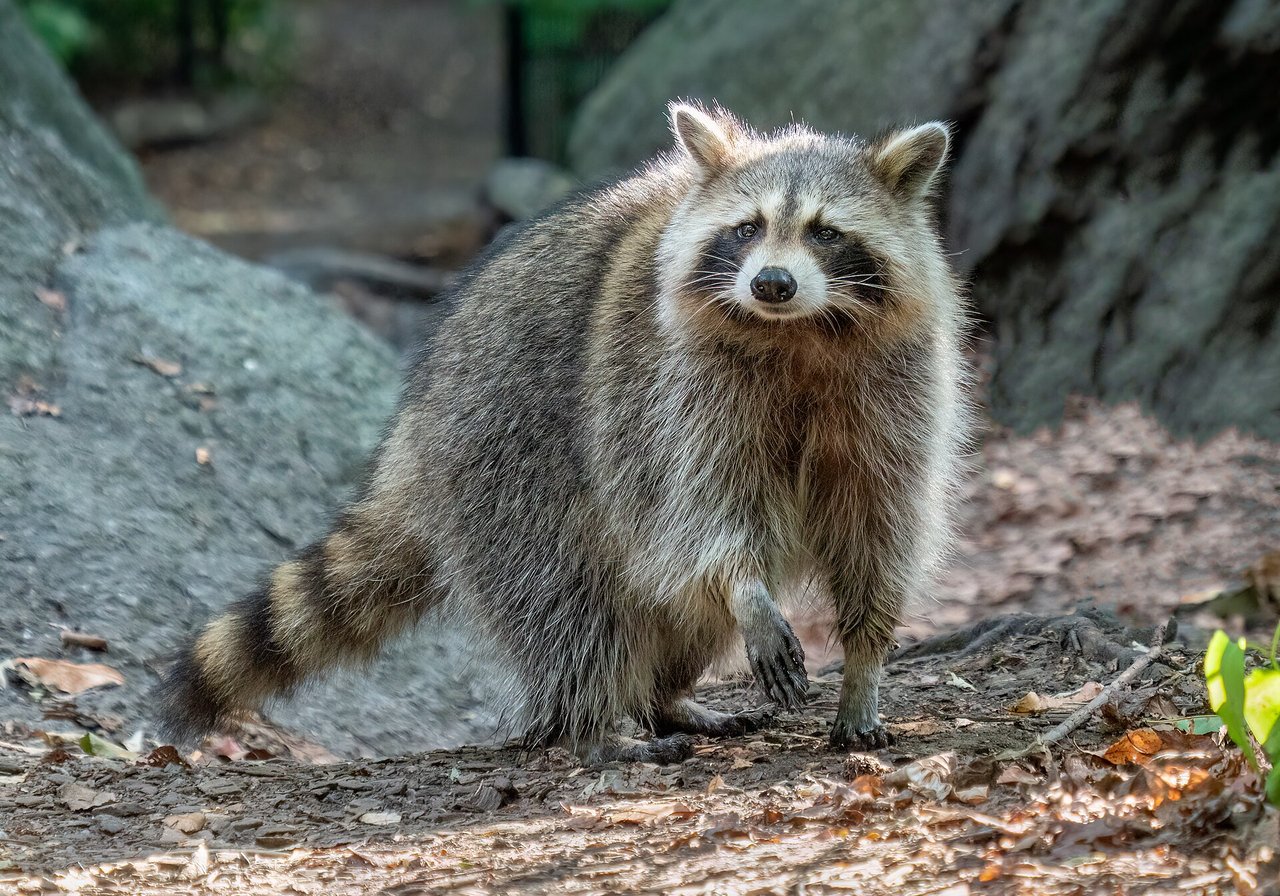
The raccoon belongs to the family Procyonidae — a New World carnivore lineage that also includes coatis, ringtails and kinkajous. Procyon lotor is the type species of the genus, with 22 recognised subspecies across North and Central America. Adults weigh 3–9 kg with dense grey-brown fur, a pointed muzzle and the characteristic black mask across the eyes.
The bushy tail carries four to ten black rings. Raccoons are plantigrade — they walk on the soles of their feet — and their front paws have long digits with sensitive pads that allow fine manipulation. Contrary to folklore, 'washing' food in water is not universal; the behaviour appears linked to moistening paw pads to improve tactile sensitivity.
In South America, procyonids occupy parallel niches: coatis forage on the ground and in trees; kinkajous are nocturnal canopy specialists in Colombian and Brazilian rainforest. Understanding raccoon ecology helps readers grasp the wider procyonid family that shares threatened forest habitats in WARN partner countries.
Diet, denning and behaviour
Raccoons are opportunistic omnivores. Wild diets include berries, nuts, insects, crayfish, frogs, bird eggs, small mammals and carrion. Near water they hunt fish and amphibians; in autumn they fatten on maize and orchard fruit. Urban raccoons exploit refuse, pet food and garden crops, often achieving densities of 50–100 individuals per square kilometre.
They are mainly nocturnal and solitary outside the breeding season. Dens are made in tree hollows, burrows abandoned by other animals, or human structures — attics, storm drains and culverts. Females raise litters of two to five kits alone; young disperse in autumn. Raccoons do not truly hibernate but may sleep for extended periods during severe northern winters, living off fat reserves.
Their intelligence and problem-solving ability are well documented in laboratory studies and field observations. This adaptability underpins both their ecological success and their reputation as agricultural and urban pests.
Range expansion and introductions
Native raccoons range from southern Canada through the United States, Mexico and Central America to northern Panama. Historically absent from the US South-west, they expanded there in the twentieth century as agriculture and water development spread. Fur farming and the pet trade introduced raccoons to Germany, the Caucasus and Japan in the twentieth century.
European populations — particularly in Germany — now number in the hundreds of thousands. Introduced raccoons compete with native carnivores for den sites and food, raid bird nests and may transmit rabies and raccoon roundworm (Baylisascaris procyonis) to humans and pets. Japan's Hokkaido population originated from escaped pets and now damages crops and heritage buildings.
In their native range, raccoons remain abundant. The IUCN lists Procyon lotor as Least Concern with a stable or increasing population trend. Road mortality, hunting for fur and fur-farm harvest affect local numbers but do not threaten the species globally.
Conservation and human conflict
Raccoons are not conservation priorities in North America, where legal protection varies by state and hunting seasons regulate harvest. Wildlife rehabilitators treat orphaned kits and animals injured by vehicles or traps. Rabies vaccination programmes in eastern North America target raccoons as a vector species.
Where raccoons are introduced, management focuses on preventing further spread and reducing damage to agriculture and native wildlife. European authorities conduct population monitoring and targeted removal in sensitive areas. The lesson for conservation is that adaptable generalists can become invasive when moved outside their native range — a principle relevant to exotic pet releases in WARN partner countries.
In Colombia and Brazil, native procyonids such as kinkajous face deforestation rather than overabundance. Protecting rainforest canopy habitat benefits these relatives while introduced raccoons in Europe illustrate the risks of translocation.
What WARN Does
WARN publishes this guide for education and is developing support through assessed animal-welfare grants. A species range, source citation or photograph does not establish a recipient or funding agreement. Check /about/where-your-money-goes/#grant-register for published grant and payment records; records not yet published must not be read as zero activity. Browse /appeals/ for the purposes currently available to support.
If this guide helps you understand wildlife and the pressures it faces, a gift to WARN supports habitat protection and free public education in our partner countries.
Raccoon: Frequently Asked Questions
Are raccoons related to bears?
Why do raccoons wash their food?
Are raccoons endangered?
Can raccoons be pets?
What do raccoons eat?
Where do raccoons live?
Are raccoons dangerous?
How long do raccoons live?
How big is a raccoon?
Sources & References
Population figures, conservation status and biological facts on this page are drawn from authoritative scientific and intergovernmental sources.
Terms used on this page
Plain-English definitions, from our wildlife and conservation glossary.
Latest Raccoon Stories
Quick, fact-checked reads on the raccoon — amazing facts, key questions and the threats it faces.
Explore more animals
Discover more animals, their habitats and their conservation status in the WARN wildlife-guide library.