Wildlife Guide · Northern Hemisphere — North America, Europe, Asia, North Africa
Raven
Corvus corax (Linnaeus, 1758)
The largest passerine — myth, intelligence and wilderness in black feathers.
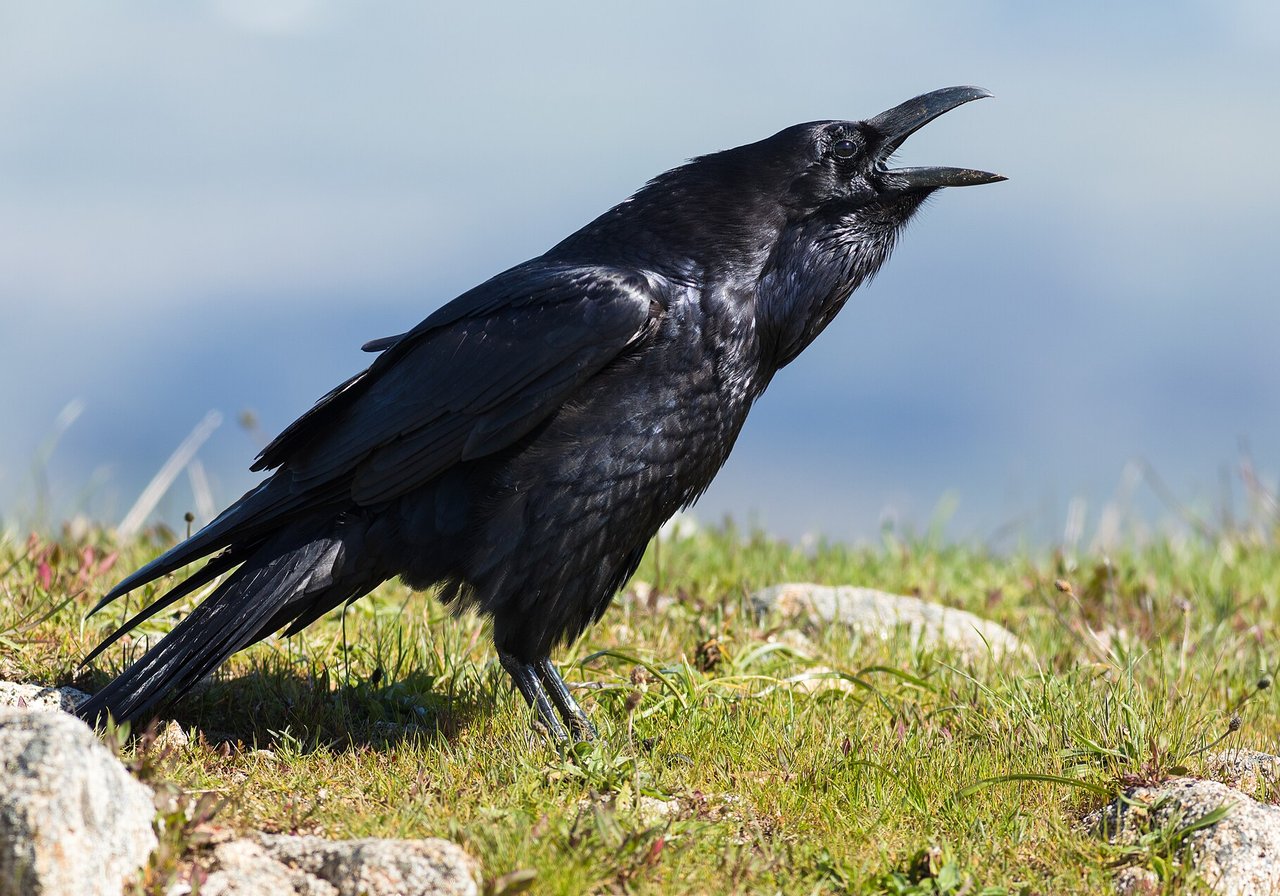
Source: Wikimedia Commons
In brief
The common raven (Corvus corax) is a Least Concern corvid of the Northern Hemisphere — the largest passerine, renowned for intelligence, tool use and deep cultural significance.
Also in Animals A to Z · Animals that start with R
By WARN Research & Conservation TeamLast updated
The common raven is the largest member of the crow family and the heaviest passerine bird on Earth. Glossy black plumage, a thick bill, shaggy throat feathers and a deep croaking call define this iconic corvid. Ravens inhabit the Northern Hemisphere — from Arctic tundra to North African mountains, Pacific coast to Himalayan passes. Listed as Least Concern, they are expanding in many regions after centuries of persecution. Ravens are among the most intelligent birds: they solve puzzles, plan for the future, recognise human faces and engage in playful aerial acrobatics. They appear in mythology from Norse Odin to Pacific Northwest First Nations tradition.
Least Concern
IUCN Red List status (2018 assessment)
1.2 kg
Typical adult weight — heaviest passerine
16 million
Estimated global population
Appendix II
CITES listing
Figures sourced from IUCN Red List — Corvus corax, RSPB — raven, Cornell Lab of Ornithology — common raven .
Raven: Quick Facts
| Weight | 0.7–1.2+ kg — heaviest passerine |
|---|---|
| Wingspan | Up to 1.3 m |
| Intelligence | Tool use, planning, face recognition |
| Global population | Roughly 16 million |
| Diet | Generalist — carrion, prey, grain, refuse |
| CITES | Appendix II |
Scientific Classification
| Kingdom | Animalia |
|---|---|
| Phylum | Chordata |
| Class | Aves |
| Order | Passeriformes |
| Family | Corvidae |
| Genus | Corvus |
| Species | Corvus corax (Linnaeus, 1758) |
Conservation Status
- IUCN Status
- Least Concern (IUCN, 2018). Recovering after persecution; increasing in many regions.
- Population
- Roughly 16 million mature individuals globally
- Trend
- Increasing in North America and western Europe
- Assessed
- 2018
- CITES
- Appendix II
Key Facts: Raven
- Ravens are the largest passerines — heavier than many raptors.
- They demonstrate advanced cognition: tool use, planning and face recognition.
- Ravens form long-term pair bonds and hold territories year-round.
- Persecution as pests caused historic declines; populations are now recovering.
- They appear in mythology worldwide — Odin's messengers, creators, tricksters.
- Ravens eat carrion, small animals, eggs, grain and human refuse — true generalists.
The corvid giant
Corvus corax dwarfs other crows — wingspan reaches 1.3 metres and weight exceeds 1.2 kg in large males. Wedge-shaped tail, thick neck and shaggy throat hackles distinguish ravens from carrion crows at distance. Flight is heavy and acrobatic; pairs perform tumbling display flights during courtship.
Eleven subspecies range across the Northern Hemisphere. Holarctic birds are largest; desert and island forms are smaller. Ravens occupy the widest elevational range of any corvid — from sea level to 5,000 metres in the Himalayas.
Vocal repertoire is rich: deep croaks, knocks, bell-like tones and mimicry of other species. Each pair maintains a territory defended year-round, with nests on cliffs, trees or structures reused across decades.
Ecology and diet
Ravens are supreme generalists. Carrion forms a staple — they follow wolves, eagles and human hunters to carcasses. They take eggs, nestlings, small mammals, insects, grain and fruit. Coastal birds scavenge beaches and fish offal.
As ecosystem cleaners, ravens recycle nutrients and control pest populations. Their habit of raiding nests creates conflict with ground-nesting birds — including threatened seabirds on some islands — where introduced or overabundant ravens can become conservation problems.
Breeding begins early in the year. Clutches contain three to seven eggs in large stick nests lined with wool and fur. Both parents feed chicks; fledglings depend for several months as they learn foraging skills.
Persecution and recovery
Ravens suffered centuries of persecution as livestock pests and symbols of ill omen. Gamekeepers poisoned and shot them; bounties operated in Britain until the twentieth century. Populations crashed across Europe and eastern North America.
Legal protection and reduced persecution allowed recovery. Ravens recolonised eastern North America from the 1960s and spread across southern Britain from strongholds in Wales and Scotland. The IUCN lists them as Least Concern with roughly 16 million mature individuals and an increasing trend in many regions.
Local conflicts persist where ravens predate threatened ground-nesters. Management on seabird islands requires case-by-case balance. CITES Appendix II regulates international trade.
Ravens in myth and modern culture
Ravens permeate human culture. Norse god Odin kept two ravens — Huginn and Muninn — that flew across the world gathering knowledge. Pacific Northwest peoples honour Raven as creator and trickster. Edgar Allan Poe immortalised the bird in Gothic verse.
Today, ravens attract ecotourists to Yellowstone, the Scottish Highlands and the Tower of London — where captive ravens remain a ceremonial tradition. Research into corvid cognition continues to reveal capacities once thought uniquely human.
WARN publishes this raven guide as free public education about a species whose intelligence and cultural depth reward careful observation in wild places.
What WARN Does
WARN publishes this raven guide as free public education. Corvids like the raven remind us that intelligence and adaptability flourish across the animal kingdom — not only in primates.
If this guide helps you understand wildlife and the pressures it faces, a gift to WARN supports habitat protection and free public education in our partner countries.
Raven: Frequently Asked Questions
How intelligent are ravens?
What is the difference between a raven and a crow?
Are ravens endangered?
What do ravens eat?
Where do ravens live?
Do ravens mate for life?
Are common ravens dangerous?
How long do common ravens live?
How big is a common raven?
Sources & References
Population figures, conservation status and biological facts on this page are drawn from authoritative scientific and intergovernmental sources.
Terms used on this page
Plain-English definitions, from our wildlife and conservation glossary.
Explore more animals
Discover more animals, their habitats and their conservation status in the WARN wildlife-guide library.